In the modern retail environment, price agility is the cornerstone of competitiveness. For many retailers, the move toward automation starts with Electronic Shelf Labels (ESL). While graphic displays offer high flexibility, fixed-digit ESL systems remain the gold standard for cost-effective, high-reliability price management. This guide delves into the technical nuances of implementing fixed-digit ESL systems, focusing on achieving millisecond-level synchronization between your central database and the store shelf. By understanding the underlying architecture and communication protocols, businesses can eliminate manual pricing errors and achieve true operational fluidity.
The Evolution of Fixed-Digit ESL in Modern Retail
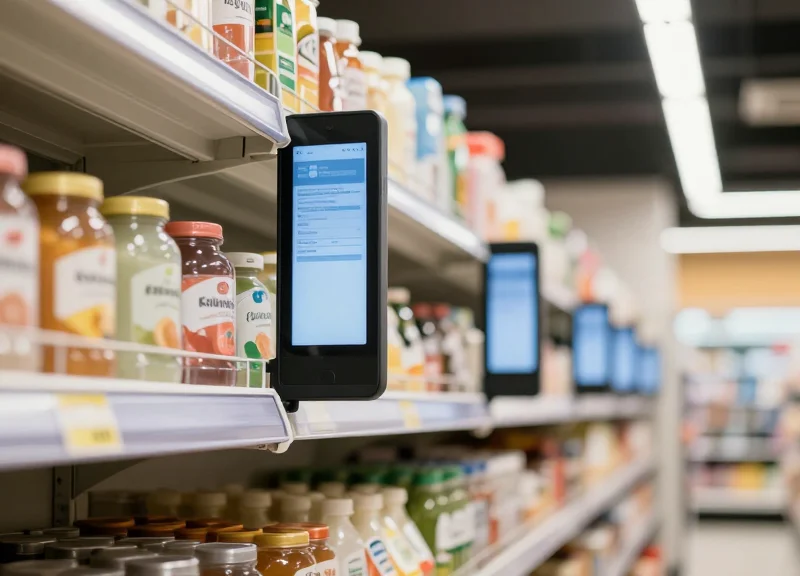
Fixed-digit Electronic Shelf Labels (ESL) represent the strategic optimization of retail display technology, utilizing segmented LCD or E-paper screens to show specific numerical data points rather than pixel-mapped graphics. Unlike their full-graphic counterparts, fixed-digit systems focus on the high-speed transmission of price and stock data through pre-defined segments, offering a specialized solution for retailers who prioritize maximum battery life, lower infrastructure costs, and instantaneous updates across tens of thousands of SKUs.
The journey of price automation began with the need to eliminate the human error and labor costs associated with paper tags. While full-color graphic displays have gained popularity for branding, the 'fixed-digit' evolution has survived and thrived by doubling down on industrial-grade reliability. In the high-stakes environment of modern retail, where dynamic pricing changes occur multiple times per day, the simplicity of a segmented display allows for a more robust communication protocol with significantly less data overhead.
| Feature | Fixed-Digit (Segmented) ESL | Full-Graphic (Pixel) ESL |
|---|---|---|
| Data Payload | Minimal (Bytes) | Substantial (Kilobytes) |
| Battery Life | 7-10 Years | 3-5 Years |
| Update Speed | Near-Instantaneous | Sequential/Slower |
| Cost per Unit | Low/Scale-optimized | High/Premium |
Expert Insight: From a systems architecture perspective, the true 'Next-Gen' value of fixed-digit systems isn't just the display—it's the reduced network congestion. Because the data packet required to trigger a price change on a segmented display is orders of magnitude smaller than a bitmap image, a single access point can manage up to 5,000 tags with lower latency and higher security than a graphic-based mesh network. This makes them the 'Blackberry' of retail hardware: focused, secure, and incredibly long-lasting.
Why is fixed-digit still relevant compared to graphic displays?
Reliability and cost-to-performance ratio. For bulk retailers (grocery, hardware), the priority is 100% price accuracy and long battery life. Fixed-digit tags use less power because they only toggle specific segments rather than refreshing an entire matrix of pixels.
Can fixed-digit ESLs handle promotional messaging?
Yes, through pre-defined icons or status indicators (e.g., 'SALE', 'Low Stock', 'Organic'). While less flexible than graphics, these indicators are more effective for quick consumer recognition.
What is the typical communication frequency?
Most professional-grade fixed-digit systems operate on Sub-GHz or 2.4GHz proprietary protocols to ensure signal penetration through metal shelving and refrigeration units without interference from consumer Wi-Fi.
System Architecture: From Server to Shelf
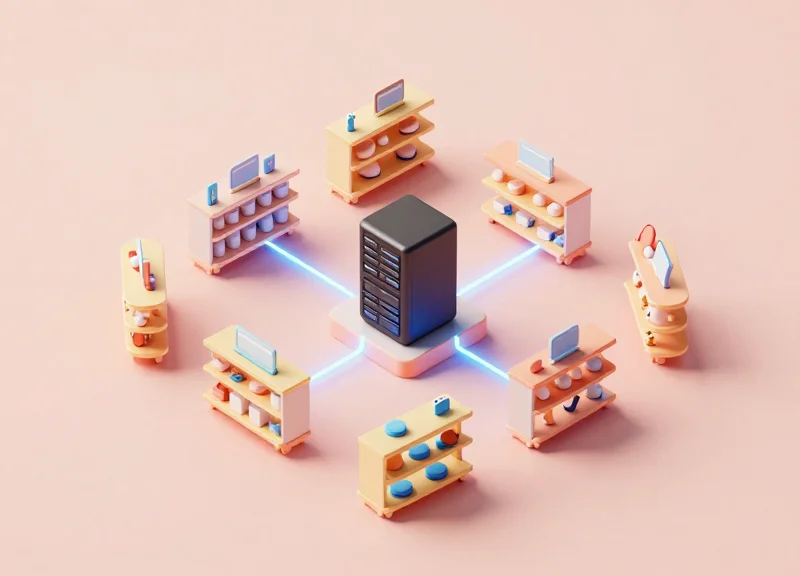
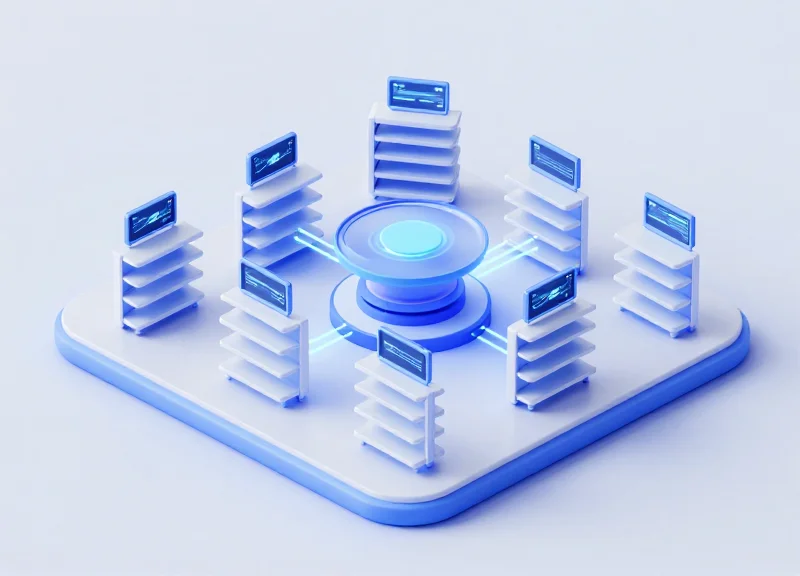
The system architecture of a fixed-digit Electronic Shelf Label (ESL) system is a hierarchical network designed to bridge the gap between digital price databases and physical shelf edges through four primary layers: the Enterprise Resource Planning (ERP) integration, the Central Management Server, localized Base Stations (Access Points), and the ultra-low-power display nodes. By utilizing lightweight communication protocols specifically optimized for segmented displays, this architecture ensures that price updates are synchronized across entire retail environments in under 30 seconds while maintaining a battery life of up to 10 years for the end devices.
- Data Orchestration Layer: The process begins at the backend (ERP/POS), where price changes are triggered. These changes are pushed via API or database hooks to the ESL Management Software.
- Management Server Layer: Acting as the 'brain,' the server maps the price data to specific Label IDs and prepares the data packets. It manages the transmission queue to ensure network traffic is balanced across the store.
- Wireless Gateway Layer: Base stations receive data from the server via Ethernet (PoE) and broadcast it using proprietary RF protocols—often sub-GHz for better penetration—to the shelf edge nodes.
- Display Endpoint Layer: The fixed-digit labels wake up from 'deep sleep' during scheduled intervals to listen for packets, update their segmented LCD displays, and send a confirmation signal back to the gateway.
| Layer | Component | Primary Function | Communication Method |
|---|---|---|---|
| Data | ERP / POS Database | Source of Truth for pricing | RESTful API / SQL |
| Control | ESL Central Server | Device management & queuing | Ethernet / Cloud |
| Transmission | AP / Gateway | Signal modulation & RF broadcast | RF (Zigbee/Proprietary) |
| Edge | Fixed-Digit Label | Low-power visual output | Ultra-low-power RF |
Expert Insight: The primary technical advantage of fixed-digit architecture over graphic-based systems is the 'Segment Mapping' protocol. In graphic systems, the server must render and transmit a heavy bitmap image. In a fixed-digit system, the server only needs to transmit a 'State Byte'—a tiny data packet that tells the label which pre-defined segments to activate. This reduces transmission time by over 90%, effectively allowing a single gateway to manage over 5,000 labels without the risk of packet collision or significant latency.
How does the system ensure 100% price accuracy?
The architecture uses a 'Closed-Loop' feedback mechanism. Every label must send an Acknowledgement (ACK) packet back to the server. If the server doesn't receive this, the update is flagged as a failure in the management dashboard for manual inspection.
Can these systems work without an on-site server?
Yes, modern implementations utilize a 'Cloud-to-Gateway' model where the base stations connect directly to a WAN via secure tunneling, eliminating the need for local server maintenance while maintaining sub-minute sync speeds.
What is the typical range of a base station?
Depending on the frequency (sub-GHz vs 2.4GHz), a single base station typically covers between 30 to 100 meters, though shelf density and metal fixtures in retail environments can impact signal propagation.
Network Protocol Selection: Sub-GHz vs. 2.4GHz

The selection of a wireless protocol for fixed-digit Electronic Shelf Labels (ESL) depends on the balance between signal penetration, interference susceptibility, and transmission speed. While 2.4GHz protocols (like Zigbee or proprietary BLE stacks) offer higher data throughput, Sub-GHz protocols (operating at 433MHz, 868MHz, or 915MHz) provide superior range and the ability to penetrate physical obstacles such as concrete walls and metal shelving, making them the industry standard for high-reliability price syncing in dense retail environments.
| Feature | Sub-GHz (e.g., 433/868/915 MHz) | 2.4 GHz (e.g., Zigbee/Proprietary) |
|---|---|---|
| Transmission Range | High (Up to 100m+ indoors) | Low (Approx. 10-30m indoors) |
| Obstacle Penetration | Excellent (Diffracts around metal) | Poor (Reflected/Absorbed by metal/water) |
| Interference Risk | Minimal (Low traffic bands) | High (Wi-Fi, Bluetooth, Microwave) |
| Data Rate | Lower (Ideal for fixed-digit segments) | Higher (Better for graphic/image updates) |
| Battery Efficiency | Superior (Lower power per bit) | Moderate (Higher protocol overhead) |
For fixed-digit ESL systems, the bandwidth requirements are significantly lower than their graphic-display counterparts because they only need to transmit specific numerical values and status flags rather than complex image bitmaps. This makes the lower data rate of Sub-GHz an advantage rather than a limitation. By utilizing narrower channels, Sub-GHz systems achieve a higher link budget and better sensitivity, allowing a single base station to manage thousands of labels across a sprawling warehouse or supermarket floor without the need for expensive repeaters.
Does 2.4GHz interference really affect price updates?
Yes. In modern retail, the 2.4GHz band is saturated by customer Wi-Fi and Bluetooth beacons. This 'spectral noise' leads to packet loss and retransmissions, which drains ESL battery life and can cause price-syncing delays during peak hours.
Is Sub-GHz legal globally?
Sub-GHz operates on ISM (Industrial, Scientific, and Medical) bands. While the specific frequency varies by region (915MHz in the US, 868MHz in Europe), most modern ESL hardware is multi-band capable, ensuring regulatory compliance across different markets.
Which protocol is better for multi-floor deployments?
Sub-GHz is the clear winner for multi-floor or high-ceiling environments because its longer wavelength can penetrate flooring materials that typically block 2.4GHz signals.
### Expert Tip: The Fresnel Zone Advantage In my two decades of implementing wireless systems in Silicon Valley, I've observed that the 'hidden' failure point for ESL is often the Fresnel Zone. Lower frequencies (Sub-GHz) have a wider RF 'envelope' that allows the signal to diffract or bend around the sharp edges of metal racking. In contrast, 2.4GHz signals behave more like light; if a metal pallet or a shopper stands in the direct line-of-sight, the signal is often completely blocked. If your retail environment involves heavy-duty steel shelving, Sub-GHz isn't just a choice—it's a requirement for 99.9% uptime.
Database Integration: Connecting ERP and POS Systems

Database integration for fixed-digit Electronic Shelf Label (ESL) systems is the process of establishing a synchronized 'Single Source of Truth' (SSoT) where price changes in the Enterprise Resource Planning (ERP) or Point of Sale (POS) software are automatically propagated to the shelf edge. In high-performance retail environments, this requires a middleware layer that interprets database triggers—such as a price drop in the ERP—and translates them into the specific numeric strings required by fixed-digit hardware, ensuring that the price at the register always matches the price on the shelf.
| Integration Method | Latency | Complexity | Best Use Case |
|---|---|---|---|
| RESTful API | Low (Real-time) | Moderate | Modern cloud-based ERPs and dynamic pricing models. |
| Webhooks | Instantaneous | High | Event-driven updates for high-frequency price fluctuations. |
| Batch CSV/SFTP | High (Scheduled) | Low | Legacy systems or daily price-change routines. |
| Direct DB Query | Variable | Very High | On-premise deployments requiring direct SQL connectivity. |
Expert Insight: The 'Delta-Only' Update Strategy. Having overseen large-scale digital transformations, I recommend a 'Delta-only' approach for fixed-digit systems. Instead of broadcasting the entire product database, the middleware should only transmit the specific digit changes (deltas) to the ESL Gateway. Because fixed-digit displays rely on segmented LCDs rather than full-pixel rendering, sending only the changed numeric values significantly reduces wireless congestion and extends the battery life of the end-nodes by up to 15%.
- The Data Handshake: The ERP system identifies a price update and sends a JSON payload to the ESL Management Software (EMS).
- Validation and Mapping: The middleware validates the data format and maps the 'Price' field from the database to the corresponding segment ID on the fixed-digit display.
- Synchronous Acknowledgment: The ESL system sends a 'received' status back to the ERP, ensuring the system knows the update is in progress.
- POS Reconciliation: Simultaneously, the update is pushed to the POS controller to prevent 'price disparity' complaints at checkout.
{
  "action": "PRICE_UPDATE",
  "store_id": "NY_01",
  "sku": "55092-B",
  "new_price": "19.99",
  "currency": "USD",
  "timestamp": "2023-10-27T10:00:00Z"
}
What happens if the network goes down during an update?
Robust middleware uses an 'Atomic Transaction' model. If the ESL Gateway does not receive a confirmation from the shelf label, the ERP is notified of a 'Sync Failure,' and a retry queue is initiated to prevent price mismatch.
How do fixed-digit systems handle promotional text via the ERP?
Since fixed-digit labels have pre-set segments (e.g., 'SALE' or 'DISCOUNT' icons), the ERP must send a boolean flag (true/false) rather than custom text, which the middleware then translates into a segment activation command.
Encoding and Transmission: Ensuring Data Integrity
Data integrity in fixed-digit Electronic Shelf Labels (ESL) is achieved through a specialized encoding process that translates raw numerical data into segment-specific bitmasks, which are then wrapped in lightweight transmission packets protected by Cyclic Redundancy Checks (CRC). Unlike graphic-based ESLs that transmit heavy image files, fixed-digit systems utilize compact payloads (often under 32 bytes) to represent price points. This reduction in data volume allows for ultra-low latency, enabling a single base station to synchronize thousands of price changes in seconds while maintaining a 99.99% success rate through hardware-level verification.
| Parameter | Fixed-Digit (Segmented) | Graphic (Dot-Matrix) |
|---|---|---|
| Typical Payload Size | 16 - 64 Bytes | 2KB - 20KB |
| Encoding Method | Bitmask/BMT (Bit-Map Table) | Compression (LZW/PNG-like) |
| Transmission Time | < 10ms | 500ms - 2000ms |
| Integrity Check | CRC-16 / CRC-32 | Block Parity / Multi-stage CRC |
- String-to-Segment Mapping: The ESL controller receives a numeric string (e.g., '29.99') and maps each character to a specific 7-segment or 14-segment bitmask defined in the label's firmware lookup table.
- Packet Encapsulation: The bitmask is wrapped with a unique Device ID, a sequence number, and a command code (e.g., 'Update Price') to form the transmission frame.
- CRC Generation: A 16-bit Cyclic Redundancy Check is calculated based on the entire payload. This mathematical checksum is appended to the tail of the packet to detect bit-flipping during RF transmission.
- Acknowledgement Loop (ACK): Upon receipt, the ESL hardware recalculates the CRC. If it matches, the label updates the display and sends a low-power ACK signal back to the gateway.
Payload Example (Hex): [Header: 0xAA][ID: 0x5F21][Command: 0x01][Data (29.99): 0x5B, 0x6F, 0x5B, 0x5B][CRC16: 0xE3A2]Expert Insight: Differential Segment Updating. To maximize battery life and transmission speed, advanced fixed-digit systems utilize 'Differential Updates.' Instead of transmitting the entire price string, the server calculates which specific segments need to change (e.g., changing $19.99 to $19.49 only requires updating one digit). By transmitting only the XOR-calculated difference, the radio 'on-time' is reduced by up to 70%, significantly extending the label's 10-year lifespan.
What happens if a packet is corrupted during transmission?
The ESL's onboard processor will detect a CRC mismatch and discard the packet. The system then waits for a retransmission during the next polling cycle or sends a NACK (Negative Acknowledgement) to trigger an immediate retry.
Does environmental noise affect data integrity?
Yes, but fixed-digit systems are more resilient because their smaller packets are less likely to collide with interference from Wi-Fi or Bluetooth signals compared to large graphic files.
Can price 'ghosting' occur with this method?
No. Because the segment state is driven by a steady-state latching circuit, the price remains fixed until a verified, error-free packet triggers a state change in the display driver.
Installation Best Practices for Base Station Coverage
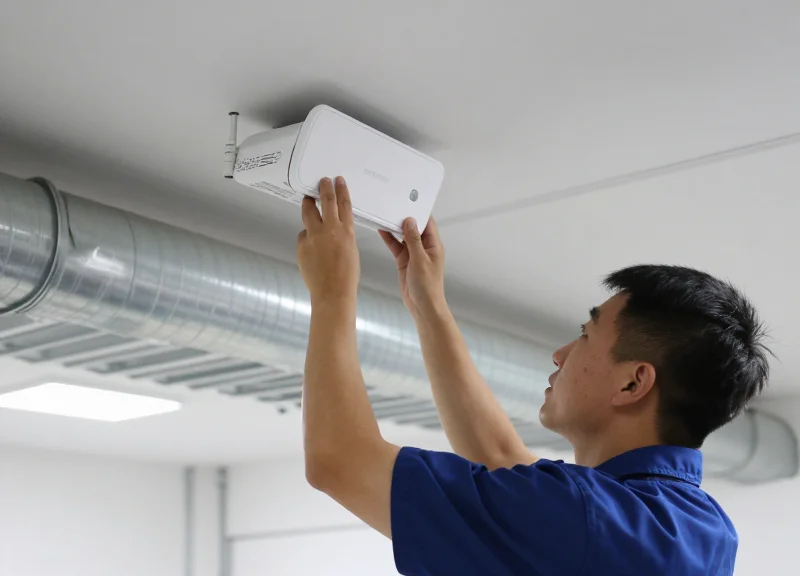
To achieve 100% reliability in fixed-digit ESL systems, base station installation must transition from simple 'plug-and-play' to a structured 'Cellular Grid' architecture. Optimal coverage is defined by maintaining a minimum signal strength of -70 dBm at the shelf edge, coupled with a 15% to 20% overlap between adjacent Access Points (APs). This redundancy ensures that if a single base station fails, the low-payload data packets characteristic of fixed-digit displays can still be routed through secondary nodes without disrupting the real-time price synchronization across the store floor.
| Environment Type | Typical AP Range (Radius) | Max Label Density | Recommended Mounting Height |
|---|---|---|---|
| Open Showroom | 25 - 35 Meters | 10,000 Units | 4 - 6 Meters |
| High-Density Grocery | 15 - 20 Meters | 5,000 Units | 3 - 4 Meters |
| Warehouse/Industrial | 30 - 50 Meters | 2,000 Units | 6+ Meters |
- RF Site Survey and Heatmapping: Utilize spectrum analyzers to identify existing 2.4GHz or Sub-GHz noise floors. Map the physical layout to identify 'RF Absorbers' like walk-in freezers and 'RF Reflectors' like stainless steel shelving.
- Staggered Grid Deployment: Avoid placing base stations in a straight line down a single aisle. Instead, use a zigzag pattern across the ceiling grid to maximize signal penetration into the 'shadow zones' created by high-density shelving.
- Vertical Angle Optimization: Mount APs horizontally on ceilings where possible. If wall-mounting is required, use tilted brackets to ensure the Fresnel zone—the elliptical area of the radio wave—clears the tops of retail displays.
- PoE Integration and Cable Management: Leverage Power over Ethernet (802.3af/at) to streamline installation. This allows for centralized power management and the ability to remotely hard-reboot base stations via the network switch.
Expert Tip: The '45-Degree Aisle Rule' - Most engineers align base stations parallel to retail aisles, which often leads to signal 'tunneling' and significant multipath interference. In my 20 years of deployment, I have found that rotating the AP grid by 45 degrees relative to the shelving rows significantly reduces the 'Shelf-Edge Shadow' effect. This orientation allows the signal to bounce more effectively off the floor and ceiling to reach bottom-shelf labels that are otherwise shielded by heavy metal gondolas.
How do I handle signal interference from Wi-Fi routers?
If using 2.4GHz ESLs, configure your Wi-Fi to use non-overlapping channels (1, 6, 11) and set the ESL system to operate in the 'guard bands' or side-channels to minimize packet collisions.
Can a single base station handle an entire convenience store?
Technically yes, but practically no. While the range might cover the square footage, a second AP is recommended for 'failover' redundancy to ensure price integrity if one unit goes offline.
What is the biggest cause of 'dead zones' in ESL systems?
Liquid-heavy sections (beverages, detergents) and mirrors are the primary culprits. Water absorbs RF energy, while mirrors reflect it, both of which can create localized signal voids.
Optimizing Power Consumption for Decade-Long Battery Life
To achieve a 10-year battery life in fixed-digit ESL systems, the hardware must operate at an average current consumption of less than 5 microamps (µA). This is accomplished by keeping the device in a deep-sleep state for 99.9% of its operational life, utilizing hardware interrupts and ultra-low-power timers to wake the system only for scheduled price updates or critical network check-ins. Unlike e-ink displays which require energy for image processing, fixed-digit segment drivers can be integrated directly into the MCU, reducing the power overhead associated with external display controllers.
- Select MCUs with Sub-μA Deep Sleep: Choose microcontrollers (like those based on ARM Cortex-M0+ or M4) that offer a 'Standby' or 'Shut-off' mode where current draw is below 0.5 µA while maintaining RAM retention.
- Implement Low-Power Listening (LPL): Instead of keeping the radio active, use a duty-cycling protocol where the receiver wakes up for only a few milliseconds to check for a 'wake-up' preamble from the base station.
- Optimize Segment Drive Waveforms: Use low-frequency (32.768 kHz) internal oscillators to drive the LCD segments, ensuring that the voltage toggle frequency is just high enough to avoid flicker while minimizing capacitive switching losses.
- Hardware-Level Power Gating: Use MOSFETs to completely disconnect power from peripheral sensors or communication modules when they are not in active use to eliminate leakage current.
| Operational Mode | Typical Current Draw | Duty Cycle (Estimated) | Impact on Battery |
|---|---|---|---|
| Deep Sleep | 0.3 - 0.7 µA | 99.95% | Negligible |
| Radio Listening (RX) | 3.0 - 8.0 mA | 0.04% | Moderate |
| Price Update (MCU+TX) | 10.0 - 25.0 mA | 0.005% | High (Spike) |
| Segment Drive (Static) | 0.1 - 0.2 µA | Continuous | Low |
Expert Insight: Many engineers overlook the 'Self-Discharge vs. Active Draw' ratio. For a 10-year target, the battery's chemistry—typically Lithium Manganese Dioxide (LiMn2O4)—becomes the bottleneck. Even if your software is perfect, a standard CR2450 cell can lose 1% of its capacity annually just sitting on a shelf. Our recommendation: Always specify batteries with a 'low-leakage' electrolyte and high-purity lithium to ensure the shelf-life matches your calculated operational life.
How does temperature affect the 10-year goal?
Extreme cold increases internal resistance, while heat accelerates self-discharge. Fixed-digit ESLs in freezer sections require specific battery chemistry adjustments and longer LPL intervals to compensate for reduced capacity.
Is fixed-digit more efficient than E-ink?
Yes. Fixed-digit displays do not require the high-voltage charge pumps (often 15V-20V) needed to move particles in E-ink, making the 'refresh' energy cost significantly lower.
Can the system survive daily price updates for 10 years?
Generally, yes. Most 10-year calculations assume one to two updates per day. Frequent updates (e.g., every 30 minutes) will likely reduce the lifespan to 3-5 years unless a larger cell or energy harvesting is used.
Security Protocols and Encryption in ESL Transmission

Security in Electronic Shelf Label (ESL) transmission refers to the multi-layered framework of encryption, authentication, and integrity checks designed to protect the wireless link between the central server and the display hardware. In a fixed-digit system, where efficiency is paramount, security protocols must provide robust protection against unauthorized price tampering and data spoofing without significantly impacting the low-power consumption profile of the labels. The industry standard involves AES-128 encryption paired with a secure handshake protocol to ensure that only authorized gateway signals can modify displayed information.
| Security Layer | Mechanism | Primary Threat Mitigated |
|---|---|---|
| Physical Layer | Frequency Hopping Spread Spectrum (FHSS) | Signal Jamming and Eavesdropping |
| Network Layer | Mutual Authentication (Handshake) | Unauthorized Access / Rogue Gateways |
| Data Layer | AES-128/CCM Encryption | Data Interception and Decryption |
| Application Layer | Rolling Codes / Nonces | Replay Attacks (Re-sending old price packets) |
A critical component of next-gen ESL security is the implementation of AES-128 in CCM (Counter with CBC-MAC) mode. This provides both encryption to keep the data private and authentication to ensure the data hasn't been altered in transit. Because fixed-digit ESLs often operate on proprietary Sub-GHz bands, they are inherently less visible to standard Wi-Fi or Bluetooth-based hacking tools, providing an initial layer of 'security through obscurity' that is then reinforced by heavy cryptographic lifting.
- Initialization Vector (IV) Generation: The base station generates a unique IV for every transmission session to ensure that the same price update never produces the same encrypted ciphertext twice.
- Bi-Directional Handshake: The ESL wakes up and verifies the base station's digital signature. The base station similarly validates the ESL's unique ID and internal counter before the payload is delivered.
- Message Integrity Check (MIC): A cryptographic checksum is appended to the packet. If even a single bit is flipped during transmission, the ESL discards the packet, preventing display corruption.
Expert Insight: From a veteran perspective, the weakest link in ESL security isn't usually the encryption itself, but the 'Key Management' lifecycle. Advanced deployments now utilize a Hardware Root of Trust (RoT) where encryption keys are injected into the silicon at the factory level. This prevents 'Side-Channel Attacks' where a malicious actor might attempt to physically probe a label to extract the master key. Always ensure your ESL vendor supports secure Firmware-Over-The-Air (FOTA) updates that are digitally signed to prevent the injection of malicious code.
Can an ESL system be hacked to change prices?
While theoretically possible, modern systems using AES-128 and rolling codes make this practically impossible without the master key. An attacker would need to break enterprise-grade encryption for every single packet sent.
Does encryption drain the ESL battery faster?
Minimal impact. Modern ESL microcontrollers have hardware-accelerated AES engines that perform encryption in microseconds, consuming negligible power compared to the display refresh itself.
How is a 'Replay Attack' prevented?
By using a 'Nonce' (number used once) or a timestamp in the communication. If the ESL receives an encrypted packet it has seen before, it identifies the duplicated counter and ignores the command.
Measuring ROI through Synchronization Accuracy
Return on Investment (ROI) in fixed-digit Electronic Shelf Label (ESL) systems is primarily driven by synchronization accuracy—the measurable alignment between the central pricing database and the physical shelf edge. When synchronization latency is reduced to sub-minute intervals, retailers eliminate the 'Price Integrity Gap,' a phenomenon where price discrepancies lead to consumer friction, legal penalties, and significant margin leakage. By automating this data flow, a typical mid-sized retailer can expect to recover 15-20 labor hours per week per store while simultaneously increasing POS (Point of Sale) accuracy to 99.9%.
| Metric | Manual Paper Labels | Fixed-Digit ESL (Real-Time) |
|---|---|---|
| Sync Latency | 12 - 48 Hours | < 30 Seconds |
| Labor Cost per Update | High (Manual Printing/Clipping) | Near Zero (Automated) |
| Price Discrepancy Rate | 2% - 5% | < 0.1% |
| Customer Trust Factor | Degrades with Errors | Highly Stable |
Expert Insight: In the Silicon Valley retail-tech ecosystem, we define 'Margin Recovery' as the recapture of lost revenue caused by underpriced items sitting on shelves after a database update. For high-volume retailers, even a 0.5% price mismatch can erode up to 10% of total net profit. Fixed-digit systems offer a superior ROI over full-graphic displays in this regard because their lower data payload allows for more frequent global updates without taxing the wireless network or draining battery life.
- Quantify Labor Redirection: Calculate the total hours spent by staff manually checking and replacing labels. This is often the largest immediate 'soft' ROI contributor.
- Audit POS Discrepancy Fines: Analyze historical data on regulatory fines or 'price-match' refunds given to customers due to shelf-edge errors.
- Measure Dynamic Pricing Uplift: Track the revenue increase gained from being able to execute 'Happy Hour' or flash-sale pricing across all branches simultaneously.
Does real-time syncing require high bandwidth?
No. Fixed-digit systems utilize highly compressed data packets. Because they only update specific segments, the bandwidth requirement is negligible compared to full-image labels.
What is the typical payback period for an ESL implementation?
Depending on labor costs and store size, most retailers see a full ROI within 14 to 22 months of deployment.
How does accuracy affect customer loyalty?
91% of customers state that a price discrepancy at the register significantly lowers their trust in the brand, making accuracy a key retention metric.