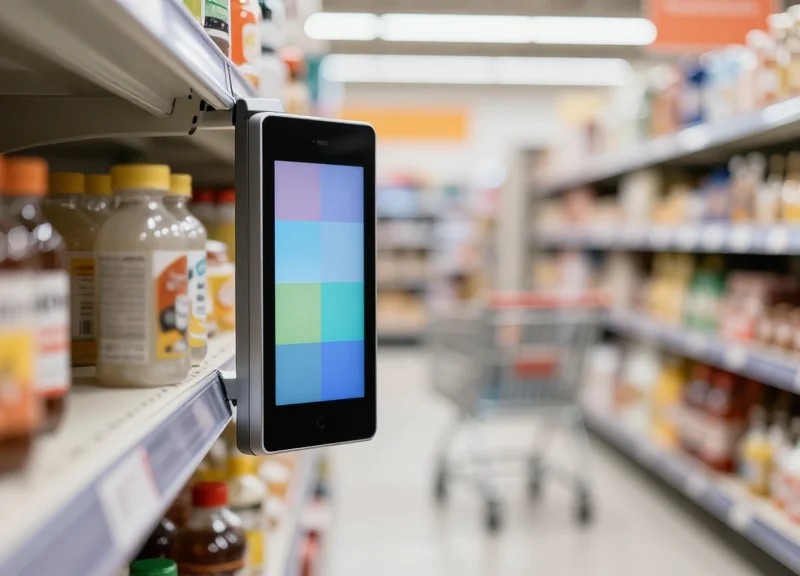

In an era where retail competition is fierce, maintaining optimal on-shelf availability (OSA) is no longer just a goal—it is a necessity. Traditional manual shelf audits are slow and error-prone, leading to lost sales and frustrated customers. Electronic Shelf Labels (ESL) equipped with multi-color LED alerts offer a revolutionary solution. These systems provide immediate visual feedback to store associates, signaling low stock, restocking needs, or misplaced items at a glance. This guide explores how to select the best ESL systems with 3-color LED alerts to transform your store operations and ensure your shelves are always ready for the customer.
The Evolution of ESL Technology Beyond Pricing

Electronic Shelf Label (ESL) technology has transitioned from a niche price-automation tool into a mission-critical IoT infrastructure. While the initial value proposition focused solely on reducing labor costs associated with manual paper tag updates, the current generation of ESLs acts as a real-time data terminal. By integrating high-visibility 3-color LED alerts, these devices bridge the gap between back-room inventory data and front-of-store execution, transforming the shelf edge into an interactive touchpoint for both employees and automated replenishment systems.
| Generation | Core Focus | Communication | Impact on OSA |
|---|---|---|---|
| 1st Gen (LCD) | Price Uniformity | Infrared / One-way | Minimal (Pricing only) |
| 2nd Gen (E-Paper) | Legibility & Centralization | Proprietary RF | Reactive Inventory Alerts |
| 3rd Gen (IoT/LED) | Operational Efficiency | Bi-directional BLE/Sub-GHz | Proactive 'Flash-to-Find' & OSA |
The leap to 3rd generation technology represents the most significant ROI shift for modern retailers. This stage introduced multi-color LED indicators (typically Red, Green, and Blue/Yellow) which serve as visual cues for store associates. Instead of workers scanning every shelf to find gaps or 'phantom inventory,' the ESL system uses internal logic to 'call out' when stock is low or a pick-up order is ready. This effectively turns the entire store into an organized warehouse grid where the hardware assists the human element.
- Bi-Directional Communication: Modern ESLs do not just receive data; they acknowledge updates and report health status, battery life, and even ambient temperature back to the central server.
- Visual Pick-to-Light: The 3-color LED allows for prioritized task management, where different colors indicate different urgency levels for restocking or e-commerce fulfillment.
- Edge Intelligence: Advanced tags can now process simple logic locally, such as triggering an alert if a specific time-threshold for a 'low stock' state is exceeded.
Expert Insight: The true differentiator in modern ESL evolution is 'Sub-Second Latency.' In older systems, triggering a light could take minutes due to the tag's 'sleep cycle.' Silicon Valley-engineered protocols now allow for near-instantaneous 'Flash-on-Demand,' which is the technical requirement for making On-Shelf Availability (OSA) workflows economically viable for high-velocity retail environments. Without sub-second response times, associates lose more time waiting for the light than they save by using it.
Decoding the Power of 3-Color LED Indicators

A 3-color LED indicator on an Electronic Shelf Label is a programmable light-emitting diode capable of flashing in distinct hues—typically Red, Green, and Blue (or Yellow)—to communicate real-time operational statuses to store associates. Unlike the static data on the e-paper screen, these LEDs provide a dynamic 'lighthouse effect,' allowing staff to identify low-stock items, locate online order products, or recognize pricing discrepancies from across the aisle without ever needing to scan a barcode or consult a handheld terminal.
| LED Color | Primary Operational Cue | Staff Action Triggered | Impact on On-Shelf Availability (OSA) |
|---|---|---|---|
| Red | Out-of-Stock or Critical Low | Immediate Restocking Required | Reduces 'Ghost Inventory' by highlighting empty facings instantly. |
| Green | Stock Arrival / Localization | Navigate to shelf for replenishment | Accelerates the 'Dock-to-Shelf' speed for new deliveries. |
| Blue / Yellow | Order Picking / Click-and-Collect | Rapid item identification for e-commerce | Ensures accurate picking and minimizes shelf-search time. |
How do 3-color LEDs improve employee productivity?
By utilizing color-coded signals, retailers can implement 'Pick-by-Light' and 'Put-by-Light' workflows. This reduces visual search friction by up to 30%, allowing associates to move directly to the correct product rather than scanning entire shelves.
Does the LED flash impact the battery life of the ESL?
Modern ESL systems use ultra-low-power protocols. While frequent flashing does consume energy, leading systems allow managers to configure flash duration and frequency (e.g., 5 seconds of flashing upon a query) to balance operational visibility with a 5-10 year battery life.
Can these colors be customized for specific store needs?
Yes. The most advanced ESL management software allows for 'logic-based triggers' where retailers can assign specific colors to custom alerts, such as Red for expired products or Yellow for high-margin promotional items that need front-facing.
Expert Tip: To maximize the utility of 3-color LEDs, implement a 'Macro-to-Micro Navigation' strategy. Set your ESL system to trigger 'Grouping Flashes' where all labels in a specific category (e.g., Dairy) pulse in unison when a shipment arrives, transitioning to individual 'Target Flashes' once the associate enters the specific aisle. This hierarchical signaling eliminates the 'needle in a haystack' problem common in large-format retail environments.
Impact of Visual Alerts on On-Shelf Availability (OSA)

On-Shelf Availability (OSA) is the ultimate metric of retail health, and 3-color LED alerts serve as the critical bridge between digital inventory data and physical execution. By providing an instantaneous, color-coded signal at the shelf edge, these systems eliminate the need for staff to cross-reference handheld devices or printouts. In a high-velocity retail environment, this transforms replenishment from a reactive, search-based task into a proactive, 'zero-search' workflow, effectively reducing Out-of-Stock (OOS) durations and ensuring that products are always available for the consumer's 'first moment of truth'.
| Metric | Traditional Manual Audits | ESL LED-Guided Replenishment |
|---|---|---|
| Detection Time | Depends on staff walk-through cycles (Hours) | Instantaneous via ERP trigger (Seconds) |
| Identification Speed | Searching for SKUs on labels (30-60s/item) | Visual 'Flash' recognition (<3s/item) |
| Inventory Accuracy | Prone to human error and oversight | Digitally synced with real-time stock levels |
| Restock Efficiency | Linear (must check every shelf) | Targeted (only visit tags that are flashing) |
Expert Insight: The 'Aisle Glance' Efficiency. From a strategic operations perspective, the most overlooked advantage of LED alerts is what we call the 'Aisle Glance.' Instead of a manager spending 20 minutes auditing an entire category, they can stand at the end of an aisle and identify every urgent inventory issue in five seconds based on the density of red or yellow flashes. This 'macro-to-micro' visibility is a game-changer for labor optimization.
How do LED alerts reduce 'Ghost Inventory'?
When a system shows stock but the shelf is empty, an LED can be programmed to flash yellow, signaling staff to investigate a potential inventory discrepancy or misplaced item immediately.
Can LED alerts prioritize restocking based on margin?
Yes. Advanced ESL systems can prioritize 'Blue' flashes for high-margin or promotional items, ensuring that the most profitable products are never the ones left in the backroom during peak hours.
Does the flash frequency impact staff productivity?
Absolutely. High-frequency 'strobe' patterns are typically used for ultra-urgent OOS events, while slow pulses may indicate low-stock warnings, allowing staff to triage their workload effectively.
By quantifying the impact, retailers often see a direct correlation between LED implementation and a 2-4% increase in overall sales, simply because the products customers intended to buy were actually on the shelf when they arrived. The visual alert system effectively turns every employee into a high-speed inventory specialist, regardless of their tenure or product knowledge.
Critical Hardware Specifications for Retail Environments

To maximize the ROI of an ESL system equipped with 3-color LED alerts, the underlying hardware must be engineered for 'Retail-Grade Resilience.' This means going beyond basic digital paper to hardware that maintains 100% legibility under harsh fluorescent lighting, survives constant shopping cart impacts, and provides near-perfect viewing angles for both human staff and automated shelf-scanning cameras. For high-traffic retailers, the hardware is not just a price tag; it is a mission-critical IoT node that must function flawlessly for 5 to 10 years without intervention.
| Specification | Gold Standard Requirement | Operational Benefit |
|---|---|---|
| Display Technology | E-ink Spectra 3 (Red/Black/White) | Paper-like readability with zero power consumption for static images. |
| Viewing Angle | Full 180° Ultra-Wide | Ensures stockers can see LED alerts and QR codes from acute angles in narrow aisles. |
| Pixel Density | 110 to 184 DPI (Dots Per Inch) | Crisp rendering of fine barcodes and high-density font sets for product info. |
| Durability Rating | IK07+ Impact Resistance | Prevents screen cracking from accidental hits by heavy shopping carts or floor scrubbers. |
Expert Insight: The 'Angle of Incidence' Factor. A common mistake in ESL procurement is ignoring the screen-to-lens gap. Higher-end ESLs use 'Optically Clear Adhesive' (OCA) bonding to eliminate the air gap between the display and the protective cover. This doesn't just improve durability; it significantly reduces internal reflection, which is the number one reason automated shelf-monitoring robots fail to read 3-color LED signals or barcodes. If your strategy involves future automation, OCA bonding is a non-negotiable hardware spec.
- Active LED Visibility: The 3-color LED should be positioned on the side or corner of the bezel with a 180-degree light pipe to ensure visibility from the end of the aisle, not just head-on.
- Environmental Sealing: Look for an IP67 rating for grocery and produce sections to protect internal circuitry from moisture, cleaning sprays, and dust ingress.
- Battery Hot-Swapping: Specify modules with user-replaceable batteries to avoid 'disposable hardware' cycles, ensuring the plastic housing lasts through multiple battery lives.
Why is a 180° viewing angle critical for On-Shelf Availability?
Staff often spot out-of-stock (OOS) alerts while walking past aisles. If the screen or LED washes out at an angle, the signal is missed, negating the benefit of the alert system.
How does display resolution impact picking speed?
Higher DPI allows for clearer, larger barcodes and bolder text. This reduces the time spent by pickers trying to align their scanners or squinting to verify SKU numbers.
Does ruggedization impact the LED brightness?
Quality rugged designs use high-transparency polycarbonate covers that protect the LED without diffusing the light, ensuring the 3-color alerts remain piercingly visible even in high-glare environments.
Software Synergy: Integrating ESL with ERP and WMS

Software synergy in the context of Electronic Shelf Labels (ESL) is the seamless interoperability between your 'Brain' (ERP or WMS) and your 'Eyes' on the shelf. For 3-color LED systems to bolster On-Shelf Availability (OSA), the integration must be bi-directional: the ERP identifies a stock threshold breach, the middleware translates this into a command, and the ESL hardware confirms the visual alert is active. Without this automated data loop, the LEDs are merely expensive ornaments rather than actionable operational tools.
- Data Harmonization: Mapping unique Product IDs (SKUs) in your ERP to the specific MAC addresses of the ESL hardware to ensure the correct tag flashes for the correct item.
- Trigger Logic Configuration: Defining the 'If-This-Then-That' rules, such as: 'If WMS inventory < 5, trigger RED LED' or 'If Click-and-Collect order is active, trigger GREEN LED'.
- API Handshake: Utilizing RESTful APIs or Webhooks to push updates from the central database to the ESL Cloud or local server with minimal latency.
- Status Feedback Loop: The ESL system reports back to the WMS that a signal was successfully displayed, providing a secondary layer of data integrity.
| Feature | Cloud-Based Integration | On-Premise Integration |
|---|---|---|
| Latency | 2-5 Seconds (Internet dependent) | Sub-second (LAN speed) |
| Scalability | High - Easily manage multiple stores | Limited - Requires local server per site |
| Maintenance | Automatic updates by provider | Manual IT oversight required |
| Best For | National Retail Chains | High-Security/Warehousing Hubs |
Expert Insight: The 'Event-Driven' Advantage. Most generic ESL implementations rely on 'polling,' where the labels check for updates every few minutes. For true OSA optimization, you should demand an Event-Driven Architecture. By using Webhooks instead of polling, your WMS can push a 'Stock Out' alert to the LED the exact millisecond a transaction occurs. This 'Active-Push' methodology can reduce restocking response times by up to 40% compared to traditional batch-processing cycles.
{
  "action": "trigger_led",
  "tag_id": "ESL-992-BX",
  "color": "RED",
  "pattern": "FLASH_3S",
  "priority": 1,
  "metadata": {
    "reason": "Low Stock Alert",
    "current_qty": 2
  }
}
Can I integrate ESL if my ERP is legacy software?
Yes, but it usually requires a 'Middleware' layer or a CSV-drop folder that the ESL station monitors. However, API-native integration is always preferred for 3-color LED responsiveness.
Does the 3-color LED drain the battery faster during integration?
The integration itself doesn't, but the frequency of the 'Flash' command does. Sophisticated software allows you to set 'LED Timeouts' to turn off alerts after a set period to preserve battery life.
What happens if the Wi-Fi goes down?
Modern ESL systems store the last command state locally. Once the connection is restored, the system synchronizes with the WMS to update any LED alerts that changed during the outage.
Optimizing Store Labor and Picking Efficiency

ESL systems with 3-color LED alerts optimize store labor by transforming static shelves into active navigation beacons, reducing item search time by up to 30% for Click-and-Collect orders. By flashing specific colors (e.g., Green for picking, Blue for restocking), these systems allow staff to bypass manual SKU verification and head directly to the target product, effectively streamlining the fulfillment process and minimizing operational friction. This visual guidance is particularly transformative in high-density categories like health and beauty or grocery, where similar-looking packaging often leads to picking errors and wasted labor hours.
- Order Trigger and Queueing: The Warehouse Management System (WMS) or ERP sends a batch of orders to the ESL gateway, which identifies the physical coordinates of each SKU.
- Zonal LED Activation: As the picker enters a specific aisle, the ESL tags for the required items begin to flash in a pre-assigned color, visible from the end of the aisle.
- High-Speed Fulfillment: The picker identifies the flashing light, grabs the item, and confirms the pick via a handheld device or a button on the tag, which immediately extinguishes the light.
- Real-Time Stock Updates: If a picker identifies a 'short' (missing stock), they can trigger a different LED color (e.g., Red) to alert the floor manager for immediate replenishment.
| Metric | Manual Paper Picking | Standard ESL (No LED) | ESL with 3-Color LED Alerts |
|---|---|---|---|
| Avg. Search Time | 15-20 Seconds | 10-12 Seconds | 3-5 Seconds |
| Picking Accuracy | 92.5% | 96.0% | 99.8% |
| Staff Training Time | 4-6 Hours | 2-3 Hours | Less than 30 Mins |
A unique strategic advantage of 3-color LEDs is the ability to support multi-picker interleaving. In traditional systems, two pickers in the same aisle often get confused. With multi-color LEDs, 'Picker A' can follow a Red flashing light while 'Picker B' follows a Green one. This 'Chromative Picking' strategy eliminates the bottleneck of staff waiting for one another or misidentifying their specific items, effectively doubling the picking throughput in high-volume micro-fulfillment centers.
How do LED alerts impact the battery life of the tags?
Modern ESLs utilize ultra-low-power sub-GHz protocols. Flashing a high-intensity LED for 10-15 seconds per pick has a negligible impact, typically maintaining a 5 to 7-year battery life even with hundreds of daily flashes.
Can the LED alerts be seen in high-glare retail environments?
Yes, top-tier ESL manufacturers use wide-angle (180-degree) LED diffusers that ensure the light is visible even under harsh fluorescent store lighting or from extreme side angles in narrow aisles.
What happens if the Wi-Fi goes down during a picking session?
Industrial-grade ESL systems operate on dedicated frequencies (like 802.15.4) separate from guest Wi-Fi. Many also have local caching, meaning the lights will continue to function according to the last synced task list.
Scalability and Future-Proofing Your ESL Investment
Scalability and future-proofing in ESL systems mean selecting a platform that can handle an exponential increase in data traffic and label count without requiring a forklift upgrade of your network infrastructure. A truly future-proof system leverages cloud-native management and open wireless standards, such as Bluetooth LE or the latest Zigbee protocols, to ensure that as your store expands or your SKU count grows, your 3-color LED alerts remain responsive and your battery life remains uncompromised.
- Cloud-Native Centralization: Choose a system that manages thousands of stores from a single dashboard, allowing for global firmware updates and uniform LED alert logic across the entire enterprise.
- Interoperability & Open APIs: Ensure the ESL gateway supports standard IoT protocols. This allows the system to communicate with future store sensors, cameras, and AI-driven inventory robots without proprietary silos.
- Dynamic Bandwidth Management: The system must be able to prioritize LED trigger signals during peak hours (like a flash sale or 'Click-and-Collect' rush) without slowing down price updates.
- Energy-Efficient LED Logic: Future-proof labels use 'smart flashing' patterns that minimize battery drain, ensuring the hardware lasts 5-10 years even with frequent daily alerts.
| Feature | Legacy Systems | Future-Proof Systems |
|---|---|---|
| Communication | Proprietary RF (433/868 MHz) | Standardized Bluetooth LE / Zigbee |
| Update Speed | Serial / One-by-one | Mass Parallel / Multicast |
| Integration | Manual CSV Exports | Real-time RESTful APIs & Webhooks |
| LED Functionality | Single Color / Static | Multi-color / Programmable Patterns |
Expert Insight: The Multicast Bottleneck. A common mistake when scaling is overlooking the 'simultaneous alert' capacity. While most systems can update prices sequentially, many struggle when 500 labels need to flash their LEDs at the exact same moment for a store-wide inventory check. To future-proof your investment, look for systems that utilize 'Multicast LED Addressing.' This technology allows a single signal to trigger hundreds of LEDs at once, preventing network congestion and ensuring that your on-shelf availability alerts are truly instantaneous regardless of store size.
Can I mix different generations of labels in the same store?
Top-tier systems allow backward compatibility, meaning you can add newer 3-color LED models to an existing setup without replacing your older monochrome tags or gateways.
How does 5G impact ESL scalability?
While 5G provides the backhaul, the local 'last-meter' connection usually remains Bluetooth or Zigbee. Future-proof gateways are increasingly '5G-ready,' allowing for rapid deployment in temporary or pop-up retail locations.
Is battery life affected by adding more LED alerts?
Yes. Future-proofing involves choosing labels with replaceable batteries or ultra-efficient power management chips that can handle 10-20 LED flashes per day over several years.
Battery Life and Maintenance Considerations
In the world of Electronic Shelf Labels (ESL), battery life is the primary driver of Total Cost of Ownership (TCO). While a standard e-paper update consumes minimal power, activating 3-color LED alerts for On-Shelf Availability (OSA) introduces a significant energy draw. A well-engineered ESL system should provide a battery life of 5 to 10 years, even with daily LED usage, by utilizing high-capacity lithium sub-thionyl chloride (Li-SOCl2) batteries and sophisticated power-management firmware that governs 'duty cycles'—the specific timing and intensity of the LED flashes.
| Activity Type | Power Consumption Level | Impact on Battery Life | Optimization Strategy |
|---|---|---|---|
| Static Image Display | Negligible (Near Zero) | Minimal | Bi-stable display requires power only for changes. |
| Price/Content Update | Moderate | Low to Moderate | Batch updates during low-traffic hours. |
| 3-Color LED Flashing | High | Significant | Limit flash duration (e.g., 30s) and use pulse intervals. |
| Wireless Handshaking | Low | Constant/Baseline | Optimize polling intervals (e.g., every 15-30 seconds). |
Maintaining long-term performance requires a paradigm shift from 'set it and forget it' to 'proactive power management.' Advanced ESL platforms now include cloud-based battery monitoring dashboards. These tools allow retail managers to identify 'power-hungry' labels—often those in high-turnover aisles where LED alerts trigger most frequently—before they fail. This predictive maintenance prevents the labor-intensive task of emergency individual replacements, allowing for scheduled, zone-based battery swaps or label rotations.
How long does the battery last if the LED flashes daily?
With a standard configuration of 30-60 minutes of LED activity per day, most enterprise-grade ESLs are designed to last 5-7 years. Without LED usage, these same labels often reach 10 years.
Are ESL batteries replaceable or must I buy new labels?
Most modern 3-color LED labels feature modular designs with replaceable battery packs. This is more environmentally friendly and cost-effective than replacing the entire hardware unit.
Does the color of the LED (Red, Green, Blue) affect battery life differently?
Yes, typically. Red LEDs often have a lower forward voltage and consume slightly less power than Blue or Green LEDs, though the difference is usually negligible compared to the total duration of the flash.
Expert Insight: The 'Active Hours' Scheduling Strategy. To maximize battery life by up to 25%, implement a 'Dark Store' power policy. Configure your software to disable all LED triggers during hours the store is closed to the public and no restocking teams are present. By aligning LED activity strictly with labor shifts (e.g., 6:00 AM to 10:00 PM), you eliminate unnecessary parasitic drain, ensuring the energy is reserved for high-impact visual signaling when it actually influences On-Shelf Availability.
Selecting Your Partner: Why Expertise Matters
Choosing the right ESL partner is a strategic decision that transcends hardware procurement; it is an investment in a partner's ability to navigate the complexities of RF interference, real-time data synchronization, and retail workflow integration. Expertise matters because the successful deployment of 3-color LED alerts requires more than just a functional bulb—it necessitates a deep understanding of how signal latency, battery management, and back-end ERP connectivity intersect to ensure that 'Out of Stock' alerts are 100% accurate and actionable for floor staff.
In my two decades in Silicon Valley's tech ecosystem, I have seen numerous IoT projects fail not because the hardware was faulty, but because the implementation partner lacked 'Retail Fluency.' A vendor with deep expertise understands the high-interference environment of a modern retail floor—packed with Wi-Fi, Bluetooth, and microwave signals—and designs the ESL network topology to ensure LED triggers fire instantly without draining battery life or congesting critical store systems.
| Feature | Standard Hardware Vendor | Strategic Expertise Partner |
|---|---|---|
| Network Design | Generic plug-and-play setup | Custom RF site survey and interference mitigation |
| LED Optimization | Binary On/Off functionality | Priority-based flashing patterns for specific tasks |
| Software Integration | Basic API documentation provided | Full-stack middleware support for ERP/WMS sync |
| Lifecycle Support | Warranty-based hardware replacement | Proactive battery health and firmware monitoring |
- The 'Signal-to-Alert' Latency Insight: Expertise unique to top-tier partners involves managing 'Signal Congestion.' In a store with 50,000 labels, triggering 500 LEDs simultaneously for a restock wave can crash a weak sub-GHz network. A veteran partner uses 'staggered polling' and 'delta-only' updates to ensure lights flash within milliseconds of a stock change without a system lag.
- Workflow Blueprinting: True experts don't just ask where you want the labels; they analyze your 'Click-and-Collect' paths and restocking schedules to configure LED colors (e.g., Blue for online picking, Red for out-of-stock) that minimize associate travel time.
What is the biggest risk of choosing a low-cost ESL vendor?
The primary risk is 'Total Cost of Ownership' (TCO) escalation. Inexperienced vendors often overlook battery drain caused by poorly optimized LED flashing intervals, leading to massive maintenance costs and label replacements within the first 24 months.
How do I verify a vendor's expertise in large-scale deployments?
Request 'Reference Site Visits' for stores with over 30,000 SKUs. Ask specifically about their 'Success Rate for Real-Time Updates' during peak holiday traffic to see if their network can handle high-volume data throughput.
Should I prioritize a local partner or the global manufacturer?
The ideal scenario is a global manufacturer with a certified local implementation team. This ensures you have direct access to R&D for firmware fixes while maintaining on-the-ground support for physical installation and troubleshooting.