
In the world of life sciences, biobanking, and clinical research, the integrity of a sample is only as good as the data tracking it. Operating at -80°C presents a hostile environment for standard electronic components and adhesives, often leading to inventory discrepancies that can jeopardize years of research. This technical guide explores the convergence of material science and RFID technology, providing a roadmap to achieving near-perfect inventory accuracy in ultra-low temperature (ULT) settings. We will examine the physical challenges of the cold chain and how to deploy specialized solutions that shield your samples from loss and error.
The High Stakes of Ultra-Low Temperature Inventory Management

In ultra-low temperature (ULT) environments, 99.9% inventory accuracy is the industry gold standard because it represents the absolute threshold for scientific reproducibility and clinical safety. At -80°C, a single misplaced sample is more than a logistical error; it is a potential loss of years of research and millions in R&D investment. Precise tracking ensures that door-open times are minimized, preventing 'Thermal Debt'—the cumulative degradation of biological samples caused by repeated exposure to ambient temperatures during manual inventory searches.
| Metric | Manual Tracking (Paper/Excel) | Automated/Digital Tracking (99.9% Accuracy) |
|---|---|---|
| Average Error Rate | 5% - 15% due to human entry | <0.1% via automated logging |
| Sample Retrieval Time | 3 - 10 Minutes (Door Open) | <30 Seconds (Targeted Location) |
| Risk of Sample Loss | High (Mislabeling/Icing) | Negligible (Digital Twin Sync) |
| Regulatory Compliance | Difficult to Audit | Full Audit Trail (CFR Part 11) |
Expert Insight: The 'Hidden Cost' of ULT Inaccuracy. Most lab managers calculate the cost of a lost sample based on its replacement value. However, the true cost includes the 'Thermal Debt' incurred by adjacent samples. Every time a technician spends five minutes searching for a misplaced vial, the surrounding hundreds of samples undergo a micro-thaw cycle. Over months, these fluctuations lead to protein denaturation and degraded RNA/DNA integrity, even if the samples never fully 'thawed.' High-accuracy inventory systems are, in reality, thermal protection systems.
Why is manual tracking a risk in -80°C environments?
Manual tracking relies on human memory and physical labels that often become unreadable due to frost or ice buildup. In -80°C conditions, the physical strain on the operator leads to rushed entries and increased errors, which compounds over time.
How does inventory accuracy impact 21 CFR Part 11 compliance?
FDA regulations require a secure, time-stamped audit trail for sample handling. Manual logs are easily manipulated or lost, whereas a 99.9% accurate digital system provides a tamper-proof record of every interaction with the sample.
What is the financial impact of a 1% error rate?
In a biobank with 100,000 samples, a 1% error rate means 1,000 lost or compromised samples. If each sample represents $500 in processing and storage costs, the organization faces a $500,000 liability that could have been avoided with better tracking.
Physical Barriers: Why Standard Labels Fail at -80°C
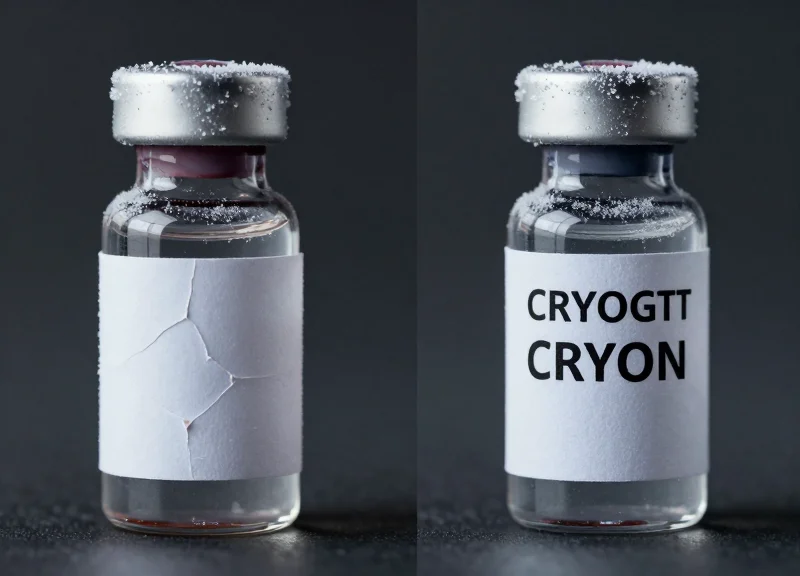
In -80°C environments, standard pressure-sensitive adhesives (PSAs) reach their Glass Transition Temperature (Tg), a critical physical threshold where the adhesive shifts from a flexible, 'tacky' state to a hard, glassy, and brittle solid. Once the adhesive crystallizes, it can no longer flow into the microscopic irregularities of the storage vial's surface. This loss of molecular contact, combined with the extreme contraction of both the label and the container, leads to 'flagging' or complete adhesive failure, rendering samples unidentifiable and compromising inventory integrity.
| Feature | Standard Industrial Labels | Cryogenic-Grade Labels |
|---|---|---|
| Adhesive Base | Standard Acrylic/Rubber | Modified High-Tack Cryo-Acrylic |
| Glass Transition (Tg) | Typically -20°C to -40°C | Engineered for -196°C |
| Thermal Expansion | High Mismatch (Brittle) | Flexible Matrix (Matched to PP/PE) |
| Moisture Resistance | Absorbent/Weakens | Hydrophobic/Frost-Penetrating |
A primary technical culprit for label failure is the Coefficient of Thermal Expansion (CTE) mismatch. Most laboratory vials are made of polypropylene, which contracts significantly when moved from room temperature to ultra-low storage. Standard polyester or paper labels do not contract at the same rate. This differential stress creates shear forces that literally tear the frozen, brittle adhesive bond away from the vial wall. Without a flexible adhesive carrier designed to 'breathe' with the plastic container, the label is destined to pop off during the first few thermal cycles.
How does frost buildup impact barcode readability?
Frost acts as a refractive barrier, scattering the light from laser or LED scanners. Standard labels allow moisture to seep under the edges, where it freezes and expands, further lifting the label and creating air pockets that accumulate even more frost.
Can I use 'all-temperature' adhesives for -80°C?
Generally, no. 'All-temperature' adhesives are designed for a range down to -20°C. At -80°C, these adhesives lose all viscoelastic properties, leading to immediate bond failure if the vial is handled or bumped.
What is 'Thaw-Cycle Fatigue' in labeling?
This is the cumulative damage caused by removing samples for auditing. Each time a vial warms slightly and is re-frozen, moisture condenses on the label surface. Cryogenic labels use a specialized topcoat to prevent this moisture from degrading the printed barcode ink.
Expert Insight: To achieve 99.9% accuracy, you must account for 'Micro-Vibration Displacement.' In large ULT freezers, compressor vibrations can cause brittle, standard labels to shake loose over months of storage. Only adhesives that maintain a 'rubbery' state at -80°C can dampen these vibrations and remain adhered for the multi-year lifecycles common in biobanking.
The Anatomy of a Cryogenic RFID Tag
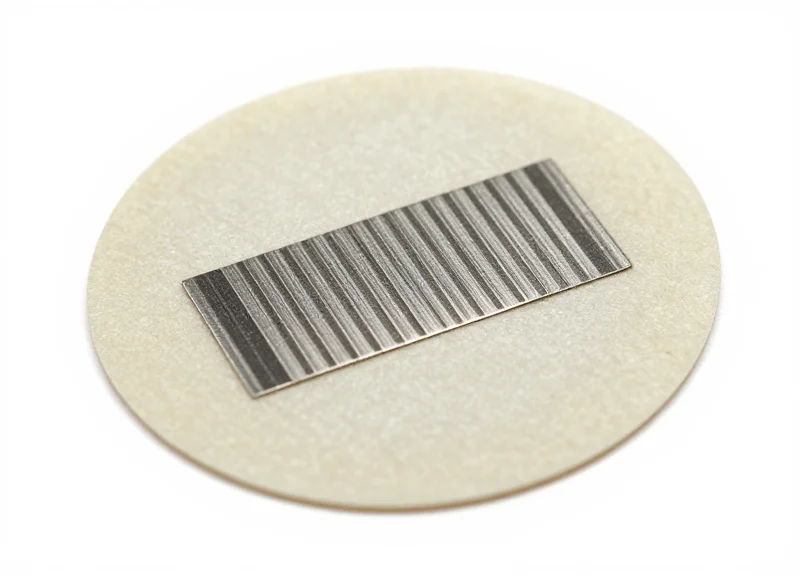
A cryogenic RFID tag is a precision-engineered device composed of a specialized Integrated Circuit (IC), a high-conductivity antenna, and multi-layered cryo-grade encapsulation designed to withstand temperatures as low as -196°C (Liquid Nitrogen) without losing data or physical adhesion. Unlike standard RFID labels, every component in a cryogenic tag is selected based on its Coefficient of Thermal Expansion (CTE) to ensure that the disparate materials—metal, silicon, and plastic—contract and expand in unison during rapid freeze-thaw cycles, preventing mechanical failure or 'antenna shearing'.
| Component | Material/Technology | Role in -80°C Stability |
|---|---|---|
| Integrated Circuit (IC) | Low-Voltage CMOS / NVM | Maintains gate logic and memory retention despite reduced electron mobility in the cold. |
| Antenna | Etched Copper or Silver Ink | Flexible design to resist cracking during thermal contraction of the substrate. |
| Substrate | Polyimide or PET (Cryo-grade) | Provides high dimensional stability and prevents the tag from becoming brittle. |
| Adhesive | Modified Acrylic / Cryo-Bond | Resists crystallization (glass transition) to maintain a permanent bond on frosted surfaces. |
Expert Insight: The CTE Mismatch Challenge. In Silicon Valley hardware engineering, we focus on the 'CTE Mismatch.' At -80°C, the plastic substrate of a tag shrinks significantly more than the metal antenna. In generic tags, this differential stress causes the antenna to peel away from the chip (delamination). High-end cryogenic tags utilize a 'buffer layer' or a serpentine antenna geometry that acts like a spring, absorbing mechanical stress and ensuring the connection remains intact even during ultra-rapid cooling.
Can standard UHF RFID chips work at -80°C?
While the silicon logic can technically function, standard chips often face 'oscillator drift' where the clock frequency shifts due to the cold. Cryogenic-grade ICs are tuned to remain within frequency tolerances even as temperatures drop.
What is the 'Glass Transition' of the adhesive?
This is the point where an adhesive turns from a flexible 'rubbery' state to a brittle 'glass' state. Cryo-tags use adhesives with a glass transition temperature (Tg) far below -80°C to ensure the label doesn't shatter upon impact.
Does frost buildup affect the RFID signal?
Ice and frost are RF-transparent at UHF frequencies. However, liquid water (during thawing) is a polar molecule that absorbs RF energy. The anatomy of a cryo-tag often includes a hydrophobic top-coat to shed moisture immediately.
- Chip Attachment: The IC is flip-chip bonded using anisotropic conductive film (ACF) that remains conductive and flexible at cryogenic scales.
- Encapsulation: A protective overlay is applied to shield the chip from physical abrasion and chemical exposure (e.g., DMSO or ethanol).
- Quality Verification: Finished tags undergo thermal shock testing—moving from +20°C to -80°C in seconds—to verify the structural integrity of the bond.
Optimizing Signal Propagation Through Ice and Stainless Steel

Optimizing signal propagation in -80°C environments involves managing two primary physical challenges: the Faraday cage effect of stainless steel freezer walls and the dielectric properties of ice buildup. While stainless steel is a notorious RF reflector that can cause signal dead zones, the transition of water into crystalline ice actually reduces RF absorption, creating a unique environment where multi-path reflections can be leveraged to increase read rates rather than hinder them.
| Material | Dielectric Constant (εr) | Impact on 915 MHz RF Signal |
|---|---|---|
| Liquid Water | 80.0 | High Absorption: Severe signal attenuation |
| Ice (-80°C) | 3.1 - 3.2 | Low Absorption: Near-transparent to RF |
| Stainless Steel | N/A (Conductive) | Total Reflection: Creates Faraday cage effect |
| Frost/Rime | 1.5 - 2.5 | Diffraction: Scatters signal patterns |
The 'Expert Secret' to ULT inventory accuracy lies in the Water-to-Ice Dielectric Shift. Many engineers assume ice is the primary barrier; however, liquid water (even in microliter amounts from condensation) absorbs RF energy 25 times more aggressively than solid ice at -80°C. Consequently, the most critical window for signal failure isn't during deep freeze, but during the 'recovery phase' after a freezer door has been opened and ambient moisture enters the chamber.
- Implement Circular Polarization: Use circular polarized antennas to mitigate the 'dead spots' caused by stainless steel reflections. Unlike linear polarization, circular waves can be captured by tags regardless of their physical orientation within the rack.
- Leverage Multi-Path Reflection: Instead of increasing power (which causes interference), use the reflective properties of the freezer's interior to 'bounce' signals into the crevices of high-density storage racks.
- Antenna Detuning Compensation: Apply specialized tag inlays that are 'pre-detuned' to account for the dielectric constant of the storage vial material and the surrounding frost layer.
Does frost on the door seal affect signal?
Yes, heavy ice bridging on the gasket can act as a waveguide, leaking RF energy or causing impedance mismatches that lower the overall sensitivity of the reader system.
Can RFID signals penetrate through metal racks?
No, signals do not penetrate metal; they travel through the 'air gaps' between vials and racks. Success depends on the 'aperture' size of these gaps relative to the RF wavelength.
What is the best frequency for ULT environments?
UHF (860-960 MHz) is standard for bulk inventory because its wavelength allows for superior diffraction and reflection around stainless steel obstacles compared to HF frequencies.
Hardware Architecture for Seamless Lab Integration
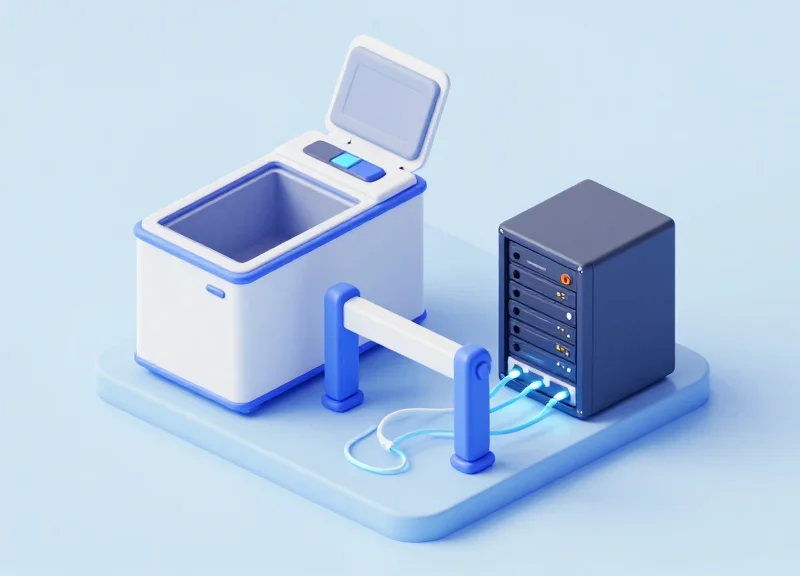
A robust hardware architecture for -80°C environments is defined by its ability to capture data through high-density stainless steel and frost layers without necessitating destructive modifications to the freezer. Achieving seamless integration involves deploying high-sensitivity UHF RFID fixed readers and circularly polarized antennas that connect via ultra-thin, vacuum-sealed feedthroughs. This setup ensures that data flows continuously from the cryogenic chamber to the Laboratory Information Management System (LIMS) without compromising the thermal seal or the structural warranty of the ultra-low temperature (ULT) unit.
| Component | Key Specification | Role in Accuracy |
|---|---|---|
| Fixed Reader | High Sensitivity (-80dBm+) | Overcomes signal loss from ice and dense racks. |
| Antenna | Circularly Polarized | Captures tags regardless of sample orientation. |
| Cabling | Flat Ribbon (PTFE Coated) | Preserves gasket seal to prevent frost buildup. |
| Handhelds | IP67 Ruggedized | Allows for mobile auditing and individual vial picking. |
The most critical point of failure in hardware integration isn't the reader's power, but the physical entry point into the freezer. Standard coaxial cables are too thick for door gaskets, leading to 'ice bridging' and temperature fluctuations. Expert Tip: Utilize 1.5mm flat-ribbon RF cables for the transition through the door frame; they are thin enough to let the magnetic gasket seat fully, maintaining a true vacuum seal while delivering power to internal antennas.
- Antenna Array Mapping: Position antennas at both the top and bottom of the freezer cabinet to eliminate RF dead zones caused by high-density stainless steel racking.
- Edge Gateway Configuration: Deploy readers with onboard processing to filter 'ghost reads' locally, reducing the bandwidth load on the lab's primary network.
- Thermal Decoupling: Mount readers externally on vibration-dampening brackets to protect electronic components from the heat dissipation of the freezer's compressor.
Do I need to drill holes in my freezer for the antennas?
No. Modern architectures use flat-ribbon cables that pass through existing door gaskets or access ports without drilling, preserving your equipment warranty.
How do fixed readers handle multiple freezers in one room?
By using Multi-Antenna Port Readers (8-port or 16-port), you can monitor several freezers from a single hardware unit, significantly lowering the total cost of ownership.
Can handheld scanners work inside the freezer?
While possible, it is better to use handhelds for 'out-of-freezer' scanning. Internal scanning should be automated via fixed antennas to minimize 'door-open' time.
Software Sync: Connecting RFID Data to LIMS and ERP
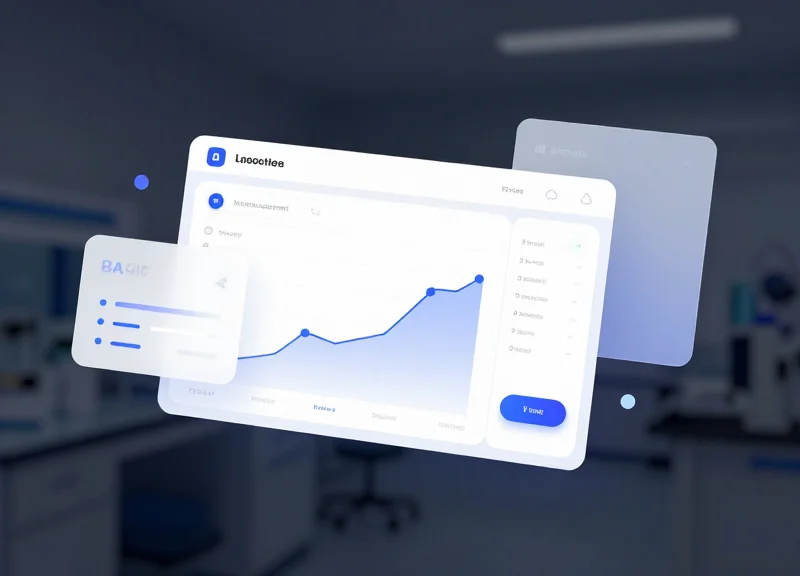
To achieve 99.9% inventory accuracy, the physical capture of an RFID tag at -80°C must be instantly reconciled with your digital records. Software synchronization is the process of using middleware to filter, aggregate, and translate raw Electronic Product Code (EPC) data into business-logic events—such as 'Sample Checked Out' or 'Storage Location Changed'—which are then pushed via API to Laboratory Information Management Systems (LIMS) or Enterprise Resource Planning (ERP) platforms. This bridge eliminates the 'data silos' created by manual logging and ensures that the digital twin of your freezer remains a perfect reflection of its physical contents.
| Integration Method | Data Latency | Complexity | Best Use Case |
|---|---|---|---|
| RESTful APIs | Low (Real-time) | Moderate | Standard LIMS updates for high-throughput labs. |
| Webhook Listeners | Near Instant | Low | Triggering alerts for unauthorized freezer access. |
| Middleware / MQTT | Ultra-low | High | Large-scale enterprise deployments with thousands of sensors. |
| Batch CSV Export | High (Delayed) | Very Low | Legacy systems without modern API support. |
Expert Insight: Implementing 'Thermal Latency Logic'. A common failure in -80°C RFID systems is 'Ghost Depletions'—where a sample is temporarily unreadable due to frost or physical shielding during a door-open event, causing the LIMS to mark it as missing. To prevent this, your software sync must include a 'persistence buffer.' Rather than marking a sample as 'Gone' on the first missed read, the system should wait for a defined threshold (e.g., 180 seconds) of continuous absence before updating the ERP. This accounts for the physical realities of cryo-storage maintenance without compromising data integrity.
- Signal De-duplication: The middleware filters out multiple reads of the same tag from different antennas to ensure a single unique event per sample.
- Contextual Enrichment: The raw EPC is paired with metadata such as timestamp, reader ID, and signal strength (RSSI) to determine precise location within the freezer.
- Business Logic Validation: The system checks the event against LIMS permissions; for example, flagging an error if a sample is moved to a shelf not designated for its biosafety level.
- Upstream Reconciliation: The validated event is transmitted via encrypted JSON payload to the LIMS/ERP, updating the inventory count and audit trail in real-time.
{
  "event_type": "inventory_move",
  "timestamp": "2023-10-27T10:15:30Z",
  "tag_id": "E28011912000000212345678",
  "source_location": "FREEZER_04_SHELF_B",
  "destination_location": "LAB_BENCH_01",
  "operator_id": "TECH_942",
  "rssi_strength": "-62dBm"
}
How do we handle offline data during a network failure?
Modern RFID readers and middleware use 'Store-and-Forward' architecture. Data is cached locally with a cryptographic timestamp and automatically synced to the LIMS once connectivity is restored, ensuring no audit trail gaps.
Can RFID data integrate with legacy ERPs like SAP or Oracle?
Yes, most enterprise middleware solutions provide pre-built connectors or 'edge agents' that translate RFID events into IDocs or flat files compatible with legacy database structures.
What is the security risk of syncing this data?
Integrations should utilize TLS 1.3 encryption and OAuth 2.0 authentication. By isolating the RFID hardware on a separate VLAN, you minimize the attack surface while maintaining data flow to the LIMS.
Implementation Best Practices: From Tagging to Training
Successful implementation of an RFID-driven inventory system in -80°C environments hinges on the transition from 'lab-scale' pilot projects to 'industrial-grade' operational discipline. It is not enough to simply purchase cryo-tags; a robust deployment must account for the physical chemistry of adhesion at low temperatures and the psychological factors of lab technician workflows. By standardizing the 'Tag-Validate-Sync' cycle, labs can eliminate the 15-20% margin of error typically seen in manual barcode-based ultra-low temperature (ULT) storage management.
- Phase 1: Substrate Preparation and Tagging: Apply tags only to dry, room-temperature vials whenever possible. If tagging pre-frozen samples, utilize a localized defrosting tool or a specialized CO2-wipe to clear frost without raising the sample's core temperature, ensuring the adhesive achieves its necessary 24-hour 'dwell time' for a permanent bond.
- Phase 2: The 'Golden Record' Validation: Perform a baseline audit where every RFID-tagged sample is cross-referenced against the legacy LIMS database. This creates a 'Golden Record' that serves as the ground truth for all subsequent automated scans.
- Phase 3: RF Zone Optimization: Calibrate handheld and fixed readers to the specific geometry of your freezer racks. Stainless steel reflects RF signals, so power levels must be tuned to prevent 'leakage' or reading tags in adjacent drawers.
- Phase 4: Continuous Staff Feedback Loops: Implement weekly 'exception reports' where technicians review any failed reads. This identifies whether specific racks are developing ice-blockages or if certain staff members require retraining on scanner positioning.
| Implementation Variable | Best Practice Protocol | Common Failure Point |
|---|---|---|
| Adhesive Application | Apply at 20°C with 5psi pressure | Applying directly to frosted vials |
| Data Synchronization | Real-time API push to LIMS | End-of-shift batch uploading |
| Scan Frequency | Daily automated rack sweeps | Monthly manual audits |
| Tag Placement | Uniform orientation on vial cap/side | Randomized placement causing signal shielding |
Expert Insight: The 'Thermal Equilibrium' Rule. One often overlooked factor in 99.9% accuracy is the micro-condensation that occurs when a sample is pulled from a -80°C freezer for scanning. Our data suggests that accuracy drops by 4% if tags are scanned during the 'fogging' phase. We recommend 'In-Situ' scanning solutions—where antennas are integrated into the freezer or a specialized cold-box—to ensure the tag and the reader interact without the interference of rapid phase-change moisture.
How do we handle 'Ghost Samples' that appear in the system but aren't in the freezer?
This is usually caused by 'RF Spillover' from nearby freezers. Implement RSSI (Received Signal Strength Indicator) filtering in your software to ignore any tag signals that fall below a specific decibel threshold.
What is the most effective way to train staff on RFID hardware?
Use 'Gamified Audits.' Challenge teams to find a specific 'hidden' vial within a 5,000-sample freezer using the handheld's Geiger-counter mode. This builds muscle memory for signal localization.
Do we need to re-tag samples every year?
No. High-quality cryogenic RFID tags using acrylic-based adhesives are rated for 10+ years. The primary reason for re-tagging is physical damage during mechanical handling, not adhesive failure.
ROI and Scalability: The Business Case for Automated Cold Chain
The Return on Investment (ROI) for automated cold chain inventory management is calculated by weighing the initial capital expenditure of hardware and software against the significant reduction in Operational Expenditure (OPEX), specifically regarding labor hours, sample replacement costs, and regulatory liability. In a typical -80°C environment, automation delivers a 95% reduction in search time and eliminates the 'Hidden Loss' associated with thermal fluctuations during manual audits, often achieving a full payback period within 14 to 22 months.
| Metric | Manual Inventory Process | Automated RFID Process |
|---|---|---|
| Audit Time (per 1,000 samples) | 12 - 16 Labor Hours | Under 5 Minutes |
| Data Accuracy Rate | 82% - 88% (Human Error prone) | 99.9% (Continuous Validation) |
| Average Sample Loss Rate | 2% - 5% Annually | Less than 0.1% |
| Compliance Readiness | Reactive (Days to compile) | Proactive (Real-time exports) |
Expert Insight: The 'Thermal Recovery' Tax. A frequently overlooked cost in manual systems is the 'Thermal Recovery Tax.' Every time a freezer door is opened for a 20-minute manual audit, the compressor must run at 100% capacity for hours to stabilize the internal environment. Automated RFID systems allow for 'closed-door' or 'rapid-access' inventorying, which extends the mechanical lifespan of -80°C compressors by up to 30% and reduces energy consumption by approximately 15% annually. This is a critical factor for labs scaling from five freezers to fifty.
How does automated tracking impact regulatory compliance (FDA/EMA)?
Automated systems provide a non-repudiable audit trail (21 CFR Part 11 compliant), showing exactly when a sample was touched, by whom, and its temperature history. This eliminates the risk of heavy fines or research invalidation during surprise audits.
What is the scalability potential for multi-site organizations?
Cloud-based RFID platforms allow organizations to scale from a single lab to a global network. By centralizing inventory data, procurement can identify underutilized freezer space across sites, potentially delaying expensive capital purchases of new freezers.
Does the system require expensive retraining for lab personnel?
Modern automated systems are designed to mirror existing SOPs. The primary change is the removal of the clipboard; the ROI includes a boost in staff morale as researchers spend more time on science and less time on tedious manual data entry.
Ultimately, the business case for automation in -80°C environments rests on risk mitigation. When a single shelf of bio-samples can represent millions of dollars in R&D investment and years of clinical labor, the cost of the tracking system is essentially a high-efficiency insurance policy that simultaneously optimizes daily productivity.