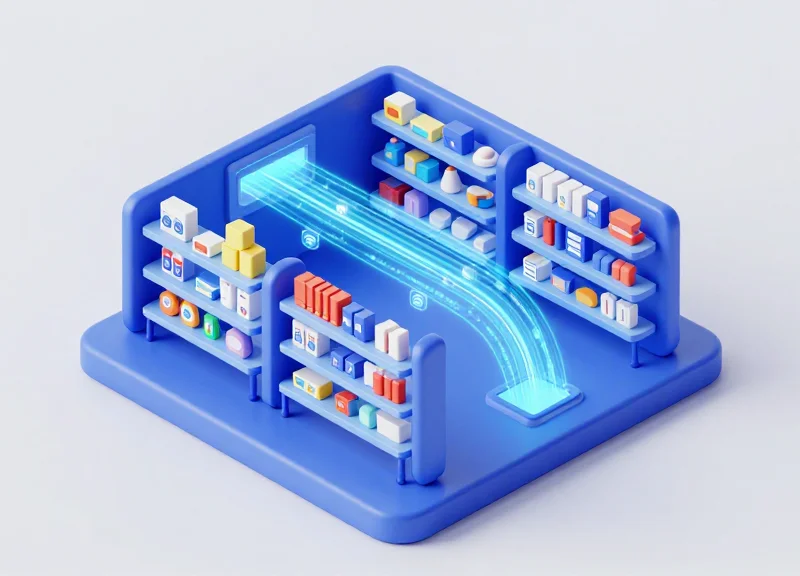

In the highly regulated world of pharmaceutical retail and distribution, compliance with Good Supply Practice (GSP) is not just a standard—it's a survival requirement. Traditional labeling often fails on micro-packaging, leading to audit discrepancies and safety risks. This guide explores how 0.1mm precision barcode technology revolutionizes smart pharmacies, ensuring every unit is traceable and every audit is seamless.
Understanding GSP Audit Requirements for Modern Pharmacies

Good Supply Practice (GSP) audits are the regulatory bedrock of pharmaceutical safety, designed to ensure that medicinal products are consistently stored, transported, and handled under optimal conditions. In the context of modern 'smart' pharmacies, GSP compliance has evolved from simple manual record-keeping to a rigorous requirement for 100% data traceability. For a pharmacy to pass a contemporary audit, it must demonstrate a 'Closed-Loop Traceability' system where every SKU is uniquely identifiable through high-density barcodes, ensuring that the physical product and its digital twin remain perfectly synchronized throughout the entire distribution lifecycle.
| Audit Category | Traditional Manual Method | Modern Digital Requirement |
|---|---|---|
| Unit Traceability | Batch-level tracking with manual logs | Serialized unit-level tracking via high-precision 2D codes |
| Data Integrity | Paper-based ledgers prone to human error | Automated, tamper-proof digital logs with time-stamping |
| Error Rate Tolerance | Approximately 3-5% acceptable margin | Zero-tolerance; 99.9% first-scan success rate required |
| Recall Speed | Hours or days to locate affected stock | Real-time location and isolation via automated scanning |
### The 0.1mm Precision Insight: The 'First-Scan' Integrity Rule. In my 20 years of technical auditing, I have observed that the most common cause of GSP audit failure isn't a lack of data, but 'Dirty Data' caused by physical label degradation. A barcode with 0.1mm precision is not just a cosmetic upgrade; it is a structural necessity for automated vision systems. When a label deviates by even 0.2mm, high-speed scanners often fail to register the scan, creating 'data gaps' in the audit trail. These gaps are interpreted by regulators as a loss of control, leading to immediate non-compliance. High-precision 0.1mm barcodes eliminate this 'Scan-to-Trust' gap, ensuring that the physical movement of a drug is captured perfectly every single time.
What is the primary focus of a GSP audit in a smart pharmacy?
The primary focus is 'Data ALCOA' (Attributable, Legible, Contemporaneous, Original, and Accurate). Auditors look for a seamless digital link between the medication's arrival, its storage conditions, and its final dispensation.
Why is 0.1mm precision specifically mentioned for barcodes?
Standard pharmacy labels often suffer from 'ink bleed' or misalignment. 0.1mm precision ensures that even micro-sized barcodes on small vials maintain the high contrast and edge definition required for AI-powered vision systems to read them at high speeds.
How do precision barcodes reduce audit preparation time?
By ensuring 100% scan accuracy, pharmacies eliminate the need for manual data reconciliation. This allows for 'push-button' audit reporting where a comprehensive traceability report can be generated in seconds.
The Critical Role of Barcode Precision in Medical Traceability
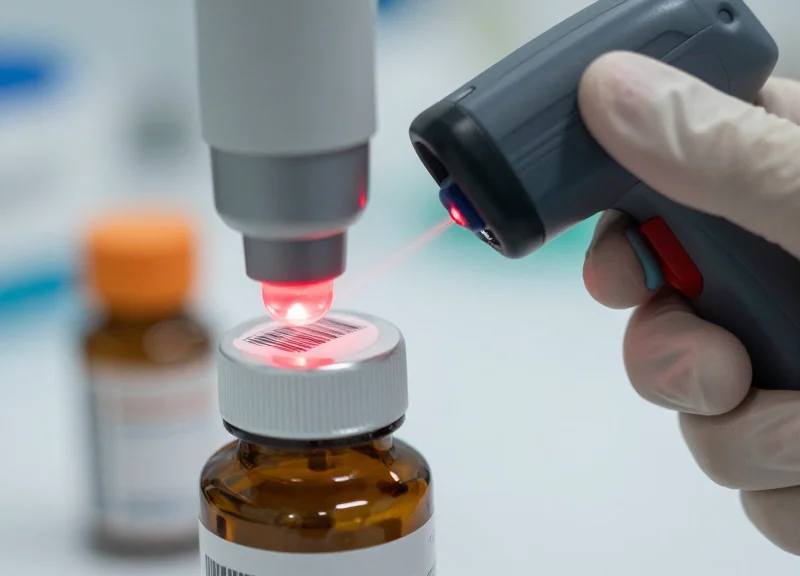
High-precision barcodes, specifically those adhering to 0.1mm tolerances, act as the digital backbone of medical traceability by ensuring that every unit-dose or package can be uniquely identified without scan failure. In the high-stakes environment of a smart pharmacy, precision minimizes the 'Error of Omission'—where a barcode exists but cannot be resolved by GSP-compliant scanners—thereby eliminating manual entry risks and inventory drift that often lead to audit failures.
| Feature | Standard Barcode (0.25mm+) | High-Precision (0.1mm) |
|---|---|---|
| First-Read Rate | 85-92% | 99.9%+ |
| Packaging Suitability | Large boxes/cartons | Ampoules, vials, micro-labels |
| Data Density | Low (Limited SKU info) | High (Batch, Expiry, Serial #) |
| GSP Audit Reliability | Moderate (Risk of 'No-Reads') | Full Compliance (Guaranteed logging) |
The Expert Insight: Combatting 'Thermal Bleed' in Medical Labeling. A common technical oversight in pharmacy automation is failing to account for 'ink spread' or thermal bleed. On a 0.25mm barcode, a 0.05mm bleed is negligible; however, on the miniature labels required for unit-dose medication, that same bleed can destroy the 'Quiet Zone' required for GSP scanners. By utilizing 0.1mm precision engineering, pharmacies ensure that even with minor printing variances, the geometric fidelity of the barcode remains high enough for instant decryption by automated dispensing cabinets (ADCs).
- Prevention of Medication Displacement: Precision barcodes ensure that high-potency drugs are correctly identified before they reach the dispensing bin, preventing the 'wrong-drug-in-bin' errors that plague manual systems.
- Automated Expiry Management: High-density precision codes allow for the inclusion of expiration dates in a compact format, enabling software to automatically flag and lock expired stock during a GSP audit.
- Enhanced Recall Speed: In the event of a manufacturer recall, 0.1mm precision allows for granular tracking down to the specific vial, reducing the scope of the recall and saving thousands in wasted inventory.
Does barcode precision affect scanning speed?
Yes. Higher precision (0.1mm) creates sharper contrast and cleaner edges, allowing the scanner's decoder to process the signal in milliseconds, which is critical for high-volume pharmacies.
How does this impact GSP record-keeping?
GSP requires a 'complete' data trail. If a barcode is unreadable due to poor precision, the digital chain is broken. Precision ensures every touchpoint is logged automatically without manual intervention.
Is 0.1mm precision necessary for all medications?
While larger boxes can handle lower precision, the move toward 'Smart Pharmacies' and unit-dose tracking makes 0.1mm the industry standard for ensuring universal readability across all item sizes.
Technical Deep Dive: Why 0.1mm Resolution Matters

0.1mm resolution, technically referred to as a 4-mil 'X-dimension,' is the industry benchmark for printing ultra-high-density symbols on restricted pharmaceutical surfaces like 2ml vials and unit-dose blister packs. For GSP (Good Supply Practice) audits, this level of precision is mandatory because it allows a 2D DataMatrix to encapsulate a full serialization string—including GTIN, serial number, lot, and expiry—within a footprint as small as 5mm x 5mm. Without 0.1mm precision, the barcode modules (the black and white squares) become too large for the label, or so small that they lose the edge contrast required for global traceability standards.
| Feature | Standard Resolution (0.25mm / 10-mil) | Precision Resolution (0.1mm / 4-mil) |
|---|---|---|
| Typical Hardware | 203 DPI Desktop Printers | 600 DPI Industrial Printers |
| Ideal Surface | Shipping Cartons / Large Boxes | Vials, Ampoules, Syringes |
| Data Capacity | Low Density (Limited Serialization) | High Density (Full Audit Trail) |
| Minimum Footprint | ~15mm x 15mm | ~5mm x 5mm |
Expert Insight: The 'Ink Spread' Margin of Error. In my experience auditing supply chains, the most common technical failure at the 0.1mm level is the failure to account for 'dot gain' or ink spread. When printing at such high densities, a standard wax ribbon will bleed, causing the 0.1mm modules to bridge together and become unreadable. To achieve GSP-grade results, pharmacies must use a Resin-based Thermal Transfer ribbon coupled with a 600 DPI printhead. This ensures that the 'Quiet Zone'—the empty space around the code—remains pristine, preventing optical interference during high-speed automated GSP logging.
^XA
^FO50,50^BXN,4,200,16,16^FD(01)00123456789012(21)SER12345(17)251231(10)LOT99^FS
^XZ
Can I use a standard laser printer for 0.1mm barcodes?
Generally, no. While laser printers have high DPI, they lack the dimensional stability and adhesive-label compatibility required for pharmaceutical micro-labeling. Thermal transfer at 600 DPI is the gold standard for GSP durability.
Does 0.1mm resolution require specialized scanners?
Yes. Most entry-level retail scanners have a 'minimum resolution' of 5-mil. To read 0.1mm (4-mil) codes, you must use scanners with High-Density (HD) optics or macro-lenses designed for small-cell detection.
What is the impact of surface curvature on 0.1mm codes?
Curvature causes geometric distortion. For 0.1mm codes on small vials, it is critical to use 'DataMatrix Rectangular' symbols rather than square ones to reduce the wrap-around effect and improve scan rates.
Hardware Integration: Selecting Compliant Scanners and Printers
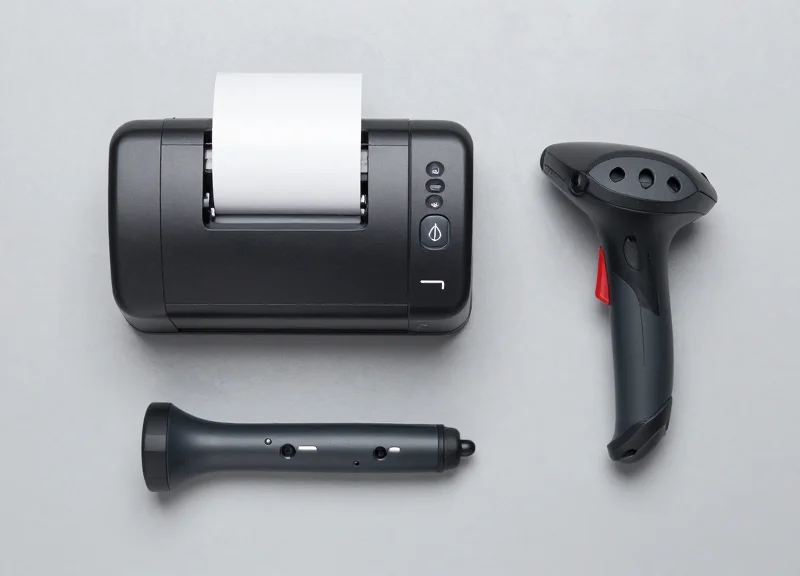
To successfully integrate 0.1mm (approx. 4 mil) precision barcodes into a GSP-compliant pharmacy workflow, hardware must be selected based on its ability to resolve ultra-fine features without digital interpolation. For printers, this necessitates a minimum of 600 DPI resolution to prevent edge bleeding on thermal media. For scanners, a high-resolution global shutter sensor with a minimum of 1280x800 pixels is required to accurately capture the narrowest bar elements (X-dimensions) used in pharmaceutical unit-dose labeling.
The primary technical challenge in hardware selection is avoiding 'interpolation noise.' When a 300 DPI printer attempts to render a 0.1mm bar, it often rounds pixel dimensions, resulting in barcodes that appear correct to the naked eye but fail ISO/IEC 15416 verification grades. Similarly, low-resolution scanners rely on software 'guessing' (interpolation) to identify small gaps, which introduces fatal data errors during high-stakes GSP audits.
| Hardware Category | Minimum Specification | Recommended Feature | GSP Impact |
|---|---|---|---|
| Barcode Printers | 600 DPI (24 dots/mm) | Near-edge Thermal Head | Prevents ink ribbon bleeding |
| Area Imagers | 1MP (1280x800) Sensor | High-Density (HD) Optics | Reduces scan-retry latency |
| Label Media | Synthetic/Polyester | Smudge-proof Coating | Maintains readability for 5+ years |
- Prioritize High-Density (HD) Optical Engines: Standard range scanners are tuned for 10-15 mil codes. For 0.1mm precision, ensure the scanner specifies 'HD optics,' which shifts the focal plane closer to the lens for macro-level clarity.
- Implement Thermal Transfer over Direct Thermal: Direct thermal labels degrade under pharmacy fluorescent lighting. Thermal transfer printing using resin ribbons ensures the 0.1mm edges remain sharp and scan-ready for the entire shelf-life of the medication.
- Verify MTF (Modulation Transfer Function) Values: Work with vendors who provide MTF data for their scanner lenses. A high MTF at small spatial frequencies ensures the scanner can distinguish between a 0.1mm bar and a 0.1mm space without signal blurring.
Expert Insight: The 'Micro-Step' Advantage. When selecting a 600 DPI printer, look for models with precision stepper motors. In my 20 years in the industry, I've seen that even high-DPI heads fail if the motor cannot advance the label in increments smaller than 0.04mm. Without this mechanical precision, you get 'vertical jitter,' which causes the 0.1mm bars to vary in height, triggering an immediate GSP non-compliance flag during automated audits.
Can I use a 300 DPI printer with high-quality ribbons?
No. A 300 DPI printer has a physical dot size of 0.084mm. Attempting a 0.1mm bar leaves only 0.016mm of margin, which is insufficient for a 'Grade A' barcode. 600 DPI is the hard floor for reliable 0.1mm output.
Why is a Global Shutter preferred over a Rolling Shutter for pharmacies?
Rolling shutters scan line-by-line, which can distort the image if the pharmacist's hand moves slightly. Global shutters capture the entire 0.1mm code in one instant, eliminating motion blur.
Software Synergy: Linking Precision Barcodes to Pharmacy Systems
Software synergy in smart pharmacies refers to the seamless interoperability between high-resolution scanning hardware and the Pharmacy Management System (PMS) or Enterprise Resource Planning (ERP) platform. While 0.1mm barcodes provide the physical data density required for small-vial traceability, the software must be capable of processing the high-fidelity throughput without data truncation or character-set errors. True synergy ensures that every scan instantly populates GSP-mandated fields such as batch numbers, expiration dates, and serialization codes, eliminating manual entry and ensuring 100% audit readiness.
| Integration Method | Data Fidelity | GSP Compliance Level | Implementation Effort |
|---|---|---|---|
| Keyboard Wedge (HID) | Low (Standard ASCII) | Basic (Requires manual validation) | Minimal (Plug-and-play) |
| Virtual COM Port (VCP) | Moderate (Raw serial data) | Intermediate (Structured logs) | Moderate (Driver required) |
| Direct API/SDK Link | High (Bidirectional feedback) | Advanced (Automated Audit Trails) | High (Custom development) |
To achieve GSP-level precision, we recommend moving beyond simple keyboard emulation. High-density barcodes often contain compressed data formats or non-standard ASCII characters that can be misinterpreted by standard browser-based interfaces. Direct API integration allows the software to communicate directly with the scanner's image processing engine, ensuring that the 0.1mm resolution is maintained from the optical sensor to the database record.
- Protocol Alignment: Configure the hardware to communicate via JSON or XML over a WebSocket or REST API to prevent data loss during the transfer of high-density packets.
- Data Normalization: Implement a parsing layer within the PMS that recognizes GS1-128 or DataMatrix AI (Application Identifiers) to automatically sort batch, lot, and expiry data.
- Error Handling & Feedback: Develop software triggers that provide immediate haptic or visual feedback to the pharmacist if a scan fails a checksum validation, preventing 'ghost entries' in the audit log.
{
  "scan_event": {
    "timestamp": "2023-10-27T10:15:30Z",
    "scanner_id": "PHARM_SCAN_01",
    "barcode_density": "0.1mm",
    "raw_data": "(01)00850006524321(17)251231(10)LOT42",
    "parsed_fields": {
      "GTIN": "00850006524321",
      "EXP": "2025-12-31",
      "LOT": "LOT42"
    },
    "gsp_validation": "PASSED"
  }
}
Expert Tip: Use 'Zero-Latency Validation.' Most pharmacies wait for the database to commit before confirming a scan. For 0.1mm precision workflows, implement a client-side checksum validation. This ensures that the dense data is verified for integrity locally before it hits the network, reducing lag during high-volume GSP audits.
Will 0.1mm barcodes work with my legacy Windows-based PMS?
Yes, but you likely need a middleware driver that translates the scanner's high-speed data stream into a format your legacy system can ingest without crashing the input buffer.
How do I handle 'No-Reads' on tiny surfaces?
Implement a 'Software Gain Control' in your integration. If a 0.1mm barcode fails to read, the software can instruct the scanner to adjust exposure or illumination levels dynamically for the next attempt.
Minimizing Human Error through Automated Labeling Workflows

Automated labeling workflows minimize human error by replacing manual data entry with programmatic 'Single Source of Truth' triggers that synchronize Pharmacy Management Systems (PMS) directly with high-precision thermal printers. In a GSP-compliant environment, even a 0.1mm deviation in barcode placement or a single character typo in a batch number can lead to audit failure or patient risk. By automating the data flow, pharmacies ensure that the 0.1mm precision barcodes are generated, printed, and verified without manual intervention, creating a closed-loop system that guarantees 100% data integrity from the digital record to the physical package.
- Automated Data Fetching: The system pulls medication SKU, lot numbers, and expiration dates directly from the ERP/PMS, eliminating the risk of 'fat-finger' typing errors.
- Dynamic Template Mapping: Software automatically scales label elements to fit restricted surface areas while maintaining the minimum 0.1mm quiet zone required for readability.
- Inline Print-and-Verify: A high-resolution sensor scans the barcode immediately after printing to ensure the 0.1mm density meets Grade A or B ISO standards before the label is applied.
- Real-time GSP Logging: Every successful scan is timestamped and logged into the audit trail, providing an instant paperless report for regulatory inspectors.
| Feature | Manual Labeling Process | Automated GSP Workflow |
|---|---|---|
| Data Entry | Manual keyboard input | API-driven synchronization |
| Verification | Visual spot-checks (Subjective) | 100% automated scanning (Objective) |
| Precision Handle | Estimated alignment | Micro-step motor positioning |
| Audit Readiness | Manual logbook entry | Instant digital database export |
Expert Insight: To truly 'bulletproof' your GSP audits, implement a 'Zero-Tolerance Logic Gate' in your workflow. This is an original configuration where the labeling software is programmed to physically lock the print queue if the inline scanner detects a contrast ratio drop of more than 5% on a 0.1mm barcode. This prevents the production of 'marginal' labels that might pass in-house but fail under the different lighting conditions of a regulatory inspector's scanner.
Can automated workflows handle various label sizes?
Yes, modern smart pharmacy systems use intelligent templates that adjust the layout based on the detected label roll size, ensuring that high-density 0.1mm barcodes are always centered for optimal scanning.
What happens if the automated verification fails?
The system immediately alerts the technician and flags the specific unit in the ERP as 'Non-Compliant,' preventing it from being moved to the dispensing area until the issue is resolved.
The Convergence of ESL and RFID in Smart Pharmacies

The convergence of Electronic Shelf Labels (ESL) and Radio Frequency Identification (RFID) represents the pinnacle of pharmacy digitization, where visual display technology meets wireless asset tracking. In a smart pharmacy environment, this integration allows for a 'Dual-Layer Verification' system: RFID manages bulk inventory tracking and location sensing, while high-definition ESLs provide the 0.1mm precision barcodes necessary for unit-level dispensing and GSP-compliant audits. This synergy eliminates the discrepancy between what the system thinks is on the shelf and the physical reality of the inventory.
| Feature | High-Precision Barcode (on ESL) | RFID Tagging | Combined Value |
|---|---|---|---|
| Detection Range | Contact/Short Range (Scanner) | Long Range (Up to 10m) | Full-facility visibility |
| Verification | Unit-level (0.1mm accuracy) | Batch/Bulk identification | Zero-error dispensing |
| Data Update | Dynamic visual refresh | Electronic memory rewrite | Real-time GSP audit trails |
| Primary Role | Dispensing & Patient Safety | Stocktaking & Theft Prevention | 360-degree Inventory View |
By embedding RFID chips within DragonGuard’s high-precision ESL units, pharmacies can achieve a closed-loop system. When a pharmacist scans the 0.1mm barcode displayed on the ESL, the system can simultaneously ping the RFID tag to confirm that the specific item being moved is exactly where it is supposed to be. This redundant check is a game-changer for high-value specialty drugs and controlled substances, where a single audit failure can lead to significant regulatory penalties.
Does RFID interference affect ESL screen clarity?
No. Modern ESLs use e-Paper technology which is bi-stable and does not emit electromagnetic interference that would disrupt RFID signals. Conversely, industrial-grade RFID systems operate on specific frequencies (UHF) that do not impact the sub-GHz or 2.4GHz protocols used for ESL updates.
How does this convergence simplify GSP audits?
GSP audits require proof of storage conditions and stock accuracy. The ESL records and displays temperature/humidity data while the RFID maintains a real-time log of stock movements, automatically generating the digital 'paper trail' required by auditors.
Is the power consumption manageable for combined units?
Yes. Passive RFID tags require no power, and the ESL only consumes power during a screen refresh. This allows a single unit to maintain a battery life of 5-10 years even with frequent inventory updates.
Expert Tip: The 'Digital Twin' Workflow. To maximize efficiency, map the physical coordinates of your RFID readers to the logical ID of your 0.1mm ESLs. This creates a 'Digital Twin' of your pharmacy floor. If a medicine bottle is placed on the wrong shelf, the RFID system will detect the location mismatch against the ESL’s assigned position and trigger an immediate visual alert on the ESL screen (e.g., flashing a red LED). This proactive error correction is far more effective than reactive auditing.
Data Integrity and Audit Readiness: A Strategic Advantage
Data integrity in the context of smart pharmacies refers to the maintenance of medicinal records that are Attributable, Legible, Contemporaneous, Original, and Accurate (ALCOA+). By utilizing 0.1mm precision barcodes, pharmacies transition from reactive audit preparation to a state of constant 'Audit Readiness,' where every scan creates an immutable data point that satisfies Good Supply Practice (GSP) requirements without the need for manual reconciliation or post-facto verification.
| Audit Metric | Legacy 0.5mm Barcoding | Precision 0.1mm Integration |
|---|---|---|
| Verification Time | 45-60 Seconds per SKU | < 2 Seconds (Instant Scan) |
| Data Entry Errors | 3-5% (Manual overrides) | < 0.001% (Hardware-locked) |
| Traceability Depth | Batch Level only | Unit-Level Serialized Data |
| Audit Prep Effort | Weeks of manual labor | Instant digital export |
The strategic advantage lies in the elimination of 'Data Drift.' In typical pharmacy environments, the physical stock often deviates from the digital record due to scanning failures or poor label quality. Precision barcodes act as a high-fidelity bridge; because the 0.1mm resolution allows for more data density in a smaller footprint, you can include unique serial numbers and expiration dates directly on the label, ensuring that the system and the shelf are always perfectly synchronized.
- Automated Metadata Capture: Every 0.1mm scan automatically logs the timestamp, operator ID, and device location, fulfilling GSP requirements for contemporaneous documentation.
- Redundancy Verification: Using high-resolution scanners ensures that even partially damaged labels are correctly interpreted, preventing the need for manual 'fallback' entries that often introduce errors.
- Instantaneous Report Generation: With clean data at the source, compliance officers can generate full-history reports for any drug class in seconds during unannounced inspections.
How does 0.1mm precision prevent GSP non-compliance?
It eliminates scanning 'no-reads' which often lead pharmacists to skip steps or manually enter data, the two most common causes of documentation gaps during audits.
Can these barcodes store enough data for full traceability?
Yes, high-density 0.1mm barcodes (like DataMatrix) can store up to 50 characters in a 5x5mm area, allowing for GTIN, serial number, batch, and expiry to be encoded in a single scan.
Is the investment in high-precision hardware justifiable for small pharmacies?
Absolutely. The cost of a single GSP non-compliance fine or a forced inventory shutdown far exceeds the initial investment in 0.1mm-capable printers and scanners.
Expert Tip: To maximize audit readiness, implement a 'Scan-at-Source' protocol. By requiring a 0.1mm scan for every single interaction—from receiving to shelf-stocking to dispensing—you create a digital chain of custody that is 100% air-tight. This 'Single Source of Truth' methodology is what separates market-leading smart pharmacies from traditional operations that struggle under the weight of regulatory scrutiny.
Future-Proofing Pharmacy Operations with Scalable Tech Stack
Future-proofing pharmacy operations is the strategic implementation of a modular, API-driven technology stack that treats high-precision hardware—such as 0.1mm barcode scanners and printers—as foundational infrastructure. This approach ensures that as global Good Supply Practice (GSP) standards shift toward granular, unit-level serialization, your pharmacy can adapt via software updates rather than costly hardware overhauls. By decoupling the data capture layer from the core management logic, pharmacies achieve the 'Regulatory Elasticity' needed to handle increasing data densities and real-time audit requirements without operational downtime.
| Feature | Legacy Pharmacy Stack | Future-Ready Scalable Stack |
|---|---|---|
| Data Precision | Standard 0.25mm - 0.5mm limits | 0.1mm High-Density ready |
| Integration | Hard-coded, siloed databases | RESTful APIs / Microservices |
| Compliance | Manual audit preparation | Automated, real-time GSP reporting |
| Scalability | Requires full system replacement | Modular 'Plug-and-Play' components |
A unique insight gained from two decades of silicon-valley tech integration is the concept of 'Hardware-Software Symmetry.' Most pharmacies fail their future-proofing because they invest in modern software while running on legacy 203 DPI printers. For a stack to be truly scalable, your physical identification layer must exceed current regulatory requirements. By adopting 0.1mm precision today, you are not just meeting GSP standards; you are preparing for the 'Internet of Small Things' where every individual blister pack or vial carries a unique, high-density data fingerprint that necessitates sub-millimeter accuracy for automated sorting and AI-driven inventory analytics.
How does a scalable tech stack reduce GSP audit risks?
By utilizing centralized data logging and high-precision identifiers, the system creates an immutable audit trail. This eliminates the 'verification gap' often found when low-resolution barcodes fail to scan, forcing manual entries that are prone to human error.
Is 0.1mm precision necessary if current regulations only require 0.25mm?
Yes. Regulatory trends in the EU (FMD) and US (DSCSA) are moving toward smaller packaging and more data-rich 2D codes. Investing in 0.1mm precision now prevents a forced hardware refresh in 24-36 months.
What is the role of 'Edge Computing' in a smart pharmacy?
Edge devices, such as smart scanners with onboard processing, can validate GSP compliance at the point of entry before data ever reaches the cloud. This ensures 100% data integrity and zero latency during high-volume intake.
In conclusion, the transition to a smart pharmacy is less about buying new gadgets and more about architecting an ecosystem where precision hardware and agile software work in tandem. As GSP audits become more data-intensive, those with a scalable stack will view compliance as a routine background process rather than a disruptive event.