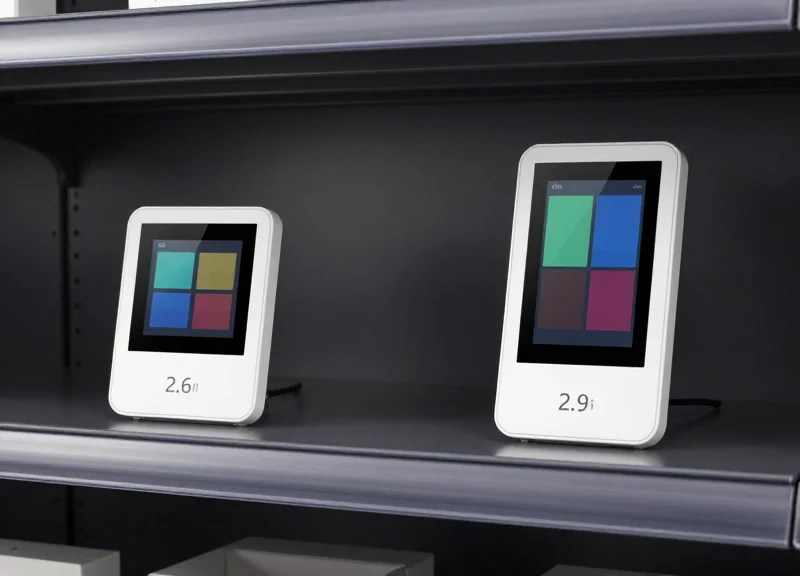

As retail environments become increasingly crowded with Wi-Fi 7, Bluetooth 6.0, and a myriad of IoT sensors, the standard 2.4GHz frequency is reaching a critical breaking point. Forward-thinking retailers are already looking toward 2026, transitioning to Sub-GHz Electronic Shelf Label (ESL) protocols to ensure stability, extended range, and ultra-low power consumption. This shift represents more than just a technical upgrade; it is a strategic defense against the inevitable wireless saturation of modern commerce spaces.
The Looming Crisis: Wireless Saturation in 2026 Retail

By 2026, wireless saturation in retail will reach a critical 'Noise Floor Threshold' where the 2.4GHz spectrum—historically used by Electronic Shelf Labels (ESL)—becomes virtually unusable for low-power transmissions. This crisis is driven by the density of Wi-Fi 7 access points, 5G small cells, and consumer wearable proliferation, leading to high packet loss and catastrophic latency for digital pricing updates. To maintain operational integrity, retailers must pivot away from standard crowded frequencies toward more resilient, long-range Sub-GHz protocols.
| Metric | 2023 Baseline | 2026 Projection | Impact on ESL |
|---|---|---|---|
| Avg. Connected Devices per Store | 500 - 1,500 | 5,000 - 10,000+ | Extreme channel congestion |
| 2.4GHz Background Noise | -90 dBm | -75 dBm to -70 dBm | Signal-to-Noise Ratio (SNR) failure |
| Standard ESL Update Success Rate | 99.9% | 85.0% - 92.0% | Inaccurate pricing and legal risk |
| Interference Sources | Wi-Fi 5/6, Bluetooth | Wi-Fi 7, Matter, 6G-ready IoT | Ubiquitous spectrum contention |
The fundamental problem is not just the volume of devices, but what I call the 'Packet Collision Cascade.' In a saturated 2026 environment, when an ESL fails to receive a price update due to interference, it triggers an automated retry mechanism. When thousands of labels simultaneously enter a high-frequency retry loop, they inadvertently become a source of interference themselves. This creates a feedback loop that can effectively 'DOS' (Denial of Service) the store's own internal IoT network. Unlike Sub-GHz frequencies, which offer superior penetration and less traffic, the 2.4GHz band lacks the physical properties to overcome this specific type of high-density electromagnetic smog.
Why is Wi-Fi 7 a specific threat to ESL systems?
Wi-Fi 7 uses 320MHz wide channels and Multi-Link Operation (MLO), which allows it to aggressively occupy multiple frequencies simultaneously. This aggressive bandwidth negotiation can easily 'drown out' the narrow-band, low-power signals used by traditional Zigbee or proprietary 2.4GHz ESL protocols.
Can't we just add more Access Points (APs) to fix the signal?
No. Adding more APs in a saturated 2.4GHz environment actually increases Co-Channel Interference (CCI). It raises the noise floor further, making it even harder for battery-operated labels to 'shout' over the background noise without depleting their batteries in months rather than years.
What is the legal risk of wireless saturation?
If a store's wireless network is too saturated to update prices before opening, the discrepancy between the shelf price and the Point of Sale (POS) price can lead to heavy fines for consumer protection violations, a risk that grows as dynamic pricing becomes standard.
What is Sub-GHz Technology? A Technical Foundation
Sub-GHz technology is a category of wireless communication that utilizes the radio spectrum below the 1 gigahertz (GHz) threshold—specifically the 433 MHz, 868 MHz, and 915 MHz bands. Unlike the ubiquitously crowded 2.4 GHz band used by Wi-Fi and Bluetooth, Sub-GHz frequencies offer significantly longer wavelengths. This physical characteristic allows signals to diffract around obstacles and penetrate solid materials like concrete, glass, and metal shelving far more effectively, making it the ideal backbone for Electronic Shelf Label (ESL) systems that require 100% data integrity across massive, cluttered floor plans.
| Feature | 2.4 GHz (Standard) | Sub-GHz (Next-Gen) |
|---|---|---|
| Wavelength | 12 cm (Short) | 33 cm to 70 cm (Long) |
| Building Penetration | Low (Reflects off metal) | High (Passes through/around) |
| Typical Range | 10 - 30 Meters | 100 - 1000 Meters |
| Power Consumption | High (Frequent re-transmissions) | Ultra-Low (High duty cycle efficiency) |
| Congestion Risk | Severe (Wi-Fi, Zigbee, BT) | Minimal (Proprietary/Industrial) |
From a physics perspective, the 'Fris Transmission Equation' dictates that path loss increases with frequency. Consequently, a 900 MHz signal inherently travels further and requires less power than a 2.4 GHz signal to achieve the same link budget. For ESL applications, this translates to 'Battery-First' architecture, where tags can remain dormant for years because they don't have to fight through the noise floor of a thousand consumer smartphones.
- 433 MHz Band: A globally recognized ISM band with exceptional range, though often limited by lower data rates and higher duty cycle restrictions in certain regions.
- 868 MHz Band: The standard for European deployments (SRD band), offering a perfect balance between data throughput and material penetration.
- 915 MHz Band: Commonly used in North America and Australia, providing higher bandwidth than 433 MHz while maintaining superior propagation over 2.4 GHz.
Veteran Insight: The 'Human Attenuation' Factor. One often overlooked variable in retail is that the human body is 60% water, which acts as a primary absorber of 2.4 GHz frequencies (the same frequency used by microwave ovens to heat water). In a crowded 2026 retail environment, a 2.4 GHz ESL signal must fight through a sea of shoppers. Sub-GHz wavelengths are long enough to pass through the 'human barrier' with minimal signal degradation, ensuring price updates reach the tag even during peak holiday foot traffic.
The Core Advantage: Penetration and Propagation

The primary advantage of Sub-GHz ESL protocols lies in their superior wavelength physics; specifically, the ability to utilize diffraction to bend around metal shelving and the high penetration power required to pass through liquid-heavy products and dense construction materials. Unlike the 2.4 GHz band, which suffers from high absorption and reflection, Sub-GHz signals maintain link integrity in "RF-hostile" environments, ensuring that pricing updates reach labels tucked behind structural pillars or deep within refrigerated units.
| Frequency Band | Wavelength Depth | Obstacle Interaction | Signal Attenuation in Liquid |
|---|---|---|---|
| 433 / 868 / 915 MHz (Sub-GHz) | 32cm - 70cm | Diffracts (bends) around metal frames | Low (Passes through) |
| 2.4 GHz (Zigbee / BLE) | 12cm | Reflects (bounces) off metal | High (Absorbed by water) |
| 5.8 GHz (Wi-Fi 6E) | 5cm | Blocks (Line-of-sight required) | Severe (Complete loss) |
In the context of 2026 retail infrastructure, 'Propagation' is no longer just about distance; it is about 'Material Transparency.' As retailers transition to dense, modular steel racking for automated micro-fulfillment, the 2.4 GHz signal—used by most legacy ESLs—increasingly hits a 'wall' of interference. Sub-GHz waves, with their significantly longer wavelengths, do not require a clear line-of-sight to the Access Point. They utilize the physical environment as a conduit rather than a barrier, reaching the back of the shelf even when obscured by canned goods or glass bottled liquids.
Why does Sub-GHz solve the 'Beverage Aisle' update failure?
Water is highly resonant at 2.4 GHz (the same principle used in microwave ovens), meaning signal energy is absorbed and converted to heat. Sub-GHz frequencies are far enough from this resonance peak to pass through liquid products with minimal signal loss.
How does diffraction help in warehouse-style retail?
Diffraction occurs when a wave encounters an obstacle similar in size to its wavelength. Sub-GHz wavelengths (~33cm) are large enough to 'pour' over the edges of metal shelves, whereas 2.4 GHz waves (~12cm) are too small, causing them to reflect and create destructive interference patterns.
Expert Insight: The 2026 'Skin Depth' Challenge. As packaging materials evolve to include more metallic foils and conductive smart-films for inventory tracking, the 'Skin Depth'—how far a signal can penetrate a conductor—becomes a critical KPI. Sub-GHz signals have a deeper skin depth than 2.4 GHz or 5 GHz alternatives. This means that even if a product is wrapped in metallic anti-theft or freshness-preservation film, a Sub-GHz ESL signal can still reach its internal antenna, whereas higher frequencies would be shielded by the packaging itself.
Sub-GHz vs. 2.4GHz: Why the Legacy Standard is Faltering

The faltering of the 2.4GHz band in modern retail environments is primarily driven by 'spectral exhaustion.' While 2.4GHz has been the default for Electronic Shelf Labels (ESLs) due to its global availability, it is now an overcrowded 'junk band' shared by Wi-Fi 6E/7, Bluetooth, Zigbee, and even microwave ovens. In a 2026 retail setting, the noise floor in the 2.4GHz spectrum is often too high for low-power ESL signals to penetrate reliably, leading to frequent packet loss and increased latency that undermines real-time pricing strategies.
| Feature | 2.4GHz (Legacy) | Sub-GHz (868/915MHz) |
|---|---|---|
| Spectral Congestion | Extreme (Wi-Fi, BT, Zigbee) | Minimal (Dedicated IoT bands) |
| Signal Range | Short (Approx. 20-30m indoors) | Long (Approx. 100m+ indoors) |
| Wall/Obstacle Penetration | Poor (Reflects off metal/liquids) | Excellent (Diffracts around objects) |
| Battery Life Impact | High (Due to retransmissions) | Very Low (High first-pass success) |
| Device Density | Limited by channel collisions | High (Better spatial reuse) |
One of the most critical, yet overlooked, disadvantages of 2.4GHz is the 'Retransmission Tax.' Because the 2.4GHz band is so crowded, ESL tags must frequently wake up to re-send data packets that were dropped due to interference. In a high-density retail environment, this can reduce the projected 10-year battery life of a tag by as much as 40%. Sub-GHz frequencies, by contrast, operate in much quieter bands where signal collisions are rare, allowing tags to remain in 'deep sleep' longer and significantly lowering the total cost of ownership (TCO) for the retailer.
Does Wi-Fi 7 impact 2.4GHz ESL systems?
Yes. Wi-Fi 7 uses Multi-Link Operation (MLO) to aggregate bands. This means even if a router is using 5GHz or 6GHz, it will intermittently 'burst' data across 2.4GHz to reduce latency, creating unpredictable interference spikes that can knock legacy ESL systems offline.
Is Sub-GHz globally compatible?
While the specific frequencies vary—868MHz in Europe and 915MHz in the Americas—modern Sub-GHz radio chips are software-defined, allowing manufacturers to use a single hardware design that adapts to local regulations, unlike the universal 2.4GHz approach.
Why didn't we use Sub-GHz from the beginning?
Historically, 2.4GHz components were cheaper due to the massive scale of the smartphone and PC markets. However, the rise of the industrial IoT has closed this price gap, making Sub-GHz economically viable for mass-scale retail deployments.
Expert Tip: When auditing your wireless infrastructure, measure your 'Packet Error Rate' (PER) during peak shopping hours. If your 2.4GHz ESL system shows a PER of over 15%, you are likely experiencing spectral saturation. Sub-GHz systems typically maintain a PER of under 1% in the same environment, ensuring that a price update sent from the cloud actually reaches the shelf edge on the first attempt.
Battery Longevity: The Power Efficiency of Low-Frequency Protocols
Sub-GHz protocols achieve superior battery longevity—often exceeding 15 years—because they leverage the physics of lower frequencies to minimize the 'active' state of the radio. In the context of Electronic Shelf Labels (ESLs), energy consumption is primarily driven by three factors: signal maintenance, packet retransmissions due to interference, and sleep-cycle management. Because Sub-GHz waves travel further and penetrate obstacles with less attenuation, the radio power required to maintain a stable link is significantly lower than that of 2.4GHz systems. More importantly, the lack of spectral noise in Sub-GHz bands means labels successfully receive updates on the first attempt, preventing the energy-draining 'retransmission death spiral' common in saturated wireless environments.
| Metric | 2.4GHz (Legacy Standard) | Sub-GHz (2026 Standard) |
|---|---|---|
| Typical Battery Life | 5-7 Years | 12-15+ Years |
| Propagation Loss | High (Requires more power) | Low (Requires less power) |
| Packet Success Rate (PSR) | 60-80% in crowded stores | 99.5%+ |
| Transmission Power | 10-100 mW | 1-10 mW |
A critical, often overlooked technical advantage is the 'Wake-up Efficiency.' Sub-GHz protocols typically utilize a simpler modulation scheme that allows for faster synchronization between the Access Point and the label. When a label wakes up from its deep-sleep state to check for updates, it spends less time in 'Rx mode' (listening) before confirming there is no data for it. In a fleet of 50,000 labels, saving even 2 milliseconds of wake-up time per cycle translates to thousands of kilowatt-hours saved over the system's lifetime, directly impacting the Total Cost of Ownership (TCO).
How does interference impact battery life in 2026 environments?
In 2026, the proliferation of Wi-Fi 7 and IoT sensors creates high noise floors. In 2.4GHz systems, this forces ESLs to resend data multiple times to break through the noise, which is the primary cause of premature battery failure. Sub-GHz operates in a 'quiet zone,' ensuring the radio stays off more of the time.
Does the 15-year battery life include frequent price changes?
Yes. While legacy systems were rated for 1-2 updates per day, modern Sub-GHz architectures are designed to handle 5-10 updates per day while still maintaining a decade-plus lifespan due to the ultra-efficient packet structure.
Is the power efficiency gain purely from the frequency?
While physics plays a major role, it is also about the protocol overhead. Sub-GHz protocols for ESLs are typically proprietary and 'lean,' unlike the heavy protocol stacks required for Bluetooth or Wi-Fi, which carry significant data overhead that drains power.
Expert Insight: From a Silicon Valley deployment perspective, the move to Sub-GHz isn't just about 'saving batteries'; it is about aligning hardware longevity with the physical lease cycles of retail stores. A 15-year battery life means the ESL system becomes a capital expenditure that requires zero maintenance until the next major store remodel. We call this 'Infrastructure-Grade IoT,' where the hardware outlasts the software cycles it supports, a feat impossible to achieve on the crowded 2.4GHz spectrum.
Mitigating Interference: Coexistence with Wi-Fi 7 and 5G

As we approach 2026, the retail environment is becoming a battlefield of invisible signals. The primary challenge is no longer just 'noise' but 'saturation.' While Wi-Fi 7 (802.11be) introduces revolutionary speeds, it achieves this by aggressively utilizing the 2.4GHz, 5GHz, and 6GHz bands simultaneously through Multi-Link Operation (MLO). For legacy 2.4GHz ESL systems, this means the 'quiet' gaps they once relied on are disappearing. Sub-GHz protocols, operating in the 433MHz, 868MHz, or 915MHz bands, provide a dedicated 'low-frequency lane' that is physically incapable of interfering with these high-frequency consumer standards, ensuring 100% price update reliability even in high-density 5G environments.
| Feature | Sub-GHz (915MHz) | Wi-Fi 7 (2.4/5/6GHz) | 5G (Sub-6/mmWave) |
|---|---|---|---|
| Spectral Overlap | None | Extensive (All bands) | High (Sub-6 overlapping) |
| Interference Risk | Near Zero | Critical (Co-channel) | Moderate (Adjacent channel) |
| Channel Width | Narrow (Ultra-efficient) | Ultra-Wide (Up to 320MHz) | Variable (Scalable) |
| Infrastructure Role | Critical IoT Control | High-Speed Data/Video | Public/Private Connectivity |
The 'Unique Insight' for 2026 is the emergence of the 'MLO Shadow Effect.' Retailers often assume that because Wi-Fi 7 uses the 6GHz band, it will clear out the 2.4GHz band for ESLs. In reality, the opposite is true. Wi-Fi 7's MLO allows a single device to transmit across multiple bands at once to minimize latency. This means a single smartphone can 'camp' on 2.4GHz while streaming on 6GHz, effectively creating a persistent noise floor that legacy ESLs cannot pierce. Sub-GHz remains the only 'Hermetic Protocol'—it is structurally decoupled from this consumer data explosion.
Does 5G signal penetration affect Sub-GHz ESLs?
No. Most commercial 5G operates in the 3.5GHz to 6GHz range (Sub-6) or much higher (mmWave). Because Sub-GHz operates at a much lower frequency, there is no harmonic interference, allowing ESL updates to pass through 5G-saturated environments without packet loss.
How does Sub-GHz handle internal retail interference like microwaves?
Microwave ovens and other industrial kitchen equipment operate at 2.4GHz. Sub-GHz systems are physically immune to this specific interference, making them ideal for grocery stores with deli and bakery sections.
Is a separate gateway required for Sub-GHz to coexist with Wi-Fi?
Yes, and this is a strategic advantage. By using a dedicated Sub-GHz gateway, you ensure that your mission-critical pricing infrastructure is not sharing backhaul resources or antenna airtime with guest Wi-Fi or POS terminals.
Ultimately, the shift toward Sub-GHz is a move toward 'Spectral Sovereignty.' By moving ESL traffic out of the crowded 2.4GHz ISM band, retailers eliminate the 'noisy neighbor' problem entirely. This ensures that a surge in customer Wi-Fi usage during peak holiday hours—or the deployment of high-bandwidth AR shopping assistants—never delays a critical price change or inventory update.
Cost-Efficiency: Reducing Infrastructure Overhead
In the context of 2026 retail environments, cost-efficiency is defined by the 'Access Point (AP) Density' required to maintain 100% connectivity across a floorplan. Sub-GHz protocols (operating at 433MHz, 868MHz, or 915MHz) provide a superior ROI because their longer wavelengths can travel up to 300 meters in open space and penetrate dense store fixtures far better than 2.4GHz signals. This physics-based advantage allows a single Sub-GHz gateway to cover the same square footage that would typically require three to five Bluetooth or Zigbee access points, effectively slashing the hardware investment and the associated labor costs of installation.
| Infrastructure Metric | Legacy 2.4GHz / BLE | Modern Sub-GHz (2026 Std) |
|---|---|---|
| Coverage Radius (Indoor) | 15–25 Meters | 70–100+ Meters |
| APs for 50k Sq. Ft. Store | 12–18 Units | 2–4 Units |
| Cabling & PoE Port Demand | High (One per AP) | Low (Minimal Runs) |
| Deployment Labor Time | 48–72 Hours | 12–18 Hours |
Expert Insight: The 'Shadow Savings' of Reduced Port Density. Beyond the sticker price of the labels and gateways, the hidden cost of ESL deployment lies in the MDF/IDF closet. For every 2.4GHz access point eliminated by switching to Sub-GHz, retailers save approximately $450 in 'Shadow Costs'—including the price of a managed PoE (Power over Ethernet) switch port, structured CAT6 cabling runs, and the hourly rate of a certified electrician. In a 500-store rollout, this reduction in infrastructure overhead often results in millions of dollars in capital expenditure savings before the first price tag is even updated.
How does fewer access points affect system reliability?
Counter-intuitively, fewer APs often lead to higher reliability in Sub-GHz systems. Because the signal penetrates obstacles rather than bouncing off them, there are fewer 'dead zones' created by multipath interference or shelving changes, leading to a more stable mesh or star network.
Does the lower frequency limit the speed of price updates?
While 2.4GHz has higher raw data rates, Sub-GHz protocols in 2026 use advanced modulation like LoRa or proprietary ultra-narrowband tech that prioritizes packet delivery over raw speed. For ESL purposes, the ability to update 10,000 tags in minutes is maintained while using a fraction of the power and infrastructure.
What is the typical TCO payback period for Sub-GHz?
Due to the 60-70% reduction in infrastructure hardware and the extended 15-year battery life, most retailers see a full return on investment (ROI) 14-18 months faster than with 2.4GHz-based systems.
Transition Strategies: Moving to Sub-GHz Infrastructure

The transition to a Sub-GHz Electronic Shelf Label (ESL) infrastructure is a strategic migration from the congested 2.4 GHz spectrum to more resilient frequencies such as 868 MHz (Europe) or 915 MHz (North America). For most enterprise retailers, the 'Hybrid Coexistence' model is the most effective roadmap, utilizing dual-radio gateways that support both legacy 2.4 GHz protocols and new Sub-GHz standards. This allows for a zero-downtime deployment where legacy tags continue to function while new, high-penetration Sub-GHz tags are rolled out in a phased manner across the store floor.
- Spectral Environment Mapping: Perform a comprehensive RF audit using Software-Defined Radio (SDR) tools to identify 'noise floors' and dead zones in the 2.4 GHz band caused by modern Wi-Fi 7 access points.
- Infrastructure Overlay: Install multi-protocol access points that act as a bridge, allowing the backend ERP system to communicate with both legacy and Sub-GHz tags through a single unified management layer.
- Targeted Aisle Pilot: Deploy Sub-GHz tags first in 'difficult' aisles—such as those featuring liquid products, metal shelving, or heavy consumer traffic—to validate performance gains in high-attenuation environments.
- Fleet Synchronization: Gradually replace remaining legacy tags during standard store reset cycles to distribute capital expenditure and labor costs over 12-18 months.
| Migration Strategy | Implementation Speed | Capex Impact | Risk Level |
|---|---|---|---|
| Big Bang Rip-and-Replace | Rapid (1-2 Weeks) | Very High | High (Potential Downtime) |
| Phased Hybrid Model | Moderate (6-12 Months) | Balanced | Very Low |
| Zone-Based Transition | Variable | Low/Spread Out | Minimal |
Expert Insight: One original perspective I have gained from two decades in Silicon Valley infrastructure is the concept of 'Spectral Shadowing.' Most retailers only consider Wi-Fi interference, but Sub-GHz migrations also solve for shadowing caused by physical store architecture. By using low-cost SDRs to visualize these shadows before deployment, IT teams can place Sub-GHz gateways in locations that would be impossible for 2.4 GHz systems, often reducing the total gateway count by up to 40%.
Will Sub-GHz interfere with my existing store Wi-Fi?
No. Sub-GHz operates far below the 2.4 GHz, 5 GHz, and 6 GHz bands used by Wi-Fi, creating a dedicated 'clean lane' for ESL traffic that is physically isolated from consumer data congestion.
Do I need to replace my backend price management software?
In most cases, no. Modern Sub-GHz solutions provide API-driven middleware that integrates directly with your existing POS and ERP, making the frequency shift transparent to the end-user.
What is the impact on battery life during the transition?
Sub-GHz tags typically see a 20-30% increase in battery longevity compared to 2.4 GHz tags during the transition because they require fewer re-transmissions to confirm a successful data packet receipt.
DragonGuardGroup's Vision: The Future of Reliable ESL Deployments

At DragonGuardGroup, our vision for the next decade of retail technology is built on the principle of 'Architectural Resilience.' While the industry has historically prioritized low-cost hardware, the next-gen wireless saturation caused by Wi-Fi 7 and 5G/6G deployments demands a shift toward specialized, interference-free communication. We believe that Electronic Shelf Labels (ESLs) should function as mission-critical infrastructure rather than mere peripheral devices. By championing the shift toward proprietary Sub-GHz protocols, we are ensuring that retail price integrity remains unshakeable, even in the most RF-congested environments, providing a foundation for real-time dynamic pricing that requires zero manual intervention.
- Interference-Free Sovereignty: Our commitment to the 433MHz, 868MHz, and 915MHz bands allows our clients to operate on a 'clean' spectrum, physically separated from the noisy 2.4GHz band used by shoppers' smartphones and store tablets.
- The 15-Year Operational Horizon: We are designing systems with the goal of matching the architectural lifecycle of the store itself, utilizing ultra-low-power Sub-GHz modulation to extend battery life beyond the standard 5-7 year replacement cycle.
- Scalability without Complexity: By leveraging the superior penetration characteristics of lower frequencies, we aim to reduce the hardware footprint (Access Points) by 60% compared to traditional Zigbee or Bluetooth-based systems.
| Feature | Legacy 2.4GHz Approach | DragonGuardGroup 2026 Vision |
|---|---|---|
| Spectrum Reliability | Crowded / High Interference | Isolated Sub-GHz Channels |
| Transmission Range | 15-30 Meters (Obstructed) | 70-100+ Meters (High Penetration) |
| Update Success Rate | 95-98% (Best Effort) | 99.99% (SLA-Backed) |
| Infrastructure TCO | High (Frequent Access Points) | Low (Concentrated Coverage) |
The DragonGuard Unique Insight: The 'Zero-Touch Correction' Mandate. Most ESL providers accept a small percentage of 'failed updates' as a cost of doing business. Our 2026 roadmap introduces Predictive Spectrum Management (PSM). This technology doesn't just react to interference; it uses edge computing within our Sub-GHz gateways to anticipate congestion spikes and proactively shift packet timing. This ensures that even during peak holiday shopping hours with thousands of connected devices in-store, your price updates are executed with the precision of a hardwired system.
Why is DragonGuard focusing on Sub-GHz instead of Bluetooth LE?
While BLE is versatile, it shares the 2.4GHz spectrum with Wi-Fi. In a 'saturated' future, BLE signals struggle with packet loss. Sub-GHz offers the 'deep-tissue' penetration needed to reach the back of metal shelving units without signal degradation.
Does this vision require a complete store overhaul?
No. Our vision includes 'Hybrid-Ready' gateways that can bridge existing 2.4GHz assets while phasing in the more robust Sub-GHz labels, allowing for a phased ROI-positive transition.
What is the primary benefit for the IT department?
Reduced maintenance and support tickets. A Sub-GHz network operates independently of the store's customer Wi-Fi, meaning IT teams no longer have to troubleshoot cross-channel interference between ESLs and guest internet.