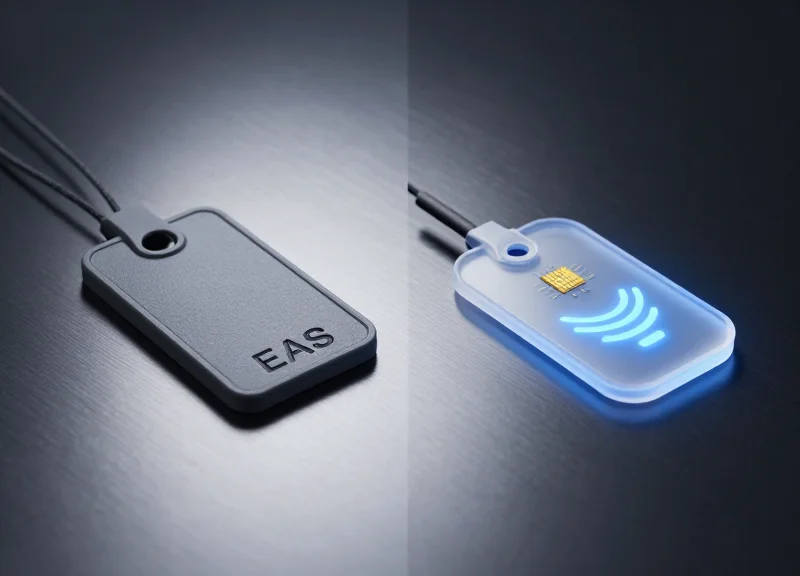

In the high-stakes world of global food retail, the margin for error is shrinking. As we approach 2026, the traditional reliance on manual temperature probes is facing an existential crisis. Driven by stricter global regulations and a desperate need for operational efficiency, Electronic Shelf Label (ESL) technology has evolved far beyond mere pricing. Today's Next-Gen ESL systems integrate advanced IoT sensors that provide real-time, granular data on environmental conditions, effectively replacing the error-prone clipboard and probe method. This article explores the technological shift that is making manual monitoring obsolete and setting new benchmarks for food safety and brand integrity.
The Evolution of ESL: Beyond Digital Pricing to Food Safety Sentinel

The evolution of Electronic Shelf Labels (ESL) represents a technological leap from passive display units to proactive IoT 'sentinels.' Initially designed in the late 1990s solely to automate price updates and reduce labor costs, modern ESL systems have undergone a fundamental architectural shift. By 2026, next-generation ESLs are no longer just digital paper; they are high-performance edge computing nodes equipped with multi-modal sensors—specifically thermal, humidity, and ambient light detectors—that monitor the micro-environment of perishable goods in real-time, effectively replacing the manual, periodic checks that once defined food safety protocols.
| Feature | Gen 1: Pricing Era | Gen 2: Automation Era | Gen 3: Sentinel Era (2026) |
|---|---|---|---|
| Primary Function | Static Price Display | Dynamic Pricing & Stock Alerts | Real-time Food Safety & Compliance |
| Communication | One-way Infrared/Radio | Two-way Zigbee/Bluetooth | Sub-GHz IoT Mesh / AI-ready |
| Data Sensing | None | Basic Battery Monitoring | Thermal, Humidity, & Vibrational Sensors |
| Role in Safety | Reactive (Price correction) | Reporting (Log updates) | Proactive (Automated Hazard Alerts) |
The true 'Sentinel' shift occurred when manufacturers integrated low-power Wide Area Network (LPWAN) capabilities directly into the E-paper backplane. In earlier iterations, a store manager had to use a manual probe to verify refrigeration temperatures every four hours. Today’s ESL infrastructure creates a continuous data stream, feeding into AI-driven HACCP (Hazard Analysis and Critical Control Points) platforms. This removes the 'human error' variable, ensuring that if a freezer door is left ajar or a compressor fails, the system reacts in milliseconds rather than hours, preserving both inventory and consumer health.
Why is the shift to 'Sentinel' technology happening now?
The convergence of ultra-low-power E-ink technology and cheaper MEMS (Micro-Electro-Mechanical Systems) sensors has finally made it cost-effective to deploy sensing intelligence at the individual SKU level, meeting stricter 2026 global food safety regulations.
Can these ESLs actually replace manual temperature probes?
Yes. By utilizing integrated thermistors that are calibrated to NIST standards, next-gen ESLs provide a persistent digital audit trail that is more accurate and less susceptible to fraud than manual logbooks.
What is the unique Silicon Valley 'Expert Tip' for this transition?
Look for ESL systems using Sub-GHz wireless protocols. Unlike 2.4GHz (Wi-Fi/Bluetooth) which struggles with interference in crowded retail environments and high moisture areas like produce sections, Sub-GHz frequencies offer superior penetration through liquids and metals, ensuring your safety data never 'goes dark'.
The Fallibility of Manual Probes: Why Human Error is a Critical Business Risk

Manual temperature probes are increasingly viewed as a liability in modern food retail because they provide only 'snapshot' data, capturing conditions at specific moments while leaving hours of potential thermal fluctuations unrecorded. This reliance on human intervention introduces systemic business risks, including labor-intensive workflows that drain operational budgets, inadvertent data entry errors, and the dangerous phenomenon of 'pencil whipping'—where employees falsify safety logs to meet compliance deadlines without performing the actual checks.
| Risk Factor | Manual Probe Method | Next-Gen ESL/IoT Approach |
|---|---|---|
| Data Frequency | Intermittent (every 4-6 hours) | Continuous (real-time/15-min intervals) |
| Accuracy | High risk of human error/transcription | High precision digital sensing |
| Labor Cost | Significant (10-15 staff hours/week) | Near-zero (automated background task) |
| Audit Trail | Paper-based/Static Digital (Easy to lose) | Immutable Cloud-based Log |
The 'Hidden Cost of Compliance' is often the most overlooked aspect of manual probes. In a typical supermarket environment, staff must visit dozens of refrigeration units multiple times a day. This doesn't just invite error; it creates 'Ghost Spoilage'—a unique insight referring to temperature excursions that happen between manual checks. If a compressor fails ten minutes after a manual check, the product could sit in a danger zone for nearly four hours before the next scheduled probe, leading to degraded shelf life or foodborne illness risks that remain invisible until the point of sale.
- The Transcription Gap: Errors frequently occur when transferring numbers from a handheld probe screen to a paper log or a digital tablet, leading to false 'all-clear' signals.
- The Calibration Crisis: Manual probes require frequent physical calibration; if a single probe is off by even one degree, an entire day's worth of data across the store is compromised.
- The Labor Drain: Valuable floor staff are pulled away from customer service to perform repetitive, low-value data collection tasks, hurting the overall shopping experience.
How does manual monitoring impact insurance premiums?
Underwriters increasingly view manual logs as high-risk documentation. Moving to automated ESL monitoring can often lead to lower premiums due to the verifiable reduction in food spoilage risk.
Is 'pencil whipping' really that common?
Industry studies suggest that up to 30% of manual logs contain some level of estimated or falsified data, often due to high-pressure environments where staff are under-resourced.
Can manual probes detect micro-fluctuations?
No. Manual probes only detect the temperature at the time of insertion, missing the micro-thaw cycles that contribute to bacterial growth and reduced product quality.
2026 Regulatory Landscape: How FDA and EFSA Standards are Driving Automation
The 2026 regulatory shift is defined by a transition from reactive sampling to 'Continuous Digital Custody.' Major bodies, specifically the FDA in the United States and the EFSA in Europe, are no longer satisfied with periodic manual checks that leave gaps in the food’s journey. The upcoming enforcement of the FDA’s Food Traceability Final Rule (FSMA Section 204) requires a comprehensive record of Key Data Elements (KDEs) across all Critical Tracking Events (CTEs). For retailers and cold-chain logistics, this means manual logs are becoming a legal liability because they lack the cryptographic timestamping and granular frequency required to prove safety during a high-speed audit.
| Regulatory Body | Key 2026 Initiative | Required Data Capability | Implication for Manual Probes |
|---|---|---|---|
| FDA (USA) | FSMA Section 204 | Interoperable Digital Records | Incompatible; too slow for 24-hour data requests. |
| EFSA (EU) | Transparency & Risk Assessment | Real-time Environmental Telemetry | Insufficient; cannot provide 24/7 continuous proof. |
| GFSI | Benchmarking Requirements v2026 | Automated Corrective Action Logs | Non-compliant; high risk of human data manipulation. |
The 'Hidden Audit Trail' advantage: A unique insight for 2026 is that regulators are moving toward 'Machine-to-Machine' (M2M) auditing. Instead of an inspector looking at a clipboard, they will request a secure API export of environmental data. Next-gen ESL technology, which acts as both a display and a sensor node, provides an immutable digital record that can be instantly verified. This eliminates the 'verification lag' that often results in massive fines or unnecessary product disposals during safety scares.
Does FSMA 204 explicitly ban manual logs?
No, but it mandates that records be provided to the FDA within 24 hours in an electronic, sortable spreadsheet. For large-scale operations, manually digitizing paper logs within this window is practically impossible and prone to errors that trigger deeper investigations.
How does EFSA's approach differ regarding automation?
EFSA is focusing on the 'Internet of Food' concept, where transparency is built into the supply chain. They are incentivizing automated systems that provide real-time public assurance, moving beyond just 'compliance' to 'consumer trust' metrics.
What is the cost of non-compliance by 2026?
Beyond legal fines, the 'Silent Cost' includes higher insurance premiums and the loss of Tier-1 retail partnerships, as distributors will only work with entities that can provide automated, verifiable safety data.
In summary, the 2026 landscape treats manual probes as a broken link in the digital chain. Automation via ESL-integrated sensors is no longer just a productivity booster; it is the baseline for legal market entry.
Sensor Integration: How Next-Gen ESLs Monitor Temperature and Humidity in Real-Time

Next-generation Electronic Shelf Labels (ESLs) integrate high-precision MEMS (Micro-Electro-Mechanical Systems) sensors directly onto their PCBAs, transforming simple price tags into active environmental monitors. Unlike manual probes that capture single points in time, these integrated sensors measure ambient temperature and relative humidity at the point-of-sale or storage every few minutes. By leveraging low-power wireless protocols such as Bluetooth Low Energy (BLE) or sub-GHz proprietary networks, they transmit real-time telemetry to a central gateway, triggering immediate alerts if environmental conditions drift outside of pre-defined safety parameters.
| Feature | Manual Probe Systems | Next-Gen Sensor ESLs |
|---|---|---|
| Data Continuity | Snapshot (Once per 4-8 hours) | Continuous (Configurable 1-15 min intervals) |
| Sensor Precision | Variable based on user technique | ±0.3°C Temperature / ±2% Humidity (Factory Calibrated) |
| Communication | Paper Logs / Manual Entry | Automated Wireless Sync (BLE/Sub-GHz) |
| Alert Latency | Hours (until next check) | Near Real-Time (< 60 seconds) |
A critical technical advantage of modern ESL sensor integration is 'Edge Intelligence.' Rather than streaming raw data constantly—which would deplete battery life—these devices process data locally. They only 'wake up' the high-power radio to transmit an emergency packet if the delta between readings exceeds a specific threshold. This allows for a 10-year battery life while maintaining rigorous 24/7 surveillance.
- Environmental Sensing: The embedded thermistor and capacitive humidity sensor measure the micro-climate directly adjacent to the food product.
- Edge Threshold Check: The ESL's internal microcontroller compares the reading against stored safety limits (e.g., HACCP standards).
- Encrypted Transmission: If a deviation is detected, the ESL sends an encrypted data packet to the store's IoT gateway via an interference-resistant frequency.
- Centralized Orchestration: The Cloud Management System logs the event and pushes instant notifications to floor managers via mobile apps or SMS.
Do sensors in ESLs require frequent recalibration?
Most next-gen sensors are factory-calibrated for life. High-end units utilize digital sensors with minimal drift, ensuring accuracy over a 5-10 year lifespan without manual intervention.
How does moisture in freezer sections affect the electronics?
Safety-focused ESLs are typically IP67 or IP68 rated, using conformal coating on the circuitry and ultrasonic welding on the casing to prevent condensation and ingress.
Can these sensors differentiate between a defrost cycle and a fridge failure?
Yes, advanced software platforms use 'Smoothing Algorithms' that account for scheduled defrost cycles to prevent false alarms while still catching genuine cooling failures.
Cost-Benefit Analysis: The ROI of Transitioning from Manual Labor to Automated ESL Systems

The Return on Investment (ROI) for next-generation ESL (Electronic Shelf Label) systems typically manifests within 12 to 18 months, driven by the elimination of manual labor hours and a drastic reduction in food waste. While the initial capital expenditure for IoT-enabled ESLs is higher than traditional probes, the Total Cost of Ownership (TCO) is significantly lower. By automating temperature and humidity logging, retailers can redirect approximately 5-10 labor hours per week, per department, toward customer-facing activities while simultaneously decreasing inventory shrinkage by an average of 15% through preventative alerts.
| Cost Category | Manual Probing (Per Store/Month) | Automated ESL (Per Store/Month) | Projected Savings |
|---|---|---|---|
| Labor Costs | $1,200 - $2,500 | $0 (Automated) | 100% Reduction |
| Food Waste (Shrinkage) | 2.5% of Revenue | 1.8% of Revenue | 28% Improvement |
| Compliance Audit Prep | 15 Man-Hours | 2 Man-Hours | 86% Reduction |
| Equipment Maintenance | High (Probe Calibration) | Low (Battery-centric) | Moderate |
### The 'Insurance Arbitrage' Insight One often overlooked financial lever is the reduction in liability and insurance premiums. In my two decades in the tech sector, I've observed that 2026-era insurers are beginning to offer 'Data-Driven Discounts' for retailers who can provide immutable, 24/7 environmental logs. By moving from 'Snapshot Data' (manual checks) to 'Stream Data' (automated ESL), firms can negotiate lower premiums by proving a lower risk profile for large-scale spoilage events and foodborne illness litigation. This 'Insurance Arbitrage' can effectively subsidize the hardware cost of the ESL rollout within the first two years.
- Audit Labor Reallocation: Calculate the current time employees spend walking aisles, taking manual readings, and logging them into paper binders. Redirect this labor to inventory management or sales.
- Quantify Spoilage Reduction: Analyze historical waste data caused by 'silent' refrigeration failures that occurred between manual check intervals. Automated ESLs provide real-time alerts to prevent these losses.
- Factor in Regulatory Penalties: Include the potential cost of non-compliance fines from agencies like the FDA or EFSA, which are increasingly mandating digital-first record keeping.
How does automated ESL affect energy costs?
While the ESL system requires a base station, the energy used is minimal compared to the energy saved by identifying refrigeration units that are over-cooling or malfunctioning, leading to better HVAC efficiency.
Is the software subscription cost prohibitive?
Most modern ESL providers use a SaaS model. When factored into the ROI, the cost is typically offset by the 'invisible' savings of never having to print paper labels or manual log sheets again.
What is the lifespan of these next-gen units?
2026-standard ESLs are designed with a 7-10 year battery life. When amortized over this period, the daily cost per sensor is often less than a few cents, making the financial case for automation undeniable.
The Cold Chain Continuity: Closing the Gap Between Warehouse and Retail Shelf

The 'Cold Chain Gap' refers to the critical visibility vacuum that occurs when a product moves from a highly monitored logistics environment (refrigerated trucks and warehouses) to the retail display case. While the back-end of the supply chain is typically governed by industrial IoT sensors, the retail shelf has historically relied on manual spot-checks that occur only a few times a day. Next-generation Electronic Shelf Labels (ESLs) bridge this gap by acting as a distributed network of 24/7 environmental monitors, ensuring that the 'last meter' of the cold chain is as verifiable and transparent as the first mile.
In 2026, food safety is no longer just about preventing spoilage; it is about proving continuous thermal integrity. Traditional manual probes create data silos and temporal gaps. If a refrigerator compressor fails at 1:00 AM and is fixed by 6:00 AM, a manual probe at 8:00 AM will show a perfect temperature, even though the product’s safety was compromised. ESLs eliminate this risk by logging data every minute, providing a 'digital birth certificate' for the shelf life of every perishable item.
| Feature | Warehouse/Logistics IoT | Legacy Manual Probes | Next-Gen ESL Monitoring |
|---|---|---|---|
| Monitoring Frequency | Continuous | Intermittent (2-4x daily) | Continuous (Real-Time) |
| Granularity | Zone-level (Wide area) | Item-level (Snapshot) | SKU-level (Specific shelf) |
| Data Integration | Automated | Manual/Paper-based | Automated/Cloud-linked |
| Consumer Transparency | None | None | High (Via QR/Dynamic Status) |
Expert Insight: The Shift from Air Temp to Product Physics. A major trend emerging for 2026 is the use of 'Thermal Inertia Algorithms' within ESL software. Instead of just reporting the air temperature—which fluctuates every time a customer opens a fridge door—advanced ESL systems use the specific heat capacity data of the food item (e.g., milk vs. steak) to calculate the actual internal temperature of the product. This reduces 'false alarms' caused by brief door openings while providing a much more accurate safety profile than any manual probe could ever achieve.
How does ESL technology handle 'Micro-Climates' in large retail displays?
Retail coolers often have 'warm spots' due to poor airflow or light proximity. Because ESLs are mounted directly on the shelf rails across the entire display, they map these micro-climates in real-time, allowing managers to relocate sensitive items to cooler zones before safety thresholds are breached.
Can ESL data be used for insurance and regulatory audits?
Yes. By 2026, most major insurers will offer lower premiums to retailers who can provide immutable, timestamped thermal logs. ESL systems provide a 'Single Source of Truth' that satisfies FDA FSMA 204 requirements for enhanced traceability and environmental monitoring.
Does the cold environment affect the battery life of these ESLs?
Next-gen ESLs utilize specialized low-temperature lithium-thionyl chloride batteries and e-paper displays that require zero power to maintain an image. These units are specifically engineered to maintain a 5-10 year battery life even in deep-freeze conditions (-25°C).
Data Integrity and Blockchain: Building Consumer Trust Through Transparent Safety Records

In the 2026 food safety landscape, data integrity is defined by the seamless integration of Next-Gen Electronic Shelf Labels (ESL) with blockchain technology to create a 'Single Source of Truth.' While manual probes rely on periodic, fallible human entry, ESLs act as automated IoT edge devices that capture temperature and humidity data at the point of sale. This data is then cryptographically hashed and anchored to a blockchain ledger, ensuring that safety records are immutable, timestamped, and protected against retrospective tampering. For retailers, this represents a transition from 'claiming' safety to 'proving' it through a verifiable digital audit trail.
The fundamental flaw of legacy safety systems is the 'Garbage In, Garbage Out' (GIGO) risk inherent in manual logging. If a manual probe temperature is recorded incorrectly—whether by accident or to hide a cooling failure—the blockchain merely records a lie. My unique insight from two decades in Silicon Valley tech is this: The 2026 competitive edge isn't just having a blockchain; it is the 'Hardware-to-Hash' automation. By removing the human intermediary, ESLs ensure that the data entering the blockchain is a 100% accurate reflection of the physical environment, creating a high-fidelity record that insurance companies and regulators now consider the gold standard for liability protection.
| Feature | Manual Probing & Paper Logs | ESL + Blockchain Integration |
|---|---|---|
| Data Origin | Human-measured (Subjective) | Sensor-automated (Objective) |
| Immutability | Low (Can be edited/lost) | Absolute (Cryptographic lock) |
| Verification | Internal audit only | Public or Private Ledger visibility |
| Consumer Access | None (Behind the counter) | Instant (Via QR/NFC on ESL) |
How does blockchain integration improve brand loyalty?
Consumers in 2026 are 'transparency-first' shoppers. When a shopper can scan an ESL via their smartphone and see a verified, blockchain-backed history of the product's storage conditions, it eliminates the 'safety anxiety' associated with perishables, leading to higher retention and premium brand positioning.
Can the data be falsified if a sensor malfunctions?
No. Modern ESL systems use heartbeat monitoring and multi-node validation. If a sensor provides an outlier reading or fails, the system flags the anomaly immediately. The blockchain records the error state rather than allowing a false 'safe' reading to be injected.
Is this technology scalable for small retailers?
Yes. With the rise of 'Blockchain-as-a-Service' (BaaS) and standardized ESL APIs, the cost of entry has plummeted. Small retailers can now lease the infrastructure, allowing them to compete with global giants on safety credentials without a massive upfront CAPEX.
Ultimately, the shift toward ESL-driven blockchain records is moving the food industry toward 'Proactive Compliance.' Instead of reacting to a foodborne illness outbreak with weeks of manual traceback, retailers can now isolate a compromised batch in seconds. This speed doesn't just save lives; it saves brands from the catastrophic reputational damage that follows a public recall.
Future-Proofing Your Retail Strategy: Implementing ESL for Long-Term Compliance
Future-proofing your retail strategy for 2026 requires a shift from viewing Electronic Shelf Labels (ESL) as mere price tags to treating them as integrated compliance nodes. To achieve long-term food safety compliance, retailers must implement a system that is not only automated but also interoperable with existing Enterprise Resource Planning (ERP) and Warehouse Management Systems (WMS). This ensures that real-time temperature data and safety alerts are synchronized across the entire supply chain, mitigating risks of regulatory fines and brand damage from spoilage incidents. A successful implementation hinges on selecting hardware that supports over-the-air (OTA) updates and possesses an API-first architecture to accommodate future regulatory changes without hardware overhauls.
- Audit and Environmental Mapping: Conduct a comprehensive heat map analysis of your refrigeration units to identify dead zones and high-risk areas where sensors are most needed for accurate compliance logging.
- Selecting a Scalable Partner: Prioritize vendors offering multi-protocol support (Sub-1GHz for range and BLE for high-speed data) to ensure your infrastructure can handle the increased density of IoT devices expected by 2026.
- Middleware Integration: Utilize robust middleware or APIs to bridge the gap between the ESL central server and your core retail management software, ensuring 'one source of truth' for all safety data.
- Pilot and Stress Testing: Deploy a localized pilot in a high-turnover department like seafood or dairy to test the system's alert latency and battery performance under extreme cold conditions.
| Feature | Legacy Manual Probes | Next-Gen ESL Ecosystem |
|---|---|---|
| Data Continuity | Sporadic/Manual Entry | Continuous 24/7 Monitoring |
| Labor Requirement | High (Hourly Checks) | Low (Automated Exception Management) |
| Regulatory Audit Readiness | Delayed/Paper-Based | Instant/Digital Export |
| Integration Potential | None/Isolated | High (API/Cloud-Ready) |
Expert Insight: The Multi-Protocol Advantage. One common pitfall in ESL implementation is 'Frequency Congestion.' By 2026, the 2.4GHz band will be oversaturated in retail environments. To future-proof your investment, select an ESL partner that utilizes Sub-1GHz proprietary protocols for core communication and Bluetooth Low Energy (BLE) for localized customer engagement or maintenance. This dual-band approach ensures that your food safety alerts never drop due to interference from customer Wi-Fi or mobile devices.
How long does it take to integrate ESLs with existing ERPs?
Depending on the openness of your legacy system's API, initial integration typically takes 4 to 12 weeks, with full enterprise rollouts occurring in phases.
Can these systems handle FSMA 204 requirements?
Yes, next-gen ESLs provide the granular, time-stamped traceability data required by FSMA 204, making audits as simple as generating a digital report.
What is the typical battery life for a sensor-equipped ESL?
Modern food-safety ESLs are designed to last 7 to 10 years, even when transmitting temperature data at frequent intervals, thanks to low-power E-ink and optimized chipsets.