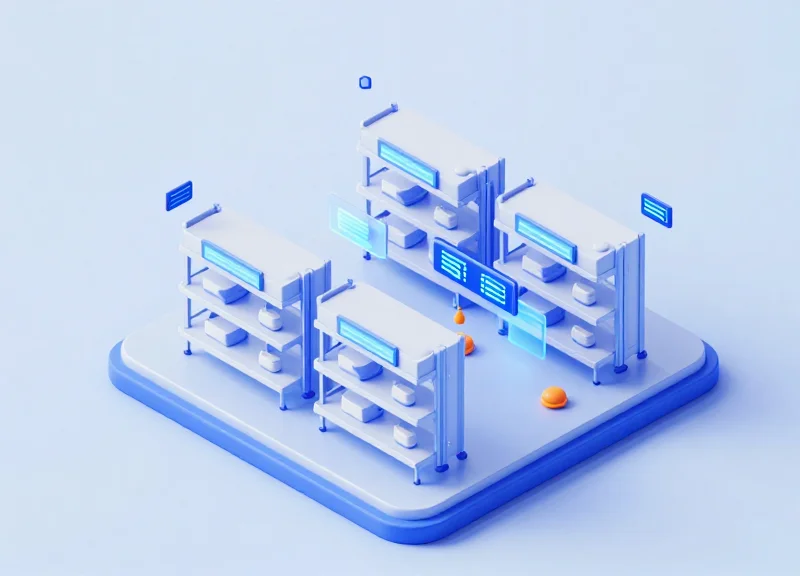
As we approach 2026, the traditional paper-based Kanban system is rapidly becoming a relic of a slower industrial era. In today's high-velocity manufacturing and logistics environments, the margin for error is razor-thin, and the demand for real-time data is absolute. Moving beyond paper isn't just a digital upgrade; it is a strategic necessity for Lean operations. This guide explores the two pillars of modern material handling: Electronic Shelf Labels (ESL) and Pick-to-Light (PTL) systems. By understanding the technological shifts and integration requirements of the next few years, decision-makers can transform their shop floor from a static environment into a dynamic, data-driven ecosystem.
The Death of Paper Kanban: Why 2026 is the Turning Point

By 2026, the traditional paper Kanban card—once the gold standard of Lean manufacturing—will transition from a functional tool to a structural liability. The turning point is driven by the collapse of the 'latency buffer.' In modern high-mix, low-volume (HMLV) environments, the 4-to-8-hour delay inherent in manual card circulation creates a 'data blind spot' that modern ERP and MES systems can no longer tolerate. As supply chains demand real-time responsiveness, the physical limitations of paper (loss, damage, and manual entry) represent a critical failure point in the digital thread.
| Metric | Paper Kanban (Manual) | Digital ESL / Pick-to-Light |
|---|---|---|
| Data Latency | 4 - 12 Hours (Physical movement) | Real-time (< 2 Seconds) |
| Error Rate | 3-5% (Lost/misplaced cards) | < 0.01% (Sensor-validated) |
| Labor Overhead | High (Manual sorting/scanning) | Near Zero (Automated updates) |
| Agility | Static (Batch printing needed) | Dynamic (Remote SKU changes) |
Why is the labor shortage killing paper systems?
As skilled labor becomes scarcer and more expensive, using human capital to physically move paper cards or perform 'milk runs' just to update inventory status is no longer economically viable. Digital systems automate the 'data run' while workers focus on production.
Does paper Kanban support High-Mix Low-Volume (HMLV)?
Hardly. In HMLV, the number of Kanban loops increases exponentially. Managing 5,000+ unique paper cards leads to 'Kanban Drift,' where the physical cards no longer represent the actual production requirements, causing massive overstock or critical shortages.
What is the 'Shadow Inventory' trap?
This is a unique insight for 2026: Because paper systems lack real-time signals, plant managers often maintain a 15% 'buffer' of extra inventory just to compensate for the lack of visibility. Digital systems eliminate this 'Shadow Inventory' by providing a single source of truth.
The transition in 2026 isn't just about 'going green' or removing paper; it's about the democratization of Electronic Shelf Label (ESL) and Pick-to-Light technology. In previous years, the ROI was difficult to prove for smaller facilities. However, with the arrival of ultra-low-power sub-GHz wireless protocols and longer battery lives (up to 10 years), the total cost of ownership (TCO) for digital systems has finally dipped below the operational cost of managing a complex paper-based loop. We are moving from 'lean as a philosophy' to 'lean as a real-time data stream.'
- Identify the 'Friction Points': Audit your current floor to see where workers are stopping production to search for cards or update clipboards.
- Calculate the 'Lost Card' Tax: Quantify how many production stoppages in the last year were caused by a misplaced or unreadable paper Kanban card.
- Analyze SKU Proliferation: If your SKU count has grown by more than 20% in two years, your manual system is likely already at its breaking point.
Electronic Shelf Labels (ESL): More Than Just Price Tags
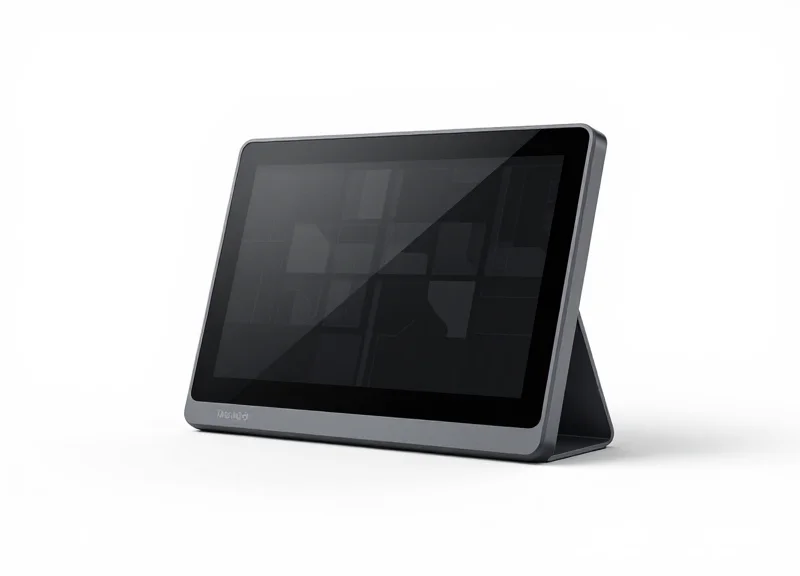
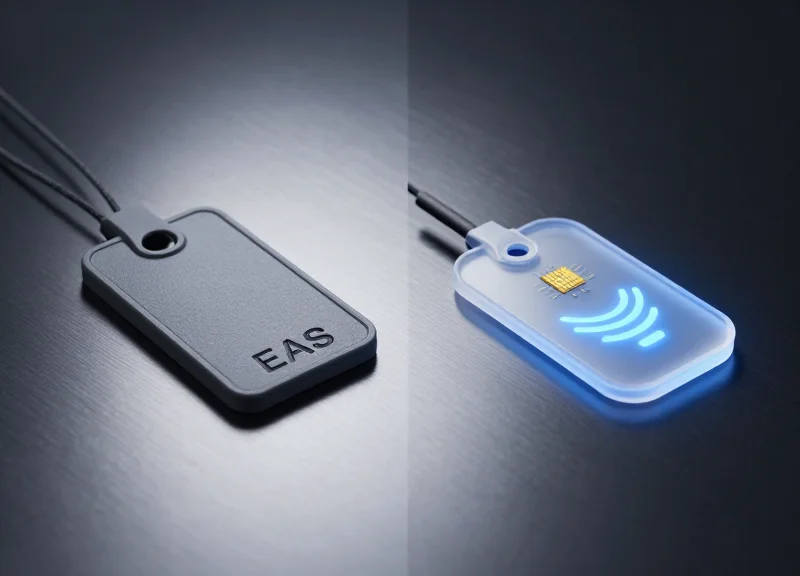
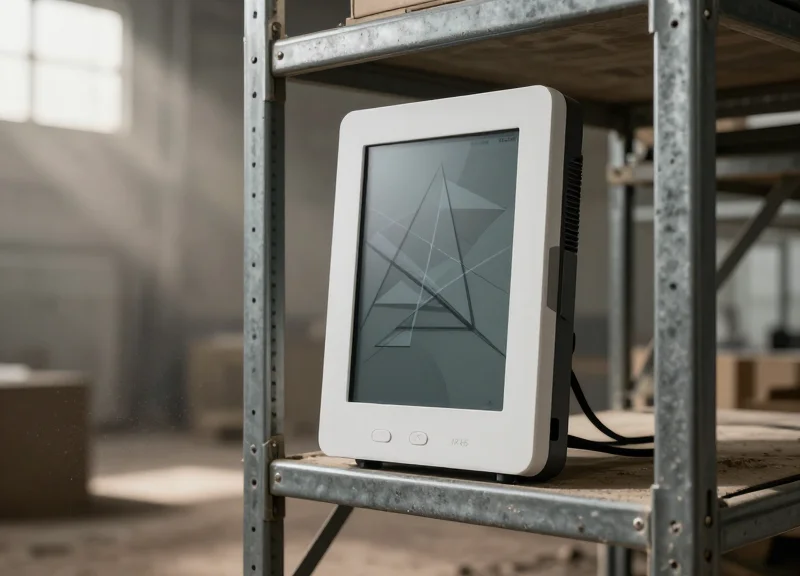
In the 2026 industrial landscape, an Electronic Shelf Label (ESL) is no longer a passive digital price tag borrowed from retail; it is a ruggedized, bi-directional IoT node. By utilizing high-contrast E-paper displays and ultra-low-power wireless protocols like BLE (Bluetooth Low Energy) or Sub-GHz radio, ESLs serve as the physical interface of your digital twin. They provide a real-time window into your Warehouse Management System (WMS), displaying not just part numbers, but dynamic replenishment triggers, batch IDs, and even QR codes for instant digital documentation access.
| Feature | Legacy Paper Kanban | Industrial ESL (2026 Gen) |
|---|---|---|
| Update Speed | Hours/Days (Manual Print) | Seconds (Sub-GHz/BLE Broadcast) |
| Data Direction | One-way (Static) | Two-way (Interactive Button/NFC) |
| Visibility | Ambient light dependent | High-contrast E-ink + Multi-color LED |
| Error Rate | High (Lost/Misplaced cards) | Near Zero (System-synced) |
- Multi-Color LED Signaling: Modern units feature programmable RGB LEDs that flash to guide pickers to the correct bin or signal a 'Stock-Out' condition visible from 50 feet away.
- NFC Read/Write Capabilities: Operators can tap a smartphone or handheld scanner against the tag to instantly update inventory counts or reassign a bin to a new SKU without touching a PC.
- Context-Aware Sensors: Premium 2026 models include integrated temperature and humidity sensors, crucial for sensitive electronics or aerospace composites storage.
Expert Insight: The 'Active Acknowledgment' Loop. A common pitfall in digital transitions is the 'blind update,' where a system assumes a part was picked because a sensor triggered. The most successful 2026 deployments utilize ESLs with integrated physical buttons. This creates a 'Human-in-the-Loop' validation: the worker must physically press the 'Confirm' button on the label to close the transaction. This small physical act reduces picking errors by 35% compared to hands-free voice picking alone, as it forces tactile engagement with the specific storage location.
How long do the batteries actually last in a high-activity warehouse?
With modern E-ink technology and specialized industrial sleep modes, a standard 2.4-inch ESL typically lasts 5 to 10 years, even with 3-5 daily image updates and periodic LED flashing.
Can ESLs survive a typical manufacturing environment?
Industrial-grade ESLs are rated IP67 or higher, meaning they are dust-tight and can withstand water spray or accidental immersion, along with high-vibration resistance for assembly line mounting.
Is the latency too high for fast-moving environments?
No. Using proprietary high-speed protocols, modern gateways can update over 5,000 tags per hour, ensuring the bin display changes almost as fast as your ERP processes the transaction.
Pick-to-Light Systems: Driving Speed and Accuracy
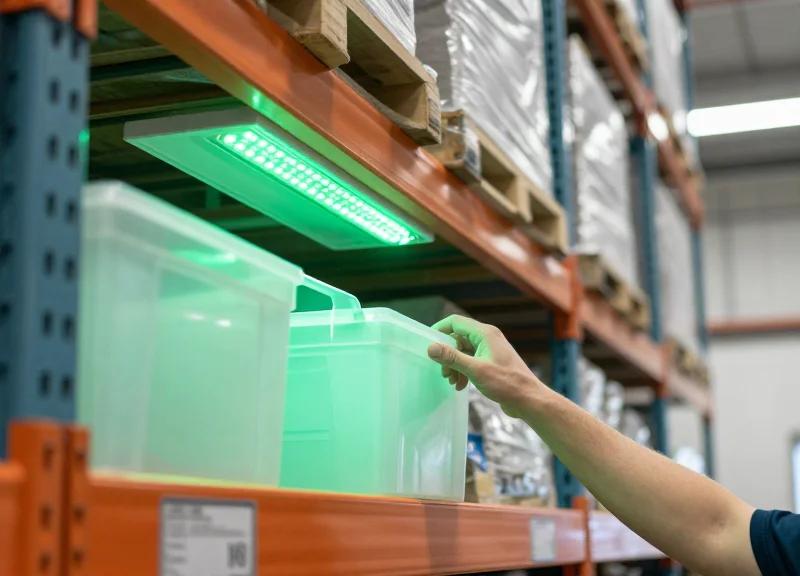
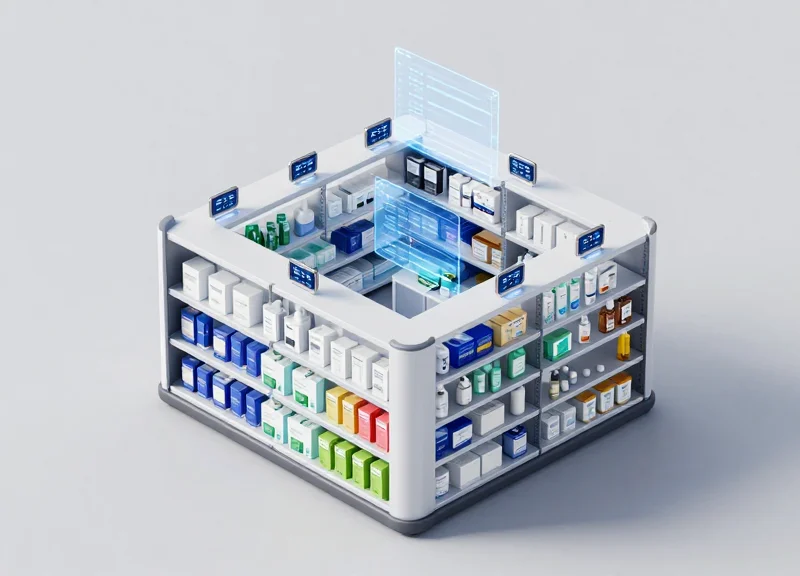
Pick-to-Light (PTL) is an advanced fulfillment technology that uses light-emitting modules mounted on shelving, racks, or workstations to guide operators to the exact location of a specific item. By replacing traditional paper pick lists with instantaneous visual cues, PTL systems allow workers to identify the correct bin and quantity required at a glance. In high-velocity fulfillment centers, this technology serves as the backbone of 'zone picking' strategies, enabling a hands-free environment that maximizes throughput while maintaining an accuracy rate often exceeding 99.7%.
The psychological impact of PTL is often overlooked but remains its greatest asset. In Silicon Valley's most efficient logistics hubs, we refer to this as reducing 'Cognitive Load.' When a worker doesn't have to scan a page for a part number or search through rows of identical bins, they enter a 'flow state' where muscle memory takes over. This shift from analytical processing (reading and verifying) to pre-attentive processing (reacting to a flash of color) is what allows a new hire to reach peak productivity in hours rather than weeks.
| Metric | Paper-Based Kanban | Pick-to-Light (PTL) |
|---|---|---|
| Average Picking Speed | 60 - 80 lines per hour | 250 - 450 lines per hour |
| Error Rate | 1% - 3% (Standard) | < 0.1% (Near-Zero) |
| Training Time | 2 - 5 Days | 15 - 30 Minutes |
| Search Time | High (Scanning Labels) | Zero (Guided by Light) |
- Order Activation: The operator scans a barcode on a tote or order container, which triggers the WMS (Warehouse Management System) to identify the required items in that specific zone.
- Visual Guidance: LED modules at the pick locations illuminate instantly. Modern 2026 systems often use multi-color 'RGB' signals to allow multiple pickers to work the same aisle simultaneously without confusion.
- Confirmation: Once the item is picked, the operator presses a confirmation button on the module or triggers a light-curtain sensor, instantly updating inventory levels in the cloud.
How does PTL handle 'High-Mix' environments?
PTL excels in high-mix scenarios by using alphanumeric displays on the light module to specify varying quantities, ensuring that even complex orders are fulfilled without manual cross-referencing.
Can PTL work alongside ESL?
Absolutely. Hybrid systems use ESL for detailed part data and PTL for rapid pick guidance, creating a comprehensive digital ecosystem that covers both information depth and execution speed.
What is the 'Light-Speed' ROI?
Most facilities see a return on investment within 6 to 12 months, driven primarily by the drastic reduction in mis-picks and the ability to scale labor during peak seasons without long training cycles.
Expert Insight: The 2026 Variable Spectrum Advantage. Leading-edge PTL systems are no longer just 'on or off.' We are now seeing the implementation of 'Spectrum Density' lighting. By varying the intensity or pulse pattern of the light, systems can now signal 'low stock' warnings to supervisors or 'priority pick' status to workers without interrupting the primary workflow. This secondary layer of communication allows for proactive replenishment before a bin ever goes empty, solving the 'last-mile' inventory gap that plagues traditional warehouses.
The Comparison: ESL vs. Pick-to-Light for Your Facility
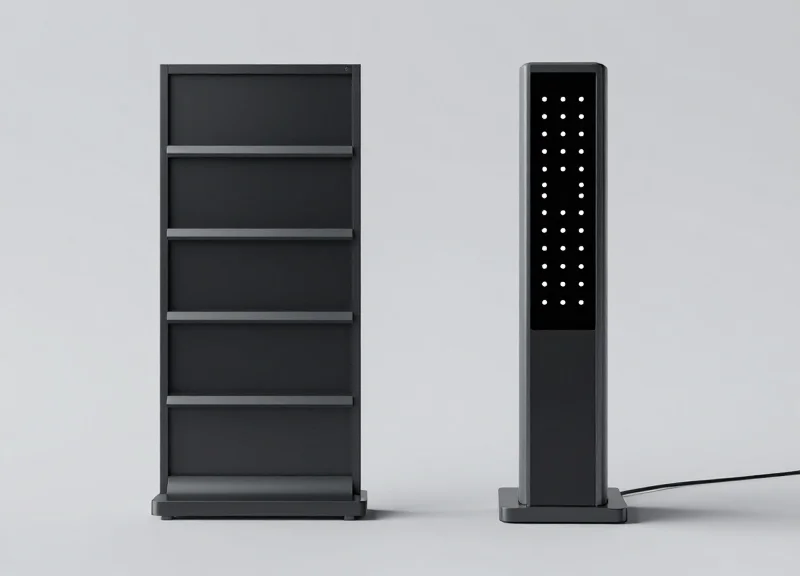
The fundamental difference between Electronic Shelf Labels (ESL) and Pick-to-Light (PTL) systems lies in their primary objective: ESL is designed for information density and layout flexibility, while PTL is optimized for raw execution speed and error reduction. In a 2026 facility environment, choosing between them is no longer about which technology is 'better,' but rather which workflow—replenishment-heavy or picking-intensive—dominates your operational floor. ESLs act as dynamic digital twins of your inventory on the shelf, whereas PTL serves as a high-visibility conductor for the human worker.
| Feature | Electronic Shelf Labels (ESL) | Pick-to-Light (PTL) |
|---|---|---|
| Primary Goal | Information & Inventory Accuracy | Picking Speed & Throughput |
| Installation | Wireless/Easy (Battery Powered) | Wired/Complex (Bus-based) |
| Data Density | High (e-Ink screens, QR codes) | Low (Numeric displays, LEDs) |
| Flexibility | High (Clip-on, move anywhere) | Low (Fixed to racking/track) |
| Response Time | 1-3 Seconds (Asynchronous) | Sub-millisecond (Real-time) |
Expert Insight: In the 2026 landscape, we are seeing the rise of the 'API-First Hybrid' model. Instead of choosing one over the other, leading Silicon Valley logistics hubs are deploying ESLs for 'Slow-Moving' and 'Medium-Moving' parts due to low infrastructure costs, while reserving PTL for the 'Golden Zone'—those high-velocity SKUs where a 1-second delay in light-up time translates to thousands of dollars in annual lost productivity. The key is ensuring both systems talk to the same WMS/ERP via a unified middleware.
- Choose ESL If:: Your facility manages a high-mix of SKUs (thousands of parts) that change locations frequently, or if you need to display complex data like assembly instructions, supplier origins, or real-time stock levels directly at the bin.
- Choose Pick-to-Light If:: Your primary KPI is 'Picks Per Hour' (PPH) in a high-volume fulfillment center. PTL is superior when workers need to be guided by bright, instantaneous visual cues that require zero cognitive load to interpret.
Can I use ESL for picking?
Yes, modern ESLs include multi-color LEDs for picking. However, they are slightly slower than PTL and battery life will decrease significantly with high-frequency flashing.
Is PTL more expensive than ESL?
Generally, yes. PTL requires physical wiring and controllers for every shelf, leading to higher upfront capital expenditure and installation labor compared to wireless ESL.
Which system is more durable in industrial environments?
Both have ruggedized versions, but PTL is often perceived as more durable because it is hard-wired. However, 2026-gen ESLs feature IP67 ratings and reinforced screens that withstand heavy industrial use.
The 2026 Tech Stack: Connectivity and IoT Protocols
In 2026, the tech stack for Digital ESL and Pick-to-Light systems has evolved from simple wireless links to robust, multi-layered communication architectures. The primary challenge in a modern warehouse isn't just distance, but 'spectral density'—the sheer number of devices competing for airwaves. A resilient 2026 tech stack prioritizes Sub-1GHz for penetration through metal racking, Bluetooth Low Energy (BLE) for localized mobile interaction, and Wi-Fi 6/7 for high-capacity data backhaul, ensuring that Kanban signals never drop even in high-interference 'noise' zones.
| Protocol | Typical Range | Interference Resistance | Best Use Case (2026) |
|---|---|---|---|
| Sub-1GHz (Proprietary/LoRa) | 300m - 1km+ | Highest (Ultra-low frequency) | Large-scale ESL deployments & metal-dense racking. |
| BLE 5.4 / Mesh | 10m - 50m | Moderate (Frequency hopping) | Pick-to-Light clusters & worker-to-tag mobile updates. |
| Wi-Fi 6 (802.11ax) | 30m - 100m | High (OFDMA tech) | Centralized gateway backhaul & high-speed data sync. |
Expert Insight: The 2.4GHz Saturation Paradox. By 2026, the 2.4GHz band is often so saturated with legacy Wi-Fi and Bluetooth that it acts as a 'digital fog' in the warehouse. My recommendation for enterprise-grade stability is to adopt a Dual-Band Control Plane. Use Sub-1GHz (868/915 MHz) for the critical 'heartbeat' and replenishment signals which must penetrate through steel shelves, and reserve BLE for 'Burst-Data'—such as firmware updates or temporary NFC-like pairing with handhelds. This prevents a localized Wi-Fi surge from crashing your entire material flow.
Does Wi-Fi 6 eliminate the need for Sub-1GHz?
No. While Wi-Fi 6 handles congestion better than older versions, its 5GHz/6GHz signals struggle to penetrate dense metal storage. Sub-1GHz remains the gold standard for reliable ESL updates in heavy industrial environments.
How does BLE Mesh improve Pick-to-Light reliability?
BLE Mesh allows tags to pass information to one another. If one gateway is blocked by a forklift or pallet, the signal 'hops' through adjacent tags to reach its destination, creating a self-healing network.
What is the security standard for these protocols in 2026?
Modern systems utilize AES-128 or 256 encryption at the hardware level. With the rise of 'Industry 4.0' threats, look for systems that offer 'Zero-Touch Provisioning' to ensure devices are encrypted before they even join the network.
Selecting the right protocol isn't just about speed; it's about the 'Total Cost of Connectivity.' A system that relies solely on Wi-Fi may require 3x more access points and higher battery consumption compared to a specialized Sub-1GHz ESL setup. When evaluating vendors, demand a spectral analysis of your facility to identify existing dead zones before committing to a protocol stack.
Integration Roadmap: ERP, WMS, and the Digital Twin
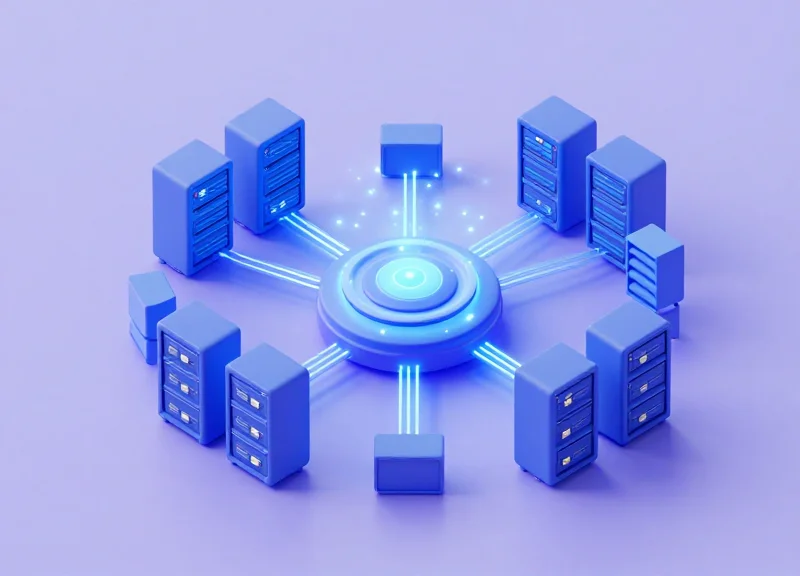
In 2026, the value of a Digital ESL or Pick-to-Light system is no longer found in the hardware alone, but in its ability to act as a physical API for your warehouse. Integration is the process of creating a bidirectional data flow where a button press on a shelf (the physical event) triggers an immediate stock decrement in your Warehouse Management System (WMS) and updates the financial inventory valuation in your Enterprise Resource Planning (ERP) suite. Without this 'seamless loop,' you are simply replacing paper clutter with expensive electronic noise.
| System Layer | Primary Function | Kanban Data Interaction |
|---|---|---|
| ERP (e.g., SAP S/4HANA) | Financial & Master Data | Triggers procurement orders when total facility stock hits reorder points. |
| WMS (e.g., Manhattan, Oracle) | Execution & Movement | Assigns picking tasks and updates bin-level quantity in real-time. |
| Digital Twin | Simulation & Visibility | Visualizes bottlenecks and simulates 'what-if' scenarios for rack layouts. |
- Phase 1: API Mapping and Payload Definition: Identify the RESTful or GraphQL endpoints of your WMS. Define what data the ESL/PTL hub sends (e.g., StationID, Timestamp, ActionCode) and what it needs to receive (e.g., SKU Name, Quantity to Pick, Priority Color).
- Phase 2: Middleware & Edge Logic Setup: Deploy an IoT gateway or middleware layer that handles 'signal de-bouncing'—ensuring that a double-click by an operator doesn't result in two separate inventory deductions.
- Phase 3: Digital Twin Synchronization: Map the physical MAC addresses of your ESL/PTL devices to a 3D coordinate system. This creates a functional Digital Twin where managers can see a 'heat map' of picking activity without entering the floor.
- Phase 4: UAT and Latency Stress Testing: Test the system under peak load. In a 2026 environment, 'Shelf-to-Database' latency must remain under 200ms to maintain operator rhythm and data integrity.
Expert Insight: Shift from 'Batch Processing' to 'Event-Driven Architecture.' Traditional ERPs often sync data every 15-30 minutes. For modern Pick-to-Light systems, this is too slow. Demand a 'Webhook' approach where the ESL system pushes data to the WMS the millisecond an action occurs. This prevents 'ghost inventory' where the system thinks an item is available when it has already been picked but not yet reported.
Can we integrate with legacy ERPs that lack modern APIs?
Yes, but it requires a 'Buffer Database.' The hardware talks to a modern SQL or NoSQL database, and an RPA (Robotic Process Automation) tool or custom script bridges the data to the legacy system via flat-file transfers or terminal emulation.
What role does the Digital Twin play in maintenance?
The Digital Twin monitors the 'health' of the integration. It can alert you if a specific ESL tag has stopped communicating or if its battery is low, allowing for predictive maintenance before a Kanban station goes offline.
Do I need a separate server for the PTL system?
Ideally, use an Edge Gateway. This allows the lights and labels to function locally even if the main corporate WAN goes down, syncing the cached data to the ERP once the connection is restored.
Evaluating ROI: Beyond Labor Savings
Calculating the Return on Investment (ROI) for Electronic Shelf Labels (ESL) and Pick-to-Light (PTL) systems requires moving beyond simple labor-hour reductions to evaluate 'Total Operational Value.' In high-velocity environments, the primary financial drivers are now the compression of safety stock levels, the elimination of premium freight costs caused by stockouts, and the monetization of reclaimed square footage. By transitioning to a digital framework, facilities often see a 15-20% reduction in working capital requirements within the first 12 months due to increased inventory velocity.
| ROI Metric | Paper Kanban Impact | Digital ESL/PTL Impact | Financial Significance |
|---|---|---|---|
| Inventory Accuracy | 92-95% (Cycle count dependent) | 99.8% (Real-time updates) | Reduces emergency re-orders and lost sales. |
| Safety Stock Buffer | High (to cover data latency) | Lean (data-driven precision) | Frees up millions in trapped working capital. |
| Floor Space Utilization | Fixed by physical card racks | Dynamic/Condensed binning | Delays capital expenditure for facility expansion. |
| Management Overhead | Heavy manual auditing | Exception-based management | Shifts high-cost talent to value-add tasks. |
Expert Insight: The Safety Stock Compression. Most CFOs overlook the 'Data Latency Tax' of paper systems. When a paper card is lost or a bin is emptied without a scan, the replenishment cycle breaks, forcing managers to carry 10-15% more safety stock than necessary. Digital systems eliminate this lag, allowing you to run 'closer to the bone' without increasing risk. In 2026, the ability to shrink your inventory footprint by just 10% often pays for the entire hardware rollout in less than 14 months.
- Quantify Stockout Opportunity Costs: Analyze the past 24 months of production line stoppages or missed shipments caused by inventory inaccuracies. Assign a per-minute or per-order cost to these events.
- Measure Square Footage Productivity: Calculate the revenue generated per square foot of warehouse space. Digital systems allow for high-density slotting that can increase storage capacity by 20-30%.
- Assess Training & Tribal Knowledge: Measure the time it takes for a new hire to reach 100% picking accuracy. PTL systems typically reduce this 'onboarding to proficiency' time from weeks to hours.
What is the average payback period for a digital Kanban system?
While it varies by facility size, most mid-to-large operations achieve a full break-even point within 14 to 22 months when accounting for both direct labor and indirect inventory savings.
Does the ROI include software maintenance and battery life?
Yes. Modern 2026-grade ESLs feature 10-year battery lives and cloud-native management, making the ongoing OpEx significantly lower than the manual labor required to manage paper-based replenishment.
Can digital systems reduce insurance premiums?
In some sectors, improved inventory accuracy and reduced forklift traffic (facilitated by optimized picking paths) lead to fewer workplace accidents and lower insurance risk profiles.
Future-Proofing Your Investment: Durability and Battery Life
In 2026, future-proofing a digital Kanban or pick-to-light system requires hardware that survives the 'Industrial Trifecta': dust, moisture, and impact. While consumer-grade electronics fail within months on a factory floor, true industrial-grade Digital ESLs must provide a minimum 10-year battery life cycle at two refreshes per day and an Ingress Protection (IP) rating of at least IP65 to ensure that the initial capital expenditure (CAPEX) is not eroded by constant maintenance and replacement costs.
| Environment Type | Recommended IP Rating | Hardware Feature Required |
|---|---|---|
| Clean Warehouse | IP54 | Dust protection and standard drop resistance |
| High-Moisture / Washdown | IP67 | Fully sealed casing and waterproof gaskets |
| Cold Storage / Freezer | IP65+ (Low Temp) | Specialized Li-thionyl chloride (Li-SOCl2) batteries |
| Heavy Manufacturing | IP68 / IK08 | High impact resistance and chemical-proof lenses |
The move toward 10-year battery cycles is driven by a shift from power-hungry Wi-Fi to ultra-low-power Sub-1GHz and BLE 5.4 protocols. However, the 'Unique Insight' for 2026 buyers is the concept of 'Refresh-Rate Budgeting.' Most manufacturers quote battery life based on a static state. In a dynamic Kanban environment, you must calculate the 'Ghost Refresh Tax'—the power consumed by the label checking for updates even when the display doesn't change. Opt for systems that utilize passive wake-up radio (WUR) technology, which allows the tag to stay in a deep-sleep state until the gateway explicitly pings it, extending life by up to 30% compared to standard polling methods.
Does an IP67 rating mean the device is indestructible?
No. IP67 protects against dust and temporary immersion in water, but it does not account for kinetic impact. For environments with heavy machinery or forklift traffic, you should also look for an IK rating (such as IK08) which measures resistance to mechanical impacts.
How does extreme cold affect the 10-year battery claim?
Standard CR2450 coin cells lose capacity rapidly below 0°C. If your facility includes cold storage, you must specify 'Extended Temp' batteries and E-ink displays formulated to refresh in sub-zero conditions without 'ghosting' or permanent crystal damage.
Can batteries be replaced, or is the unit disposable?
Most 2026 industrial models are moving toward replaceable battery packs to maximize the lifecycle of the E-ink screen itself, which can last 15+ years. Ensure your selection allows for tool-less or rapid-tool battery swaps to minimize labor costs during the 10-year refresh cycle.
The Role of AI and Analytics in Digital Kanban

In 2026, the integration of Artificial Intelligence (AI) and advanced analytics into digital Kanban systems shifts the focus from "what happened" to "what will happen." By processing high-velocity data from Electronic Shelf Labels (ESL) and Pick-to-Light (PTL) sensors, these systems use Machine Learning (ML) algorithms to autonomously adjust reorder points, predict throughput bottlenecks, and optimize material flow before human operators even detect a slowdown. This evolution turns the humble bin signal into a sophisticated node in a self-healing supply chain.
| Feature | Reactive Digital Kanban (Legacy) | AI-Driven Kanban (2026 Standard) |
|---|---|---|
| Replenishment | Fixed threshold triggers | Dynamic, demand-forecasted triggers |
| Bottleneck Detection | Reported after delay occurs | Predicted 2-4 hours in advance |
| Labor Allocation | Static station assignments | Real-time redirection based on PTL flow |
| Inventory Levels | Safety stock based on history | Minimalist 'Just-in-Time' via ML modeling |
One of the most significant breakthroughs for 2026 is 'Synthetic Lead Time' modeling. Unlike traditional systems that rely on historical averages, AI-enabled Digital Kanban looks at external variables—such as regional logistics delays, power grid fluctuations, or even ambient warehouse temperature affecting chemical material shelf-life—to adjust the replenishment cycle in real-time. This prevents the 'bullwhip effect' that often plagues paper-based or early-stage digital systems.
- Predictive Heat Mapping: Uses PTL sensor data to visualize 'hot zones' where pickers are congregating, allowing AI to suggest layout changes to reduce congestion.
- Anomaly Detection: Identifies irregular picking patterns that may indicate a mislabeled batch or a malfunctioning ESL unit, triggering an automatic audit.
- Autonomous Reorder Points (ARP): The system monitors consumption velocity and automatically tightens or loosens inventory buffers without manual ERP overrides.
Expert Insight: The Digital Twin of the Bin. We are seeing a move toward 'Atomic Simulation,' where the AI maintains a digital twin of every single bin on the floor. By running thousands of 'what-if' scenarios per second, the system can tell you with 98% accuracy if a specific line will run out of a component by the next shift transition, allowing for pre-emptive labor scheduling that was previously impossible.
Does AI require a massive data science team?
No. 2026 systems are 'Edge-Native,' meaning the ML models are pre-trained and embedded in the Kanban software. Users interact with natural language dashboards rather than complex code.
How does AI handle 'Black Swan' events?
The analytics engine detects deviations from the norm instantly and switches to 'Resilience Mode,' prioritizing critical SKU replenishment over standard optimization routines.