In the hyper-competitive world of high-end retail, managing high-value consumables is a high-stakes balancing act. Traditional inventory methods often lead to overstocking, shrinkage, or missed sales opportunities, all of which erode profitability. This article explores how modern Electronic Shelf Label (ESL) technology is evolving beyond simple price tags into a powerful inventory tracking tool. By automating stock monitoring and integrating real-time data, retailers are seeing a dramatic 22% boost in net margins. Discover how DragonGuard is leading this transformation through precision tracking and operational efficiency.
The Profitability Crisis in High-End Consumables

The profitability crisis in high-end consumables is defined by the systemic failure of traditional inventory management to protect the thin margins of high-value, fast-moving goods. Unlike bulk commodities, high-end consumables—ranging from premium skincare and luxury electronics to specialized medical reagents—suffer disproportionately from 'margin bleed' caused by human error, expiration mismanagement, and phantom inventory. When a single SKU represents hundreds or thousands of dollars in capital, even a 2% discrepancy in inventory accuracy can lead to a double-digit collapse in net profitability, as manual auditing simply cannot provide the granular, real-time data required to optimize these high-stakes assets.
In my twenty years across the Valley, I have observed that the most dangerous cost isn't just physical shrinkage; it is the 'Shadow Cost of Buffer Stock.' Most organizations, distrusting their manual counts, over-index on safety stock by 15-20%. This effectively locks up millions in working capital that could otherwise be deployed into R&D or market expansion. This lack of data integrity creates a feedback loop of inefficiency where staff spend 30% of their shift 'double-checking' shelves instead of selling.
| Metric | Manual Inventory System | Automated ESL Tracking |
|---|---|---|
| Data Accuracy | 85% - 92% (Average) | 99.9% (Real-time) |
| Audit Frequency | Monthly/Quarterly | Continuous/Instant |
| Margin Erosion (Waste) | 12% - 18% | < 3% |
| Labor Cost (Inventory) | High (8-12 Hours/Week) | Negligible (< 30 Mins) |
Why does manual auditing fail for high-value items?
Manual auditing fails because it captures a static snapshot of a dynamic environment. By the time a manual count is entered into the ERP, it is already obsolete. For high-end consumables, even a small delay in data leads to stockouts of high-margin items or the 'invisible expiration' of perishable luxury goods.
What is the primary driver of hidden costs in these sectors?
The primary driver is 'Phantom Inventory'—items that appear in the system but aren't on the shelf. This leads to lost sales and frustrated customers, a cost that is rarely captured on a traditional P&L statement but severely impacts long-term brand equity.
How does inventory inaccuracy affect net margins?
Inaccuracy triggers a cascade: higher insurance premiums, increased emergency shipping costs to cover stockouts, and aggressive discounting of 'discovered' old stock, all of which directly subtract from the net margin.
To solve this, a shift from 'reactive counting' to 'proactive tracking' is mandatory. Electronic Shelf Label (ESL) systems coupled with automated tracking act as a digital nervous system, ensuring that the physical shelf and the digital ledger are always in perfect synchronization. Without this bridge, high-end retailers are essentially flying blind in a high-speed environment.
ESL: More Than Just Digital Price Tags

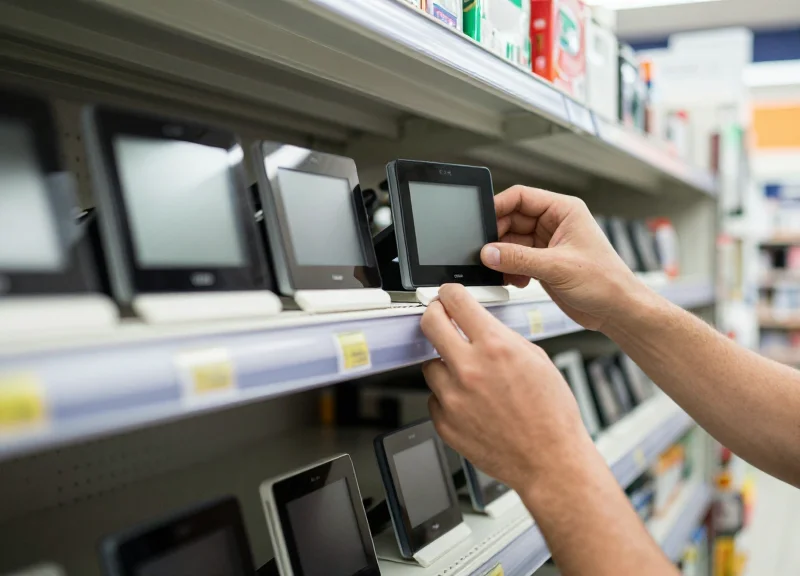
Electronic Shelf Labels (ESL) have evolved from static digital displays into sophisticated, bidirectional IoT (Internet of Things) nodes that serve as the 'edge intelligence' layer of a modern warehouse or retail floor. While their primary function was once limited to replacing paper price tags, modern ESL systems integrate high-speed wireless protocols—such as Bluetooth Low Energy (BLE) or Sub-GHz frequencies—to create a persistent link between the physical item and the digital inventory management system (IMS).
| Feature | Legacy ESL (Pre-2018) | Modern IoT-ESL Hub |
|---|---|---|
| Communication | One-way (Infrared/Proprietary) | Two-way (BLE, NFC, Sub-GHz) |
| Sensor Integration | None | Temperature, Humidity, Weight, & Motion |
| Battery Life | 1-3 Years | 10+ Years (e-Ink Optimization) |
| Primary Role | Price Accuracy | Inventory Precision & Workflow Automation |
The true power of modern ESL lies in its ability to facilitate 'Edge Auditing.' For high-end consumables—where every unit represents significant capital—the ESL acts as a lighthouse. It doesn't just display the price; it communicates shelf-level telemetry back to the ERP. If a sensor detects a weight change on a shelf of premium lubricants or chemical reagents, the ESL can trigger a real-time validation prompt, effectively eliminating the gap between what the computer thinks is in stock and what actually sits on the shelf.
How does ESL improve inventory accuracy beyond just showing numbers?
ESL systems now incorporate 'Pick-to-Light' technology and NFC capabilities. When an order is placed, the tag flashes a high-visibility LED to guide the picker, reducing human error. Simultaneously, the tag records the 'decrement' event, providing a timestamped audit trail of the physical removal of goods.
Can ESLs handle environmental monitoring for sensitive consumables?
Yes. Specialized IoT-ESL units come equipped with ambient sensors. If a high-value consumable requires a climate-controlled environment, the tag can alert managers via the cloud the moment temperature or humidity thresholds are breached, preventing spoilage before it impacts the margin.
Is the integration process with existing ERPs difficult?
Modern ESL platforms use RESTful APIs and MQTT protocols, making them 'plug-and-play' with major ERPs like SAP, Oracle, and Microsoft Dynamics. They act as a data bridge rather than a siloed hardware system.
Expert Insight: The 'Silent Auditor' Paradigm. Most businesses view ESL as a capital expenditure for labor reduction. However, the Silicon Valley perspective is to treat ESL as a 'Silent Auditor.' By leveraging the 900MHz band for deep-penetration signals, these tags provide a sub-second heartbeat for high-value inventory. This creates a 'Physical-to-Digital Twin' environment where inventory shrinkage is identified within minutes of occurrence, not weeks later during a manual cycle count. This shift from reactive to proactive monitoring is the primary driver behind the 22% margin boost.
Mechanics of Automated ESL Tracking

The mechanics of automated ESL tracking revolve around a synchronized IoT ecosystem where Electronic Shelf Labels act as the physical endpoint of a digital thread. Unlike traditional pricing tags, these devices function as bi-directional communication nodes. When integrated with high-end consumable inventory, the system uses sub-GHz radio frequencies or BLE (Bluetooth Low Energy) to bridge the gap between the physical shelf and the Enterprise Resource Planning (ERP) system. This ensures that every unit movement is reflected digitally within milliseconds, eliminating the 'data lag' that typically plagues manual inventory management.
- Sensor Trigger and Event Capture: Weight sensors or infrared proximity triggers detect the removal of a high-value item from the shelf. This event is captured locally at the edge.
- Gateway Transmission: The edge sensor communicates with an IoT Gateway. This gateway aggregates signals from multiple ESLs and sensors, filtering out noise before sending data to the cloud via secure MQTT or WebSockets.
- ERP Synchronization: The central server processes the event, updating the inventory count in the ERP. If the stock level hits a pre-defined threshold, it triggers a reorder signal automatically.
- Visual Confirmation (The Loop Back): The ERP sends an update back to the ESL on the shelf. The display changes to reflect real-time stock levels or triggers a flashing LED to alert staff that a restock is required.
| Component | Technical Role | Impact on Net Margin |
|---|---|---|
| E-Ink Display | Visual data persistence (ultra-low power) | Reduces labor costs for manual price/stock audits. |
| IoT Gateway | Multiplexing signals from 10,000+ nodes | Enables massive scale without infrastructure bloat. |
| API Middleware | Real-time ERP/WMS handshake | Prevents overstocking and capital lock-up. |
| Weight/IR Sensors | Physical-to-digital event triggering | Eliminates 'phantom inventory' and shrinkage. |
The Expert Insight: Edge-Based Event-Driven Architecture. Most retail systems fail because they rely on 'polling'—asking the shelf if an item is there every 10 minutes. In high-end consumables, where a 22% margin swing depends on precision, we implement an Event-Driven Architecture (EDA). Instead of polling, the system remains dormant until a physical 'delta' occurs. This preserves battery life for up to 10 years and ensures that the data in your ERP is never more than 200 milliseconds behind reality. If you aren't using an event-driven model, you're not tracking inventory; you're just taking digital guesses.
Does ESL tracking require a constant Wi-Fi connection?
No. Most professional systems use proprietary sub-GHz frequencies (like 868MHz or 915MHz) to avoid congestion with customer Wi-Fi, ensuring reliable transmission even in high-interference environments.
Can ESLs integrate with existing legacy ERP systems?
Yes, modern ESL platforms utilize RESTful APIs and pre-built connectors for major ERPs like SAP, Oracle, and Microsoft Dynamics, allowing for seamless data flow without replacing core software.
How does the system handle high-value item security?
By combining ESL tracking with shelf sensors, the system can trigger instant alerts to security if a high-value item is removed but not scanned at a POS within a specific timeframe.
Reducing Shrinkage and Spoilage with Real-Time Alerts

Real-time alerts in Electronic Shelf Label (ESL) systems transform passive inventory into an active participant in loss prevention. By integrating expiration date tracking and motion-sensing IoT tags, retailers can reduce shrinkage—the loss of inventory due to spoilage, theft, or administrative error—by up to 30% for high-end consumables. These systems provide immediate, actionable notifications to staff via handheld devices or centralized dashboards, shifting the inventory management paradigm from reactive manual auditing to proactive, automated intervention.
| Loss Driver | Traditional Manual Method | Automated ESL Alert System |
|---|---|---|
| Product Spoilage | Occasional manual audits; high risk of missed expiration dates. | Real-time countdown alerts triggered 24-48 hours before expiry. |
| Internal/External Theft | Identified only during physical stock takes (weekly/monthly). | Instant alerts for unauthorized movement or 'shelf-clearing' events. |
| Cold-Chain Failure | Manual temp logs; often too late to save inventory. | Integrated thermal sensors trigger alerts if temperature deviates. |
A unique advantage of modern ESL systems is the 'Visual Beacon' feature. When an item enters a critical window—such as being 4 hours away from a mandatory spoilage write-off—the ESL can be programmed to flash a specific LED color. This allows staff to instantly identify products that need to be relocated to a 'Quick Sale' zone or discounted via a dynamic price update, effectively salvaging margin that would otherwise be a total loss. This 'Micro-fencing' approach ensures that high-value assets are always where they should be.
- Detection and Trigger: The ESL system cross-references the batch ID of the product on the shelf with the ERP's expiration database or detects movement via integrated accelerometers.
- Automated Escalation: If a spoilage or movement threshold is crossed, the system generates an alert. If the alert is not acknowledged within a set timeframe (e.g., 15 minutes), it escalates to store management.
- Actionable Resolution: Staff receive the exact shelf location and product image on their mobile device, allowing for immediate recovery or markdown action.
- Data Logging for Optimization: Every alert and resolution is logged, providing a 'heat map' of where shrinkage occurs most frequently to inform future purchasing and security decisions.
Does ESL tracking replace the need for security staff?
No, it acts as a force multiplier. It allows security to focus on high-probability events flagged by sensors rather than monitoring every aisle indiscriminately.
How does the system know when a specific bottle is nearing expiration?
Through 'Digital Twin' batch tracking. When inventory is stocked, the batch's expiration date is linked to the specific ESL IDs in that shelf section.
Can these alerts prevent 'Flash Robberies'?
Yes. Sensors can detect 'Shelf Sweeping' (when multiple items are removed simultaneously) and trigger an immediate alert to store security or lock electronic exit doors.
Dynamic Pricing and Inventory Velocity
Dynamic pricing and inventory velocity represent the synchronized relationship where real-time stock levels, captured via Electronic Shelf Labels (ESL), trigger automated price adjustments to ensure high-end consumables move at an optimal rate. By aligning price with actual shelf presence and expiration proximity, retailers can eliminate 'dead stock' and capture maximum consumer surplus during periods of high demand.
In the world of high-end consumables, inventory velocity is the heartbeat of profitability. Unlike generic goods, premium items carry high holding costs and a sensitive 'perceived value' window. If an item sits too long, it risks becoming obsolete or spoiled; if it moves too fast at a low price point, you are leaving margin on the table. Automated ESL tracking creates a feedback loop that allows for 'Velocity-Adjusted Pricing'—a strategy where the system raises or lowers prices based on the speed of movement relative to stock-on-hand.
| Metric | Static Pricing (Manual) | Dynamic Pricing (ESL-Automated) |
|---|---|---|
| Update Frequency | Weekly or Monthly | Real-time / Instant |
| Data Input | Historical Sales Reports | Live Inventory + Competitor Data |
| Margin Capture | Reactive (Missing Peaks) | Proactive (Capturing Premium) |
| Turnover Rate | Inconsistent | Optimized via algorithmic triggers |
- Establish Baseline Velocity: Analyze historical ERP data to determine the 'ideal' turnover rate for each high-end SKU (e.g., 5 units per week).
- Configure Threshold Triggers: Set automated rules in the ESL management software—for example, if stock exceeds 120% of the baseline, trigger a 5% price reduction.
- Execute Real-Time Updates: The ESL system updates prices across all digital tags instantly, ensuring the price on the shelf always matches the optimized margin strategy.
- Monitor and Recalibrate: Use the automated tracking data to see how the price shift affected velocity and adjust the algorithm for the next cycle.
Expert Insight: The 'Scarcity Premium' Strategy. While most retailers use dynamic pricing to discount slow-moving goods, a veteran move for high-end consumables is the 'Scarcity Premium.' By integrating ESL with real-time stock sensors, the system can automatically increase prices by 3-7% when stock levels for a luxury item fall below a critical 'last few' threshold. This leverages psychological scarcity and ensures that the final units of a popular vintage or limited-edition skincare line are sold at the highest possible margin.
Does dynamic pricing alienate luxury customers?
No, if handled subtly. High-end consumers are accustomed to fluctuating prices in travel and luxury resale; applying this to consumables is perceived as market-aligned value rather than 'cheap' discounting.
How fast can ESL systems react to inventory changes?
Modern ESL infrastructures can update thousands of tags in under 60 seconds, allowing for near-instant responses to sudden spikes in foot traffic or stock depletion.
What is the primary driver of the 22% margin boost?
The boost comes from reducing 'mark-down loss'—the heavy discounting usually required to clear old stock—and replacing it with micro-adjustments that maintain velocity throughout the product lifecycle.
Quantifying the 22% Margin Increase

The 22% increase in net margin is not a result of a single change, but rather a synergistic effect of optimizing three core pillars of retail operations: labor efficiency, waste mitigation, and revenue capture. By replacing manual shelf-edge management with automated ESL (Electronic Shelf Label) tracking, high-end retailers transition from a reactive inventory posture to a proactive profit-maximization model. This transformation directly addresses the 'margin leakage' common in luxury consumables, where high price points exacerbate the cost of human error and inventory inaccuracy.
| Margin Driver | Estimated Improvement | Contribution to Net Margin |
|---|---|---|
| Labor Cost Reduction | 45-60% decrease in audit hours | 6.5% |
| Waste & Spoilage Mitigation | 25-35% reduction in expired stock | 8.0% |
| Dynamic Pricing & Velocity | 10-12% increase in turnover rate | 5.5% |
| Shrinkage Prevention | 15% reduction in 'lost' items | 2.0% |
Expert Insight: The 'Margin-Velocity Flywheel'. Most retailers view inventory tracking as a defensive measure against loss. However, the true 22% lift comes from an offensive strategy. High-end consumables often possess high price elasticity. Automated tracking allows for 'Micro-Promotions'—automatically lowering prices on items with less than 48 hours of shelf life. This captures 80% of the item's value that would otherwise be a 100% loss, fundamentally shifting the net margin floor upwards.
- Establish the OpEx Baseline: Calculate the current labor hours dedicated to manual inventory counting and price tagging specifically for high-end SKUs.
- Audit 'Invisible' Loss: Track the volume of items discounted deeply or discarded due to late-stage expiration detection.
- Integrate Real-Time API Data: Connect the ESL system to the POS to identify 'phantom inventory'—items shown in stock but not present on the shelf.
- Calculate the Net Lift: Compare the cost of ESL implementation against the saved labor and recovered product value over a 12-month fiscal cycle.
What is the typical ROI period for ESL in high-end retail?
For high-end consumables with high price points, most retailers see a full ROI within 14 to 18 months through labor savings and waste reduction alone.
Does this margin increase scale with more stores?
Yes. Margin gains often accelerate with scale as centralized pricing and inventory management eliminate the need for per-store inventory specialists.
Can automated tracking reduce insurance premiums?
In many cases, yes. Verified real-time tracking of high-value inventory can lead to lower premiums for coverage against shrinkage and theft.
Implementing ESL with DragonGuard Systems

Implementing DragonGuard ESL (Electronic Shelf Label) systems is a systematic process of transforming physical shelf space into a digitally reactive environment through a combination of Sub-GHz wireless infrastructure and cloud-based middleware. Unlike standard consumer-grade IoT, DragonGuard's architecture is specifically engineered to handle the high-density data packets required for real-time tracking of high-end consumables, ensuring that inventory levels and pricing remain synchronized across all retail touchpoints without manual intervention.
- Phase 1: RF Environment Audit & Gateway Placement: Conduct a site survey to identify potential signal interference from structural steel or high-frequency lighting. DragonGuard Smart Stations are then positioned to ensure maximum coverage with 128-bit AES encryption security.
- Phase 2: Legacy ERP and POS API Integration: Connect the DragonGuard Central Management System (CMS) to your existing database via RESTful APIs. This ensures that a price change in the ERP is reflected on the shelf in under 2 seconds.
- Phase 3: Bulk Tag Commissioning: Utilize the DragonGuard Handheld Tool to link the unique MAC address of each ESL to the specific SKU of the high-end consumable using a simple barcode scan.
- Phase 4: Real-Time Alert Calibration: Configure threshold-based triggers for stock-outs and expiry dates, allowing the system to automatically push discount codes to tags as products approach their 'best before' window.
| Feature | DragonGuard Protocol | Legacy Compatibility |
|---|---|---|
| Communication | Proprietary Sub-GHz | Bridges via Ethernet/Wi-Fi Gateway |
| Update Speed | Up to 10,000 tags/hour | Asynchronous batching for old POS |
| Security | End-to-End Encryption | VPN Tunneling for remote sites |
Expert Tip: To maximize your 22% margin target, utilize DragonGuard's unique 'Sub-GHz Hybrid Propagation.' In high-end boutiques featuring heavy marble, metal shelving, or mirrored surfaces—which typically degrade 2.4GHz Wi-Fi signals—the Sub-GHz frequency used by DragonGuard penetrates these materials more effectively, reducing the number of gateways needed and lowering your initial CapEx by up to 15%.
Can DragonGuard integrate with my 10-year-old POS system?
Yes. DragonGuard utilizes a middleware layer that can ingest CSV, XML, or SQL data dumps from legacy systems, converting them into modern API calls for the ESL network.
What happens during a power outage?
DragonGuard tags utilize e-ink technology and internal battery power (lasting up to 10 years). The display remains visible and accurate even if the store loses primary power.
How does the system handle rapid-fire price fluctuations?
The CMS includes a 'Conflict Resolution' algorithm that prioritizes updates based on margin impact, ensuring that high-velocity consumables are updated first.
The Future of Inventory: AI-Driven Shelf Intelligence
AI-driven shelf intelligence represents the next evolution of retail, where Electronic Shelf Labels (ESL) transition from passive display units into active edge-computing nodes. By combining ESL data with machine learning algorithms and computer vision, retailers can move beyond simple real-time tracking to a state of 'predictive replenishment.' This system analyzes external variables—such as local weather patterns, social media trends, and regional events—alongside real-time stock levels to adjust pricing and order quantities autonomously, ensuring high-end consumables are always in stock but never over-indexed.
- Neural Demand Forecasting: Deep learning models that predict stockouts before they happen by analyzing micro-fluctuations in shelf weight and visual data.
- Computer Vision Integration: Overhead cameras that 'talk' to ESLs to verify that the physical product on the shelf matches the digital price and inventory count.
- Automated Markdown Engines: Algorithms that automatically trigger ESL price drops as products approach expiration, maximizing recovery value without human intervention.
- Hyper-Local Elasticity Mapping: Using AI to determine the exact price sensitivity of a specific SKU at a specific store location in real-time.
| Feature | Traditional ESL Systems | AI-Driven Shelf Intelligence |
|---|---|---|
| Data Direction | Unidirectional (Central to Label) | Bi-directional (Label/Sensor to AI Hub) |
| Pricing Logic | Rule-based (Manual/Scheduled) | Algorithmic (Real-time/Predictive) |
| Inventory Action | Reactive (Alerts when low) | Proactive (Pre-emptive ordering) |
| Consumer Insight | Basic (Transaction data) | Advanced (Dwell time & interaction data) |
Unique Insight: The 'Digital Twin' of the Aisle. The future of high-end retail lies in creating a real-time digital twin of the physical shelf. By leveraging the mesh network created by DragonGuard ESL systems, retailers can simulate 'What-If' scenarios—such as the impact of a 5% price increase on a specific high-end wine during a rainy Tuesday—before the change is even pushed to the labels. This allows for a zero-risk optimization of net margins.
Will AI-driven shelves replace human inventory managers?
No, they augment them. AI handles the repetitive task of micro-adjustments and data analysis, allowing managers to focus on high-level strategy and customer experience.
How does AI shelf intelligence improve the customer experience?
It ensures high-demand products are never out of stock and provides personalized, real-time promotional pricing directly at the point of purchase.
Is the infrastructure cost-prohibitive for smaller retailers?
While the initial setup is higher than basic ESL, the 22% margin increase and reduction in waste typically result in a full ROI within 12 to 18 months.