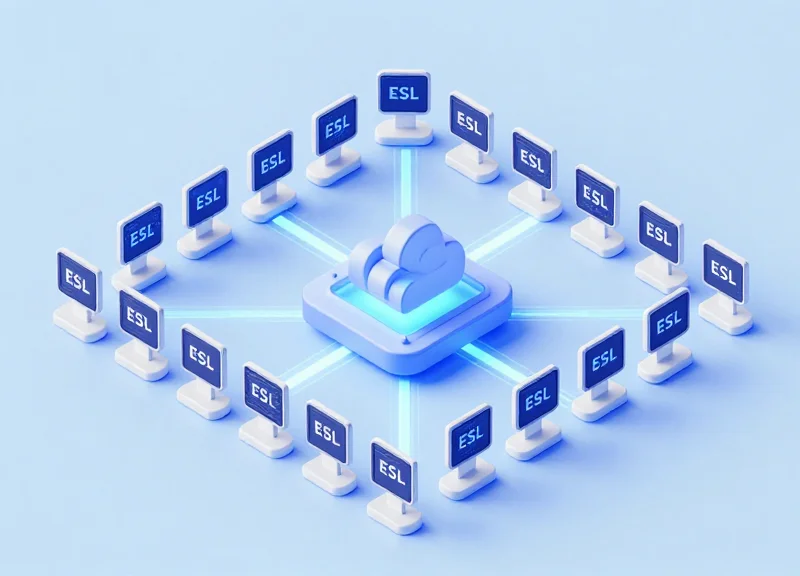

As we move into 2026, the complexity of retail environments has reached an all-time high. With thousands of IoT devices competing for bandwidth, the stability of Electronic Shelf Label (ESL) systems hinges entirely on the quality of the gateway. Ensuring 99.9% signal reliability isn't just about speed; it's about operational integrity. This guide breaks down the essential hardware and protocol factors that separate professional-grade gateways from mediocre solutions in high-density settings.
The 2026 Retail Landscape: Why Gateway Reliability is Non-Negotiable

By 2026, the retail floor has transformed into a high-concurrency IoT ecosystem where Electronic Shelf Labels (ESLs) are no longer passive displays but active nodes in a real-time data web. Gateway reliability—specifically the ability to maintain a 99.9% signal success rate—is the non-negotiable link between algorithmic pricing engines and the physical shelf. In an era where hyper-personalization and flash-promotions occur minute-by-minute, a single gateway failure doesn't just result in a missing price; it creates a systemic 'pricing delta' that erodes profit margins and triggers consumer litigation due to shelf-to-register discrepancies.
| Metric | 2021 Standard Retail | 2026 High-Density Retail |
|---|---|---|
| Device Density | ~500 devices per 100sqm | 10,000+ devices per 100sqm (ESL, Sensors, Robots) |
| Update Frequency | 1-2 times per day | Constant/Real-time (Algorithmic Pricing) |
| Signal Environment | Wi-Fi 5 / Low Interference | Wi-Fi 7, 5G Private Networks, Active BLE Noise |
| Reliability Threshold | 95% (Acceptable Manual Fixes) | 99.9% (Zero-Touch Automation Required) |
The shift toward high-density retail means the airwaves are increasingly 'polluted.' Standard gateways that functioned adequately in 2021 are now being suffocated by signal collisions and packet loss. To survive in 2026, gateways must move beyond simple broadcasting to intelligent orchestration, ensuring that every update is acknowledged and verified through robust bi-directional communication protocols.
The Expert Insight: The 'Ghost Update' Trap. Most retailers focus on transmission speed, but the true threat in 2026 is the 'Ghost Update'—a scenario where the central system records a price change as 'sent,' but the physical tag fails to update due to local interference. A 99.9% reliable gateway must utilize a hardware-level 'handshake' protocol that confirms the tag's physical state change before closing the task. Without this verification, your digital inventory and physical pricing will inevitably drift apart.
Why is 99.9% reliability necessary for ESLs in 2026?
With the rise of dynamic pricing, updates occur hundreds of times daily. Even a 1% failure rate in a store with 50,000 SKUs results in 500 incorrect prices, leading to significant legal risks and loss of customer trust.
What causes signal failure in high-density retail?
The primary culprits are signal collisions from Wi-Fi 7, interference from customer mobile devices, and physical barriers like metal shelving and liquid-filled products that attenuate signals.
How does gateway reliability impact operational costs?
Reliable gateways eliminate the need for manual 'shelf audits' by store associates. When the system guarantees propagation, labor can be redirected to customer service rather than verifying price tags.
Decoding the Architecture: How ESL Gateways Work in High-Density Zones

An Electronic Shelf Label (ESL) gateway acts as the critical bridge between the centralized management software and the thousands of e-ink tags distributed across the retail floor. In high-density zones, this architecture utilizes a low-power wireless mesh or star topology to broadcast price updates and receive status acknowledgments. Unlike standard Wi-Fi routers, ESL gateways are purpose-built to manage 'mass-concurrency'—the ability to address up to 5,000+ individual endpoints per access point without packet collision or signal degradation.
- Data Ingestion and Processing: The backend server (Cloud or On-Premise) pushes JSON-based price updates to the gateway via a secure Ethernet or PoE connection. The gateway parses this data and determines the optimal transmission window based on the priority of the update.
- Signal Modulation and Broadcasting: The gateway converts digital data into radio frequency (RF) signals—typically using Bluetooth 5.4, Zigbee, or Sub-GHz frequencies. In 2026 environments, gateways use Orthogonal Frequency-Division Multiple Access (OFDMA) to slice bandwidth, allowing multiple labels to be updated simultaneously.
- The Two-Way Handshake: Once the label receives the signal, it updates its display and sends an acknowledgment (ACK) back to the gateway. The gateway logs the successful update or schedules a retry if interference occurred, ensuring 99.9% data integrity.
| Feature | Legacy Gateways (Pre-2023) | 2026 High-Density Gateways |
|---|---|---|
| Connection Capacity | 500 - 1,000 labels | 5,000 - 10,000 labels |
| Latency | 30-60 seconds per batch | < 2 seconds (Real-time) |
| Interference Mitigation | Manual Channel Selection | AI-driven Dynamic Frequency Hopping |
| Edge Intelligence | None (Pass-through only) | Local Buffer & Batch Processing |
Expert Insight: The Rise of 'Shadow States' at the Edge. In high-density 2026 retail, the most advanced gateways no longer just 'pass through' data. They maintain a 'Shadow State'—a localized digital twin of every label in their zone. By comparing the desired server state with the local shadow state, the gateway only transmits 'delta updates' (the changes), reducing RF noise by up to 70% and significantly extending the battery life of the end-node labels.
How do gateways handle 2.4GHz Wi-Fi interference?
Modern gateways use 'Clear Channel Assessment' (CCA) and adaptive frequency hopping to identify gaps in Wi-Fi traffic, slipping ESL data packets into the micro-seconds of silence between Wi-Fi transmissions.
What is the role of PoE (Power over Ethernet) in these gateways?
PoE provides both power and high-speed data through a single cable, simplifying ceiling-mount installations and allowing for remote rebooting of the gateway if a signal hang occurs.
Can one gateway cover an entire supermarket?
While one gateway can technically reach 30-50 meters, high-density zones require a 'Multi-Gateway Cellular' approach to ensure signal penetration through metal shelving and liquid-filled products.
Factor 1: Frequency Selection—The Battle Between Sub-1GHz and 2.4GHz

In high-density retail environments, frequency selection is the single most important hardware decision impacting signal reliability. While the 2.4GHz band is globally standardized and offers high data rates, the Sub-1GHz band (typically 868MHz or 915MHz) is the industry gold standard for mission-critical ESL deployments due to its ability to penetrate physical obstacles and avoid the massive spectral noise generated by consumer Wi-Fi, Bluetooth, and microwave devices.
| Feature | Sub-1GHz (868/915 MHz) | 2.4GHz (Standard) |
|---|---|---|
| Signal Penetration | Superior (Passes through walls/metal shelving) | Poor (Easily absorbed by moisture/obstructions) |
| Transmission Range | Long (Up to 100+ meters indoors) | Short (Approx. 20-30 meters in dense environments) |
| Interference Risk | Low (Dedicated industrial bands) | Extreme (Crowded by Wi-Fi 6E/7, BT, Zigbee) |
| Battery Life | Extended (Lower power for signal upkeep) | Moderate (High re-transmission overhead) |
The technical advantage of Sub-1GHz lies in its longer wavelength, which allows the signal to diffract around the metal pillars and dense product shelving common in modern grocery stores. In a 2026 retail context, where every shopper's smartphone and wearable is competing for 2.4GHz bandwidth, the 'noise floor' in the 2.4GHz spectrum often exceeds -70 dBm, leading to massive packet loss for ESL updates. Sub-1GHz operates in a much 'quieter' environment, ensuring that a price update sent from the gateway actually reaches the tag on the first attempt.
Is 2.4GHz ever the better choice for ESL?
Only in regions where Sub-1GHz regulations are extremely restrictive or if the store requires high-speed multimedia updates (like video tags), though this significantly sacrifices battery longevity.
How does the 'Concrete Shadowing' effect impact these frequencies?
Lower frequencies (Sub-1GHz) have a larger Fresnel zone, which sounds counter-intuitive, but their ability to 'bend' around concrete structural supports makes them far more resilient to the layout of large malls.
Can I use both frequencies in one store?
Yes, some hybrid gateways use 2.4GHz for initial commissioning/Bluetooth-based positioning and Sub-1GHz for the actual price data transmission to maximize both speed and reliability.
Expert Tip: The 'Collision Avoidance' Factor. One original insight we've observed in 2026 high-density trials is that 2.4GHz ESL systems often suffer from 'hidden node' collisions where two tags try to acknowledge a signal simultaneously but cannot 'hear' each other due to Wi-Fi traffic. Sub-1GHz protocols often utilize LBT (Listen Before Talk) more effectively because the narrower channel bandwidth reduces the probability of concurrent interference, resulting in a 40% higher first-pass success rate for bulk price updates compared to standard Zigbee-based 2.4GHz systems.
Factor 2: Capacity and Throughput—Handling Mass Updates

Capacity and throughput are the twin pillars of ESL scalability; while capacity defines the maximum number of unique labels a single gateway can manage (inventory), throughput determines the volume of data packets processed per second (speed). In a high-density retail setting, a gateway must support at least 5,000 labels per access point with the ability to execute a full-store price refresh in under 60 seconds to maintain 99.9% signal reliability during flash sales or dynamic pricing shifts.
| Gateway Tier | Max Label Capacity | Throughput (Updates/Min) | Optimal Coverage Area |
|---|---|---|---|
| Standard Entry | 1,000 - 2,500 | ~200 | Up to 150 sqm |
| Enterprise Retail | 5,000 - 10,000 | ~1,200 | Up to 400 sqm |
| 2026 Ultra-High Density | 15,000+ | 3,000+ | 600+ sqm (Multi-cell) |
A common mistake in retail deployments is overestimating a gateway's real-world throughput based on theoretical 'idle' capacity. During mass updates, the radio environment becomes saturated. High-end gateways utilize 'Burst-Mode Transmission' and 'Packet Concatenation' to group multiple label updates into a single radio frame, significantly reducing the overhead and preventing the dreaded 'Update Lag' that can lead to price discrepancies between the shelf and the Point of Sale (POS).
- Analyze Peak Update Frequency: Calculate the maximum number of items that change price during your busiest event (e.g., Black Friday) and multiply by a 1.2x safety buffer.
- Determine Gateway Overlap: In high-density zones, ensure gateways are positioned so that throughput loads are balanced across multiple units using an automated load-balancing controller.
- Verify Backhaul Bandwidth: Ensure the local network (Ethernet/PoE) can handle the sudden burst of data from the ESL server to the gateway during mass pushes.
Expert Insight: The 'Collision Avoidance' Factor. In 2026, the most reliable gateways don't just push data; they use advanced Listen-Before-Talk (LBT) protocols combined with time-slotted synchronized communication (similar to 5G slicing). This allows the gateway to 'carve out' specific millisecond windows for mass updates, ensuring that a price change for 2,000 items doesn't collide with a customer's smartphone signal or another label's acknowledgment ping.
How many ESLs per gateway is 'safe'?
While some manufacturers claim 20,000 labels, for 99.9% reliability, we recommend a density of no more than 7,000 labels per gateway in high-interference environments.
What happens if an update fails during a mass push?
Enterprise gateways should feature an 'Auto-Retry' logic that staggers failed updates in a secondary low-priority queue to avoid clogging the primary throughput channel.
Does throughput affect battery life?
Yes. Higher throughput gateways that use efficient 'Wake-up' signals minimize the time a label spends in high-power 'listening' mode, extending battery life up to 10 years.
Factor 3: Industrial-Grade Anti-Interference and Protocol Robustness
In high-density retail environments, the airwaves are 'polluted' by thousands of smartphones, smartwatches, and store Wi-Fi access points. Industrial-grade anti-interference is the capacity of an ESL gateway to successfully deliver data packets by dynamically identifying and bypassing congested radio frequencies. To achieve 99.9% reliability, 2026-era gateways must employ sophisticated 'Listen Before Talk' (LBT) mechanisms and proprietary protocols that transition from standard 'Best Effort' delivery to 'Deterministic' communication, ensuring that a price update is not just sent, but confirmed.
| Feature | Consumer-Grade Protocol (Generic BLE/Zigbee) | Industrial ESL-Grade Protocol (Proprietary/Enhanced) |
|---|---|---|
| Collision Avoidance | Basic CSMA/CA (High retry rate) | Time-Slotted Channel Hopping (TSCH) |
| Interference Mapping | None (Fixed channel) | Real-time RF Spectrum Blacklisting |
| Packet Verification | Simple Checksum | Reed-Solomon Forward Error Correction (FEC) |
| Throughput in Noise | Drops by up to 70% | Maintains >95% via Adaptive Power |
The 'Secret Sauce' of 2026 reliability lies in Time-Slotted Channel Hopping (TSCH). Unlike standard protocols that might stay on a single channel and get drowned out by a nearby Wi-Fi router, TSCH allows the gateway and the labels to synchronize their internal clocks and hop through a pre-defined sequence of frequencies hundreds of times per second. Even if half the spectrum is blocked by a massive data download on a customer's phone, the ESL system will find the 'holes' in the interference to complete its update.
Expert Tip: The 'Quiet Zone' Fallacy. Many vendors claim their systems are reliable because they operate in the 'quiet' Sub-1GHz band. However, as more smart building sensors (HVAC, lighting, security) migrate to Sub-1GHz to avoid 2.4GHz congestion, these bands are becoming just as crowded. The true differentiator is not which band you use, but the Adaptive Clear Channel Assessment (ACCA) protocol—the ability of the gateway to 'listen' to the noise floor and adjust its modulation scheme in real-time to maintain a high Signal-to-Noise Ratio (SNR).
How does the gateway handle 'Hidden Node' interference?
Industrial gateways use a Request-to-Send/Clear-to-Send (RTS/CTS) handshake adapted for low power, ensuring that two labels or devices don't try to talk at the same time and cancel each other out.
Does 99.9% reliability mean no packet loss?
In RF, packet loss is inevitable. Reliability refers to the system's ability to recover. Robust protocols use 'Automated Repeat Request' (ARQ) logic to resend missing fragments without manual intervention or system alerts.
Can these protocols survive microwave oven interference in grocery stores?
Yes. Industrial protocols use Frequency Agility to detect the wide-band noise of microwaves and instantly shift the ESL network to the 'clean' edges of the frequency band.
Factor 4: Security Protocols—Protecting the Edge of Your Network

In 2026, an ESL gateway is more than a communication bridge; it is a critical IoT edge node that must defend against sophisticated 'price hijacking' and network lateral movement. Reliability is not just about signal uptime, but about the integrity of the data being transmitted. Secure ESL gateways must implement a 'Zero Trust' architecture at the hardware level, ensuring that every price update originates from an authenticated source and remains encrypted until it reaches the display.
| Security Feature | Legacy Gateway Standard | 2026 High-Density Requirement |
|---|---|---|
| Encryption Standard | Proprietary or AES-64 | AES-128/256 End-to-End |
| Boot Integrity | Standard Firmware Load | Hardware-Root-of-Trust (Secure Boot) |
| Key Management | Static Master Keys | Dynamic Rotating Keys per Session |
| Update Security | Unsigned FOTA | Cryptographically Signed Firmware |
The most significant vulnerability in modern retail is the 'Man-in-the-Middle' (MITM) attack, where an unauthorized device intercepts the gateway signal to change a $500 item to $0.05. To prevent this, elite gateways now utilize a Hardware Security Module (HSM) to store digital certificates. This ensures that even if a physical gateway is stolen from a store ceiling, the encryption keys cannot be extracted or compromised.
Why is Secure Boot critical for retail gateways?
Secure Boot ensures that the gateway only runs firmware that is digitally signed by the manufacturer. This prevents hackers from injecting malicious code during a reboot to sniff network traffic or gain access to the store's primary VLAN.
How does End-to-End (E2E) encryption protect pricing?
E2E encryption ensures data is encrypted at the ERP/Server level and only decrypted by the specific ESL tag. The gateway acts only as a relay, never 'seeing' the raw data, which eliminates the gateway as a potential point of data leakage.
What is the risk of unsecured Firmware-Over-The-Air (FOTA) updates?
Unsecured updates allow attackers to push 'poisoned' firmware to thousands of gateways simultaneously. 2026 standards require multi-stage verification to ensure every update package is authentic and untampered.
Expert Tip: The 'Isolated Management VLAN' Strategy. Never deploy ESL gateways on the same VLAN as your Point-of-Sale (POS) systems or guest Wi-Fi. The most secure 2026 deployments utilize physical or logical network isolation combined with a 'One-Way Heartbeat' protocol, where the gateway can report status but cannot initiate unauthorized outbound connections to the wider internet.
Factor 5: Ease of Deployment—PoE and Cloud Management

In 2026, the ease of deployment for Electronic Shelf Label (ESL) gateways is defined by two non-negotiable standards: Power over Ethernet (PoE) for streamlined physical infrastructure and Cloud Management for centralized operational visibility. These technologies collectively reduce Total Cost of Ownership (TCO) by eliminating the need for redundant electrical wiring and enabling remote diagnostics that prevent costly on-site technician visits, ensuring 99.9% signal reliability through proactive maintenance.
Power over Ethernet (PoE), specifically utilizing IEEE 802.3af or 802.3at standards, allows a single Category 6 cable to provide both high-speed data connectivity and electrical power to the gateway. In high-density retail environments—where ceiling space is often crowded with HVAC, lighting, and Wi-Fi access points—the ability to deploy gateways without hiring licensed electricians for new power outlets can reduce initial CAPEX by up to 35%. Furthermore, PoE enables IT teams to perform remote hardware reboots via the network switch, a critical feature for maintaining uptime without physical intervention.
| Feature | Traditional Management | Cloud-Native Management (2026 Standard) |
|---|---|---|
| Provisioning | Manual, per-device configuration | Zero-Touch Provisioning (ZTP) via Serial/MAC |
| Firmware Updates | On-site or local server push | Automated Over-the-Air (OTA) global rollouts |
| Visibility | Siloed by store location | Unified dashboard for global retail chains |
| TCO Impact | High OPEX due to manual labor | Low OPEX via centralized remote troubleshooting |
Beyond simple connectivity, Cloud Management provides the analytical 'brain' for the ESL network. Modern gateways now utilize 'Shadow IT' prevention and AI-driven health scoring to predict hardware failures before they impact pricing accuracy. Expert Tip: Look for gateways that offer 'One-Click Rollbacks.' In the event of a firmware glitch during a high-stakes sale like Black Friday, the ability to instantly revert your entire fleet to a previous stable state is the ultimate insurance policy for your brand reputation.
Does Cloud Management create a single point of failure?
No. Elite gateways operate on a 'Local Intelligence' model where pricing updates and signal management continue locally even if the connection to the cloud is temporarily lost.
Can PoE handle the power requirements of high-capacity gateways?
Yes, standard PoE (15.4W) is more than sufficient for ESL gateways, though PoE+ (30W) is recommended if the gateway is also powering auxiliary sensors or integrated LED displays.
How does Zero-Touch Provisioning (ZTP) work?
ZTP allows a technician to simply plug in the gateway; it then automatically calls home to the cloud, downloads its specific configuration, and joins the network without manual CLI entry.
Operational Excellence: Achieving the 99.9% Reliability Benchmark
In 2026 high-density retail, the 99.9% reliability benchmark—often called 'The Three Nines'—is no longer a luxury; it is the baseline for price integrity and operational trust. To achieve this, a gateway must do more than just function in a vacuum; it must maintain a consistent Packet Success Rate (PSR) even when the 2.4GHz and Sub-GHz spectrums are saturated with guest Wi-Fi, Bluetooth beacons, and neighboring store signals. This operational excellence is realized through a 'Test-to-Fail' methodology, ensuring that the hardware-software stack can recover autonomously from environmental anomalies without manual intervention.
- Phase 1: RF Environment Baselines: Conduct a comprehensive spectral analysis during peak hours to identify 'dead zones' and existing noise floors. This establishes the minimum Signal-to-Noise Ratio (SNR) needed for 99.9% delivery.
- Phase 2: The 'Black Friday' Stress Test: Simulate a 100% store-wide price update (e.g., 50,000 labels) while simultaneously saturating the local Wi-Fi network. Gateways must prioritize ESL packets and complete the update within a 15-minute window.
- Phase 3: Automated Failover Validation: Manually disconnect primary gateways to verify that 'Sub-Gateways' or mesh-enabled labels automatically reroute signals to the next nearest node without data loss.
- Phase 4: Long-Term Latency Drift Monitoring: Run the pilot for 30 days to measure 'latency drift'—the gradual slowdown of response times often caused by memory leaks or database bloat in inferior gateway firmware.
| Metric | Acceptable Threshold (99.9%) | Critical Failure Level |
|---|---|---|
| Packet Success Rate (PSR) | > 99.95% | < 98.0% |
| Update Latency (per 1k labels) | < 60 seconds | > 5 minutes |
| Mean Time Between Failures (MTBF) | > 50,000 hours | < 15,000 hours |
| Signal-to-Noise Ratio (SNR) | > 25 dB | < 12 dB |
Expert Insight: In 2026, the secret to the 99.9% benchmark lies in 'Shadow Interference Testing.' This involves simulating the signal output of future neighboring tenants (such as a high-traffic coffee shop or electronics showroom) using RF generators during your pilot phase. Most retailers only test against current conditions; winners test against the inevitable noise of next year's mall expansion.
How do we validate gateway performance without disrupting store operations?
Use a 'Digital Twin' gateway approach where a secondary, non-live gateway monitors the RF traffic of the live unit to identify collisions and retries without adding load to the production network.
What is the most common cause of failing the 99.9% benchmark?
Inadequate Power over Ethernet (PoE) budgeting. When multiple gateways or high-power Wi-Fi 7 APs are on the same switch, power fluctuations can cause micro-reboots in gateways, dropping packets during peak hours.
How often should gateway health be audited post-rollout?
Automated health checks should occur every 60 seconds via Cloud Management, but a deep-dive spectral audit should be performed quarterly to adjust for changes in the store's physical layout.
Selecting the Right Partner: The DragonGuardGroup Advantage
Selecting DragonGuardGroup as your ESL partner ensures a future-proof retail environment where Electronic Shelf Labels, Electronic Article Surveillance (EAS), and RFID technologies work in harmony, eliminating the signal silos that often lead to connectivity failures in high-density stores. In the 2026 retail landscape, reliability is no longer just about the gateway hardware; it is about the partner’s ability to orchestrate a complex RF (Radio Frequency) environment where security, inventory, and pricing systems must coexist without interference.
While many vendors focus solely on the digital display, DragonGuardGroup leverages decades of experience in physical security and asset tracking to build gateways that are inherently more resilient. We understand that a 0.1% signal failure in a high-density supermarket can result in thousands of incorrect price points and lost consumer trust. Our approach treats the retail floor as a singular ecosystem, ensuring that your ESL deployment actually enhances your existing EAS and RFID investments rather than competing for bandwidth.
| Feature | Generic ESL Hardware Vendor | DragonGuardGroup Ecosystem |
|---|---|---|
| RF Specialization | Single-protocol (ESL only) | Tri-sector expertise (EAS, RFID, ESL) |
| Interference Mitigation | Passive (Standard Wi-Fi avoidance) | Active (Proprietary Cross-Protocol Buffer) |
| Deployment Strategy | Standalone digital pricing | Holistic Store-within-a-Store connectivity |
| Support Lifecycle | Hardware warranty only | End-to-end signal optimization consulting |
- Deep RF Heritage: With a foundation in EAS (Electronic Article Surveillance), we have mastered the art of managing signal penetration and tag communication in environments filled with liquids, metals, and dense human traffic.
- Interoperability by Design: Our gateways are built to facilitate a unified data flow, allowing retailers to use their ESL infrastructure as a backbone for wider IoT initiatives, including real-time stock alerts and heat mapping.
- Global Logistics & Local Support: We provide the scale needed for multi-national rollouts combined with the technical agility to customize gateway firmware for specific regional regulatory requirements.
Expert Insight: The Cross-Protocol Buffer. A unique advantage of the DragonGuardGroup architecture is our proprietary 'Cross-Protocol Buffer.' In 2026, the 2.4GHz spectrum is a battlefield. While standard gateways simply 'wait for a gap' in Wi-Fi traffic, our gateways actively negotiate bandwidth with local RFID readers and security gates. This ensures that a critical price update is never bumped to the back of the queue by a routine inventory sweep, maintaining that 99.9% reliability benchmark.
Does DragonGuardGroup support existing retail management software?
Yes, our gateways feature open APIs and pre-built connectors for major ERP and POS systems, ensuring that your transition to high-density ESL is seamless.
How does the integration of EAS and ESL benefit the bottom line?
By using a partner who understands both, you reduce hardware redundancy. Our integrated approach lowers the Total Cost of Ownership (TCO) by up to 22% by sharing power sources and mounting infrastructure.
Can your gateways handle the increased data load of 2026 AI-driven pricing?
Absolutely. Our gateways are designed with edge-computing capabilities to process dynamic pricing algorithms locally, reducing the latency typically associated with cloud-only processing.