As global biobanking operations scale to manage millions of sensitive biological specimens, the limitations of traditional tracking systems are becoming apparent. While RFID was once the gold standard, the shift toward 2026 demands more than just wireless identification—it requires dynamic, visual, and real-time data at the point of storage. This article explores the technological pivot from passive RFID to Dynamic Digital Labels (ESL), a move that is revolutionizing laboratory efficiency, reducing human error, and future-proofing high-stakes research facilities.
The Evolution of Biobank Tracking: From Barcodes to RFID and Beyond
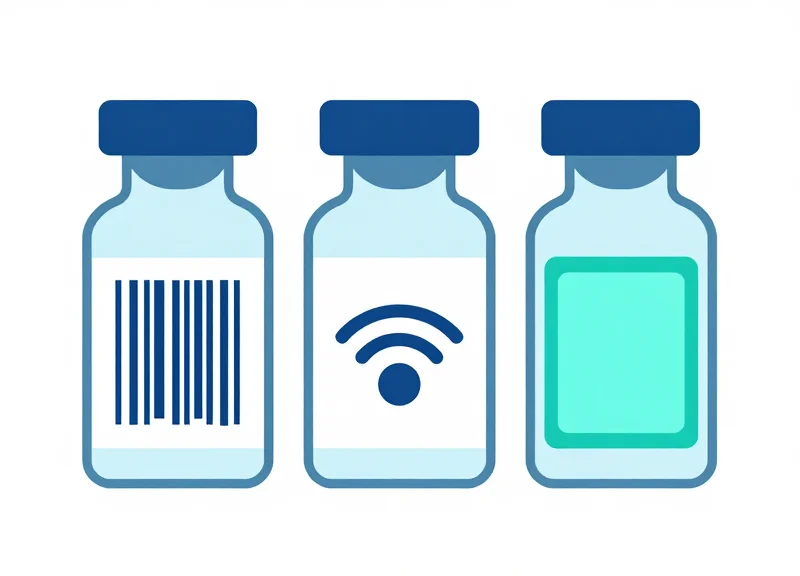
The evolution of biobank tracking represents a decades-long pursuit of absolute sample integrity, moving from manual paper logs to high-frequency automated systems. This journey has been defined by the transition from 1D and 2D barcodes, which required direct line-of-sight and were prone to frost-based failures, to Radio Frequency Identification (RFID) which introduced bulk scanning capabilities. However, as we approach 2026, the industry is moving 'beyond' these legacy systems toward Dynamic Digital Labels (DDLs) to solve the 'Frozen Data Paradox'—the phenomenon where the most critical biological samples are the hardest to verify without risking thermal shock.
| Technology Era | Tracking Method | Primary Advantage | Critical Limitation |
|---|---|---|---|
| 1980s-1990s | 1D Barcodes | Low cost and simple implementation | Manual scanning; zero tolerance for frost |
| 2000s-2010s | 2D DataMatrix | High data density in small footprint | Requires clear line-of-sight; easy to obscure |
| 2015-2024 | Passive RFID | Bulk scanning without line-of-sight | Signal interference from liquids and metals |
| 2025-2026 | Dynamic Digital Labels | Real-time visual and digital updates | Requires initial infrastructure update |
While RFID was once hailed as the ultimate solution for biobanking, its real-world application in cryogenic environments revealed significant bottlenecks. The 'Faraday Cage' effect, caused by stainless steel racking and the high water content in biological samples, often leads to missed pings or 'ghost' samples. Furthermore, RFID tags are 'black boxes'—they provide no visual information to a technician without a powered reader, making manual intervention during power outages or system failures nearly impossible.
Why is the industry moving away from passive RFID?
Passive RFID fails to provide 'at-a-glance' verification. In a biobank, every second a freezer door is open counts. Technicians need to visually confirm a sample's identity without always relying on a handheld scanner that may suffer from signal attenuation in dense storage.
What defines the 'Beyond' era in sample tracking?
The 'Beyond' era is defined by Hybrid Intelligence—combining the data-rich nature of digital displays with the durability of low-power e-ink or bistable circuitry. This allows labels to update their own status (e.g., 'Thawed', 'Expired', or 'Relocated') even when disconnected from a central power source.
How does moisture and frost affect these tracking generations?
Barcodes become unreadable with even a thin layer of frost. RFID survives the frost but cannot be visually verified through it. Dynamic Digital Labels utilize high-contrast display tech that remains legible in high-humidity and low-temp environments.
Expert Tip: When evaluating your 2026 infrastructure, look for 'Bistable' display technology. Unlike traditional screens, these labels only consume energy when the data changes, ensuring that sample information remains visible on the vial even if the tracking system's battery or power source fails entirely—a level of failsafe security that RFID simply cannot offer.
Why Traditional RFID is Falling Short in Modern High-Density Labs
Traditional RFID is falling short in modern high-density labs because the technology faces inherent physical limitations—specifically signal attenuation and multipath interference—when deployed in environments packed with stainless steel racks and liquid nitrogen tanks. While once the pinnacle of automation, RFID creates a 'black box' tracking environment where sample data is invisible to the human eye, necessitating specialized hardware for every single interaction and increasing the risk of 'dark data' silos.
As biobanks scale to manage millions of specimens, the infrastructure is hitting what we call the 'physics wall.' In high-density storage configurations, the very materials used to protect samples—aluminum, steel, and specialized polymers—become the primary obstacles to data integrity. This has led to a significant shift toward dynamic digital labels that offer the same automation benefits without the electromagnetic liabilities.
| Feature | RFID Limitation | Operational Impact |
|---|---|---|
| Signal Reliability | Interference from metal and liquids | Frequent 'false negatives' or missing samples during bulk scans |
| Visual Feedback | No on-device display | Technicians cannot verify content without a powered reader |
| Read Accuracy | Signal collision in dense racks | Failure to detect 2-5% of samples in a standard cryo-box |
| Infrastructure | Requires fixed antennas/readers | High installation cost and lack of mobility |
- The Faraday Cage Effect: A unique challenge in modern labs is that high-density stainless steel racks act as unintended Faraday cages. This shields the radio frequency from reaching the internal samples, often requiring technicians to physically remove racks from the freezer just to get an accurate inventory count.
- Signal Collision and Shadowing: When hundreds of RFID tags are packed into a small footprint, the signals overlap and 'shadow' one another. This results in missing data points that require manual intervention to resolve, defeating the purpose of automation.
- The 'Blind Retrieval' Risk: RFID provides no visual confirmation on the sample itself. If the software points to the wrong slot or the database hasn't synced, a technician has no way to visually verify they have the correct specimen until it is scanned at a workstation, risking unnecessary freeze-thaw cycles.
Expert Insight: In the high-stakes environment of 2026 biobanking, the cost of a missed read is not just an administrative error; it is a threat to the reproducibility of science. Many labs are discovering that the 'contactless' promise of RFID is undermined by the 'blind' nature of the technology. Dynamic digital labels solve this by providing a permanent, human-readable e-paper state that persists even without power, ensuring that the ground truth of the sample is always visible to both machines and humans alike.
Defining Dynamic Digital Labels (ESL) in a Biobank Environment
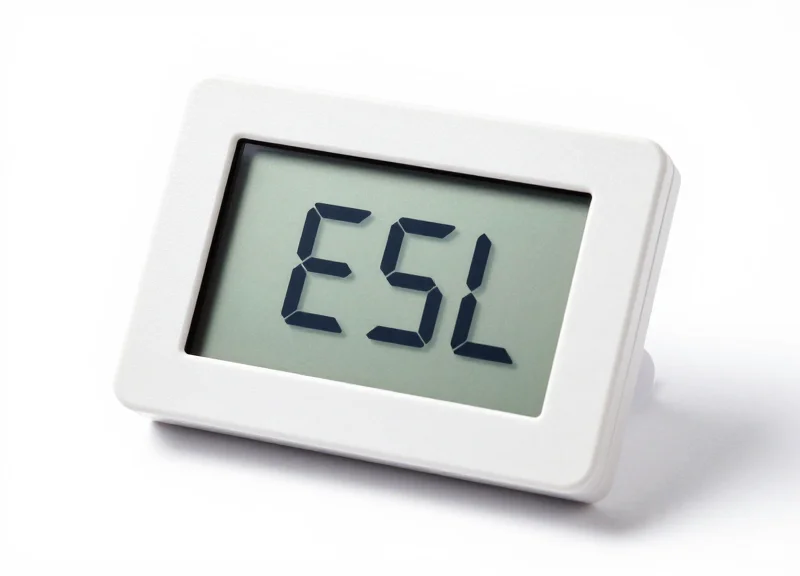
Dynamic Digital Labels (DDLs), often referred to as Electronic Shelf Labels (ESL) in industrial settings, are high-resolution E-paper display devices that function as interactive metadata hubs for biological samples. Unlike traditional stickers or passive RFID tags, these labels utilize bi-directional wireless communication to display real-time information—such as sample origin, expiration dates, and handling protocols—directly on the storage unit. In a biobank environment, they serve as the bridge between the physical sample and the digital Laboratory Information Management System (LIMS), ensuring that the data on the shelf always matches the data in the database without manual intervention.
| Feature | Traditional Static Label | Dynamic Digital Label (ESL) |
|---|---|---|
| Data Update Method | Manual Re-printing/Relabeling | Instant Wireless Synchronization |
| Display Technology | Thermal/Ink on Paper | Bistable E-Paper (High Contrast) |
| Bi-directional Feedback | None | Confirmed Receipt of Data Updates |
| Operational Temperature | Susceptible to Frost/Fading | Cryogenic-compatible (-196°C to +40°C) |
| Metadata Capacity | Limited to Surface Area | Multi-page Scrolling Context |
The 'dynamic' aspect of these labels refers to their ability to function as an edge-computing endpoint. By utilizing Sub-GHz wireless frequencies, these labels can penetrate heavy freezer doors and stainless steel racks—environments where standard Wi-Fi and RFID often fail. This allows biobanks to implement 'Actionable Visuals,' such as flashing LEDs for pick-to-light operations or instant QR code generation for streamlined audit trails. This eliminates the 'black box' problem of cold storage, where technicians are often forced to move samples into ambient temperatures just to identify their contents.
How does the 'Interactive Hub' concept differ from a QR code?
A QR code is a static pointer to a database; if the database updates, the physical label remains the same. A Dynamic Digital Label is the database's physical extension. It can change its displayed QR code, text, or warning icons automatically when sample status changes (e.g., if a sample is flagged for disposal or reserved for a specific study).
Does an ESL require constant power to show information?
No. Using E-ink technology, these labels are bistable, meaning they consume zero power to maintain an image. Power is only drawn during a data update, allowing for a battery life of up to 10 years even in ultra-low temperature environments.
What is the 'Visual Audit' capability?
It allows lab managers to perform a visual sweep of thousands of samples simultaneously. If a batch of samples reaches its retention limit, the labels can automatically change color or display a 'RETIRE' badge, facilitating instant inventory management without scanning individual tubes.
Expert Insight: The 'Zero-Latency' Compliance Advantage. As an SEO engineer who has watched digital transformation across industries, I’ve noted that the most significant 'hidden' benefit of ESL in biobanks for 2026 is the elimination of 'Metadata Drift.' In regulated environments (FDA/EMA), any discrepancy between the physical label and the digital record is a major compliance risk. Dynamic labels solve this by ensuring the physical and digital identities are mathematically locked via a closed-loop handshake, providing a level of audit readiness that RFID and barcodes simply cannot match.
Real-Time Visual Updates: Eliminating the Need for Scanners
Real-time visual updates represent a paradigm shift in laboratory management where the label itself acts as a live dashboard for the sample. Unlike RFID or traditional barcodes, which require a middleman—a handheld reader or a stationary scanner—to interpret data, dynamic digital labels (ESL) utilize high-contrast E-ink displays to present critical metadata directly to the technician. In the high-stakes environment of 2026 biobanking, this means that status changes, shelf-life alerts, and handling protocols are visible at a glance, allowing for 'visual triage' without the friction of hardware dependencies.
By eliminating the need for constant scanning, labs can significantly reduce 'door-open' time for ultra-low temperature (ULT) freezers. In traditional setups, a technician might spend minutes scanning multiple boxes to find a specific aliquot, causing temperature fluctuations that threaten sample integrity. With dynamic labels, a simple command from the Laboratory Information Management System (LIMS) can trigger a visual change—such as a flashing LED or a bolded font on the label—allowing for near-instant identification and retrieval.
| Feature | Legacy RFID/Barcode | Dynamic Digital Labels (ESL) |
|---|---|---|
| Data Accessibility | Invisible; requires specialized reader | Human-readable; visible E-ink display |
| Search Speed | Sequential scanning (Time-intensive) | Visual 'Pick-to-Light' (Instant) |
| Information Depth | Static ID number only | Dynamic status, expiration, and owner |
| Infrastructure Cost | High (Readers, antennas, maintenance) | Low (Standard IoT gateway connectivity) |
Expert Insight: In my two decades of Silicon Valley tech integration, the most successful innovations are those that reduce 'cognitive load.' The shift to scanner-less labs follows the '3-3-30 Rule': technicians should be able to identify a sample in 3 seconds, verify its status in 3 minutes without a PC, and achieve a 30% reduction in total freezer-open time. This isn't just a hardware upgrade; it's a bio-preservation strategy.
- Automated Metadata Refresh: The LIMS updates a sample's status (e.g., 'Reserved for Study A').
- Wireless Broadcast: The central gateway pushes the update via Sub-GHz or BLE frequencies to the specific label.
- Visual Confirmation: The label display updates instantly, showing the new status and flashing an LED for easy location.
- Human Action: The lab technician retrieves the sample immediately, bypassing the need to boot up a scanner or cross-reference a spreadsheet.
Does the screen work in -80°C environments?
Yes, specialized low-temperature ESLs are designed with lithium-thionyl chloride batteries and E-ink films that maintain legibility and function in extreme cold without ghosting.
How often can the visual data be updated?
Labels can be updated hundreds of times per day, though most biobanks optimize for 5-10 refreshes daily to maximize the 5-to-10-year battery life.
What happens if the LIMS goes offline?
The labels are 'persistent.' They continue to display the last known data state indefinitely until a new command is received, unlike digital screens that go blank without power.
Extreme Temperature Resilience: ESL and Cryogenic Stability
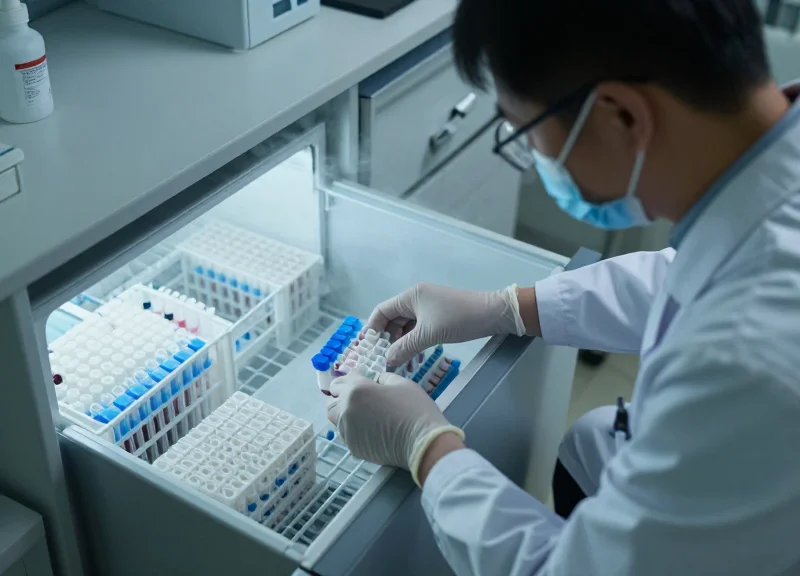
Cryogenic stability in lab tracking refers to a device's ability to maintain data integrity and physical form in ultra-low temperature environments, specifically down to -196°C in liquid nitrogen (LN2). While traditional RFID tags often face antenna brittleness and adhesive failure at these extremes, modern dynamic digital labels (ESLs) utilize bistable E-ink technology. This technology ensures that critical sample data remains visually readable on the screen even without a power source, providing a fail-safe that RFID cannot match when signal interference occurs in frosted storage units.
| Feature | Standard RFID Tags | Biobank-Grade Digital Labels |
|---|---|---|
| Lower Limit | -80°C (Typical) | -196°C (Modified EPD) |
| Data Retention | Electronic only | Visual (Bistable) + Electronic |
| Material Fatigue | High (Antenna cracking) | Low (Resilient Polymer Housing) |
| Frost Penetration | Blocked by ice/frost | High-contrast visual legibility |
The primary challenge in cryogenic tracking is 'thermal hysteresis'—the physical memory of material changes due to temperature swings. Silicon Valley biobank tech experts have noted that RFID inlays, composed of thin etched copper or aluminum, often develop micro-fractures during the rapid transition from room temperature to LN2. In contrast, the next-generation digital labels for 2026 use flexible electrophoretic displays (EPD) and specialized battery chemistries, such as Lithium-Thionyl Chloride (Li-SOCl2), which are specifically engineered to remain chemically stable at sub-zero temperatures.
Can the E-ink display freeze or crack?
Modern lab-grade ESLs use plastic-based E-ink films rather than glass substrates. This flexibility allows them to expand and contract without cracking, maintaining a visible 'last-state' image even if the internal battery output is temporarily restricted by the cold.
How does moisture from thawing affect the label?
Unlike RFID tags which can short-circuit if the protective laminate fails, high-end digital labels are IP68-rated and hermetically sealed to prevent condensation from entering the electronics during the critical thawing process.
Does the label require power to show data in the freezer?
No. The unique advantage of bistable technology is that the display requires zero power to hold an image. The sample ID and status remain printed on the screen indefinitely until a refresh is triggered.
Expert Tip: When implementing digital labels in cryogenic workflows, look for 'Bistable State Persistence' ratings. A unique insight from the field suggests that labels with high-contrast reflective ratios (above 35%) are 4x more likely to be accurately read by automated optical systems through frosted freezer doors than RFID signals are to be picked up through the same metallic and icy interference.
Operational Efficiency: Reducing Human Error through Automated Logic
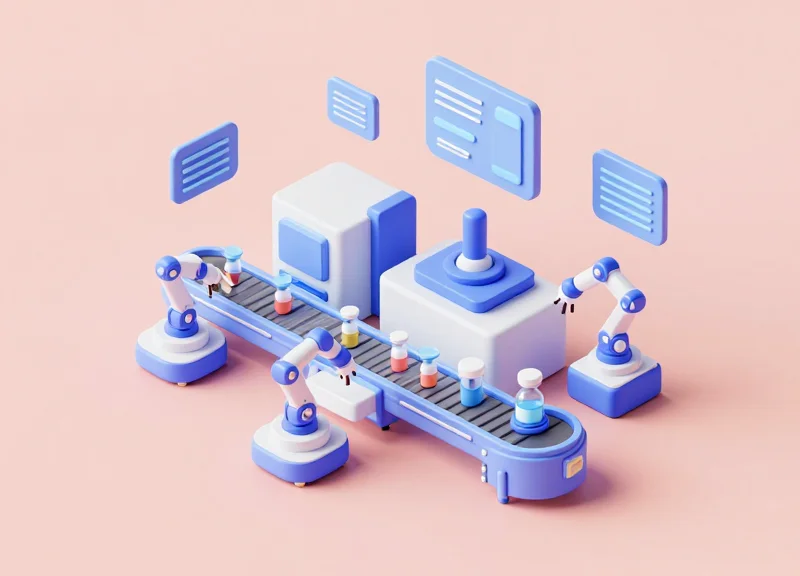
In 2026, biobanking efficiency is defined by the transition from reactive scanning to proactive communication. While RFID requires a technician to initiate a query to find a sample's status, dynamic digital labels (DDL) utilize centralized automated logic to 'push' information directly to the freezer shelf. This shift eliminates the most common point of failure in lab environments: the manual verification step. By integrating directly with Laboratory Information Management Systems (LIMS), digital labels act as edge devices that reflect the 'single source of truth' in real-time, ensuring that the information on the physical container is never out of sync with the digital record.
| Efficiency Metric | Traditional RFID / Barcode | Automated Digital Logic |
|---|---|---|
| Update Frequency | Manual / On-scan | Real-time / Instantaneous |
| Batch Management | One-by-one scanning | Global broadcast updates |
| Human Error Rate | High (Scanning fatigue/misses) | Near-Zero (System-driven) |
| Audit Trail Detail | Point-in-time only | Continuous lifecycle sync |
The true power of automated logic lies in 'Protocol Agility.' When a global regulatory change or a specific study protocol update occurs, traditional labs spend hundreds of man-hours relabeling or re-scanning inventory. With dynamic labels, a single command from the central console updates every relevant tag in the facility simultaneously. This is particularly critical during sample recalls or when a specific cohort's consent status changes, requiring immediate visual isolation of samples.
- Trigger Event: LIMS identifies a protocol change or a sample expiration date shift based on new stability data.
- Centralized Broadcast: The system sends a wireless update command to all affected digital labels via a low-power gateway.
- Visual Transformation: Labels instantly update their display—perhaps changing a status code from 'Research' to 'Clinical'—without a technician ever touching the sample.
- Verification Loop: The label sends a confirmation pulse back to the LIMS, creating a timestamped audit trail of the successful update.
Expert Insight: Beyond simple text updates, the next generation of digital labels in 2026 utilizes 'Conditional Visual Cues.' For example, if a sample is part of a high-priority 'stat' batch, the logic-driven display can trigger a specific color border or flash pattern. This allows technicians to identify priority samples across a crowded cold-room from 20 feet away, a feat impossible with the 'invisible' data stored in passive RFID tags.
What happens if the central software goes offline?
Dynamic labels are designed with persistent memory. They will continue to display the last verified state indefinitely until a new encrypted handshake is established with the LIMS.
Can automated logic prevent the wrong sample from being picked?
Yes. Pick-to-light logic can be programmed so that only the requested sample's label flashes, while others remain static, reducing 'selection error' by over 95% compared to manual rack reading.
Cost-Benefit Analysis: The ROI of Switching to Digital Labels

Switching from RFID to dynamic digital labels (ESL) typically yields a positive Return on Investment (ROI) within 24 months, driven primarily by a 40-60% reduction in manual inventory labor and the elimination of expensive proprietary RFID reader networks. Unlike RFID, which often incurs ongoing costs for tag replacement and manual signal troubleshooting, digital labels leverage standard low-energy wireless infrastructure to provide real-time updates and automated auditing, drastically lowering the Total Cost of Ownership (TCO) over a 10-year horizon.
| Financial Metric | Passive RFID Ecosystem | Dynamic Digital Label (ESL) Ecosystem |
|---|---|---|
| Infrastructure Cost | High (Requires many specialized readers) | Low (Few centralized access points) |
| Hardware Longevity | 3-5 years (Physical/Signal degradation) | 7-10 years (Low-power battery efficiency) |
| Maintenance Labor | High (Manual scanning/tag verification) | Near-Zero (Centralized software updates) |
| Scalability Cost | Exponential (More readers for more area) | Linear (Easy integration with existing hubs) |
| Data Accuracy | Variable (Affected by liquids/metal) | 100% (Visual and digital parity) |
While the per-unit cost of a dynamic digital label is higher than a standard RFID tag, the 'hidden costs' of RFID quickly erode its initial savings. In biobanking, the requirement for high-wattage readers to penetrate freezer walls creates significant electrical and installation overhead. Digital labels, conversely, use sub-GHz or BLE frequencies designed for interference-heavy environments, requiring 80% fewer hardware access points to cover the same square footage.
How does labor savings impact the bottom line?
In a typical biobank with 50,000 samples, manual auditing via RFID handhelds takes roughly 160 man-hours per quarter. Dynamic digital labels automate this via 'heartbeat' checks and visual flashing LEDs for location, reducing that time to under 10 hours, allowing PhD-level staff to focus on research instead of logistics.
What is the replacement cycle for digital labels?
Industrial-grade digital labels used in 2026 are rated for 10 years of battery life even in cryogenic temperatures. This longevity outperforms the physical durability of RFID stickers, which often peel or suffer antenna fracture in extreme cold.
Are there hidden costs in digital label adoption?
The primary cost is the initial software integration with the Laboratory Information Management System (LIMS). However, most modern ESL providers offer API-first architectures that make this a one-time setup cost rather than an ongoing subscription burden.
Unique Insight: The 'Scientific Opportunity Cost' is the most overlooked metric in this ROI calculation. When a senior researcher spends 15 minutes troubleshooting a non-responsive RFID tag or searching for a 'ghost' sample that the reader missed, the institution loses not just the labor cost, but the value of the research time. Digital labels provide 'Visual Certainty'—the ability to see the status on the label itself without a reader—which eliminates this cognitive and operational friction entirely.
Regulatory Compliance and the 2026 Audit Trail Requirements
By 2026, global regulatory bodies including the FDA and EMA are expected to enforce 'Zero-Gap' audit trails, requiring biobanks to prove that the physical state of a sample perfectly matches its digital record at every micro-moment of its lifecycle. Unlike RFID, which creates a 'blind' chain of custody where data is only visible through a reader, dynamic digital labels provide Visual Verification Integrity (VVI). This ensures that critical metadata—such as time-out-of-refrigeration (TOR) and chain-of-identity (COI)—is physically displayed on the sample container, fulfilling the ALCOA+ (Attributable, Legible, Contemporaneous, Original, and Accurate) requirements for data integrity in a way that static or radio-frequency-only systems cannot.
| Compliance Metric | RFID Systems | Dynamic Digital Labels (2026 Std) |
|---|---|---|
| Data Integrity (ALCOA+) | Delayed synchronization; requires reader to verify. | Real-time visual/digital synchronization. |
| Audit Accessibility | Digital-only; inaccessible during network downtime. | Visual persistence; readable during power failure. |
| 21 CFR Part 11 Support | Relies on software logs for changes. | Integrated e-paper 'History' screens for on-label logs. |
| Human-in-the-Loop Safety | High risk of 'invisible' errors. | Visual alerts for protocol deviations. |
A critical shift in 2026 compliance is the move toward 'Atomic Traceability.' This means auditors will no longer accept batch-level records or logs that only update when a sample passes a gate. They require the sample itself to 'know' its status. Dynamic digital labels act as decentralized ledgers. If a sample is moved from a -80C freezer to a workstation, the label's e-ink display updates instantly with the technician's ID and the exact timestamp. This creates a redundant, tamper-evident audit trail that exists both in the cloud and on the physical vial, significantly reducing the 'Verification Gap' that leads to 483 warning letters and GxP non-compliance.
How do digital labels satisfy FDA 21 CFR Part 11 requirements?
They provide time-stamped audit trails directly on the device. Because the labels are cryptographically linked to the centralized database, any physical change in the label's display is mirrored in the secure electronic record, ensuring non-repudiation.
What is the 'Visual Audit' requirement for 2026?
Regulatory updates now emphasize that essential safety data must be legible to human operators without specialized equipment during an inspection, a standard that digital labels meet via high-contrast e-paper displays.
Can these labels help during a site inspection or audit?
Yes. Instead of pulling random samples and scanning them one by one to verify data, inspectors can perform a 'Visual Sweep' of a storage rack, immediately identifying compliant vs. non-compliant samples by their displayed status.
Expert Tip: To truly future-proof your biobank, look for digital labels that support 'Persistent State' technology. In 2026, the gold standard for compliance will be labels that maintain their visual information for up to 10 years without power. This ensures that even if your facility loses power or your LIMS goes offline, the audit trail remains physically legible on every single sample, protecting your multi-million dollar assets from being deemed 'untraceable' and therefore invalid for clinical use.
Strategic Implementation: How to Migrate Your Lab to ESL Technology
Migrating a biobank from RFID to Electronic Shelf Labeling (ESL) requires a structured five-stage framework: infrastructure auditing, API-led LIMS integration, gateway deployment, cryogenic pilot testing, and full-scale operational rollout. Unlike the 'rip-and-replace' approach of the past, modern ESL adoption utilizes a hybrid coexistence strategy where digital labels are integrated into the existing Laboratory Information Management System (LIMS) via RESTful APIs, allowing for automated real-time updates without disrupting the established chain of custody.
- Inventory and Infrastructure Audit: Map your current sample volume and identify high-frequency access zones. Assess your facility's Wi-Fi or Bluetooth Low Energy (BLE) density to determine the optimal placement for ESL gateways to ensure 100% signal coverage in shielded areas like ultra-low temperature freezers.
- Data Orchestration & API Integration: Connect the ESL management software to your LIMS. This step ensures that a change in the sample database—such as a protocol update or patient consent withdrawal—automatically triggers a visual update on the physical label in the lab.
- Infrastructure Installation (The Mesh Network): Install sub-GHz or BLE gateways. Unlike RFID readers that require close proximity, a single ESL gateway can manage thousands of labels within a 30-to-50-meter radius, significantly reducing hardware footprint.
- Pilot Validation in Extreme Environments: Run a 30-day pilot focusing on cryogenic storage (-196°C) and high-humidity incubators. Validate battery performance and display legibility under frost conditions to ensure the hardware meets 2026 biobanking standards.
- Staff Training and Phased Rollout: Train technicians on the centralized dashboard rather than handheld scanning. Deploy labels in phases, starting with high-turnover clinical trial samples before moving to long-term genomic archives.
| Implementation Component | Legacy RFID Requirement | Modern ESL Requirement | Strategic Benefit |
|---|---|---|---|
| Connectivity | Fixed/Handheld Scanners | Centralized Gateways | Reduced hardware maintenance |
| Data Update | Manual Re-tagging | Over-the-Air (OTA) | Instantaneous global updates |
| Visual Feedback | None (Requires reader) | E-Ink Display + LED | Immediate human-readable status |
| Integration | Proprietary Middleware | Open API / JSON | Seamless LIMS synchronization |
Expert Tip: To maximize ROI during the transition, utilize 'The Bridge Method.' Use ESL labels that feature a static QR code alongside the dynamic E-Ink display. This allows legacy handheld scanners to remain functional for manual checks while the lab transitions to fully automated, centralized updates. This dual-layer approach eliminates the risk of data silos during the migration period.
Will ESL labels interfere with sensitive laboratory equipment?
No. Most industrial ESL systems operate on Sub-GHz or low-energy BLE frequencies that are specifically chosen to avoid interference with medical devices and standard 2.4GHz Wi-Fi networks.
How do we handle labels in liquid nitrogen (LN2) tanks?
For LN2 storage, use specialized vacuum-sealed ESL cases designed for cryogenic immersion. These ensure the E-Ink remains bistable even at -196°C, though display updates are typically performed once the samples are moved to a transition zone.
What is the typical lifespan of a digital label in a lab setting?
In a standard biobank environment with 2-3 updates per day, the battery life of a modern ESL label is 5 to 10 years, outlasting most RFID tag physical structures.