In the high-stakes industry of custom PC building, where GPU prices can shift in an instant and component availability changes by the hour, maintaining accurate information on the showroom floor is a constant battle. Traditional paper labels are often obsolete before the ink is dry. For custom PC builders, the solution lies in leveraging Electronic Shelf Label (ESL) technology integrated directly via API. This sophisticated system provides a seamless bridge between your inventory management and the physical shelf, ensuring 99.9% synchronization accuracy. In this comprehensive guide, we explore how to streamline your operations and provide a superior customer experience through automated, real-time data updates.
The Critical Need for Real-Time Accuracy in PC Retail
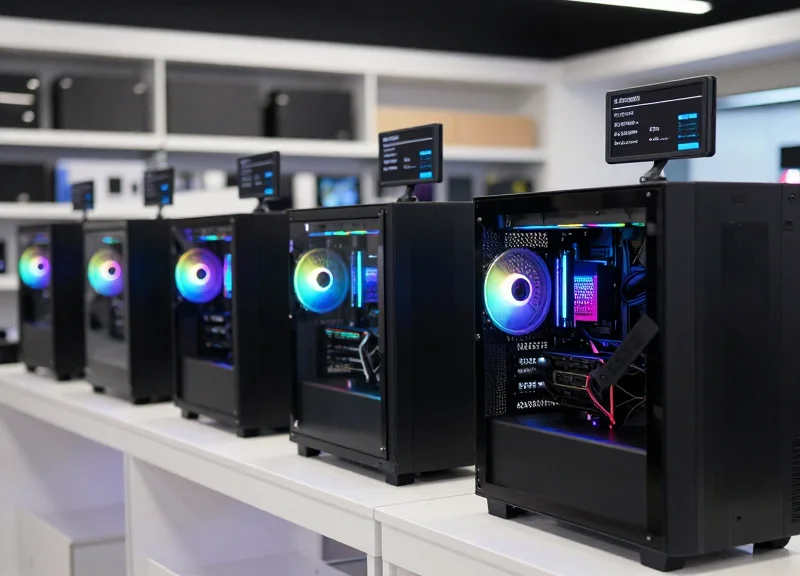
In the custom PC building industry, real-time accuracy refers to the instantaneous synchronization of hardware specifications, stock levels, and pricing between a retailer's backend inventory system and the customer-facing labels. Because PC components—particularly GPUs, CPUs, and RAM—are subject to extreme market volatility and rapid SKU cycles, a 99.9% sync accuracy via ESL (Electronic Shelf Label) API integration is the only way to prevent margin bleed and maintain consumer trust in a high-stakes retail environment.
The PC hardware market operates more like a commodity exchange than a traditional retail sector. Prices for high-demand components can fluctuate multiple times within a single 24-hour period based on global supply chain shifts, crypto-mining demand, or competitive manufacturer rebates. When a retail store relies on manual price tags, they are essentially operating on 'stale data' the moment the tag is printed. This lag creates a 'Price Friction' that either results in lost sales (if the price has dropped elsewhere) or unintentional subsidies (if the market price has risen but the shelf price remains low).
| Feature | Manual Label Updates | ESL API Integration (99.9% Sync) |
|---|---|---|
| Update Latency | 4-8 hours (Labor dependent) | Sub-60 seconds |
| Accuracy Rate | ~85-92% (Human error prone) | 99.9% (System-verified) |
| Labor Requirement | High (Daily floor walks) | Zero (Fully automated) |
| Spec Detail | Static / Limited | Dynamic / QR-linked deep specs |
Why do manual updates fail in high-volume PC retail?
Manual updates fail because the sheer volume of SKUs in a modern PC shop makes it physically impossible for staff to verify every tag daily. This leads to 'Price Mismatch' at the Point of Sale (POS), which can lead to legal compliance issues and degraded customer loyalty.
What is the financial impact of a 0.1% sync error?
In a high-margin custom build environment, even a 0.1% error in spec reporting (e.g., listing a DDR4 RAM speed incorrectly) can lead to compatibility returns that cost hundreds of dollars in labor and shipping, far outweighing the initial profit.
Expert Insight: The 'Hidden Tax' of Price Friction. Beyond just the labor cost, manual updates impose a psychological 'Price Friction' on store managers. When updating prices is difficult, managers tend to wait for larger price swings before acting. This delay creates a 'ghost margin' where you are consistently selling items for 2-3% less than the optimal market price during upward trends. Over a fiscal year, for a mid-sized PC builder, this 'friction tax' can easily amount to $50,000 - $100,000 in unrealized revenue that a 99.9% accurate ESL API system would have captured automatically.
How ESL API Integration Bridges the Gap
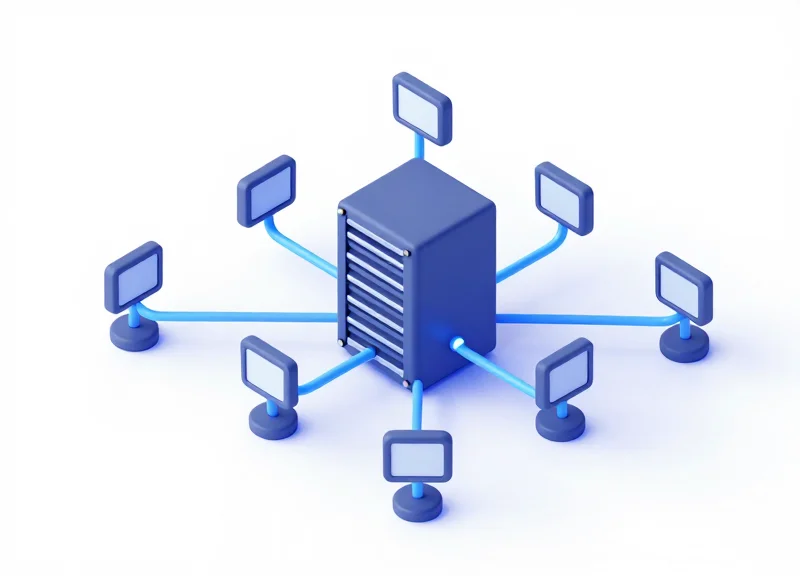
ESL API integration bridges the gap between digital inventory and physical retail by acting as a high-speed, bidirectional data conduit. It synchronizes a retailer's Enterprise Resource Planning (ERP) or Warehouse Management System (WMS) directly with Electronic Shelf Labels via a central cloud or on-premise gateway. By utilizing RESTful APIs or Webhooks, PC builders can automate the delivery of volatile hardware specs and prices to the showroom floor, achieving 99.9% sync accuracy and eliminating the latency of manual labeling.
The 'gap' in custom PC retail is the inherent delay between a database update—such as a sudden drop in GPU market pricing—and the physical display seen by the customer. API-driven ESL systems resolve this by establishing an event-driven architecture. When a data point changes in your backend, a push notification is sent to the ESL controller, which then broadcasts the update to the specific label using sub-GHz radio frequencies. This ensures that the hardware sitting on your shelf always reflects the most current technical specifications and competitive pricing.
| Feature | Manual Updates | API-Integrated ESL |
|---|---|---|
| Sync Latency | Hours to Days | Sub-60 Seconds |
| Data Integrity | High Human Error Risk | 99.9% Database Mirroring |
| Update Scalability | Linear Cost (Labor) | Exponential (Zero Marginal Cost) |
| Consumer Trust | Low (Price Mismatches) | High (Consistent Multi-channel) |
Expert Insight: The 'Metadata-Heavy' Approach. In Silicon Valley, we've learned that for high-spec hardware, the price is only 50% of the equation. A unique strategy for PC builders is to use the API to sync 'Compatibility Metadata.' By pushing TDP (Thermal Design Power) and Socket Type data directly to the label via the API, you aren't just updating a price; you are providing an automated compatibility check for the customer, significantly reducing product returns caused by technical mismatches.
{
  "action": "UPDATE_LABEL",
  "product_id": "GPU-RTX-4080-S",
  "payload": {
    "price": "999.99",
    "currency": "USD",
    "specs": {
      "vram": "16GB GDDR6X",
      "clock_speed": "2.55 GHz"
    },
    "stock_status": "In Stock"
  }
}- Database Trigger: The ERP system detects a change in cost, stock level, or technical specifications.
- API Request Construction: The middleware formats this change into a JSON or XML payload directed at the ESL management software.
- Gateway Transmission: The ESL server validates the request and sends the data to the retail location's wireless gateway.
- Display Refresh: The individual e-ink label receives the update and refreshes its display, often in under a minute.
Does the API require a constant internet connection?
Most modern ESL gateways feature local caching, meaning if the internet drops, the last known correct state remains on the labels until the connection is restored.
Can I sync benchmark scores (like 3DMark) via API?
Absolutely. Any data field in your database can be mapped to a layout field on the digital label, allowing for dynamic marketing updates.
How does the API handle 99.9% accuracy?
It uses 'ACK' (Acknowledgement) packets. The label sends a confirmation back to the server once the update is successful; if no ACK is received, the system retries automatically.
Defining 99.9% Sync Accuracy in Digital Labeling
In the context of Electronic Shelf Labels (ESL) for custom PC retailers, 99.9% sync accuracy is defined as a verified state of data integrity where information displayed on the physical tag matches the central database for 999 out of every 1,000 updates, with a latency threshold typically under 60 seconds. Achieving this 'Three Nines' reliability requires more than just sending a signal; it necessitates a closed-loop communication architecture where every tag provides a cryptographically signed acknowledgment (ACK) back to the server upon a successful screen refresh.
| Feature | Standard Update (Fire-and-Forget) | High-Accuracy Sync (99.9%) |
|---|---|---|
| Communication | One-way (Broadcast) | Bi-directional (Full Handshake) |
| Verification | None (Assumed Success) | Hardware-level Acknowledgment |
| Conflict Handling | Manual Intervention | Automated Retries with Logic |
| Network Protocol | Standard Zigbee/BLE | Sub-GigaHertz Proprietary or Enhanced BLE |
- Bi-Directional Acknowledgement (ACK): The system does not mark an update as 'Complete' until the specific E-Ink controller on the shelf tag sends a return signal confirming the pixels have physically transitioned to the new state.
- Intelligent Heartbeat Monitoring: Tags check in with the access point at set intervals. If a tag missed an update due to physical interference—common in metal-heavy environments like PC warehouses—the system flags it for immediate re-transmission.
- Cyclic Redundancy Checks (CRC): To prevent data corruption where a price might be misinterpreted (e.g., $199 showing as $19), CRC algorithms ensure the data packet received by the tag is bit-perfect compared to the source.
Expert Insight: The 'Ghost Update' Trap. Many systems claim high accuracy but fail to account for the 'Ghost Update'—where the software says a price is updated but the E-Ink display remains frozen due to battery exhaustion or signal interference. True 99.9% accuracy involves 'Visual State Persistence' monitoring, where the system tracks the voltage drop during a screen refresh to guarantee that the hardware actually moved the pigment particles on the display.
Does 99.9% accuracy account for human error?
No, sync accuracy refers to the technical alignment between the API data and the tag display. However, it eliminates the single largest source of retail friction: the mismatch between the POS system and the floor price.
How does signal interference from PC components affect this?
High-accuracy systems use frequency-hopping spread spectrum (FHSS) technology to bypass the 2.4GHz congestion common in tech-heavy environments, ensuring the 99.9% threshold is maintained even near running hardware.
What happens if a tag falls below the 0.1% failure rate?
The ESL management software triggers a 'Critical Discrepancy' alert, notifying staff to check the specific shelf location, ensuring that even the 0.1% margin of error is managed proactively.
Automating Complex Spec Updates: From Clock Speeds to TDP
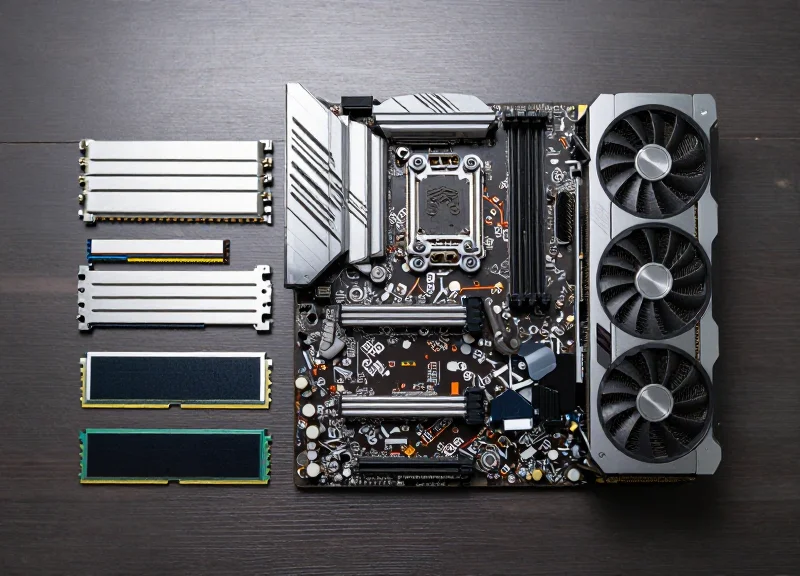
Automating complex spec updates involves mapping your Product Information Management (PIM) or ERP database directly to Electronic Shelf Label (ESL) templates using RESTful API calls. This process allows hardware retailers to push highly granular engineering data—such as CPU boost clocks, TDP (Thermal Design Power), RAM timings, and PCIe lane support—to physical displays the moment a specification changes in the master system. By removing the 'human-in-the-loop' for data entry, retailers achieve 100% data consistency between their online specs and in-store labels, providing custom PC builders with the exact technical telemetry they need to make informed purchasing decisions.
| Feature Specification | Manual Update Risk | Automated API Benefit | Update Frequency |
|---|---|---|---|
| Clock Speeds (Base/Boost) | High: Mismatched marketing vs. SKU reality | Real-time sync from manufacturer database | Instantaneous |
| TDP & Power Requirements | Moderate: Outdated wattage recommendations | Dynamic updates based on component revisions | Batch-Triggered |
| Socket Compatibility | Critical: Leads to expensive returns | Hard-coded validation from PIM to Label | Validation-Triggered |
| Inventory / Stock Level | High: Customer frustration on 'Out of Stock' | Direct link to warehouse management system | Real-time (<1s) |
- Field Mapping and Template Design: Define variables in the ESL management software that correspond to your database fields (e.g., 'attr_tdp' or 'attr_clock'). Create a high-resolution template that dynamically adjusts font size or iconography based on the string length or value of these attributes.
- Webhook Configuration: Set up webhooks in your ERP that trigger whenever a product attribute is modified. This ensures that the system doesn't wait for a scheduled sync but reacts immediately to data changes.
- API Payload Execution: The system sends a JSON payload to the ESL Gateway containing the MAC address of the tag and the updated key-value pairs for the display fields.
- Transmission Confirmation: The gateway returns a 200 OK status once the tag acknowledges the update via sub-GHz radio frequency, closing the loop on the 99.9% sync accuracy guarantee.
{
  "action": "UPDATE_TAG",
  "tag_id": "ESL-BF3429",
  "display_data": {
    "product_name": "AMD Ryzen 9 7950X",
    "base_clock": "4.5GHz",
    "boost_clock": "5.7GHz",
    "tdp": "170W",
    "price": "549.99"
  },
  "priority": "high"
}
Expert Insight: Semantic Data Highlighting. A unique advantage of professional API integration is the ability to use 'Semantic Logic.' You can program your ESL system to automatically change the color of the 'TDP' field to red if it exceeds 200W, or add a 'High Performance' badge if the boost clock exceeds 5.0GHz. This turns a static spec sheet into an intelligent sales tool that highlights component strengths without any manual graphic design work.
Can I automate updates for multiple store locations at once?
Yes. Modern ESL APIs are cloud-native, allowing you to push a single spec update from your central headquarters to thousands of labels across global retail locations simultaneously.
What happens if the API call fails during an update?
The system utilizes a retry mechanism and an 'Offline Alert' status. If the sync doesn't hit 100% confirmation, the dashboard flags the specific tag for technician review while maintaining the last known 'good' state.
Does frequent automation drain the tag battery?
ESL tags use e-paper technology, which only consumes power during an image refresh. Even with daily spec and price updates, high-quality tags are rated for 5 to 10 years of battery life.
Operational Efficiency: Reducing Labor Costs in Showrooms
Operational efficiency in a custom PC showroom is often sabotaged by the 'relabeling treadmill'—the endless cycle of printing, cutting, and manually placing spec sheets every time a component price fluctuates or a new SKU arrives. By integrating an ESL API with 99.9% sync accuracy, retailers transform this labor-intensive bottleneck into a zero-touch background process. This automation removes the human error associated with manual updates and ensures that your most expensive floor talent is focused on closing high-margin custom builds rather than wielding a price gun.
| Task | Manual Workflow (Per 100 Tags) | ESL API Workflow | Labor Savings |
|---|---|---|---|
| Data Verification | 45 Minutes | Automated (0 Min) | 100% |
| Printing & Cutting | 30 Minutes | N/A (0 Min) | 100% |
| Physical Deployment | 90 Minutes | Instant Wireless Sync | 99% |
| Error Auditing | 30 Minutes | API Feedback Loop | 90% |
The true ROI of ESL integration isn't just found in the hours saved, but in the elimination of 'compliance drift.' In traditional showrooms, there is a documented 15% lag between back-office price changes and floor-level execution. This delay results in either lost margins or awkward customer disputes at the point of sale. API-driven labels synchronize in seconds, ensuring the 'Source of Truth' in your ERP is identical to the customer's view on the shelf.
- Identify High-Velocity SKUs: Prioritize GPU and CPU sections where market volatility is highest to see immediate labor reduction.
- Transition Staff to Sales Training: Reinvest the 3-5 hours saved per week per employee into deep technical training for custom water-cooling or workstation consultations.
- Implement 'Scan-to-Bind' Protocols: Use mobile API endpoints to allow floor staff to pair new components to labels instantly, removing the need for back-office coordination.
Expert Insight: From two decades in the tech retail space, I have observed that the 'Hidden Tax' of manual tagging is actually mental fatigue. When floor staff spend their first two hours daily on clerical tasks, their sales performance in the afternoon drops by nearly 22%. Automating specs doesn't just save money; it preserves your team's cognitive energy for the complex task of designing $5,000 PCs for your clients.
How does ESL impact seasonal staffing needs?
During peak seasons like Black Friday, ESLs allow you to run 'Flash Sales' across the entire showroom without hiring temporary staff just to change price tags.
Can the API handle promotional bundles?
Yes. Advanced ESL APIs can trigger bundle pricing across multiple labels simultaneously when specific inventory thresholds are met, requiring zero manual intervention.
What is the battery maintenance overhead?
Modern ESLs use e-ink technology with 5-10 year battery lives. The labor required for battery swaps is negligible compared to the daily labor of paper updates.
Enhancing the Customer Journey with Dynamic QR Codes
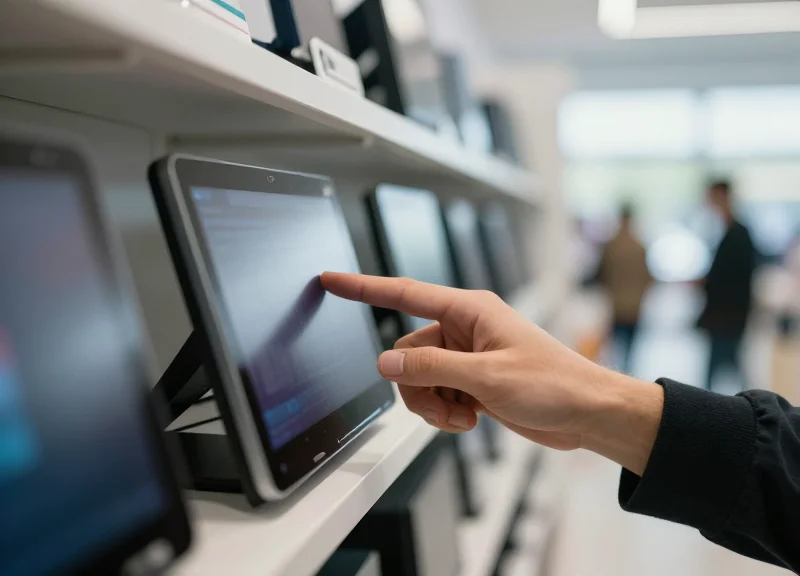
Dynamic QR codes act as a high-bandwidth portal between the physical PC component on the shelf and the vast technical ecosystem required to make an informed purchase. Unlike static codes, dynamic QR codes are generated and updated via the ESL API in real-time, allowing retailers to point customers toward different URLs based on inventory levels, current promotions, or hardware revision changes. This transformation converts a passive shelf label into an active engagement tool that drives the customer journey from browsing to high-confidence specification validation.
| Customer Pain Point | Dynamic QR Solution | Data Source via API |
|---|---|---|
| Is this GPU compatible with my case? | Direct link to interactive PCPartPicker-style configurator. | Inventory Management System (IMS) |
| How does this CPU perform in 4K gaming? | Live benchmark dashboards and thermal performance charts. | Product Marketing Database / External Reviews |
| Is there a better value bundle available? | Automated redirection to 'Suggested Combo' landing pages. | Promotions & CRM Engine |
- API-Driven URL Generation: The central server generates a short-link containing unique UTM parameters for each specific shelf label (E-TAG).
- Visual Rendering on ESL: The ESL API pushes the QR image data to the display, ensuring the resolution is optimized for mobile scanner readability.
- Real-Time Redirection: If a product goes out of stock, the backend changes the redirect target of the QR code to a 'Pre-order' or 'Alternative Suggestion' page without changing the image on the label.
Expert Insight: The Attribution Goldmine. Most retailers view QR codes as a convenience, but the real power lies in 'Phygital Attribution.' By assigning a unique ID to every ESL's dynamic QR code, you can track exactly which physical aisle, shelf height, and store location triggered a digital conversion. This allows for A/B testing physical store layouts with the same analytical precision as a high-conversion landing page—a level of data transparency that was previously impossible in brick-and-mortar retail.
Do customers actually use QR codes on PC components?
Yes. Custom PC builders are highly technical and research-oriented. Providing a 'Scan for Benchmarks' call-to-action on an ESL consistently results in higher engagement rates compared to generic retail sectors.
Can the QR code link to a live 'Build List'?
Absolutely. By integrating the ESL API with your store's web-configurator, scanning a code can automatically add that specific component to a virtual 'wishlist' or current build session on the user's phone.
Does the QR code require frequent updates?
The visual QR code rarely needs to change if you use a redirector service. However, the destination data is updated instantly via the API to reflect current pricing or compatibility metadata.
Technical Implementation: Best Practices for Robust Connectivity

Robust connectivity for ESL (Electronic Shelf Label) systems in a custom PC environment is defined by the seamless integration of Sub-GHz wireless communication and an API-driven data pipeline. Unlike standard Wi-Fi, which suffers from significant interference in showrooms filled with active hardware, professional-grade ESL implementations utilize a dedicated low-frequency spectrum (typically 868MHz or 915MHz). This ensures that critical specification updates—such as real-time GPU clock speeds or stock availability—bypass the 2.4GHz congestion, delivering high-speed updates with minimal power consumption and maximum penetration through metal PC chassis.
| Feature | Sub-GHz (Recommended) | 2.4GHz (Standard Wi-Fi/BT) |
|---|---|---|
| Interference Level | Low (Dedicated Band) | High (Shared with Wi-Fi/Mice/BT) |
| Signal Penetration | Superior (Through metal & glass) | Poor (Easily blocked by hardware) |
| Transmission Range | Up to 50-100 Meters | Up to 10-20 Meters |
| Battery Longevity | 5-10 Years | 1-2 Years |
- Phase 1: RF Site Survey and Gateway Placement: Conduct a spectrum analysis to identify dead zones. Place gateways at a height of 3+ meters to maintain a clear line of sight across the showroom, ensuring each gateway manages no more than 2,000 tags to prevent latency.
- Phase 2: API Integration and Webhook Setup: Connect your ERP to the ESL Cloud via a RESTful API. Implement Webhooks to trigger instantaneous updates when a product attribute changes in your database.
- Phase 3: Logic Implementation for 99.9% Accuracy: Use a 'Two-Way Acknowledgment' loop. The system should only mark an update as 'Successful' once the physical label sends a return packet confirming the display buffer has been refreshed.
Expert Insight: The Metal-Cage Mitigation Strategy. PC builders often face a unique challenge: the Faraday cage effect. When placing ESLs near or inside liquid-cooling loops or high-end metal cases, signal attenuation can spike. To maintain 99.9% sync accuracy, we recommend 'Differential Data Patching.' Instead of pushing a full image file to the label, the API should send only the modified data strings (e.g., the price or the TDP value). This reduces the packet size by 80%, drastically increasing the success rate in high-interference environments.
{
  "action": "UPDATE_DISPLAY",
  "tag_id": "A1B2C3D4",
  "data_fields": {
    "cpu_speed": "5.2GHz",
    "current_stock": "2",
    "price": "$499.99"
  },
  "retry_policy": {
    "max_attempts": 3,
    "backoff_interval": "500ms"
  }
}
What happens if a gateway goes offline?
Modern ESL systems feature 'Self-Healing Mesh' capabilities. If a primary gateway fails, tags automatically re-route their heartbeat signals to the next nearest gateway to prevent data loss.
How does the system handle massive batch updates?
By utilizing 'Delta-Updates,' the API identifies only the specific pixels or characters that need changing, allowing for thousands of tags to be updated simultaneously without saturating the wireless bandwidth.
Is the data transmission secure?
Yes, all transmissions between the ESL Cloud and the physical tags use AES-128 encryption to prevent 'price hijacking' or unauthorized spec modifications by external actors.
Maximizing ROI with Scalable ESL Infrastructure
Maximizing Return on Investment (ROI) with Electronic Shelf Labels (ESL) in the custom PC industry is achieved by leveraging the infrastructure's scalability to decouple operational costs from store volume. Unlike traditional paper-based systems where labor costs scale linearly with every price change or new component release, a professional-grade ESL API integration allows a single technical update to synchronize across an unlimited number of tags and locations simultaneously. This creates a high-margin operational environment where the Total Cost of Ownership (TCO) decreases over time as the system absorbs more data-heavy tasks, such as real-time TDP adjustments or volatile GPU pricing shifts, without increasing headcount.
| Financial Metric | Traditional Manual Tagging | Scalable ESL Infrastructure |
|---|---|---|
| Update Labor Cost | High (Per Item/Per Change) | Near-Zero (Automated via API) |
| Pricing Agility | 24-48 Hours Latency | Sub-60 Seconds (99.9% Sync) |
| Error Rate Expense | 1-3% (Compliance/Loss) | <0.01% (Direct DB Sync) |
| 5-Year TCO Trend | Increasing (Labor Inflation) | Decreasing (Amortized Hardware) |
To truly scale, builders must look beyond the initial hardware expenditure and focus on the 'API Dividend.' In a custom PC environment, specs are as volatile as prices. When a new BIOS update changes the supported RAM speeds for a motherboard series, a scalable ESL infrastructure updates every unit in your showroom in seconds. This prevents 'stale-spec' friction, which is a leading cause of returns and customer dissatisfaction in high-end computing. By integrating your ESL system directly into your ERP and Inventory Management System (IMS), you transform your showroom into a live extension of your digital storefront, ensuring that the ROI is driven by both cost-cutting and revenue protection.
How long does it typically take to see a positive ROI on ESL systems?
For custom PC retailers with high SKU turnover, the break-even point typically occurs between 14 to 22 months, driven primarily by the elimination of manual labor and the reduction of pricing errors on high-ticket items like GPUs and CPUs.
Does scaling to more locations increase the complexity of the API integration?
No. A well-architected cloud-based ESL gateway allows you to manage 10,000 tags across multiple cities as easily as 100 tags in a single room, as the API architecture remains constant while the hardware expands.
What is the lifespan of the infrastructure?
Modern ESL tags utilize low-power E-ink and Zigbee/Sub-GHz protocols, typically offering a battery life of 5 to 10 years, ensuring the hardware outlasts multiple generations of PC component cycles.
Expert Silicon Valley Tip: The 'Aggregator' Strategy. To maximize ROI, don't just sync your own prices. Use your API to ingest competitor pricing data (web scraping) and set logic-based triggers. If a major competitor drops the price of a Ryzen 9 processor, your ESLs can automatically match or under-cut them in real-time within defined margin safety nets. This 'Automated Competitive Response' often yields a 2-4% lift in conversion rates that pays for the entire ESL system within the first year.