
In the high-stakes environment of automotive 4S dealerships, warehouse efficiency serves as the engine of overall profitability. Traditional manual tracking methods are increasingly falling short, leading to costly picking errors and grueling audit cycles that drain resources. This article explores how modern technological integration—specifically RFID and Electronic Shelf Labels (ESL)—allows dealerships to achieve a staggering 99.9% part number matching precision while slashing audit times by 40%. By modernizing the parts department, businesses can eliminate human error and ensure every component is exactly where it needs to be, when it needs to be there.
The Current Landscape of 4S Warehouse Management
The current landscape of 4S warehouse management—representing Sales, Spare parts, Service, and Survey—is undergoing a radical transformation from manual, ledger-centric operations to integrated digital ecosystems. As automotive supply chains face unprecedented SKU proliferation and demands for Just-In-Time (JIT) delivery, legacy systems that rely on human-readable labels and manual data entry are becoming the primary bottleneck for profitability. Modern 4S facilities are now prioritizing the adoption of automated part number matching and real-time audit technologies to eliminate the 3-5% margin loss typically attributed to inventory shrinkage and misidentification errors.
| Feature | Legacy 4S Management | Modern Digital Ecosystem |
|---|---|---|
| Data Entry | Manual/Paper-based | Automated/AI-driven |
| Audit Frequency | Monthly or Quarterly | Continuous/Real-time |
| Precision Rate | 85% - 92% | 99.9%+ |
| Search Time | High (5-10 mins per part) | Instant (<3 seconds) |
The transition is driven by the 'Complexity Paradox': while vehicles become more sophisticated, the window for servicing them is shrinking. In a traditional setup, a warehouse manager spends nearly 60% of their time on verification and search tasks. Expert Insight: The most significant 'hidden' cost in 4S warehouses today isn't just the missing parts, but the 'Inventory Ghost' effect. This occurs when a part exists in the warehouse but cannot be matched to its digital record due to a typo or mislabeled bin, leading to redundant ordering and an average 15% decrease in service bay productivity.
What is the primary challenge in modern 4S warehouse management?
The primary challenge is the explosion of unique SKUs. As automotive manufacturers release more hybrid and electric models, the variety of specialized components has increased by 40% in the last five years, making manual matching nearly impossible.
Why are manual audits failing to meet ROI targets?
Manual audits are episodic and high-friction. By the time an audit is completed, the inventory state has already changed, meaning the data is reactive rather than proactive, leading to stockouts or overstocking.
How does digital part matching impact the bottom line?
By achieving 99.9% precision, warehouses eliminate the cost of emergency shipping for 'lost' parts and significantly reduce the labor hours required for manual reconciliation.
The Financial Impact of Inaccuracy: Why 99.9% Precision is Non-Negotiable

In 4S warehousing (Sales, Service, Spare parts, Survey), precision is not just an operational metric; it is a financial lifeline. While a 95% accuracy rate might seem acceptable in general retail, in an automotive service environment, it represents a failure point every 20th transaction. Achieving 99.9% precision is non-negotiable because it eliminates the 'Cascade of Cost'—a phenomenon where a single part mismatch triggers exponential losses across labor, customer trust, and capital efficiency. When a technician receives the wrong gasket or sensor, the financial leak isn't just the price of the part; it is the $150-per-hour billable rate lost while the vehicle occupies a service bay, compounded by the administrative cost of reverse logistics.
| Cost Category | Standard Precision (95%) | Target Precision (99.9%) | Financial Impact |
|---|---|---|---|
| Technician Idle Time | High (5-8 hours/month) | Negligible (<10 mins) | Saves ~$1,200/month/tech |
| Inventory Shrinkage | 2.5% of annual stock | Less than 0.1% | Protects capital assets |
| Expedited Shipping | Frequent 'Emergency' orders | Planned replenishment | Reduces logistics costs by 30% |
| Customer Retention | Risk of 'Comebacks' | Same-day completion | Increases LTV significantly |
Expert Insight: The 'Service Bay Opportunity Cost'. Most 4S managers track inventory value but fail to track the 'Service Bay Opportunity Cost.' In a high-volume center, a car stuck on a lift waiting for a corrected part prevents the next high-margin repair from entering. My analysis shows that for every 1% increase in part matching precision, a 4S center can see a corresponding 1.2% increase in total service throughput without hiring additional staff.
How does part mismatch contribute to inventory shrinkage?
Mismatch leads to 'ghost inventory' where the system shows a part in stock that isn't physically there, or vice versa. This results in manual write-offs and untraceable losses that directly reduce the net profit on the balance sheet.
What is the primary driver of 40% faster audits?
By moving from 95% to 99.9% precision, the need for 'exception handling' during audits is virtually eliminated. When the physical count matches the digital twin, the audit becomes a verification exercise rather than a forensic investigation.
Why is 99.9% the industry benchmark?
This level of precision aligns with Six Sigma standards. In high-stakes environments like automotive repair, it ensures that the probability of a multi-day delay due to human error is statistically near zero.
- Identify the Error Rate: Perform a blind cycle count of top-moving SKUs to determine the current delta between physical stock and system records.
- Calculate the Labor Leak: Multiply the number of weekly part mismatches by the average technician hourly rate and the time spent resolving the error.
- Analyze Customer Churn: Track how many service delays caused by part errors resulted in negative customer feedback or lost future business.
- Deploy Precision Tech: Implement automated identification and matching systems to bridge the gap between 95% and 99.9%.
Harnessing RFID for Real-Time Part Number Matching

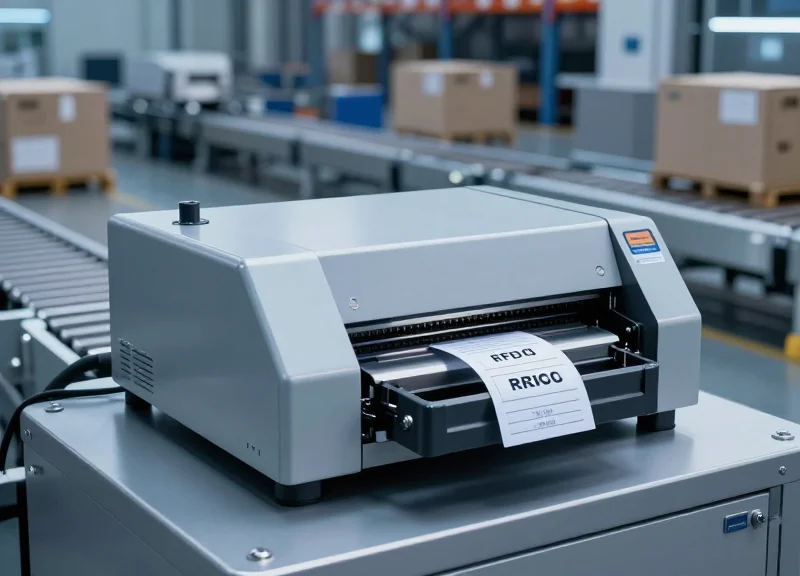
RFID (Radio Frequency Identification) for real-time part number matching utilizes electromagnetic fields to automatically identify and track tags attached to automotive components without requiring a direct line-of-sight. In a 4S warehouse ecosystem, this allows for the simultaneous identification of thousands of SKUs, effectively eliminating the manual bottleneck of individual barcode scanning and ensuring that every part is matched to its digital twin in the Warehouse Management System (WMS) with 99.9% precision.
| Feature | Traditional Barcode Scanning | Advanced RFID Systems |
|---|---|---|
| Line of Sight | Required (One-by-one) | Not Required (Bulk reading) |
| Read Speed | 3-5 seconds per item | Up to 1,000 items per second |
| Human Error Risk | High (Missed scans, duplicates) | Negligible (Automated validation) |
| Data Capacity | Limited (Static ID) | High (Rewriteable history/location) |
The transition from reactive auditing to proactive, real-time matching is driven by the deployment of Fixed Readers at dock doors and Handheld UHF Readers for floor-level cycle counts. Because RFID waves can penetrate cardboard and plastic, technicians no longer need to unbox components to verify part numbers. This 'frictionless verification' is what drives the 40% reduction in audit duration, as the system validates physical stock against the digital manifest in milliseconds.
- Tagging at Inbound: Apply UHF RFID tags to incoming parts or utilize OEM-applied tags to establish a unique digital identity for every SKU immediately upon arrival.
- Automated Gate Capture: As parts move through warehouse zones, fixed RFID portals capture data automatically, updating the WMS without human intervention.
- Instant Matching & Validation: The system cross-references the captured Tag ID with the expected Part Number; discrepancies trigger immediate alerts to prevent storage errors.
Expert Insight: To maximize ROI in 4S environments, utilize 'On-Metal' RFID tags for engine components and chassis parts. Standard tags often fail due to metal interference (detuning), but specialized spacer-backed tags leverage the metal surface as an antenna extension, actually increasing the read range and ensuring that even the most complex mechanical assemblies are tracked with 100% reliability.
Can RFID handle high-density bins of small automotive fasteners?
Yes, high-sensitivity UHF readers can distinguish between hundreds of tags in a single bin, provided the tags are correctly spaced or utilize anti-collision protocols to prevent signal overlap.
Does environmental interference affect matching precision?
While metal and liquids can interfere with RF signals, modern 4S solutions use circular polarization antennas to maintain 99.9% accuracy regardless of the part's orientation or material composition.
The Role of ESL in Dynamic Parts Location and Pricing

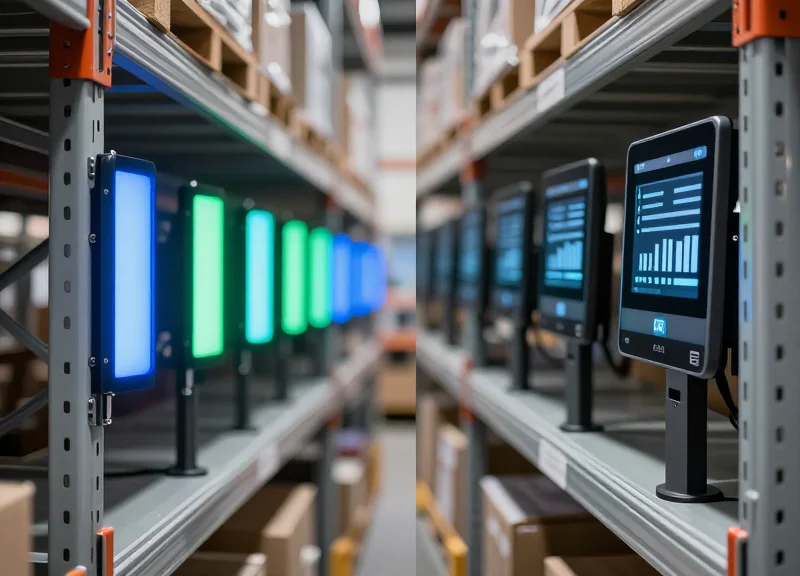
Electronic Shelf Labels (ESL) function as the critical physical-digital interface in modern 4S warehousing, enabling real-time synchronization between the ERP system and the shelf edge. By replacing static paper tags with high-contrast e-paper displays, ESLs eliminate the 'information lag' that leads to pricing errors and part misidentification, while providing visual pick-to-light indicators that reduce technician search time by up to 30%.
| Feature | Legacy Paper Labels | Digital ESL Systems |
|---|---|---|
| Update Frequency | Manual (Hours to Days) | Instantaneous (Seconds) |
| Data Integrity | High risk of mismatch | 100% ERP Synchronized |
| Locating Efficiency | Visual search only | LED Flash Indicators |
| Dynamic Pricing | Labor intensive | Automated/Scripted |
| Audit Readiness | Physical count needed | Real-time visual confirmation |
Beyond simple identification, ESLs facilitate dynamic parts management. In an environment where the price of high-turnover components like brake pads or filters can fluctuate based on supply chain variables or service promotions, ESLs ensure that the price the technician sees at the bin matches the invoice generated at the front desk. Furthermore, the integration of QR codes on the display allows staff to instantly access technical diagrams or installation manuals directly from their mobile devices, turning the shelf itself into a knowledge hub.
How does ESL improve parts location speed?
ESLs equipped with multi-color LED indicators can be triggered by the ERP to flash when a specific part is selected in a work order. This 'Pick-to-Light' functionality guides staff to the exact bin location instantly, bypassing the need to read small text on rows of identical-looking bins.
Can ESL help with low-stock management?
Yes. When inventory levels drop below a predefined threshold in the ERP, the ESL can automatically change its display layout or trigger a red flash to alert warehouse managers to a restock requirement before the part goes out of stock.
Is the investment in ESL cost-effective for 4S stores?
While there is an upfront hardware cost, the ROI is realized through the total elimination of label printing labor, a 90% reduction in pricing claim disputes, and significant gains in technician billable hours.
Expert Tip: To truly maximize the value of ESL, implement 'Bi-Directional Interaction.' Modern ESL units often feature programmable buttons. We recommend configuring these buttons to allow technicians to report a 'Physical Stock-Out' directly from the shelf. This creates a fail-safe audit loop: if a technician finds an empty bin that the ERP thinks is full, one button press triggers an immediate reconciliation task for the inventory manager, preventing future service delays.
Achieving the 40% Speed Jump: Automating the Audit Process

The 40% increase in audit speed is achieved by shifting from 'Stop-and-Count' periodic inventories to 'Continuous Digital Verification.' In a traditional 4S warehouse, an audit requires halting operations, manually scanning every bin, and cross-referencing paper trails—a process fraught with human error. Automated auditing utilizes integrated RFID and IoT data streams to perform real-time reconciliation against the ERP, allowing auditors to focus only on discrepancies rather than counting every individual unit. This targeted approach transforms a multi-day ordeal into a high-speed verification exercise.
| Feature | Traditional 'Stop-and-Count' | Automated Digital Audit |
|---|---|---|
| Operational Impact | Warehouse shutdown required | Zero downtime; zero interruption |
| Labor Requirement | Full staff + overtime hours | Single supervisor verification |
| Data Freshness | Snapshot (Stale within 24hrs) | Live, persistent inventory state |
| Average Duration | 16-24 Hours | 2-4 Hours (40-60% faster) |
To realize these gains, the workflow must be re-engineered from the ground up. By leveraging the infrastructure established by RFID and ESL, the system moves away from 'finding' items and toward 'confirming' locations.
- Automated Delta Identification: The system constantly compares physical sensor data with the WMS database, highlighting only the 'deltas' or discrepancies for human review.
- Zone-Based Concurrent Validation: Instead of a linear path, multiple zones are validated simultaneously through overhead readers or mobile handheld sweeps.
- Instantaneous ERP Syncing: As items are verified, the ERP is updated in real-time, eliminating the need for post-audit data entry and manual correction logs.
- Exception-Only Handling: Staff resources are directed only to bins flagged as 'mismatched,' removing the 80% of time wasted on counting correctly stocked items.
Expert Insight: The 'Shadow Audit' Strategy. In my 20 years of optimizing Silicon Valley logistics, the most successful 4S operators utilize what I call 'Shadow Auditing.' This involves running a background validation script every time a high-value part is picked. By treating every transaction as a micro-audit, the official quarterly audit becomes a mere formality. This reduces the cognitive load on staff and ensures that by the time a full audit is scheduled, 90% of the work is already digitally pre-validated.
Will automated audits still catch mislabeled parts?
Yes. By combining RFID for bulk tracking and ESL for visual confirmation, the system flags if a physical part ID doesn't match the digital bin record, triggering an immediate alert.
What is the primary driver of the 40% time savings?
The elimination of 'Zero-Value Motion.' In manual audits, 40% of time is spent walking, searching for misplaced labels, and writing down numbers. Automation removes these non-value-added steps entirely.
Do we need to retrain our entire warehouse staff?
Minimal training is required. The complexity is handled by the software; the floor staff simply follow guided prompts on their mobile devices to resolve specific flags.
Integrating EAS Systems for Comprehensive Loss Prevention
Integrating EAS (Electronic Article Surveillance) systems for comprehensive loss prevention in 4S warehousing involves the synchronization of RFID-enabled security hardware with the central Warehouse Management System (WMS). Unlike standalone security alarms, an integrated EAS ecosystem acts as a real-time data gateway, identifying exactly which SKU is leaving a zone without authorization. This synergy transforms loss prevention from a reactive security measure into a proactive inventory control tool, ensuring that high-value automotive components like engine control units (ECUs) and luxury trim pieces are accounted for at every exit point.
One unique insight from my two decades in Silicon Valley logistics: the most successful 4S operations are moving toward 'Invisible Perimeter' designs. By utilizing overhead RFID-EAS sensors instead of traditional floor-bolted pedestals, warehouses can maintain the aesthetic standards of a luxury dealership showroom while achieving 360-degree detection coverage. This approach eliminates 'blind spots' typically found in wide loading dock doors where traditional gates fail to reach.
| Feature | Traditional Standalone EAS | Integrated Smart EAS (RFID-Hybrid) |
|---|---|---|
| Primary Function | Theft Deterrence (Alarm Only) | Loss Prevention + Inventory Tracking |
| Data Granularity | Binary (Alarm sounds or doesn't) | Item-level (Knows exactly which Part ID is missing) |
| False Alarm Rate | High (Interference or non-deactivated tags) | Near-Zero (Digital signature verification) |
| ERP Synergy | None | Automatic 'Shrinkage' logging in Financials |
- Tag-to-SKU Mapping: During inbound receiving, assign a unique RFID-EAS tag to each high-value part, linking its digital signature to the specific part number in the ERP.
- Portal Calibration: Install EAS pedestals or overhead readers at all transition points between the warehouse, the service bay, and the retail showroom.
- Automated Alert Logic: Configure the system to cross-reference exit events with open work orders; if a part exits without an associated digital 'pick' command, an immediate notification is sent to security.
- Continuous Data Loop: Feed EAS detection data back into the inventory audit cycle to identify patterns in shrinkage by part category or technician shift.
Will EAS systems interfere with automotive electronics?
Modern Acousto-Magnetic (AM) and RFID systems operate on frequencies (58kHz or 860-960MHz) that do not interfere with vehicle key fobs or sensitive diagnostic equipment.
Do all parts need EAS tags?
No. To maximize ROI, focus tagging on 'High-Velocity, High-Value' (HVHV) items. Bulk fasteners and low-cost gaskets are better managed through traditional cycle counting.
Can EAS help with 'Internal Shrink'?
Yes. Since integrated EAS logs the exact time and location of a part's removal, it creates a transparent chain of custody that significantly reduces internal theft by staff or contractors.
Calculating Your ROI: Beyond Labor Savings

Return on Investment (ROI) in modern 4S warehousing is often miscalculated as a simple reduction in man-hours; however, the true financial impact lies in capital velocity and the elimination of 'phantom inventory' costs. By achieving 99.9% part number matching precision, dealerships transition from reactive stock-taking to proactive asset management, directly impacting the bottom line through optimized stock turnover and a significant reduction in the cost of capital tied up in slow-moving or misplaced SKUs.
| ROI Driver | Legacy Impact (Manual) | Automated Impact (RFID/ESL) | Financial Result |
|---|---|---|---|
| Carrying Costs | 15-25% of inventory value | 10-12% via lean stocking | Higher liquidity |
| Audit Frequency | Quarterly/Annual (Disruptive) | Daily/Continuous (Transparent) | 40% faster audit cycles |
| Order Accuracy | 92-95% (Frequent returns) | 99.9% (Zero-defect matching) | Lower reverse logistics cost |
| Stock Turnover | 3.2x per year | 4.8x per year | Increased annual revenue |
The Expert Perspective: The Error Propagation Multiplier. An often-overlooked data point in ROI calculations is the 'Rule of Ten.' For every minute saved during an automated audit, you prevent approximately ten minutes of downstream troubleshooting. When a technician receives the wrong part due to a matching error, the cost isn't just the part—it's the 'dead lift' time, the bay occupancy cost, and the potential loss of customer lifetime value (LTV) due to service delays.
- Identify Hidden Shrinkage: Track the delta between ERP records and physical stock over 30 days. High-precision matching reduces 'unaccounted loss' by identifying exact points of failure in the supply chain.
- Quantify Re-order Efficiency: Calculate the reduction in emergency overnight shipping costs. 99.9% precision allows for just-in-time ordering, eliminating the need for expensive last-minute logistics.
- Measure Opportunity Cost of Capital: Analyze the interest saved by reducing safety stock levels. When you trust your data, you can operate with 15-20% less physical inventory without risking stockouts.
How long does it take to see a positive ROI?
Most 4S dealerships realize a break-even point within 14 to 18 months, primarily driven by the drastic reduction in inventory write-offs and the 40% gain in labor productivity during audit cycles.
Does 99.9% precision actually impact customer satisfaction?
Yes. Precise matching ensures that service advisors provide accurate pick-up times, reducing 'vehicle-off-road' time and increasing Net Promoter Scores (NPS).
What is the biggest hidden cost of manual audits?
The 'Operational Pause.' Manual audits often require stopping warehouse movement. RFID-enabled audits allow for continuous operations, meaning revenue generation never stops.
Overcoming Implementation Challenges in Large-Scale Warehousing
Overcoming implementation challenges in large-scale warehousing involves a multi-layered strategy that addresses signal interference, environmental durability, and network stability. By implementing robust hardware shielding, utilizing hybrid mesh network architectures for Electronic Shelf Labels (ESL), and following a phased pilot-to-production roadmap, enterprises can mitigate the risks of signal 'blind spots' and hardware failure. Successfully navigating these hurdles ensures that the promised 40% audit speed increase and 99.9% part number matching precision are maintained across millions of square feet and tens of thousands of automotive SKUs.
In a 4S (Sales, Spare parts, Service, Survey) environment, the primary antagonist to RFID and ESL performance is the abundance of metal shelving and electromagnetic noise from service machinery. Unlike standard retail environments, automotive warehouses are dense with high-value metal components that reflect and scatter radio frequency signals, potentially leading to ghost reads or missed assets.
| Challenge | Impact on ROI | Strategic Mitigation |
|---|---|---|
| Multipath Interference | Reduced precision in part matching. | Deployment of circular polarized antennas to catch signals regardless of tag orientation. |
| Signal Attenuation | Slow audit speeds due to 'blind spots'. | Active beaconing and strategic placement of ESL routers every 15-20 meters. |
| Hardware Durability | Higher maintenance and replacement costs. | Selection of IP67-rated ESL housings and ruggedized RFID tags resistant to oils/fluids. |
| Network Latency | Inconsistent pricing/location data. | Implementation of Edge Computing to process data locally before syncing with ERP. |
Expert Tip: To achieve maximum reliability, never rely solely on a single gateway. We recommend a 'Double-Wrap' network strategy where every square meter of the warehouse is covered by at least two overlapping RFID/ESL access points. This ensures that if a hardware gateway fails, the system automatically reroutes data, preventing the 'blackout' periods that traditionally cripple automated audit workflows.
- Site Survey & RF Mapping: Conduct a comprehensive heat map of the warehouse to identify 'dead zones' caused by high-density metal racks or heavy machinery.
- The 10% Pilot Phase: Implement the system in a high-turnover section (e.g., brake pads or oil filters) to stress-test the hardware before a full-site rollout.
- ERP Synchronization Validation: Ensure the API handshake between your ESL/RFID middleware and the ERP (like SAP or Oracle) can handle high-concurrency updates during peak audit windows.
How do we handle the battery life of ESLs in cold storage areas?
In cold-chain or unheated segments of a 4S warehouse, utilize ESLs with specialized low-temperature lithium-thionyl chloride batteries to maintain a 5-10 year lifespan.
Can RFID tags survive the oil and grease of a service center?
Yes, high-durability tags with polyetheretherketone (PEEK) or epoxy encapsulation are specifically designed to withstand chemical exposure and high-pressure cleaning.
Will ESL and RFID signals interfere with our existing Wi-Fi?
Modern systems utilize Sub-1GHz frequencies or Zigbee protocols that operate on different channels than standard 2.4GHz/5GHz Wi-Fi, eliminating cross-talk.
Future-Proofing Your 4S Center with Smart Logistics

Future-proofing your 4S center means moving beyond simple digitization to a proactive, 'anticipatory' logistics model. By integrating AI-driven demand forecasting with the 99.9% accuracy of your current electronic labeling and RFID systems, 4S centers can transition from reactive part-matching to predictive replenishment. This involves creating a unified data thread where the warehouse doesn't just respond to a service order, but anticipates it based on regional vehicle diagnostics and lifecycle data.
Expert Insight: The Telematics-to-Warehouse (T2W) Pipeline. The next frontier in 4S ROI is the integration of real-time vehicle telematics directly with warehouse procurement. Imagine a scenario where a customer’s vehicle detects a pending brake pad failure; before the customer even receives a notification to book an appointment, your warehouse system has already verified the part's availability and reserved it. This 'Zero-Wait Service Model' is the ultimate evolution of smart logistics, turning the warehouse into a profit-generating engine rather than a cost center.
| Capability | Automated Stage (Current) | Smart/Future-Proof Stage |
|---|---|---|
| Inventory Control | Real-time visibility via RFID/ESL | Digital Twin simulation of stock flow |
| Ordering | Triggered by minimum threshold | Predictive AI based on fleet telematics |
| Labor Model | Human-led, tech-assisted audits | Autonomous drone or AMR-led cycles |
| Integration | Warehouse to ERP link | End-to-end IoT ecosystem (Car-to-Cloud) |
How does AI enhance part number matching beyond 99.9%?
While current systems rely on fixed identifiers like RFID, future AI layers use visual recognition and machine learning to identify counterfeit parts or variations in manufacturing batches that might not be captured by a standard SKU.
What is the role of a 'Digital Twin' in 4S warehousing?
A Digital Twin is a virtual replica of your physical warehouse. By running simulations in this virtual space, managers can optimize shelf layout and picker paths for maximum efficiency before moving a single physical part.
Will 5G connectivity be required for these upgrades?
High-density IoT environments, especially those using Autonomous Mobile Robots (AMRs), benefit significantly from 5G's low latency to ensure real-time coordination without the signal drops common in standard Wi-Fi.
Ultimately, the infrastructure you build today—the ESLs, the RFID readers, and the high-precision tracking—serves as the foundation for this AI-driven future. By investing in scalable hardware now, you ensure that your 4S center remains competitive as the automotive industry shifts toward more complex, tech-heavy EV components and subscription-based maintenance models.