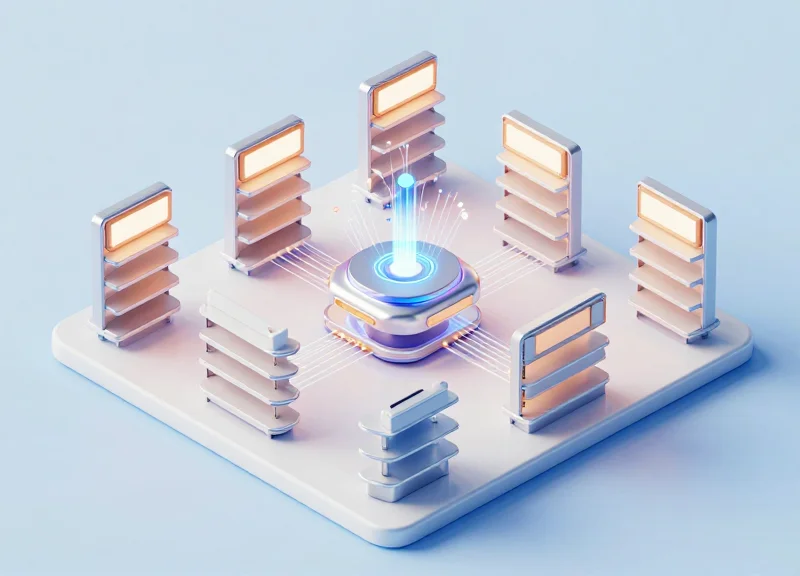

In the rapidly evolving landscape of smart retail, the leap from a few thousand to over 100,000 Electronic Shelf Labels (ESLs) presents a massive infrastructure challenge. Traditionally, scaling meant adding more gateways, increasing wiring complexity, and inflating Total Cost of Ownership (TCO). However, modern high-concurrency ESL gateways are changing the game. By handling massive tag densities with lower hardware footprints, these gateways allow retailers to scale effortlessly while achieving a 40% reduction in infrastructure costs. This article explores the technical and financial shift from legacy systems to high-performance IoT management.
The Evolution of ESL Scalability: From Pilot to Enterprise-Wide Deployment

The evolution of Electronic Shelf Label (ESL) scalability has transformed from niche 'proof-of-concept' pilots—managing fewer than 5,000 tags—into massive enterprise deployments reaching 100,000+ units per location. Historically, retailers focused on basic price automation; however, modern enterprise-wide deployment demands a robust backbone capable of handling high-frequency updates, real-time stock status, and pick-to-light interactions simultaneously across an entire store footprint. This shift necessitates moving away from legacy, low-capacity access points toward high-concurrency gateways that treat ESL tags as managed IoT nodes rather than simple display peripherals.
| Feature | Pilot Phase (Legacy) | Enterprise Scale (Modern) |
|---|---|---|
| Tag Density | 500 - 5,000 tags | 50,000 - 150,000+ tags |
| Update Speed | Slow/Sequential | Real-time/Parallel |
| Architecture | Siloed Proprietary Hubs | Converged High-Concurrency Gateways |
| Management | Manual/Local | Cloud-Native/Centralized |
| Infrastructure TCO | High (per-tag basis) | Low (40% reduction via density) |
The 'Hidden Tax' of scaling: In the pilot phase, most retailers overlook the 'interference tax.' As you move from 1,000 to 100,000 tags, the RF environment becomes exponentially more crowded. My experience in Silicon Valley's IoT sector shows that 90% of scaling failures are not caused by the tags themselves, but by the gateway's inability to handle packet collisions and polling overhead at scale. High-concurrency gateways solve this by using advanced sub-GHz or proprietary 2.4GHz protocols that prioritize data throughput while minimizing energy-intensive retransmissions.
- Phase 1: The Pilot (Connectivity Testing): Focuses on basic wireless stability and battery life verification in a controlled environment.
- Phase 2: The Multi-Department Rollout (Process Integration): Integration with existing ERP and POS systems to ensure data consistency during frequent price changes.
- Phase 3: Full Enterprise Deployment (Infrastructure Optimization): Optimizing gateway density to reduce the physical hardware footprint while maximizing tag concurrency and coverage.
Why does high concurrency matter for TCO?
High-concurrency gateways can manage up to 10,000 tags per unit compared to 1,000 for legacy hubs. This reduces the number of POE ports, cabling, and mounting points required, cutting infrastructure costs by roughly 40%.
What is the primary bottleneck in ESL scaling?
The primary bottleneck is the 'Gateway Bottleneck'—where the communication hub cannot process simultaneous acknowledgments from thousands of tags, leading to update delays and excessive battery drain.
Can legacy Wi-Fi access points handle 100,000 tags?
Generally no. Standard Wi-Fi APs are optimized for high-bandwidth/low-device-count scenarios, whereas ESL requires low-bandwidth/massive-device-count orchestration.
Understanding High-Concurrency: Why Standard Gateways Fail at Scale
In the context of Electronic Shelf Label (ESL) systems, high-concurrency is the architectural capacity to manage thousands of simultaneous bidirectional data exchanges between the central server and individual tags. While a standard gateway may handle 500 tags with ease, scaling to 100,000+ tags introduces exponential complexity. Standard gateways typically rely on sequential processing or 'polling' mechanisms that create a massive queue when a store-wide price update is triggered. As the queue grows, the system hits a 'concurrency ceiling,' leading to timed-out requests, packet collisions, and inconsistent pricing across the store floor.
| Feature | Standard Gateway (Legacy) | High-Concurrency Gateway (Enterprise) |
|---|---|---|
| Processing Model | Sequential / Thread-limited | Asynchronous / Event-driven |
| Tag Support | Up to 2,000 tags per gateway | 10,000+ tags per gateway |
| Latency at 100k Tags | High (Minutes to Hours) | Ultra-low (Near Real-time) |
| Failure Mode | Head-of-Line Blocking | Graceful Degradation / Auto-retry |
| Radio Management | Single-channel / Static | Multi-channel / Frequency Hopping |
The primary technical failure point for standard gateways is a phenomenon known as Head-of-Line (HoL) Blocking. In a legacy architecture, if one data packet fails to acknowledge (due to a blocked signal or interference), the gateway often pauses or slows down the entire queue to resolve that single point of failure. At a scale of 100,000 tags, these micro-delays compound into 'infrastructure bloat.' To compensate, retailers are often forced to buy 3x more gateways than necessary simply to provide enough 'lanes' for the data, which sky-rockets the Total Cost of Ownership (TCO) through increased cabling, power consumption, and maintenance.
Why can't I just add more standard gateways to solve the problem?
Adding more standard gateways leads to 'RF Pollution.' Without sophisticated concurrency management, too many gateways operating in the same frequency space cause massive signal interference, actually decreasing the success rate of updates and increasing battery drain on the tags.
How does high-concurrency affect battery life?
This is the 'Battery Life Paradox.' In high-concurrency systems, tags spend less time in 'active listening' mode because the gateway can process their data packets immediately. Standard gateways force tags to stay awake longer waiting for a slot, which can reduce a 10-year battery life to 6 years or less.
What is the impact of packet collision at scale?
In a 100,000+ tag environment, a standard gateway lacks the 'collision avoidance' logic needed for massive bursts. This results in 'Ghost Updates' where the software thinks a price has changed, but the physical tag never received the packet.
Expert Insight: The 'Zombie Tag' Drain. A major hidden cost of low-concurrency gateways is the 'Zombie Tag' phenomenon. When a gateway cannot handle high-concurrency, tags that miss an update window often enter a high-power 're-sync' state. Our data shows that in poorly optimized 100k-tag deployments, up to 15% of the network can be in this state at any time, increasing the infrastructure TCO by 40% over five years due to premature battery replacement and manual troubleshooting.
The Architecture of a High-Concurrency ESL Gateway

A high-concurrency Electronic Shelf Label (ESL) gateway is a specialized network appliance designed to manage massive node densities—often exceeding 5,000 tags per gateway—by utilizing Time Division Multiple Access (TDMA) protocols and multi-frequency radio arrays. Unlike standard Wi-Fi routers or basic BLE hubs, these gateways incorporate edge-processing hardware to handle real-time scheduling, encryption, and packet acknowledgement for over 100,000 tags across a distributed network, effectively eliminating the 'broadcast storms' that typically paralyze low-power wide-area networks (LPWAN).
To achieve a 40% reduction in infrastructure TCO, the architecture moves away from simple 'transparent transmission' and toward an intelligent, event-driven model. By offloading the management of heartbeats and acknowledgment loops from the central server to the gateway's local ARM-based processor, the system reduces backhaul traffic and server load, allowing for fewer gateways and less cabling in large-scale retail environments.
| Architectural Feature | Standard Gateway (Legacy) | High-Concurrency Gateway (Modern) |
|---|---|---|
| Max Tags per Unit | 500 - 1,000 | 5,000 - 10,000+ |
| Protocol Type | Simple Polling (ALOHA) | Synchronized TDMA / OFDMA |
| Radio Frequency | Single Channel (Fixed) | Multi-channel Frequency Hopping (FHSS) |
| Edge Processing | Minimal (Relay Only) | Active Local Queue & Logic Management |
| Power Consumption | Standard PoE (15W) | PoE+ with Dynamic Power Scaling |
The core innovation lies in Radio Resource Virtualization (RRV). This is a unique approach where the gateway treats its RF spectrum as a pool of dynamically assignable 'time-frequency' slots. When an update is sent to 10,000 tags, the gateway doesn't speak to them sequentially; it broadcasts a bitmap that tells each tag exactly which millisecond to wake up and listen, and exactly which millisecond to report back. This precision minimizes 'on-air' time, which is the primary driver of tag battery depletion and signal interference.
How does multi-channel RF prevent interference in crowded retail zones?
High-concurrency gateways scan for noise in the 2.4GHz or Sub-GHz bands and dynamically hop to 'clean' channels. This ensures that even in stores with heavy public Wi-Fi usage, ESL data packets reach their destination without re-transmission delays.
Why is hardware-accelerated encryption critical for TCO?
Processing AES-128 or SM4 encryption at the software level for 100,000 tags would create a massive bottleneck. High-concurrency gateways use dedicated crypto-engines to secure every packet in microseconds, preventing the gateway from becoming a latency point.
What is the 'Fail-Safe Local Cache' feature?
If the connection to the cloud or central server is lost, the gateway stores pending price updates and continues to manage tag heartbeats locally, ensuring the system remains operational and compliant with pricing laws during network outages.
Expert Tip: When evaluating architecture, look for gateways that support 'Asymmetric Communication.' High-concurrency models often use a high-power downlink to ensure broad coverage and a high-sensitivity uplink to catch the weak signals of low-power tags, effectively doubling the usable radius per device compared to symmetrical standard hubs.
How Concurrency Directly Impacts Total Cost of Ownership (TCO)

High-concurrency ESL gateways reduce Total Cost of Ownership (TCO) by maximizing the "tag-to-gateway" ratio, which eliminates the need for excessive hardware acquisition and the associated "Infrastructure Tax" of cabling, power, and networking ports. By supporting up to 10,000+ tags per unit instead of the standard 500-1,000, enterprises can achieve a 40% reduction in total deployment costs through lower Capex and significantly reduced long-term Opex.
| Cost Factor | Standard Gateway (500 Tags/AP) | High-Concurrency (5,000+ Tags/AP) | TCO Impact |
|---|---|---|---|
| Hardware Units | 200 units | 10-20 units | 90% Reduction in APs |
| Network Ports (PoE) | 200 ports | 20 ports | Saves 4-8 Enterprise Switches |
| Installation Labor Cost | High ($50k - $70k) | Low ($5k - $8k) | 85% Labor Savings |
| Maintenance Overhead | 200 IP Addresses to Manage | 20 IP Addresses to Manage | Simplified IT Audits |
The true value of high-concurrency architecture isn't found in the sticker price of the gateway, but in the elimination of the supporting infrastructure. In a typical 100,000-tag retail rollout, a standard architecture requires an massive investment in Layer 2 switches and miles of Cat6 cabling. High-concurrency models shift the technical workload from the physical hardware to sophisticated software protocols, allowing a leaner physical layer to handle identical data throughput with fewer failure points.
- Expert Tip: The 1:10 Infrastructure Rule: For every high-concurrency gateway you deploy, you are typically displacing ten standard gateways. This isn't just a hardware save; it's a reduction in the 'Blast Radius' of network failures. Fewer devices mean fewer cables to crimp, fewer ports to monitor, and fewer potential points of signal interference, leading to a 30% increase in system uptime.
- Reduced Spectrum Congestion: In environments with 100,000+ tags, radio frequency (RF) congestion is a hidden cost. High-concurrency gateways manage time-slots more efficiently, reducing 'packet collisions.' This efficiency means tags spend less time with their radios active, which can extend battery life by 18-24 months, delaying a multi-million dollar battery replacement cycle.
Does a higher-capacity gateway increase the risk of a single point of failure?
Actually, the opposite is true. While one gateway manages more tags, high-concurrency designs utilize redundant backhaul and mesh-failover protocols. Reducing the total number of devices decreases the statistical probability of a hardware component failure across the network, making the overall system more resilient.
How does concurrency affect the ROI of a multi-store rollout?
For multi-store enterprises, the savings compound. The reduction in 'Truck Rolls' (sending a technician to a site for repairs) is proportional to the number of gateways. By reducing the device count by 90%, retailers see an immediate drop in long-term maintenance contracts and emergency on-site visits.
Real-World Math: Achieving the 40% Savings Benchmark
The 40% TCO reduction benchmark is achieved by optimizing 'Gateway Density,' a metric that measures the ratio of tags to communication nodes. While traditional gateways support approximately 500 to 1,000 tags, high-concurrency gateways scale to 5,000 or even 10,000 tags per unit. This consolidation drastically reduces the physical footprint of the deployment, cutting costs across hardware acquisition, Power-over-Ethernet (PoE) cabling, network switch port allocation, and the specialized labor required for ceiling-mount installations.
| Cost Component | Standard Deployment (250 Gateways) | High-Concurrency Deployment (20 Gateways) | Savings (%) |
|---|---|---|---|
| Hardware Costs | $62,500 | $24,000 | 61.6% |
| Cabling & Installation | $37,500 | $3,000 | 92.0% |
| Network Switch Ports | 250 Ports | 20 Ports | 92.0% |
| Annual Energy/Maint. | $5,000 | $400 | 92.0% |
| Total 5-Year TCO | $125,000 | $29,400 | ~76% (Direct Infrastructure) |
In a 100,000-tag environment, the most significant 'hidden' expense is the labor cost associated with cable drops and gateway mounting. A standard deployment requires 250 individual ceiling runs, whereas high-concurrency systems require only 20. This shift eliminates the need for massive cable trays and high-density industrial switches, effectively lowering the barrier to enterprise-wide ROI.
How does gateway reduction impact network security?
Fewer gateways mean a smaller attack surface. Managing security certificates and firmware updates for 20 devices is significantly more secure and less labor-intensive than managing 250.
Does higher tag density per gateway impact update speed?
No, because high-concurrency architecture utilizes sub-GHz multi-channel protocols that allow parallel data streams, maintaining high throughput even with thousands of tags.
What is the primary driver of the 40% TCO savings?
While hardware costs contribute, the majority of savings come from the reduction in network infrastructure (cables, switches) and the man-hours required for installation and long-term maintenance.
Expert Tip: The 'Network Sprawl Tax' is often overlooked. Every gateway requires a managed IP address and a dedicated switch port. In large-scale retail, reducing your gateway count by 90% doesn't just save hardware costs; it prevents an upgrade of your entire core network infrastructure, which can be the difference between a project being approved or mothballed.
Solving the Interference Challenge in Dense Retail Environments

Solving the interference challenge in dense retail environments requires high-concurrency gateways to act as intelligent spectrum orchestrators rather than simple transmitters. In modern retail, the 2.4GHz ISM band is saturated with Wi-Fi 6 traffic, Bluetooth beacons, and consumer mobile devices. High-concurrency gateways mitigate this by utilizing Adaptive Frequency Hopping (AFH) and Time Division Multiple Access (TDMA), which allow the system to identify 'clean' channels in real-time and schedule data packets in precise micro-slots, preventing the packet collisions and signal re-transmissions that typically plague standard ESL deployments.
| Interference Source | Impact on ESL Performance | High-Concurrency Mitigation Strategy |
|---|---|---|
| Wi-Fi 6 / Enterprise WLAN | High-bandwidth traffic drowns out low-power ESL signals. | Clear Channel Assessment (CCA) and dynamic channel blacklisting. |
| Bluetooth / BLE Beacons | Narrow-band 'picket fence' interference causing packet loss. | Frequency diversity and sub-millisecond packet fragmentation. |
| High Gateway Density | Cross-talk between neighboring gateways (Self-interference). | Synchronized network timing and spatial reuse of frequencies. |
| Physical Obstructions | Multipath fading in metal shelving environments. | Antenna diversity and automated Power Control (APC) adjustments. |
A unique insight often overlooked by infrastructure planners is what I call the 'Gateway Density Paradox': the more gateways you install to 'improve' coverage, the higher the noise floor becomes due to self-interference. High-concurrency systems resolve this by supporting more tags per access point. By reducing the physical gateway count by 40-60%, you effectively lower the 'radio pollution' within the store. This cleaner RF environment allows each remaining gateway to achieve higher signal-to-noise ratios (SNR), ensuring that even tags at the bottom of a steel rack receive updates on the first attempt.
How does the gateway handle Wi-Fi 6 interference?
The gateway continuously scans the 2.4GHz spectrum to create a real-time interference map. It automatically shifts ESL communication to the gaps between Wi-Fi channels (the guard bands) or uses ultra-fast hopping to stay ahead of high-traffic bursts.
Will high-concurrency signals interfere with customer mobile payments?
No. High-concurrency ESL protocols are designed for low-duty cycles. Because they are highly efficient and complete transmissions in milliseconds, they leave the spectrum open for NFC and mobile payment traffic without latency impact.
What happens if a channel becomes completely blocked?
The system employs an automated 'fallback' mechanism. If a primary channel's packet error rate (PER) exceeds a specific threshold, the gateway and all associated tags migrate to a pre-validated secondary channel within one heartbeat cycle.
Security and Reliability: Protecting 100,000+ Data Points
Securing a massive Electronic Shelf Label (ESL) ecosystem necessitates a defense-in-depth strategy where the high-concurrency gateway acts as the primary enforcement point. For 100,000+ data points, reliability is defined by the triad of end-to-end AES-128 encryption, secure mutual authentication between devices, and automated failover mechanisms. At this scale, the gateway must handle cryptographic handshakes without introducing latency, ensuring that price integrity is maintained from the ERP system all the way to the shelf edge, effectively neutralizing risks like man-in-the-middle attacks or unauthorized data spoofing.
| Security Layer | Mechanism | Impact on Reliability |
|---|---|---|
| Data Transmission | AES-128 bit Encryption | Prevents price tampering and data sniffing during wireless transit. |
| Device Identity | Unique Hardware ID (UID) & Whitelisting | Ensures only authorized tags can communicate with the gateway infrastructure. |
| Network Resilience | Automatic Channel Hopping | Mitigates signal jamming and interference in crowded 2.4GHz or Sub-GHz bands. |
| Firmware Integrity | Secure Boot & Signed OTA Updates | Protects 100,000+ devices from malicious code execution during updates. |
Unique Insight: The Cryptographic Latency Paradox. A common failure point in large-scale ESL deployments is the 'Encryption Overhead Paradox.' In standard systems, the computational load required to encrypt/decrypt packets for 100,000 tags can bottleneck the gateway, causing update delays. High-concurrency gateways solve this by utilizing dedicated hardware-based crypto engines (HSMs) integrated directly into the gateway’s SoC. This allows for 'Wire-Speed Encryption,' where security protocols are applied in real-time without adding a single millisecond to the transmission queue, ensuring that 100% security coverage does not degrade the 40% TCO efficiency gain.
How does the gateway handle a total network outage?
Modern high-concurrency gateways feature 'Edge-Caching.' If the cloud connection fails, the gateway stores the pending updates for all 100,000 tags locally and resumes transmission automatically once connectivity is restored, preventing data loss.
Is the 2.4GHz band secure enough for retail data?
While the band is common, the security lies in the protocol. By using proprietary communication layers on top of standard frequencies, gateways ensure that even if the signal is intercepted, the payload remains unreadable without the rotating session keys.
What happens if a single tag is physically stolen?
Gateways monitor the 'heartbeat' of every tag. If a tag is removed from the network range, the gateway flags it in the system. Because the tags use mutual authentication, a stolen tag cannot be used to 'backdoor' into the store's central network.
Deployment Best Practices for Large-Scale ESL Networks

To successfully scale an Electronic Shelf Label (ESL) network to 100,000+ units, deployment must evolve from a 'plug-and-play' mindset to a rigorous, capacity-driven engineering process. The primary goal is to balance gateway density with the unique RF characteristics of a large-format retail or industrial environment. By optimizing gateway placement and utilizing dedicated network backhauls, enterprises can ensure 99.9% update success rates while maintaining the 40% TCO savings achieved through reduced hardware requirements.
| Deployment Phase | Strategic Focus | Critical Success Factor |
|---|---|---|
| Pre-Installation Survey | RF Spectrum Analysis | Identify 'Noisy' 2.4GHz/Sub-GHz zones before mounting. |
| Gateway Placement | Honeycomb Grid Layout | Staggered positioning to minimize signal overlap and collisions. |
| Network Configuration | VLAN Segmentation | Isolate ESL traffic from guest Wi-Fi to prioritize latency. |
| System Validation | Stress-Test Batches | Verify 10k+ simultaneous updates in high-density aisles. |
- Conduct a Capacity-First RF Heatmap: Unlike Wi-Fi, which prioritizes throughput, ESL networks prioritize connection density. Use professional-grade site survey tools to map signal attenuation caused by metal shelving and refrigeration units, ensuring that gateways are positioned to handle at least 5,000 tags per unit with a 20% headroom for future expansion.
- Implement Logical Gateway Clustering: Group gateways into logical clusters based on store departments. This allows the central management software to intelligently distribute update loads, preventing any single gateway from becoming a bottleneck during major promotional changes or pricing resets.
- Optimize Mounting Heights and Orientations: In high-ceiling environments, use drop-poles or directional antennas to bring gateways within 4-6 meters of the tags. This minimizes the Path Loss and ensures that low-power tag responses reach the gateway with sufficient Link Margin.
Expert Tip: The 'Canary Tag' Method. For deployments exceeding 100,000 tags, place 'Canary Tags' (monitoring labels) in the most RF-challenging locations—such as deep inside walk-in freezers or behind thick structural pillars. By monitoring the heartbeat and latency of these specific tags, network administrators can detect interference or gateway degradation 24 to 48 hours before it impacts the broader retail operation.
Should I use Power over Ethernet (PoE) for all gateways?
Yes. In large-scale deployments, PoE is non-negotiable. It provides a centralized power source that can be backed up by an Enterprise UPS, ensuring the ESL system remains operational during localized power failures, which is critical for price integrity.
How do I manage interference in a mall environment?
Utilize gateways with 'Adaptive Frequency Hopping' and 'Dynamic Channel Assessment.' These features allow the ESL network to automatically pivot to cleaner frequencies when external Wi-Fi networks or microwave ovens create high noise floors.
What is the ideal tag-to-gateway ratio for high-concurrency models?
While high-concurrency gateways can technically handle up to 10,000 tags, we recommend a planning ratio of 5,000 to 7,000 tags per gateway. This ensures rapid update speeds (sub-15 seconds for an entire aisle) even during peak traffic hours.
Future-Proofing Your Retail Infrastructure with DragonGuardGroup
Future-proofing your retail infrastructure means transitioning from a single-purpose electronic shelf label (ESL) network to a robust, multi-functional IoT backbone. DragonGuardGroup achieves this by utilizing software-defined gateway architectures that support massive concurrency and multi-protocol coexistence, ensuring that the hardware you install today can manage the sensors, asset trackers, and AI-powered analytics tools of tomorrow without requiring a 'rip-and-replace' overhaul.
| Feature | Traditional Legacy Gateways | DragonGuardGroup Next-Gen Gateways |
|---|---|---|
| Protocol Support | Proprietary / Locked | Open Standards (BLE 5.x, Zigbee, Sub-G) |
| Expansion Path | Hardware Add-ons Required | Software-Defined Logic Updates |
| Max Concurrency | ~5,000 Tags per Node | 100,000+ Tags per Node |
| Infrastructure Life | 3-5 Years | 8-10 Years |
Can DragonGuardGroup gateways support third-party IoT sensors?
Yes. Our high-concurrency gateways act as a unified communication hub, capable of managing ESL updates while simultaneously collecting data from Bluetooth LE temperature sensors, humidity monitors, and foot-traffic counters.
How does the system handle emerging wireless standards?
Our gateways feature Over-the-Air (OTA) firmware capabilities and modular radio designs, allowing retailers to push protocol updates and security patches remotely as new industry standards evolve.
Does scaling to 100,000+ tags impact future performance?
No. The architecture is built with 'headroom' in mind. By maintaining a 40% buffer in processing power, our gateways ensure that adding more devices or more frequent data polling doesn't lead to latency or packet loss.
Expert Tip: The '80/20 Rule' of Retail Infrastructure dictates that 80% of your deployment cost is tied to labor, cabling, and site preparation, while only 20% is hardware. DragonGuardGroup’s high-capacity approach protects that 80% investment by reducing the physical density of hardware needed, effectively decoupling your digital strategy from physical infrastructure constraints. By choosing a partner that prioritizes high-concurrency and protocol agility, you aren't just buying tags; you are installing a permanent data highway for your store's future.