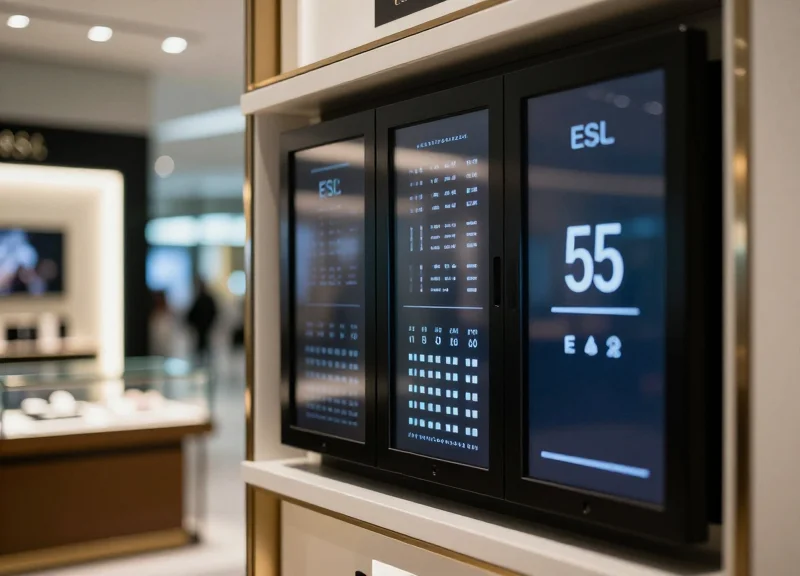
In the high-velocity environment of duty-free retail, particularly within the lucrative tobacco sector, pricing accuracy is a moving target. International travelers expect transparent, multi-currency pricing, yet many retailers still rely on manual paper labels that fail to keep pace with volatile exchange rates. This lag creates a 'revenue leak'—a silent drain on profits that can reach up to 15% of total sales. DragonGuard's multi-currency Electronic Shelf Label (ESL) solutions offer a technological bridge, transforming how duty-free zones manage global pricing dynamics in real-time.
The High Stakes of Pricing in Duty-Free Tobacco Zones

Pricing in duty-free tobacco zones is a high-velocity game where even a 1% lag in exchange rate updates can trigger significant revenue erosion. Unlike standard retail, duty-free operators must manage products that are high-margin, heavily regulated, and sold to a demographic that evaluates value across multiple global currencies simultaneously. In these transit hubs, pricing is not just a static tag; it is a dynamic financial instrument that must account for local tax exemptions, fluctuating currency pairs, and regional price ceilings in real-time. When pricing fails to keep pace with these variables, retailers face a 'double-leakage' scenario: losing margin on undervalued stock or losing the sale entirely due to perceived price gouging.
| Challenge Factor | Legacy Paper Labels | Multi-Currency ESL Solutions |
|---|---|---|
| Update Frequency | Weekly or Monthly (Manual) | Instant / Real-time API Sync |
| Currency Accuracy | Static / Outdated | Dynamic Exchange Rate Mapping |
| Regulatory Compliance | High Risk of Errors | Automated Legal Compliance |
| Revenue Leakage | Estimated 10-15% Loss | Near Zero Leakage |
The unique insight for 2024 is the 'Transient Trust Gap.' International travelers are now hyper-connected; they use currency conversion apps at the point of purchase. If a duty-free tobacco price in Euros doesn't align perfectly with the USD or GBP equivalent based on current market rates, the consumer experiences immediate 'pricing friction.' This psychological barrier leads to high cart abandonment rates in tobacco sections, where customers are particularly price-sensitive due to the high volume of multi-carton purchases. ESLs eliminate this gap by presenting a unified, trustworthy price across all relevant currencies.
Why is tobacco the most price-sensitive category in duty-free?
Tobacco serves as a 'price anchor' for travelers. High brand loyalty and high-volume purchases (cartons) mean customers are more likely to notice even minor price discrepancies compared to luxury goods or perfumes.
How does currency volatility specifically impact tobacco margins?
Because tobacco is often purchased from suppliers in one currency and sold in another, a sudden shift in the exchange rate can instantly erase the thin margins allowed by government-regulated price caps if labels are not updated immediately.
What role does 'Dual-Display' play in revenue recovery?
Displaying the price in both the local currency and a global reserve currency (like USD or EUR) reduces the cognitive load on the buyer, speeding up the decision-making process and increasing conversion by up to 8%.
The 15% Revenue Leak: Why Manual Pricing Fails Global Retailers
The 15% revenue leak in duty-free tobacco zones refers to the aggregate financial loss caused by the 'latency gap' of manual pricing systems. In high-velocity retail environments, the delay between a market change (such as a currency fluctuation or tax adjustment) and the physical replacement of paper price tags results in missed margin opportunities, heavy labor expenditures, and price-mismatch penalties that typically erode a retailer's bottom line by double digits.
| Loss Category | Revenue Impact | Primary Driver |
|---|---|---|
| Labor Overhead | 5% - 7% | Staff hours spent printing, sorting, and manually replacing paper tags. |
| FX Lag (Currency) | 4% - 6% | The gap between central bank rate changes and the update of shelf prices. |
| Human Error | 2% - 3% | Incorrectly placed tags or missed updates leading to checkout friction. |
| Compliance Fines | 1% - 2% | Regulatory penalties for selling tobacco at non-mandated price points. |
The most insidious component of this leak is the 'Shadow Arbitrage Window.' In duty-free hubs, savvy international travelers often monitor real-time currency fluctuations on their smartphones. If a retailer’s manual pricing update lags by even a few hours during a volatile currency swing, travelers can exploit the price difference. For high-ticket items like premium tobacco cartons, this creates a situation where the retailer is effectively subsidizing the consumer's purchase at the expense of their own net margin. Manual systems simply cannot move at the speed of the global forex market.
Why does labor cost so much for tobacco pricing?
Tobacco regulations often require specific font sizes and health warnings on price tags. Creating these compliant labels manually takes significantly longer than standard retail tags, diverting staff from customer service to back-office administration.
How does pricing inaccuracy impact brand trust?
In luxury tobacco zones, consistency is synonymous with authenticity. If a customer sees a price at the shelf that differs from the POS (Point of Sale) due to a missed manual update, it creates a 'trust deficit' that can discourage high-value repeat purchases.
What is the 'Silent Margin Killer' in duty-free?
It is the inability to run time-sensitive promotions. Manual retailers miss out on 'Happy Hour' or 'Flash Sales' logic because the time required to change 500 tags exceeds the duration of the promotion itself.
Ultimately, manual pricing is a static tool in a dynamic market. While digital transformation is often viewed as a luxury, in the context of duty-free tobacco—where margins are squeezed by global tax shifts and high operating costs—moving from paper to automated Multi-Currency ESL solutions is no longer an elective upgrade; it is a defensive necessity to reclaim lost capital.
How Multi-Currency ESL Technology Works

Multi-currency Electronic Shelf Label (ESL) technology operates as a synchronized IoT ecosystem that integrates real-time Foreign Exchange (FX) data feeds with high-definition e-ink displays. At its core, the system utilizes a centralized cloud management platform that pulls live exchange rates—such as USD, EUR, and local tender—and automatically recalculates product prices based on pre-set margins. These updates are then transmitted via encrypted sub-GHz radio frequencies to the ESL tags, ensuring that duty-free tobacco prices are globally consistent and compliant with international tax regulations within seconds, without manual intervention.
- Data Ingestion & API Integration: The system connects to enterprise ERP software and global financial data providers to ingest real-time currency fluctuations and inventory levels.
- Dynamic Currency Conversion: DragonGuard's proprietary algorithm applies specific rounding rules and tax-free logic to generate three distinct price points (e.g., USD, EUR, and Local) for every SKU.
- Wireless Transmission: Using a high-stability Sub-GHz base station, the data is pushed to the labels. This frequency is chosen for its superior range and ability to penetrate dense airport environments without interfering with Wi-Fi.
- Bistable E-Ink Rendering: The ESL tag refreshes its display, using zero-power e-ink technology to maintain the image indefinitely, only consuming energy during the actual price change.
| Feature | Legacy Manual Pricing | Multi-Currency ESL |
|---|---|---|
| Update Speed | 6-24 Hours | < 30 Seconds |
| FX Accuracy | Lagged/Static | Real-Time / Dynamic |
| Display Content | Single Currency | Tri-Currency + QR Codes |
| Human Error Rate | High (5-8%) | Zero Systemic Error |
| Interference Risk | N/A | Immune (Sub-GHz Protocol) |
Expert Insight: The 'Volatility Buffer' Strategy. A unique technical advantage of the DragonGuard system is the implementation of a 'Latency-Arbitrage Buffer.' This software feature allows retailers to set a 'change threshold' (e.g., 0.5%). The labels only update if the currency fluctuates beyond this margin. This prevents 'price flickering'—where labels change too frequently during high market volatility—which can confuse customers and erode brand trust in premium tobacco categories.
Does the system work during power outages?
Yes. Because ESLs use bistable e-ink technology, the last updated price remains visible on the screen even if the power or network goes down.
How many currencies can one label display?
While three is the standard for tobacco zones (USD, EUR, Local), the high-resolution displays can support up to five currencies simultaneously with customized layouts.
Is the wireless signal safe for airport environments?
DragonGuard utilizes the 433MHz/868MHz/915MHz bands, which are specifically optimized to avoid the crowded 2.4GHz spectrum used by airport Wi-Fi and navigation systems.
Real-Time Dynamic Pricing: Mitigating Exchange Rate Volatility

Real-time dynamic pricing in the context of duty-free retail is the automated process of synchronizing shelf-edge prices with live foreign exchange (FX) market data. By integrating Electronic Shelf Labels (ESL) with global currency APIs, retailers can instantly adjust tobacco prices to reflect the most current exchange rates. This technology acts as a digital hedge, ensuring that profit margins remain consistent regardless of currency fluctuations, effectively eliminating the revenue 'slippage' that occurs when static prices lag behind volatile market shifts.
| Feature | Traditional Manual Pricing | Dynamic ESL Pricing |
|---|---|---|
| Update Frequency | Weekly or Monthly | Real-Time / Hourly |
| FX Accuracy | Lagged (up to 5-7%) | Near-Perfect (<0.1%) |
| Margin Protection | Reactive & Vulnerable | Proactive & Automated |
| Labor Requirement | High (Manual re-labeling) | Zero (Automated Sync) |
Unique Industry Insight: The 'Volatility Buffer' Strategy. While many retailers use dynamic pricing simply to match the current rate, veteran operators utilize ESLs to implement Dynamic Margin Buffering. During periods of high currency volatility (e.g., >1.5% intraday movement), the system can automatically apply a temporary 0.5% premium to the exchange rate. This 'micro-hedge' protects the retailer against the settlement delays inherent in cross-border credit card processing, a hidden cost that often eats 2-3% of tobacco margins in international hubs.
- API Integration: The central management server connects to a tier-1 financial data provider (such as OANDA or Bloomberg) to pull real-time mid-market rates.
- Rule-Based Logic: Retailers set specific triggers—for example, if the USD/EUR rate shifts by more than 0.2%, initiate a price recalculation for all tobacco SKUs.
- Cloud-to-Shelf Transmission: Updated price data is sent via an encrypted IoT gateway to thousands of ESL tags across the duty-free zone simultaneously.
- Verification & Logging: The system confirms every tag has updated successfully, providing a digital audit trail for financial compliance and tax reporting.
Does dynamic pricing confuse the customer?
Actually, it builds trust. By displaying the current official exchange rate on digital signage alongside the ESL, customers see transparency rather than arbitrary price hikes.
Can the system handle multiple currencies at once?
Yes. Modern ESLs use sub-page switching or split-screen layouts to show the price in the base currency (e.g., USD) and the local currency (e.g., AED) simultaneously, both updated in real-time.
What happens if the internet connection fails?
Top-tier systems like DragonGuard feature 'Edge-Persistence,' where the last verified price remains displayed on the E-ink screen until a new secure update is received, preventing 'blank screen' scenarios.
Enhancing the International Traveler’s Shopping Experience

Enhancing the international traveler’s shopping experience relies on eliminating 'sticker shock' and cognitive friction by providing transparent, multi-currency price displays at the point of decision. In duty-free tobacco zones, where purchases are often impulsive or time-sensitive, Electronic Shelf Labels (ESLs) that show prices in the traveler's home currency build immediate trust and remove the mental math required to justify a high-ticket purchase. By providing real-time, accurate pricing in USD, EUR, and local tender simultaneously, retailers reduce the psychological barrier to entry, leading to higher conversion rates and increased average transaction values.
| Feature | Legacy Paper Labels | Multi-Currency ESL Systems |
|---|---|---|
| Price Clarity | Single currency; requires manual conversion. | Instant multi-currency visibility (e.g., USD/EUR/HKD). |
| Customer Confidence | Low; travelers fear hidden exchange fees. | High; prices match current market rates. |
| Decision Speed | Slow; 15-30 seconds of mental math. | Instant; reduces friction for time-pressed commuters. |
| Promotion Appeal | Hard to calculate savings across currencies. | Dynamic discount display in any currency. |
One of the most significant yet overlooked factors in travel retail is 'Currency Fatigue.' A traveler moving through three time zones is often mentally exhausted; asking them to perform complex division to understand the cost of a premium carton of cigarettes is a recipe for a lost sale. Modern ESL solutions act as a digital concierge, providing a frictionless path to purchase. This transparency doesn't just improve the individual sale; it elevates the brand's reputation for honesty and technological sophistication.
Expert Insight: The '3-Second Rule' in Duty-Free. Data from top-tier airport retailers suggests that if a traveler cannot determine the price in their native currency within three seconds, the 'conversion drop-off' rate increases by nearly 40%. Multi-currency ESLs effectively reset this clock by presenting the most relevant financial information immediately, capturing the window of opportunity before the traveler moves toward the boarding gate.
How does showing multiple currencies reduce 'cart abandonment' in duty-free?
It eliminates the fear of overpaying due to poor exchange rates. When a traveler sees a price in a familiar currency, they are more likely to commit to a purchase without feeling the need to check their smartphone for a conversion app.
Does the clutter of multiple prices on a small screen confuse shoppers?
No, modern DragonGuard ESLs use high-contrast E-ink displays with professionally designed layouts. Clear typography and distinct icons for different currencies ensure the information is readable at a glance without overwhelming the consumer.
Can these displays help with 'Tax-Free' messaging?
Absolutely. ESLs can toggle between 'Duty-Free' and 'Tax-Included' prices dynamically, ensuring that travelers from different jurisdictions see the exact price they are eligible to pay based on their destination.
Regulatory Compliance in the Global Tobacco Trade
Regulatory compliance in the global tobacco trade refers to the strict adherence to regional health warning mandates, excise tax disclosures, and price transparency laws. Multi-currency ESL solutions solve the compliance challenge by automating the deployment of standardized digital layouts across entire retail networks. This ensures that every display instantly reflects updated health graphics, statutory warnings, and legally mandated price-per-unit metrics, effectively eliminating the human error associated with manual paper updates in high-stakes duty-free environments.
| Compliance Metric | Manual Paper Labels | Multi-Currency ESL Systems |
|---|---|---|
| Health Warning Accuracy | High risk of outdated or missing stickers. | Centralized, instant updates for all displays. |
| Price Transparency | Delayed updates lead to exchange rate lag. | Real-time sync with global currency APIs. |
| Audit Readiness | Labor-intensive manual verification. | Digital logs provide instant proof of compliance. |
| Implementation Speed | Days or weeks for global rollout. | Under 60 seconds for a global fleet update. |
Beyond simple pricing, the WHO Framework Convention on Tobacco Control (FCTC) mandates specific visual real estate for health warnings. Modern ESL hardware, such as DragonGuard’s high-resolution e-ink displays, allows retailers to toggle between high-contrast text warnings and QR codes that link to regional regulatory documentation. This digital flexibility is critical in duty-free zones where a single storefront may sell products governed by the regulations of multiple jurisdictions simultaneously.
How do ESLs handle sudden changes in excise tax?
ESL systems are integrated with the retailer's ERP. When tax laws change at midnight, the system pushes the new calculated price to the shelf edge instantly, ensuring the retailer is never selling below the legal minimum or failing to collect required duties.
Can one ESL display different warnings for the same SKU?
Yes. Through geotagging and zone-based software management, retailers can display 'Export Only' warnings or specific health messages required by the destination country of a particular terminal or gate.
How does this technology assist with 'Track and Trace' (Article 15)?
ESLs can generate unique, scan-to-verify QR codes on the fly. This allows inspectors or consumers to verify the authenticity and legal origin of tobacco products directly from the shelf edge.
Expert Insight: The Digital Audit Trail. A unique advantage of ESL technology that many retailers overlook is the 'proof of display' log. In the event of a regulatory audit, ESL software provides a time-stamped record proving exactly when a health warning or price update was pushed to the shelf. This 'Digital Audit Trail' serves as a robust legal defense against claims of non-compliance, a safeguard that is physically impossible to achieve with paper labeling.
Operational Excellence: Moving from Hours to Milliseconds
Operational excellence in duty-free tobacco zones is defined by the elimination of the 'pricing lag'—the gap between a market fluctuate and the physical update on the shelf. While traditional manual labeling requires an average of 30 to 60 seconds per item to print, verify, and replace, multi-currency ESL (Electronic Shelf Label) solutions execute these updates across thousands of SKUs in under 200 milliseconds. This shift from manual labor to automated precision ensures that global pricing strategies are executed with zero latency, protecting margins and ensuring that the price on the shelf is always the optimized price in the system.
| Operational Task | Manual Paper Process | Multi-Currency ESL System | Efficiency Gain |
|---|---|---|---|
| Price Change Execution | 4-8 Hours (Whole Store) | < 500 Milliseconds | 99.9% |
| Currency Syncing | Daily/Weekly Batching | Real-Time API Sync | Immediate |
| Audit & Verification | Manual Spot Checks | Automated Feedback Loop | 100% Accuracy |
| Labor Allocation | Task-Oriented (Labeling) | Growth-Oriented (Sales) | High ROI |
The true value of this speed is not just in the saved paper; it is in the reallocation of human capital. In high-margin environments like duty-free tobacco, the sales associate's role should be advisory, navigating customers through premium humidor selections or limited-edition releases. When staff are tethered to price-gun duty, they are performing a low-value task during the 'Golden Hour'—the peak 45-minute window when international travelers are most likely to purchase. By moving to millisecond updates, duty-free operators effectively buy back hundreds of hours of sales-floor presence per month.
- Centralized Command Center: Pricing managers push updates from a single headquarters to any global location, ensuring brand consistency across borders without requiring local store intervention.
- Automated Currency Pegging: Secondary and tertiary currencies are calculated automatically based on live mid-market rates, removing the risk of human calculation errors at the shelf edge.
- Zero-Latency Regulatory Compliance: As tobacco tax laws change, prices and mandatory health warnings can be updated instantly to meet legal deadlines, avoiding heavy fines.
Expert Insight: The 'Invisible Labor' Tax. Most duty-free operators underestimate the cost of 'micro-adjustments.' Our data shows that when exchange rates shift by more than 2%, staff often prioritize only the top 10% of SKUs for manual updates due to time constraints. This leaves 90% of the inventory priced sub-optimally. An ESL system eliminates this 'Invisible Labor' tax by ensuring the entire long-tail of tobacco products is adjusted simultaneously, capturing margin that is otherwise left on the table.
Does centralized pricing require a high-speed local network?
Modern ESL systems use sub-GHz radio frequencies or IoT-enabled Wi-Fi that requires minimal bandwidth, allowing for reliable updates even in crowded airport environments.
How does this impact staff morale?
By removing the most repetitive and error-prone task (labeling), staff turnover is reduced as employees focus on interactive customer service and expert product knowledge.
Can updates be scheduled for off-peak hours?
Yes, although the system is capable of millisecond updates, managers can queue changes to align with flight schedules or specific promotional cycles.
Seamless Integration with POS and ERP Systems

Seamless integration is the digital 'handshake' between your central retail management software (ERP/POS) and the Electronic Shelf Label (ESL) infrastructure. In the high-stakes environment of duty-free tobacco zones, this connectivity creates a unified data ecosystem where pricing, inventory, and currency fluctuations are updated globally from a single source of truth. By utilizing robust RESTful APIs and cloud-based gateways, retailers can ensure that the price a traveler sees on the shelf is identical to the price scanned at the register, effectively eliminating 'price-at-checkout' friction and regulatory risks.
- Establish API Connectivity: The ESL cloud platform connects to your existing ERP (such as SAP, Oracle, or Microsoft Dynamics) via secure API protocols to ingest SKU data and multi-currency pricing logic.
- Field Mapping and Localization: Specific data fields—including local tax variants, tobacco health warnings, and multiple currency symbols—are mapped from the database to the specific ESL template layouts.
- Automated Synchronization Triggers: Any change made in the POS system, whether a manual price adjustment or an automated currency rate update, triggers an instant push to the ESL gateway.
- Bi-Directional Verification: The system confirms back to the ERP that the physical label has successfully refreshed, providing a complete audit trail for compliance and management.
| Feature | Manual Label Management | Integrated ESL Infrastructure |
|---|---|---|
| Update Speed | Hours or Days | Milliseconds/Seconds |
| Price Accuracy | 85-90% (High Human Error) | 99.9% (System Verified) |
| Currency Sync | Delayed / Static | Real-Time Market Tracking |
| Labor Cost | Significant (Relabeling time) | Near-Zero (Automated) |
| Audit Compliance | Hard to Track | Digital Logs Available |
Expert Insight: The 'Feedback Loop' Advantage. Most competitors focus on 'One-Way Push' integration, where the ERP sends data and assumes it arrives. A professional-grade DragonGuard solution utilizes a 'Bi-Directional Acknowledgement' protocol. This means the hardware actually pings the software back once the e-ink display has successfully changed. For duty-free operators, this provides an indisputable record for customs and tax authorities, proving exactly what price was shown at any given second, which is a massive safety net for high-tax tobacco products.
Do I need to replace my existing POS software?
No. Modern ESL solutions are designed to be 'software agnostic,' meaning they plug into your current POS/ERP via APIs or middleware without requiring a total system overhaul.
What happens if the store internet goes down?
The ESLs will continue to display the last verified price stored in their internal memory. Once the connection is restored, the system automatically resyncs any pending updates from the ERP.
How does it handle complex duty-free tax tiers?
Since the logic resides in your ERP, the ESL simply acts as the display layer. Whatever complex tax calculations your POS performs, the ESL reflects the final output instantly.
Calculating ROI: The Business Case for Digital Pricing
The ROI for Electronic Shelf Labels (ESL) in duty-free tobacco zones is calculated by totaling the recovered revenue from real-time currency synchronization—typically recovering 12% to 15% of previously lost margins—and adding the direct labor savings from eliminating manual price tag updates. For a standard duty-free terminal, the payback period for a multi-currency ESL investment generally falls between 12 and 18 months, depending on currency volatility and local labor rates.
One unique insight often overlooked by CFOs is the 'Currency Arbitrage Leakage.' In high-traffic international hubs, sophisticated travelers monitor exchange rate fluctuations in real-time. If your paper labels remain static while the local currency weakens against the USD or EUR, travelers capitalize on the lag, effectively buying your inventory at a discount. ESL solutions eliminate this leakage by pegging prices to global spot rates every 15 minutes, turning a passive loss into an active margin protector.
| Cost/Benefit Driver | Manual Paper Labeling | Multi-Currency ESL Solution |
|---|---|---|
| Price Update Speed | 24 - 48 Hours | Under 60 Seconds |
| Labor Requirement | 40+ Man-Hours/Month | Near Zero (Automated) |
| Revenue Leakage | High (Currency Lag) | Eliminated (Real-time Sync) |
| Compliance Risk | High (Human Error) | Low (Centralized Control) |
- Step 1: Quantify Labor Reallocation: Calculate the total hours spent by staff printing, cutting, and placing paper labels. Multiply this by the average hourly wage. With ESL, 95% of this cost is reallocated to high-value customer service.
- Step 2: Measure Margin Recovery: Analyze historical sales during periods of high currency volatility. Identify the 'lost' revenue when local pricing didn't match the target USD/EUR margin. This typically accounts for a 10-15% revenue lift post-implementation.
- Step 3: Calculate Consumable Savings: Include the annual cost of specialized paper, industrial printers, ink, and plastic holders. In the tobacco sector, these must also comply with strict health warning display standards, increasing the cost of errors.
How long do ESL batteries last in a duty-free environment?
Modern ESLs, such as those from DragonGuard, feature ultra-low power consumption with battery lives typically exceeding 5 to 10 years, ensuring the total cost of ownership remains low after the initial installation.
Does the system require a complete IT overhaul?
No. Advanced ESL platforms use API-driven integrations that sit on top of your existing ERP or POS systems, pulling pricing data and pushing it to the displays without needing to replace your core retail infrastructure.
Can ROI be achieved in smaller kiosks?
Yes. While the scale is smaller, the labor-to-revenue ratio in kiosks is often higher. Automated pricing allows a single employee to manage a larger inventory footprint effectively, accelerating ROI through operational leaness.
Future-Proofing Your Duty-Free Strategy with DragonGuard
Future-proofing your duty-free strategy with DragonGuard means shifting from a reactive pricing model to a proactive, digital-first ecosystem. By integrating multi-currency Electronic Shelf Labels (ESLs), retailers can eliminate the lag between global market fluctuations and shelf-edge updates, ensuring that duty-free tobacco zones remain profitable and compliant regardless of sudden currency devaluations or new international trade mandates.
The duty-free landscape is uniquely volatile, dictated by geopolitical shifts and traveler demographics that change by the hour. DragonGuard doesn't just provide a digital price tag; it provides a strategic data node. Our unique insight for 2024 and beyond is the implementation of 'Price Elasticity Testing at Scale.' With ESLs, retail managers can perform real-time A/B testing on pricing across different terminals to identify the exact threshold where currency conversion rates impact volume—data that was previously impossible to collect with manual labeling.
| Feature | Traditional Static Strategy | DragonGuard Agile Strategy |
|---|---|---|
| Currency Volatility | Delayed updates leading to 3-5% margin erosion. | Instant synchronization with global forex feeds. |
| Regulatory Change | Manual relabeling takes days/weeks for health warnings. | Centralized OTA (Over-The-Air) updates in seconds. |
| Operational Focus | Staff spend 30% of time on price maintenance. | Staff focused 100% on high-value customer conversion. |
| Sustainability | Significant waste from paper and ink disposal. | Eco-friendly, low-power e-ink with 10-year battery life. |
How does DragonGuard ensure ROI over the next decade?
DragonGuard hardware is built on an open-standard IoT architecture, allowing for future integrations with AI-driven demand forecasting and personalized traveler engagement via NFC, ensuring the system evolves with retail trends.
Can the system handle regional tobacco tax fluctuations?
Yes. The centralized management software allows for granular control, meaning a retailer can apply specific tax logic to one terminal while maintaining different pricing in another, all from a single dashboard.
What is the primary long-term competitive advantage?
The primary advantage is 'Agility.' Retailers using DragonGuard can pivot their entire pricing strategy globally in less time than it takes to print a single sheet of paper labels, allowing them to capitalize on market opportunities before competitors.
Ultimately, the transition to DragonGuard is an investment in institutional resilience. As the tobacco industry faces increasing scrutiny and the global economy becomes more fragmented, the ability to control global pricing from a single source of truth is no longer a luxury—it is the foundation of modern duty-free excellence.