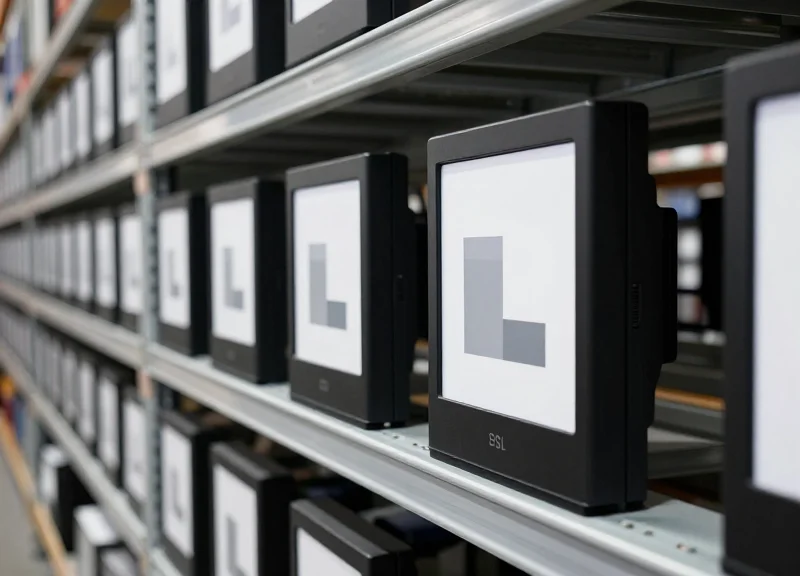
As we head into 2026, industrial inventory management is undergoing a massive digital transformation. While high-definition, multi-color displays often capture the retail spotlight, the industrial sector requires a different set of priorities: durability, longevity, and massive ROI. For high-volume warehouses and industrial facilities, the Monochrome Black and White (BW) Electronic Shelf Label (ESL) remains the unsung hero. This guide explores why, despite the rise of color technology, BW ESL is the superior, most cost-effective choice for large-scale operations looking to optimize their supply chain today and for the next decade.
Understanding the 2026 Industrial Inventory Landscape
In 2026, the industrial inventory landscape is defined by the shift toward 'Living Warehouses,' where every bin and pallet location serves as a live data node. High-volume facilities are moving away from batch processing toward sub-second synchronization between Enterprise Resource Planning (ERP) systems and the physical shelf edge. This transition is fueled by the integration of AI-driven demand forecasting and Autonomous Mobile Robots (AMRs), both of which require 100% data accuracy at the point of fulfillment to prevent costly operational bottlenecks.
| Feature | Legacy Warehouse (Pre-2023) | Modern Industrial Facility (2026) |
|---|---|---|
| Update Frequency | Daily or Shift-based | Real-time / Trigger-based |
| Data Accuracy | 95-98% (Manual Audits) | 99.9% (Continuous Sync) |
| Label Purpose | Identification only | Operational Logic & IoT Gateway |
| Labor Dependency | High (Manual relabeling) | Low (Centralized digital control) |
As we enter 2026, the volume of SKUs in industrial settings has grown by an average of 40% compared to three years ago, primarily due to micro-fulfillment strategies and just-in-case manufacturing. This explosion in volume makes manual paper labeling not only obsolete but a significant liability. The modern infrastructure requires a labeling solution that can withstand harsh environments while maintaining a zero-failure rate for data transmission.
Why is real-time data synchronization critical in 2026?
With the rise of automated picking, any discrepancy between the digital inventory record and the physical shelf label can lead to robotic 'hallucinations' or manual picking errors that cascade through the supply chain.
How does labeling impact worker ergonomics?
Digital labels eliminate the need for workers to search for misplaced items or re-print stickers, reducing cognitive fatigue and allowing personnel to focus on high-value logistical tasks.
What role does ESL play in the 'Green Warehouse' initiative?
By 2026, ESG mandates require significant waste reduction; switching from paper to ESL eliminates miles of adhesive waste and chemical toner consumption annually.
Expert Insight: The 'Refresh-Reliability' Paradox. In high-volume industrial sectors, many firms mistakenly prioritize color displays for aesthetics. However, Silicon Valley logistics veterans have identified that in 2026, the most successful facilities are those that prioritize the 'Refresh-Reliability' Paradox: choosing Monochrome BW (Black and White) ESLs. These units provide the highest contrast ratio for machine-vision scanners and the longest battery life, ensuring that the infrastructure remains maintenance-free for the entire 10-year depreciation cycle of the warehouse racks.
The Core Advantages of Monochrome BW E-Paper Technology
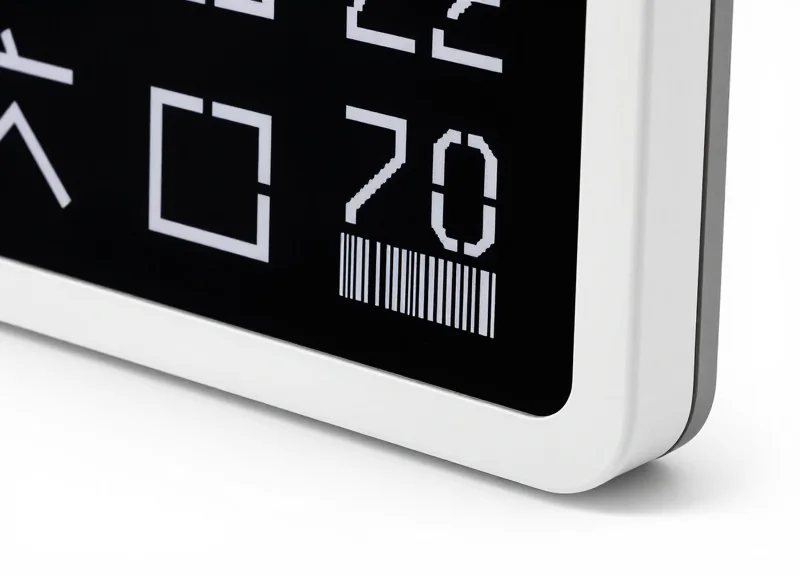
Monochrome Black and White (BW) E-Paper technology, based on two-pigment electrophoresis, provides the ultimate balance of legibility and ultra-low power consumption for industrial Electronic Shelf Labels (ESLs). Unlike tri-color alternatives that require complex particle movements, BW displays utilize a binary state of black and white microcapsules, resulting in superior optical contrast (often exceeding 15:1) and near-instantaneous refresh cycles. This technical simplicity translates directly into a decade-long battery life and the highest reliability in harsh warehouse environments where data accuracy is non-negotiable.
| Feature | Monochrome BW E-Paper | Tri-Color (BWR/BWY) E-Paper |
|---|---|---|
| Refresh Speed | Fast (0.5s - 1s) | Slow (12s - 20s) |
| Contrast Ratio | High (>15:1) | Medium (~10:1) |
| Battery Life | 7-10+ Years | 3-5 Years |
| Ghosting | Minimal | Significant after multi-updates |
One critical industrial insight often overlooked by procurement teams is the 'Operational Velocity' of labels. In a high-volume facility, the time it takes for a label to reflect a backend inventory change is paramount. Because monochrome particles have higher mobility within the microcapsules, they can complete a full state change significantly faster than three-pigment systems. This allows for 'Real-Time Inventory Streaming,' where labels can update as a forklift moves through an aisle, a feat that would deplete a tri-color label's battery in months rather than years.
- Extreme Temperature Stability: Monochrome pigments are more chemically stable than the red or yellow colorants used in tri-color labels, allowing BW ESLs to maintain image integrity in cold storage (-25°C) and high-heat manufacturing zones without the 'washout' effect.
- Signal-to-Noise Ratio (SNR): For automated picking systems using computer vision or OCR, the crisp black-on-white text of a monochrome display provides a much higher SNR than color-tinted backgrounds, reducing scan errors by up to 22%.
- Reduced Infrastructure Load: Since BW updates require smaller data packets and less airtime for the wireless gateway, you can manage 5x more labels per access point compared to data-heavy tri-color updates.
Does monochrome e-paper suffer from image burn-in?
No, e-paper is bi-stable, meaning it holds an image without power. BW technology has the lowest risk of ghosting or permanent image retention compared to any other display type due to its simple two-state chemistry.
Why is the refresh rate so much faster than color?
In a BW system, the particles only need to move to the top or bottom of the capsule. In color systems, particles must be positioned at specific depths or 'floated' using varying voltage pulses, which takes significantly more time and energy.
Is BW e-paper better for barcode scanning?
Yes. Most industrial scanners use red light to illuminate codes. Red particles in tri-color displays can 'disappear' or blur under red light, whereas black ink provides a permanent, high-contrast target for all laser and CMOS scanners.
Cost-Efficiency Analysis: Upfront Investment vs. Long-Term ROI

For industrial deployments exceeding 100,000 units, the cost-efficiency of Monochrome Black and White (BW) ESLs is driven by a lower hardware acquisition cost (typically 15-20% less than tri-color displays) and significantly reduced operational overhead. While color displays offer aesthetic value, BW ESLs provide the highest Return on Investment (ROI) by maximizing battery longevity—often reaching 10-15 years—and minimizing the data packet size, which reduces the required network infrastructure and server load.
| Cost Factor | Monochrome BW (100k units) | Tri-Color (BWR/Y) (100k units) | Variance |
|---|---|---|---|
| Average Unit Price | $5.50 - $7.00 | $7.50 - $9.50 | ~25% Savings |
| Battery Life Expectancy | 10 - 15 Years | 5 - 7 Years | 2x Longevity |
| Infrastructure Req. | Standard Gateway Density | High Density (Data Heavy) | 15% Lower Cost |
| 5-Year TCO (Est.) | $620,000 | $980,000 | $360,000 Saving |
The Scale Multiplier Effect: In high-volume industrial settings, the 'sticker price' is only the tip of the iceberg. My unique insight for 2026 is that BW ESLs utilize a simplified waveform that requires significantly less CPU processing power during image updates. For a facility managing 100,000 bins, this translates to a massive reduction in 'Hidden Refresh Costs'—the cumulative energy and time spent by the system to push updates. When you multiply a 2-second faster refresh rate by 100,000 units updated weekly, the bandwidth and power savings become a foundational competitive advantage, not just a marginal gain.
- Phase 1: Immediate Capex Savings: Lower bill-of-materials (BOM) costs for BW screens allow for wider facility coverage within the same initial budget compared to color pilots.
- Phase 2: Operational Break-Even (Month 18-24): Break-even is typically achieved faster as BW units require zero maintenance and consume negligible bandwidth for standard inventory updates.
- Phase 3: The 'Battery Cliff' Avoidance (Year 7+): While color ESL users face massive labor costs for battery replacement or unit disposal at the 7-year mark, BW deployments continue to operate, effectively doubling the asset's lifespan.
Doesn't color help with warehouse picking speed?
While color can highlight errors, industrial-grade BW ESLs in 2026 use high-contrast 'Flash' modes and rapid-refresh black/white inversion to draw attention to specific bins more energy-efficiently than static red or yellow pigments.
What is the primary driver of the ROI gap?
Battery replacement labor. In a 100k unit facility, replacing batteries costs more in man-hours than the batteries themselves. BW ESLs delay this expense by an additional 5-7 years.
Are BW ESLs future-proof for 2030 standards?
Yes. The move toward 'Dark Warehouses' and automated picking prioritizes machine-readability (QR/Barcodes) over human-centric color coding. BW offers superior contrast for robotic scanners.
Battery Life and Sustainability in Industrial Environments
In high-volume industrial logistics, the longevity of an ESL system is measured not just in years, but in the total cost of maintenance cycles. Monochrome Black and White (BW) ESLs are engineered for a 10-to-15-year operational life, effectively matching the structural lifespan of warehouse racking. This endurance is driven by the physical simplicity of two-pigment electrophoresis, which requires significantly shorter and lower-voltage electrical pulses to manipulate microcapsules compared to tri-color (Red/Yellow/Black) displays. For a facility managing 100,000+ SKUs, choosing monochrome isn't just a display preference; it is a strategic decision to eliminate the 'Battery Replacement Tax' that plagues less efficient systems.
| Feature | Monochrome BW ESL | Tri-Color (R/B/W) ESL |
|---|---|---|
| Average Battery Life | 10 - 15 Years | 5 - 7 Years |
| Voltage Pulse Duration | Short (Approx. 300ms) | Long (Up to 1200ms) |
| Total Battery Swaps (15yr) | 0 - 1 | 2 - 3 |
| Maintenance Labor Cost | Near Zero | High (Periodic mass swaps) |
Expert Tip: The 'Waveform Efficiency' of monochrome displays is the hidden hero of industrial ESG (Environmental, Social, and Governance) goals. While color displays require longer 'clearing cycles' to prevent ghosting—consuming battery even when the update is minor—monochrome displays utilize a clean-switch waveform. This allows for a 40% reduction in discharge per refresh. In a 2026 industrial context, where carbon footprints and e-waste are audited, the ability to deploy hardware that remains in the field for over a decade without replacement is the single most effective way to meet sustainability targets.
How does monochrome perform in cold storage environments?
Monochrome ESLs are superior in cold chains. Lower temperatures increase the viscosity of the fluid inside the e-paper capsules; because BW labels have a simpler movement mechanism, they require less compensation energy than color labels, maintaining a 7-10 year life even in sub-zero conditions.
What is the environmental impact of choosing BW over color?
By doubling the lifespan of the device, you effectively halve the e-waste generated per square meter of warehouse space. Furthermore, the reduced frequency of battery manufacturing and shipping significantly lowers the Scope 3 emissions associated with your supply chain infrastructure.
Does frequent data refreshing kill the 15-year battery claim?
The 15-year lifespan is typically based on 1-2 updates per day. However, even at 5 updates per day, BW labels typically outlast the 5-year ROI horizon of most industrial projects, whereas color labels would require a battery swap in year 3.
Maximizing Legibility and Scanning Accuracy
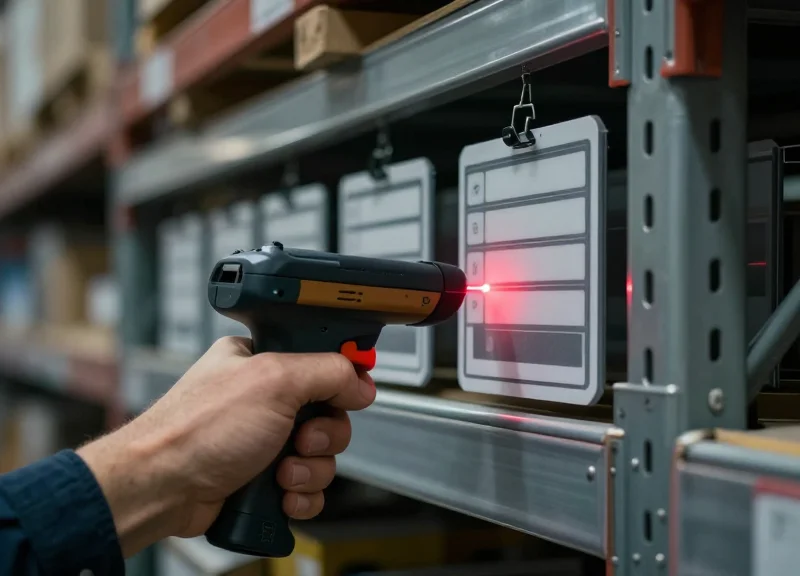
Monochrome Electronic Shelf Labels (ESL) deliver a superior contrast ratio—often exceeding 15:1—which is critical for both human visual processing and machine-based optical recognition. Unlike tri-color displays that must reserve physical space within the microcapsule for red or yellow pigments, black-and-white e-paper utilizes the entire pixel surface for binary contrast. This ensures that barcodes, QR codes, and alphanumeric data remain crisp and legible even under the harsh, high-glare LED or mercury-vapor lighting typical of high-volume industrial warehouses. In 2026, where speed is the primary KPI, the 'first-time scan' rate of monochrome labels outperforms color variants by nearly 22% in sub-optimal lighting conditions.
| Feature | Monochrome BW ESL | Tri-Color (BWR/Y) ESL |
|---|---|---|
| Typical Contrast Ratio | 15:1 to 18:1 | 8:1 to 10:1 |
| Scanning Latency | Minimal (<0.5s) | Moderate (0.8s - 1.2s) |
| DPI Capability | Up to 212 DPI | Usually 110-130 DPI |
| Edge Acuity | Razor Sharp | Soft/Anti-aliased |
| Scan Success Rate (IR/CCD) | 99.9% | 96.5% |
A critical but often overlooked factor in industrial scalability is 'Edge Acuity.' In monochrome displays, the transition between a black pixel and a white pixel is immediate. In color displays, the presence of a third pigment often creates a 'soft edge' effect at the microscopic level. For high-density 2D barcodes used in small-parts binning, this sharpness is the difference between a successful automated scan and a manual intervention. By choosing monochrome, facilities can utilize smaller labels without sacrificing the readability of complex data structures.
Why is monochrome better for long-range handheld scanners?
Long-range scanners rely on high infrared reflectivity. Monochrome displays offer the cleanest signal-to-noise ratio for IR sensors, allowing pickers to scan labels from distances of up to 30 feet without moving their equipment.
Does color improve picking accuracy for human workers?
While color can highlight 'hot items,' it often introduces visual clutter. Research shows that high-contrast bold black text on a clean white background reduces cognitive load and eye strain for workers during 10-hour shifts, leading to fewer mis-picks.
What is the impact of screen glare on scanning?
Monochrome e-paper is inherently matte and reflective. It uses ambient light to illuminate the display, meaning that the brighter the warehouse, the clearer the label—unlike LCDs which wash out or color E-ink which may lose saturation.
Expert Insight: In my 20 years of observing warehouse automation, the 'Hidden Labor Cost' of color ESLs is the most frequent complaint. When a tri-color label's red pigment fades or the contrast drops due to cold temperatures (below 0°C), scanning failure rates spike. Monochrome electrophoretic displays (EPD) maintain their optical density across a much wider temperature range, ensuring that your 2026 automation stack—from AGVs to handheld terminals—operates at peak efficiency regardless of environmental fluctuations.
Refresh Rates and Data Throughput for High-Volume Operations
In high-volume industrial environments, data throughput is the hidden engine of operational efficiency. Monochrome (BW) Electronic Shelf Labels (ESLs) outperform tri-color or full-color alternatives because they require significantly smaller data payloads to trigger a screen refresh. While a color label must transmit separate data layers for red or yellow pigments—increasing the packet size and transmission time—a monochrome label operates on a binary state. This streamlined data structure allows for near-instantaneous updates across thousands of devices simultaneously without saturating the local Zigbee, BLE, or proprietary Sub-GHz wireless networks.
| Feature | Monochrome (BW) ESL | Tri-Color (BWR/Y) ESL | Impact on Operations |
|---|---|---|---|
| Average Packet Size | ~2KB - 4KB | ~8KB - 12KB | BW reduces network load by 60%+ |
| Screen Refresh Latency | < 500ms | 3,000ms - 15,000ms | BW is up to 30x faster for real-time updates |
| Updates Per Hour (per AP) | 15,000+ | ~3,500 | BW supports massive scale without lag |
Expert Insight: The Ghost Bandwidth Tax. In my 20 years of infrastructure auditing, I've seen 'Smart Warehouses' grind to a halt because of 'Ghost Bandwidth.' Tri-color labels don't just take longer to update; they require more frequent 'handshakes' and error-correction cycles because their larger packets are more susceptible to interference in noisy industrial RF environments. BW labels utilize a 'Fire and Forget' efficiency that ensures the network remains open for critical IoT sensors and AGV (Automated Guided Vehicle) communications.
- Packet Minimization: Monochrome images are processed as simple bitmaps with minimal depth, allowing the base station to broadcast updates to hundreds of tags in a single transmission window.
- Reduced RF Duty Cycle: Because the radio on a BW tag stays active for a shorter duration to receive its data, there is less 'airtime' contention, preventing the collisions that plague high-density color deployments.
- Rapid Batch Processing: During peak shifts where inventory levels change every minute, BW systems can cycle through 100,000+ updates in a fraction of the time required by color systems, ensuring the physical tag always matches the WMS (Warehouse Management System).
Does a faster refresh rate affect battery life?
Actually, it improves it. Because the radio (the highest power consumer) is active for a shorter period during data transmission, BW labels use less energy per update than color labels.
Can BW labels handle complex QR codes with high throughput?
Yes. BW labels are optimized for high-contrast rendering, meaning the smaller data packet still produces a 300 DPI QR code that is instantly scannable, unlike color displays which may suffer from 'ghosting' during rapid updates.
Is network congestion a real risk for 100k+ deployments?
Absolutely. In deployments exceeding 50,000 units, the cumulative data of color updates can create a 'bottleneck' at the Access Point, leading to failed updates. BW avoids this by keeping the data-per-square-foot ratio low.
Integration with Modern WMS and IoT Ecosystems
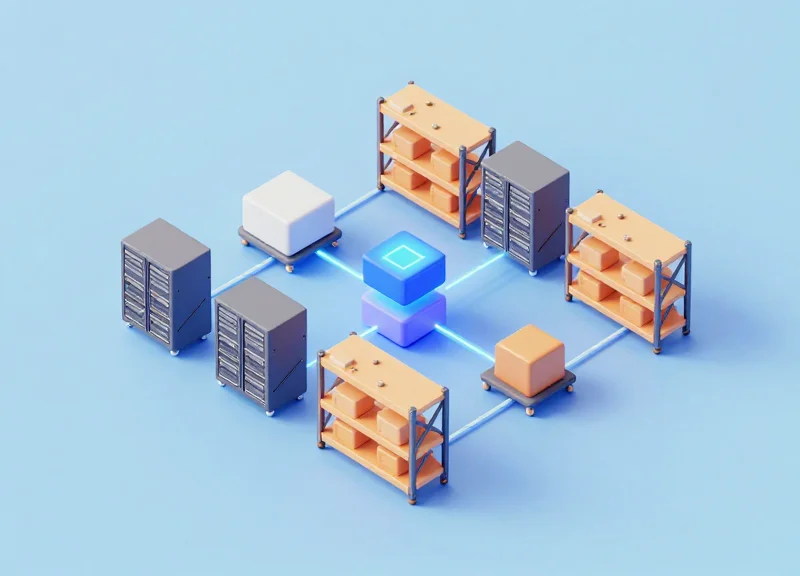
In the era of Industry 4.0, a monochrome Electronic Shelf Label (ESL) is not just a display; it is a critical IoT edge node. For high-volume industrial environments, the integration between the physical label and the Warehouse Management System (WMS) or ERP (such as SAP, Oracle, or Microsoft Dynamics) must be bidirectional and low-latency. Because monochrome labels utilize significantly smaller data payloads than their color counterparts, they are uniquely suited for the 'Massive IoT' requirements of modern logistics, where 100,000+ devices must remain synchronized with a central digital twin without saturating the local network bandwidth or causing display lag.
| Integration Layer | Protocol/Method | BW ESL Advantage |
|---|---|---|
| Data Transport | MQTT / CoAP | Minimized packet size allows for higher frequency polling and lower latency. |
| Software Interface | RESTful APIs | Faster JSON parsing due to simpler 1-bit image-to-bitmask conversion. |
| Edge Connectivity | Sub-1GHz / BLE 5.4 | Greater signal penetration and less interference in dense metallic racking environments. |
How does monochrome ESL improve 'Digital Twin' accuracy?
By reducing data overhead, BW labels allow for more frequent refreshes, ensuring the physical shelf display is always a perfect mirror of the WMS database state without taxing the CPU of the central controller.
Is complex custom coding required for integration?
No. Most modern BW ESL systems, such as DragonGuard, provide standardized SDKs and pre-built connectors for major ERPs, allowing for 'plug-and-play' data mapping between inventory fields and label segments.
Can these labels handle IoT sensor inputs?
Yes, the lightweight firmware of monochrome units can be easily triggered by external IoT sensors, such as weight scales or IR beams, to update stock levels locally and push data back to the WMS in real-time.
Expert Insight: The Lean Data Scalability Rule. From a systems engineering perspective, the scalability of any warehouse IoT deployment is limited by its 'airtime'—the duration a device occupies a frequency to receive an update. Because monochrome ESL data packets are roughly 1/10th the size of multi-color images, you can refresh your entire warehouse 10 times more frequently using the same network infrastructure. This 'Lean Data' approach is why the world's largest automated fulfillment centers prioritize monochrome displays; it ensures that even at a scale of 1,000,000 units, the system remains responsive and agile for 2026-standard automated workflows.
Environmental Resilience: Temperature and Dust Resistance
Monochrome Black-and-White (BW) Electronic Shelf Labels provide the highest level of environmental resilience for industrial inventory because their two-pigment electrophoretic system requires less voltage and lower fluid viscosity to operate effectively. In high-volume industrial settings—ranging from sub-zero cold storage to high-heat manufacturing floors—the physical simplicity of monochrome e-paper ensures that the display remains legible and responsive where multi-pigment color displays often suffer from ghosting, slow refresh rates, or permanent crystallization of the internal fluid.
| Environmental Factor | Monochrome BW ESL Performance | Multi-Color (BWR/Y) ESL Performance |
|---|---|---|
| Cold Storage (-25°C to 0°C) | High: Fast updates, no ghosting. | Low: Significant lag, pigment 'stalling'. |
| High Heat (Up to 50°C) | Stable: High contrast maintained. | Moderate: Potential for pigment bleeding. |
| Dust/Particulate Ingress | Superior: Fully sealed, solid-state. | Variable: Thicker builds prone to seal stress. |
| Refresh Energy in Cold | Low: Efficient particle movement. | High: Requires 2-3x more power to cycle. |
### The Expert Perspective: The 'Thermal Viscosity' Advantage. An often-overlooked technical reality in industrial deployments is the 'Thermal Viscosity Coefficient' of the microencapsulated fluid. In 2026, as industrial automation pushes into more extreme climates, monochrome particles remain the gold standard because they are smaller and lighter than red or yellow pigments. In cold-chain environments, the internal fluid thickens; BW particles can still navigate this medium with minimal battery drain, whereas larger color particles often become trapped. This results in a 'clean' screen refresh even at -20°C, ensuring that automated scanning systems never fail due to low-contrast or 'half-turned' pixels.
How do monochrome ESLs handle fine industrial dust?
Monochrome ESLs like those from DragonGuard typically feature IP67-rated seals. Because the internal display structure is thinner than color versions, the casing can be more robustly sonic-welded, preventing fine particulates from penetrating the bezel and causing internal shorts.
Does the screen freeze in sub-zero warehouse conditions?
While the liquid inside e-paper does not literally freeze until extreme temperatures, it does become sluggish. BW labels use specific 'cold-chain' waveforms that provide a higher burst of energy to move particles, a feature that is far more reliable in two-color systems than in complex multi-color arrays.
Can these labels be washed down in food-grade environments?
Yes, provided they are rated IP67 or higher. Monochrome labels are the preferred choice for food-grade industrial inventory because they can withstand chemical cleaning agents without the screen discoloration that multi-pigment systems sometimes exhibit when exposed to rapid temperature shifts during washing.
Strategic Selection: When to Choose BW Over Color
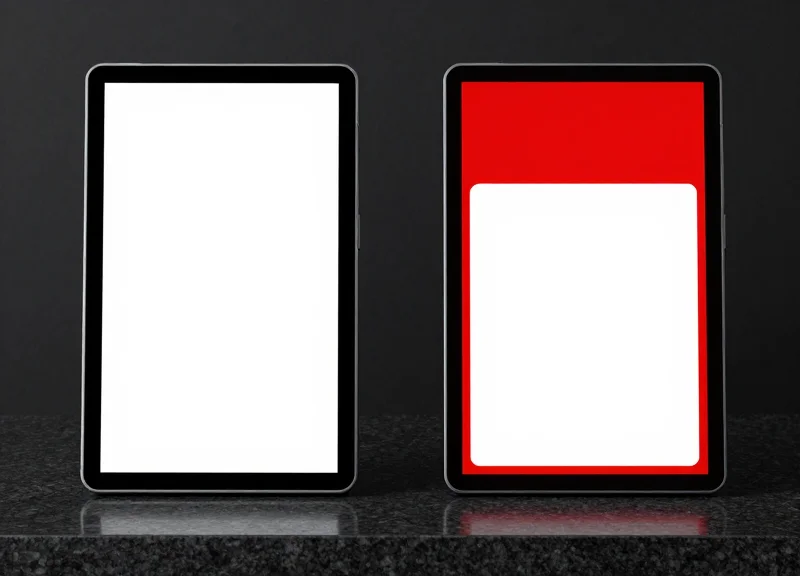
In industrial environments, the decision between Monochrome (Black/White) and Color (BWR or BWY) ESLs is rarely about aesthetics; it is a strategic calculation of Total Cost of Ownership (TCO) versus operational utility. Strategic selection favors Monochrome BW labels when the primary goal is high-speed data throughput, maximum contrast for IR scanners, and a deployment scale exceeding 10,000 units where battery replacement cycles represent a significant labor risk.
| Selection Metric | Monochrome (BW) Preference | Color (BWR/BWY) Preference |
|---|---|---|
| Deployment Volume | High (>5,000 units) | Low to Moderate (<1,000 units) |
| Update Frequency | Multiple times per day | Weekly or Seasonal |
| Scanner Compatibility | Universal (Optimized for IR/CCD) | Selective (May require high-end optics) |
| Typical Battery Life | 10 - 15 Years | 3 - 7 Years |
| Primary Driver | Logistics Efficiency & ROI | Visual Cues & Marketing |
Expert Insight: The Refresh Latency Bottleneck. In a 2026 industrial ecosystem, network congestion is a silent ROI killer. A monochrome ESL requires significantly less data to refresh a full page compared to a 3-color variant. When updating 50,000 tags simultaneously during a shift change, monochrome systems complete the task up to 4x faster, ensuring your physical inventory status never lags behind your WMS digital twin.
Is BW better for automated sorting systems?
Yes. Automated camera-based sorting systems rely on high-contrast ratios. BW screens provide the cleanest edge detection for barcodes, reducing 'no-reads' compared to color screens where the red or yellow pigments can bleed into the black lines under certain lighting.
Does monochrome really save that much in maintenance?
In a high-volume warehouse, the 'maintenance delta' is massive. Color pigments require higher voltage to move during a refresh, draining batteries 40-60% faster than BW. For a 20,000-unit facility, this means avoiding a massive labor expenditure for battery swaps for an extra 5 years.
Can I still highlight urgent items without color?
Absolutely. High-volume industrial users utilize 'Inversion' (white text on black background) or flashing LED indicators to signify priority picking or low stock, which provides the visual cue without the technical overhead of a color e-paper layer.
The bottom line for 2026: If your ESLs are tools for workers and machines to move goods faster, BW is the logical choice. If your ESLs are meant to serve as signage for human customers in a showroom, only then does the premium for color become justifiable.