In the high-stakes environment of clinical laboratories, reagent management is often an invisible drain on profitability. With global supply chain fluctuations and tightening healthcare budgets, the traditional manual approach to tracking expiration dates and stock levels is no longer sustainable. Studies indicate that inefficient inventory management can lead to a staggering amount of expired or unused supplies. However, the adoption of Electronic Shelf Labels (ESL) is revolutionizing this sector. By transitioning to a data-driven, automated system, laboratories are successfully eliminating up to 40% of reagent waste, transforming a logistical headache into a clear competitive advantage and a significant return on investment (ROI).
The Hidden Costs of Manual Reagent Management

Manual reagent management is an invisible drain on clinical laboratory budgets, characterized by a reliance on paper logs, whiteboards, or static spreadsheets that fail to capture real-time inventory dynamics. This outdated approach leads to a cascade of financial inefficiencies, most notably the 'Safety Stock Paradox'—where staff over-order supplies to prevent critical stockouts, inadvertently increasing the volume of reagents that expire before use. For a typical high-volume lab, these hidden costs typically manifest as a 20% to 40% loss in total inventory value due to expiration, emergency shipping fees, and highly paid technicians spending up to 15% of their shift performing manual cycle counts instead of clinical analysis.
| Cost Category | Manual Management Impact | Economic Consequence |
|---|---|---|
| Inventory Shrinkage | Lack of FEFO (First-Expired-First-Out) visibility. | High waste from expired reagents. |
| Labor Overhead | Technicians manually counting vials/bottles daily. | Lost clinical productivity and high burnout. |
| Procurement Inaccuracy | Ordering based on 'gut feeling' or old logs. | Capital tied up in excess 'dead' stock. |
| Operational Disruption | Sudden stockouts discovered mid-run. | Emergency shipping costs and delayed patient results. |
Beyond the balance sheet, manual management introduces significant clinical risk. When reagents are not tracked with precision, the First-Expired-First-Out (FEFO) principle is frequently violated. This results in 'The Shadow Inventory' phenomenon—where older reagents are pushed to the back of the refrigerator and forgotten until they become a total loss. In my two decades of observing laboratory operations, the most overlooked cost is the 'Opportunity Cost of Talent.' Every hour a PhD-level lab manager spends reconciling a spreadsheet is an hour lost to diagnostic innovation or quality assurance improvements that could drive higher reimbursements.
How does manual tracking cause 'just-in-case' ordering?
Due to the lack of real-time visibility, lab managers fear running out of critical assays during peak testing times. Without data-driven alerts, they maintain excessive buffer stocks that exceed actual demand, leading to higher expiration rates.
What is the primary labor cost associated with manual reagent management?
The primary labor cost is 'Walk Time.' Technicians must physically travel to multiple storage locations to verify stock levels, a process that is often repeated across shifts due to lack of a centralized, digital 'single source of truth.'
How does manual management affect reagent expiration?
Manual systems rely on human eyes to check dates. In a busy clinical environment, expiration dates are easily missed, meaning expensive reagents are only identified as expired after they are already unusable or, worse, during a run.
Understanding ESL: More Than Just a Digital Price Tag
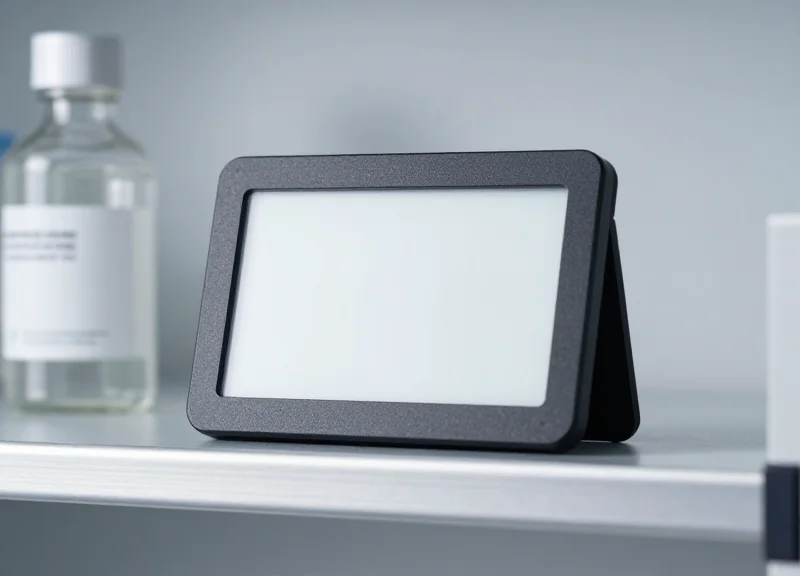
In a clinical laboratory, an Electronic Shelf Label (ESL) is a networked IoT (Internet of Things) device that replaces static paper labels with dynamic, high-contrast e-paper displays. Unlike retail price tags, clinical-grade ESLs serve as bi-directional communication portals, synchronizing directly with your Laboratory Information Management System (LIMS) to provide real-time visibility into reagent batch numbers, precise expiration dates, and remaining volume—essential data points that manual labeling cannot maintain accurately.
| Feature | Standard Retail ESL | Clinical-Grade ESL Node |
|---|---|---|
| Primary Function | Dynamic Pricing | Inventory Integrity & Compliance |
| Display Tech | Standard E-Ink | High-Resolution E-Paper (Multi-color) |
| Sterilization | Not Required | IP67 Rated / Chemical Resistant |
| Battery Life | 5-7 Years | Up to 10 Years (Low-energy RF) |
| LED Feedback | Optional (Single Color) | Multi-color (RGB) for Status Alerts |
The Veteran's Perspective: A common misconception is that ESL is merely a display technology. In reality, the 'secret sauce' is the sub-GHz or BLE (Bluetooth Low Energy) infrastructure that allows a single access point to manage thousands of labels with 99.9% transmission reliability. This ensures that when a reagent lot is recalled or a 'Use-By' date passes, the change is reflected on the shelf in under 60 seconds, preventing the technician from ever pulling an invalid bottle.
Is ESL technology compatible with cold storage and sterile zones?
Yes. Clinical ESLs are designed with specialized components that operate in temperatures as low as -25°C for reagent refrigerators and feature sealed, IP67-rated housings that can withstand standard lab disinfection protocols using isopropyl alcohol or hydrogen peroxide vapors.
How does ESL improve technician workflow specifically?
Through 'Pick-to-Light' functionality. Lab managers can trigger the integrated RGB LEDs on specific labels to flash, guiding technicians to the exact reagent needed for a specific assay, reducing search time and the risk of cross-contamination.
Does implementing ESL require a complete IT overhaul?
No. Modern ESL systems use API-driven middleware that sits between your LIMS/ERP and the labels, requiring minimal modification to existing database structures while providing a robust audit trail for regulatory compliance.
By moving beyond the 'digital price tag' mindset, clinical laboratories can treat every reagent bottle as a data point. This shift from passive storage to an 'active shelf' environment is the foundational step required to achieve the 40% reduction in reagent waste that modern data-driven ROI models now predict.
Real-Time Monitoring: The Key to Reducing Waste by 40%

Real-time monitoring using Electronic Shelf Labels (ESL) reduces reagent waste by up to 40% by providing a continuous, automated stream of inventory data that eliminates human error and oversight. Unlike manual logs that are only as accurate as the last entry, ESL systems create an 'always-on' visibility layer where expiration dates, batch numbers, and stock levels are synchronized with the Laboratory Information System (LIS). This ensures that reagents nearing their end-of-life are flagged for immediate use or return before they become unsalvageable losses.
In a high-throughput clinical environment, the 'set it and forget it' nature of ESL technology is transformative. The labels act as active IoT sentinels, reflecting real-time changes in the backend database. If a specific lot of immunoassay kits is approaching its 30-day expiration window, the system doesn't just record it—it communicates it. This proactive visibility shifts the lab from a reactive 'clean-up' mode to a precision-driven 'preventative' management style.
| Feature | Manual Monitoring | ESL Real-Time Monitoring |
|---|---|---|
| Data Accuracy | Subject to human error and lag | 100% synchronized with LIS/ERP |
| Expiration Alerts | Periodic manual shelf audits | Instant automated LED flashing/alerts |
| Inventory Visibility | Visible only during physical counts | 24/7 remote cloud-based access |
| Reagent Rotation | Relies on staff memory (FIFO) | Dynamic visual cues guide selection |
- Automated Expiration Logic: The system monitors the 'First-In, First-Out' (FIFO) protocol by highlighting the oldest viable reagent on the shelf with a specific LED color, ensuring it is used first.
- Threshold Notifications: When stock levels dip below a pre-calculated safety buffer, the system automatically triggers a reorder request, preventing emergency shipping costs.
- Batch-Level Control: If a specific reagent lot is recalled, the ESLs for that batch can be updated instantly to 'Do Not Use,' preventing diagnostic errors and wasted lab hours.
Expert Insight: Beyond simple alerts, the most advanced labs use 'Inventory Velocity Balancing.' By analyzing the real-time burn rate of reagents, the ESL system can calculate exactly when a reagent will expire based on current usage trends. If the data shows a reagent is likely to expire before it can be used at Lab A, it can be transferred to Lab B (a higher-volume facility) weeks in advance. This inter-facility optimization is only possible with the granular, real-time data provided by ESL technology.
How does the ESL alert staff to expiring reagents?
Most ESLs feature multi-color LED indicators that can flash red or yellow when a reagent is within 48 hours of expiration, providing a physical visual cue that is impossible to miss.
Can real-time monitoring work in cold storage?
Yes, clinical-grade ESLs are designed to operate in refrigerated and frozen environments, ensuring that the most sensitive (and expensive) reagents are monitored constantly.
Does the system require a constant Wi-Fi connection?
ESL systems typically use low-power sub-GHz or BLE protocols that are highly stable and designed to avoid interference with other clinical wireless devices.
The ROI Calculation: Hard Data on Laboratory Automation

Calculating the Return on Investment (ROI) for Electronic Shelf Labels (ESL) in a clinical laboratory is determined by the formula: (Total Annual Savings - Annualized System Cost) / Annualized System Cost. For most mid-to-large scale laboratories, the primary drivers of this ROI are a 40% reduction in reagent expiration waste and a 75% decrease in time spent on manual inventory audits. When these factors are combined with the prevention of audit-related fines, most facilities realize a full capital recovery within 12 to 18 months of implementation.
| Metric | Manual Process (Annual) | ESL Automated (Annual) | Projected Savings |
|---|---|---|---|
| Reagent Waste (Expiring) | $65,000 | $13,000 | $52,000 |
| Labor (Inventory Management) | 1,040 Hours | 208 Hours | 832 Hours |
| Administrative Error Costs | $12,000 | $1,500 | $10,500 |
| Total Operational Cost | $115,000+ | $35,000 | $80,000/yr |
To move beyond surface-level estimates, laboratory directors must evaluate the Total Cost of Ownership (TCO). While the initial hardware investment in e-ink displays and access points is a visible capital expenditure, the 'hidden' ROI lies in the recovery of high-value labor. When a specialized lab technician earning $45/hour spends 20% of their week counting bottles, the laboratory isn't just losing money on labor—it is losing the revenue-generating potential of that technician's clinical expertise.
- Identify Baseline Waste: Audit the last 12 months of reagent disposal logs to determine the exact dollar value of items discarded due to expiration or temperature excursions.
- Quantify Labor Leakage: Track the total man-hours dedicated to manual shelf-scanning, data entry, and order reconciliation.
- Factor in Compliance Risk: Estimate the potential cost of CAP (College of American Pathologists) or CLIA non-compliance fines, which automated ESL logs effectively mitigate.
### The Expert Insight: The 'Invisible Multiplier' A unique financial benefit often overlooked by procurement teams is the 'Inventory Velocity' increase. ESL systems enable 'First-In, First-Out' (FIFO) protocols to be enforced via visual LED alerts on the tags. By ensuring that the oldest reagents are always used first, labs can reduce their standing inventory by 15-20%, freeing up significant cash flow that was previously tied up in overstocked cold storage.
How long does it take to see a positive ROI?
Most clinical labs see a neutral cash flow impact within 9 months and a full ROI within 18 months, depending on reagent throughput and lab size.
Does ESL reduce the need for FTEs?
It rarely leads to layoffs; instead, it reallocates existing Full-Time Equivalents (FTEs) from low-value administrative tasks to high-value clinical testing, increasing the lab's total test volume capacity.
What is the lifespan of the hardware?
Modern ESL tags utilize ultra-low-power Zigbee or Bluetooth protocols, with battery lives typically exceeding 5 to 7 years, ensuring the ROI persists long after the initial payback period.
Enhancing Regulatory Compliance and Audit Readiness
Electronic Shelf Labels (ESL) transform laboratory compliance from a reactive, labor-intensive hurdle into a proactive, automated asset by providing a real-time, immutable digital record of every reagent’s journey. In the context of CLIA, CAP, and ISO 15189 standards, ESL systems ensure that lot numbers, expiration dates, and storage conditions are synchronized across physical labels and Laboratory Information Systems (LIS) simultaneously, virtually eliminating the risk of 'documentation gaps' that frequently trigger audit citations.
| Compliance Metric | Manual Paper/Spreadsheet Tracking | ESL-Automated Compliance |
|---|---|---|
| Data Integrity | High risk of transcription errors and illegible logs. | Automated LIS synchronization ensures 100% accuracy. |
| Audit Trail | Fragmented; requires manual retrieval of logbooks. | Instant, centralized digital history with timestamped logs. |
| Recall Management | Slow, manual search for affected lot numbers. | Instant identification and visual flashing alerts on shelves. |
| Expiry Validation | Relies on visual checks; prone to human oversight. | Automated lock-outs and real-time color-coded warnings. |
One of the most significant advantages of ESL in a clinical setting is the ability to maintain 'Audit Readiness' 365 days a year. Instead of the typical 'mad scramble' preceding a CAP inspection, the laboratory maintains a continuous state of validation. This is achieved through the integration of sensors and digital displays that serve as the physical manifestation of the lab's Quality Management System (QMS).
- Automated Lot-to-Vial Reconciliation: As new reagents are scanned into the system, ESLs automatically update to show the current active lot, ensuring personnel always use validated materials first.
- Environmental Mapping: ESL systems integrated with IoT sensors can display current shelf temperatures, fulfilling the requirement for documenting storage conditions at the point of use.
- Immutable Change Logs: Every update to a label is logged with a user ID and timestamp, providing the 'who, what, and when' required by 21 CFR Part 11.
Expert Insight: The 'Visual Recall' Advantage. Most laboratories fail audits not because they don't have the data, but because they cannot quickly find it or accidentally use a recalled lot during a chaotic shift. A unique advantage of modern ESL is the 'Flash-to-Find' capability. During a manufacturer recall, the compliance officer can trigger all affected lot numbers to flash a red LED light on the shelf. This provides a physical safety net that digital spreadsheets alone cannot offer, effectively neutralizing the risk of using non-compliant materials.
How does ESL help with CLIA personnel competency requirements?
By displaying QR codes on the reagent label that link directly to SOPs or training videos, labs can prove to auditors that 'Just-in-Time' training is available to all staff at the point of reagent handling.
Can ESL systems handle multi-site compliance?
Yes. ESL platforms allow centralized compliance officers to monitor reagent status and expiration across multiple satellite clinics from a single dashboard, ensuring standardized quality across the entire network.
What happens during a power or network outage?
ESL labels use E-ink technology, which requires no power to maintain the image. Even in a total power failure, the last compliant data remains visible on the shelf, ensuring no loss of critical safety information.
Human Factor: Reducing Cognitive Load and Laboratory Errors

Implementing Electronic Shelf Labels (ESL) in a clinical laboratory setting addresses the 'Human Factor' by automating the visual verification process, effectively reducing the cognitive load on laboratory professionals. By replacing static, manual tags with dynamic, color-coded digital displays, labs can eliminate decision fatigue—a primary driver of pre-analytical errors. Research indicates that 60% to 70% of all laboratory errors occur during the pre-analytical phase, often due to misidentification or the use of expired reagents. ESL systems provide an immediate 'at-a-glance' status that allows technicians to focus on complex diagnostic tasks rather than administrative inventory validation.
| Inventory Task | Manual Process (High Load) | ESL Automated Process (Low Load) |
|---|---|---|
| Expiration Check | Reading small print on every bottle; manual logs. | LED flash alerts for reagents expiring within 24 hours. |
| Stock Replenishment | Cross-referencing clipboards with shelf quantities. | Real-time digital stock levels displayed on-shelf. |
| Recall Management | Searching through batches by hand for lot numbers. | Instant highlighting of specific lots via system command. |
| Staff Training | Extensive memorization of storage protocols. | Intuitive color-coded visual cues (e.g., Green=Safe). |
Beyond simple visibility, the psychological impact of a digitized environment cannot be overstated. Laboratory burnout is at an all-time high, and removing the 'background noise' of inventory management directly improves staff morale. When a technician no longer fears that they might have missed a tiny expiration date on a critical reagent, their confidence in the diagnostic output increases. This shift from reactive crisis management to proactive clinical work is a key driver in reducing turnover rates among specialized lab personnel.
Unique Expert Insight: The Peripheral Vision Advantage. Unlike traditional labels that require 'foveal' (central) focus to read, modern ESLs utilize programmable LED flash patterns. In high-stress clinical environments, 'attentional blink' occurs where the brain misses visual stimuli due to overload. Flashing LEDs leverage the human peripheral nervous system's sensitivity to motion and light change, alerting technicians to errors even when they aren't looking directly at the label. This provides a 'safety net' that manual labels can never achieve.
Does the transition to ESL require extensive staff retraining?
No. Most lab technicians find ESL systems more intuitive than manual ones. Training typically focuses on interpreting the software dashboard rather than the physical labels, which use universal color codes (Red/Yellow/Green) that are instantly understood.
How does ESL reduce errors during emergency high-volume shifts?
During peak hours, cognitive load peaks. ESLs provide 'visual shortcuts,' such as highlighting the exact location of a needed reagent via an LED light (Pick-to-Light), preventing the accidental selection of the wrong chemical variant.
Can digital labels help with multi-lingual staff or travel techs?
Yes. ESLs can be programmed to display information in multiple languages or use standardized ISO icons, ensuring that temporary or traveling staff can maintain accuracy without deep familiarity with local shelf layouts.
Seamless Integration with LIS and ERP Ecosystems

Integrating ESL hardware with Laboratory Information Systems (LIS) and Enterprise Resource Planning (ERP) tools turns static shelving into a dynamic, interconnected asset. By leveraging bi-directional APIs and industry-standard protocols like HL7 or FHIR, clinical labs can automate the flow of inventory data from the procurement stage to the point of consumption. This synchronization ensures that what appears in the digital ledger is always physically reflected at the lab bench, creating a single source of truth that reduces the labor-intensive reconciliation processes typically required in high-throughput environments.
- Data Extraction (ERP/LIS): The system pulls real-time inventory levels, lot numbers, and expiration dates from the central database (e.g., SAP, Oracle, or Epic Beaker).
- Logic Processing via Middleware: A dedicated IoT gateway interprets the data, applying business rules such as 'First-Expired, First-Out' (FEFO) logic to determine which labels need updating.
- Wireless Transmission: Updated information is sent via sub-GHz or 2.4GHz encrypted protocols to the specific ESL units associated with those reagents.
- Physical Confirmation: The ESL displays the new data and provides a back-channel signal to the LIS confirming the update was successful, completing the digital-to-physical loop.
| Data Field | Source System | ESL Display Function | Operational Benefit |
|---|---|---|---|
| Lot Number | ERP / LIS | Digital Display | Ensures precise tracking for recall management. |
| Stock Level | ERP / Inventory | Dynamic Quantity | Triggers automated reordering when thresholds are met. |
| Expiration Date | LIS | Color Coding/Blinking | Visual alert prevents the use of expired reagents. |
| Storage Temp | BMS (Building Mgmt) | Live Monitoring | Warns staff if cold-chain reagents are at risk. |
Expert Tip: To maximize ROI, look for ESL solutions that offer 'Edge Intelligence.' Instead of relying on the LIS to push every minor change, intelligent ESL gateways can monitor local shelf-edge interactions and only sync back to the ERP when specific thresholds are crossed. This reduces network traffic and ensures that even during a temporary LIS outage, your physical labeling remains accurate and operational.
Does ESL integration require a complete LIS overhaul?
No. Modern ESL platforms use middleware that sits between the ESL hardware and your existing software. If your LIS/ERP supports API calls or standard file exports (CSV/XML), it can likely be integrated without modifying the core LIS architecture.
How is data security maintained during the sync?
Data is typically transmitted using AES-128 or AES-256 encryption. Furthermore, the ESL system only requires metadata for display (e.g., item name, count, date) and does not need access to sensitive Patient Health Information (PHI).
Can the system handle multi-site lab environments?
Yes. A centralized ERP can manage multiple lab locations by routing specific inventory data to the corresponding local ESL gateways, allowing for enterprise-wide visibility from a single dashboard.
Implementation Strategy: Best Practices for a Digital Transition
Implementing Electronic Shelf Labels (ESL) in a clinical laboratory is not merely a hardware upgrade; it is a fundamental shift in digital workflow that requires a phased, data-first strategy. The most effective implementation strategy involves a four-stage 'Agile Rollout'—Discovery, Data Hygiene, Pilot, and Full-Scale Integration—designed to minimize downtime and ensure that the digital inventory reflects the physical reality of the lab environment without interrupting critical diagnostic cycles.
- Baseline Inventory Audit & Data Hygiene: Before installing a single label, perform a deep audit of your current reagent SKU list. Standardize naming conventions and consolidate redundant entries to ensure the LIS/ERP database provides clean, accurate feeds to the ESL system.
- Strategic Hardware Mapping: Map your laboratory's physical environment to optimize signal strength. Account for stainless steel structures and cold storage units (freezers/fridges) that may require specialized sub-GHz frequency base stations or specific mounting brackets.
- The 'Parallel Run' Pilot: Select one high-turnover department (e.g., Chemistry or Hematology) for a 14-day parallel run. Maintain manual logs alongside the ESL system to validate the accuracy of automated expiration alerts and stock-out triggers.
- Staff Training & Champion Selection: Identify 'Super Users' across shifts. These internal champions facilitate peer-to-peer training, reducing the cognitive load on staff and accelerating the cultural shift toward data-driven inventory management.
| Implementation Phase | Key Objective | Typical Timeline |
|---|---|---|
| Pre-Implementation | Network audit and SKU standardization | 2-3 Weeks |
| Infrastructure Setup | Gateway installation and LIS bridging | 1 Week |
| Departmental Pilot | Workflow validation in one sector | 2 Weeks |
| Full Lab Rollout | Global activation across all departments | 1-2 Weeks |
Expert Insight: The 14-Day Validation Bridge. A common mistake is a 'Big Bang' switchover where manual tracking is abandoned overnight. In my 20 years of technical deployments, the most resilient labs utilize a 14-day 'Validation Bridge.' By running both systems concurrently for two full weeks, you identify edge cases—such as specific reagents that are moved between departments—that your initial data mapping might have missed. This prevents the 'trust gap' that occurs if the digital system shows an error early in its lifecycle.
Can ESLs operate inside -80°C ultra-low temperature freezers?
Yes, but they require specialized ruggedized casing and low-temperature batteries. Standard ESLs are typically rated for 0°C to 50°C, so ensure your vendor provides specialized tags for cold-chain inventory.
How do we handle reagents that arrive without manufacturer barcodes?
Implement a 'Receive-and-Tag' protocol at the loading dock. Staff scan the packing slip to generate a temporary QR code that syncs the item to its designated ESL on the shelf immediately upon arrival.
What is the biggest barrier to a successful transition?
Internal culture. If staff feel the system is an 'auditing tool' rather than a 'workload reducer,' adoption will stall. Frame the transition as a way to eliminate the 2-3 hours of manual inventory counting they currently perform weekly.