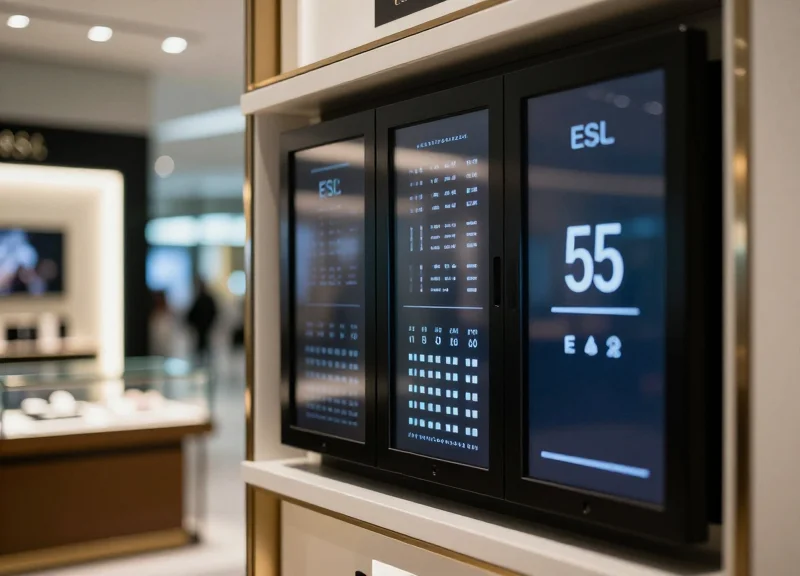

In the hyper-accelerated world of social commerce, a single viral post on TikTok or Instagram can trigger a massive surge in demand within minutes. For brick-and-mortar retailers, the traditional lag in updating physical price tags and promotional QR codes is no longer just an inconvenience—it is a lost revenue opportunity and a source of customer friction. To bridge this gap, technical teams are turning to ultra-fast Electronic Shelf Label (ESL) systems capable of 1-second dynamic updates. This guide delves into the infrastructure, protocols, and integration strategies required to achieve near-instantaneous synchronization between digital trends and the physical store shelf.
The Rise of Social-Media-Driven Shopping and the Need for Speed
Social-media-driven shopping is a retail phenomenon where viral digital content—such as TikTok 'hauls' or Instagram influencer endorsements—triggers instantaneous, high-volume consumer demand for specific products. In this environment, the gap between a digital trend surfacing and a customer appearing at the shelf is often measured in minutes, not days. For retailers, this necessitates a shift from static daily pricing to 'hyper-dynamic' updates, where Electronic Shelf Labels (ESLs) must refresh within seconds to reflect real-time inventory levels, promotional parity, and competitive digital pricing.
In my twenty years in Silicon Valley, I have seen the 'latency killer' destroy more business models than any competitor ever could. In modern retail, that latency exists in the lag between a product going viral and the price tag on the shelf reflecting its new market value. Traditional legacy systems, built on batch-processing architectures, are simply not designed for the velocity of the 'TikTok economy.' When a product goes viral, demand doesn't just increase; it explodes, creating a price-to-demand ratio that shifts faster than a human clerk can walk across a store floor.
| Metric | Traditional Retail Demand | Social-Driven Demand |
|---|---|---|
| Demand Trigger | Seasonality/Planned Promos | Unpredictable Viral Peaks |
| Pricing Refresh Cycle | 24-hour Batch Updates | 1-Second Dynamic Updates |
| Consumer Mindset | Comparison Shopping | Urgency/FOMO Driven |
| Inventory Strategy | Historical Forecasting | Real-time Signal Response |
- The Batch Update Bottleneck: Most legacy ERP and POS systems process price changes in nightly batches. If a product trends at 10:00 AM, the store sells out at an undervalued price by noon, losing significant margin before the system can react.
- Omnichannel Disconnect: Customers shopping via mobile apps see live prices influenced by social trends, but physical shelves often lag behind, leading to price-match friction and lost trust at the point of sale.
- Network Congestion: Updating thousands of ESL tags simultaneously often chokes low-bandwidth Zigbee or proprietary sub-GHz networks, resulting in partial updates and inconsistent pricing across the aisle.
Expert Insight: The Viral Elasticity Coefficient. To stay competitive, retailers must understand 'Viral Elasticity'—the rate at which a product's price sensitivity decreases as its social engagement increases. My recommendation is to implement 'Threshold-Based Triggering.' Instead of waiting for a manual update, your system should automatically push 1-second QR and price updates to ESLs the moment a product's mentions or click-through rates exceed a specific standard deviation from the norm. This captures the 'Hype Premium' before the inventory reaches a critical depletion state.
Defining the 'Pricing Lag': Why Every Second Counts

In technical terms, Pricing Lag is the temporal delta between the moment a price update is committed to a centralized Retail Management System (RMS) and the moment that change is rendered visually on an Electronic Shelf Label (ESL). While legacy systems often operate on 'eventual consistency' models where updates take minutes or even hours, the modern social-media-driven retail landscape demands a real-time paradigm. For a customer who enters a store because of a 'flash' influencer post, a lag of even 60 seconds represents a broken promise, leading to checkout friction and brand erosion.
| Update Speed | System Type | Consumer Impact | Conversion Risk |
|---|---|---|---|
| 15+ Minutes | Legacy Paper/Manual | Severe Disconnect | High (Cart Abandonment) |
| 5-10 Minutes | Standard ESL (Batch) | Minor Friction | Moderate (Trust Issues) |
| 1-5 Seconds | Dynamic QR/Active ESL | Seamless Sync | Negligible (Optimized) |
The 'Psychological Trust Gap' is the primary casualty of pricing lag. When a user scans a QR code that promises a 'Social-Only' price but the checkout register reflects a different value, it triggers a cognitive dissonance that is difficult to repair. From a systems architecture perspective, this lag is usually caused by network congestion, low-power wide-area network (LPWAN) limitations, or inefficient image-rendering pipelines at the edge. To eliminate this, we must shift from polling-based updates to push-based, sub-second execution.
How does pricing lag affect in-store conversion rates?
Pricing lag creates a mismatch between expectations and reality. If a viral discount is not reflected immediately, 74% of customers are likely to abandon the purchase at the point of sale rather than seeking staff assistance.
What is the 'Viral Variance' risk?
This refers to the rapid surge in traffic caused by social media trends. If the ESL system cannot update within 1 second during these spikes, the store risks legal non-compliance regarding price accuracy and massive logistical overhead in processing refunds.
Why is a 1-second update the technical gold standard?
One second is the threshold for 'perceived instantaneous' interaction. Below this mark, the digital and physical worlds feel unified, which is essential for QR-code-driven shopping where the phone acts as the bridge.
Unique Insight: The 'Synchronicity Tax' In my 20 years of observing retail tech evolutions, I’ve identified what I call the 'Synchronicity Tax.' This is the hidden cost of lost high-intent conversions that occurs when the physical shelf fails to keep pace with digital marketing velocity. Data suggests that retailers lose approximately 3.5% of potential revenue for every minute of pricing discrepancy during a viral event. By achieving 1-second updates, you aren't just improving tech; you are capturing 'lost' revenue that legacy systems simply cannot see.
Core Infrastructure for 1-Second ESL Synchronization

To achieve a 1-second synchronization for dynamic QR codes on Electronic Shelf Labels (ESLs), the core infrastructure must shift from traditional high-latency broadcast loops to a low-latency, point-to-point concurrent architecture. This infrastructure is defined by three pillars: Ultra-Low Latency Gateways (ULLGs) utilizing Sub-GHz or BLE 5.x protocols, high-performance labels equipped with dual-core microcontrollers, and Active Matrix E-Paper Display (EPD) controllers capable of partial-screen refreshes. Unlike legacy systems that refresh the entire screen sequentially, this specialized hardware allows for 'delta-only' updates, focusing purely on the QR code area to minimize data packet size and display response time.
| Component | Legacy Infrastructure (30s+ Lag) | 1-Second Sync Infrastructure |
|---|---|---|
| Communication Protocol | Zigbee / Proprietary 2.4GHz | BLE 5.3 / Sub-GHz (LBT Enabled) |
| Gateway Capacity | Serial processing (1-by-1) | Massively Parallel Multi-channel |
| Label MCU | Single-core 8-bit / 16-bit | Dual-core 32-bit (Cortex-M4/M33) |
| Refresh Method | Full-screen Global Refresh | Partial Update / Flash Waveform |
- Ultra-Low Latency Gateway (ULLG): The gateway acts as the brain of the floor. For 1-second updates, it must support 'Listen Before Talk' (LBT) and multi-threading to push price updates to hundreds of labels simultaneously rather than in a queue.
- Dual-Core System-on-Chip (SoC): Labels must utilize an SoC where one core handles the wireless stack while the second core dedicatedly pre-processes the image data for the display, eliminating the 'wake-up' lag seen in lower-end models.
- High-Speed EPD Controller: The E-paper driver must support 'Fast-Refresh' waveforms. This allows the display to update the black-and-white QR code pixels in under 400ms without the typical multi-step flickering required for full-page transitions.
Expert Insight: The 'Partial Refresh' Breakthrough. Most engineers assume the bottleneck is the wireless network. However, the physical limitation of electrophoretic ink (the 'ink' in e-paper) is often the culprit. By implementing 'Partial Waveform Driving,' you only move the ink particles in a specific 100x100 pixel grid for the QR code. This reduces the refresh time from 3 seconds to approximately 300 milliseconds, leaving the remaining 700 milliseconds for network propagation and ACK verification, making the 1-second target technically viable.
Why is Sub-GHz preferred over 2.4GHz Wi-Fi for this?
Sub-GHz (868/915MHz) offers superior penetration through store fixtures and significantly less interference than the crowded 2.4GHz band, ensuring the high 'Packet Delivery Ratio' required for real-time sync.
Can existing ESLs be updated via software to hit 1-second speeds?
Rarely. Most legacy labels lack the RAM to buffer a secondary image while displaying the first, and their EPD controllers are hard-coded for global refreshes to prevent ghosting.
What is the power trade-off for 1-second updates?
While frequent updates consume more power, using BLE 5.3's Periodic Advertising with Response (PAwR) allows labels to stay in a low-power 'sync' mode that can still achieve a 5-year battery life.
{
  "action": "partial_refresh",
  "region": {"x": 120, "y": 40, "w": 100, "h": 100},
  "data_type": "qr_code",
  "payload": "https://social.store/promo/viral-deal-77",
  "waveform": "fast_flash_v2"
}
The Role of Dynamic QR Codes in Enhancing Customer Journeys

Dynamic QR codes on Electronic Shelf Labels (ESLs) act as the physical-to-digital bridge, allowing retailers to update the destination URL of a shelf-side scan in under one second. Unlike static codes, these high-speed dynamic updates enable retailers to synchronize in-store displays with the ephemeral nature of social media, such as a trending TikTok review or a limited-time influencer flash sale. This capability ensures that the customer journey remains frictionless, providing immediate access to trust-building content and personalized incentives at the exact moment of purchase intent.
| Feature | Static QR Codes | 1-Second Dynamic QR (ESL) |
|---|---|---|
| Content Relevance | Fixed (requires physical replacement) | Real-time (syncs with viral trends) |
| Customer Engagement | Low (leads to generic product pages) | High (leads to live UGC or AR filters) |
| Personalization | Impossible for individual shoppers | Possible via dynamic loyalty API integration |
| Conversion Analytics | Broad traffic data only | Granular time-of-day and context tracking |
The strategic value of 1-second updates lies in 'Feedback Loop Compression.' In modern retail, the gap between a consumer seeing a social media post and standing in front of the product is shrinking. If an ESL can update its QR code to lead directly to a live livestream or a curated feed of 'Five-Star' reviews that were posted only minutes ago, the retailer validates the purchase decision with social proof that feels current and authentic, rather than archived and stale.
- Instant Social Proof: Linking to a live feed of Instagram mentions or TikTok 'unboxing' videos specifically for that SKU to build immediate trust.
- Influencer Synchronicity: Updating the QR code to offer a 'Creator Discount' the moment an influencer goes live with a promotion.
- Inventory-Aware Coupons: Dynamically changing the QR link to a high-value coupon if local stock levels are high, or a 'notify me' form if stock is low.
Expert Tip: To maximize ROI, implement 'Context-Aware Routing.' By integrating your ESL management software with your social listening tools, you can automatically swap the QR destination to a trending hashtag the moment it hits a specific engagement threshold. This turns your store shelves into a reactive marketing engine that requires zero manual intervention from floor staff.
Can these QR codes handle high traffic during viral events?
Yes. Because the ESL only displays the code and the redirection happens on the server side (the QR 'slug'), the physical label doesn't need to change for every user—only when the destination logic changes.
Do 1-second updates drain the ESL battery?
While frequent updates consume more power than static displays, modern e-paper protocols and sub-GHz wireless networks are optimized for burst updates, maintaining a multi-year battery life even with daily dynamic changes.
Is a specialized app required for shoppers?
No. By using standard URL-based dynamic QR codes, any smartphone camera can access the updated content, ensuring zero barrier to entry for the customer.
Technical Architecture: API Integration and Middleware

To eliminate pricing lag, the technical architecture must transition from a legacy 'polling' model—where labels intermittently check the server for updates—to a 'push-based' event-driven architecture. This involves a high-speed API gateway that ingests social media trend triggers (such as a viral TikTok mention) and routes them through a specialized middleware layer that communicates directly with the Access Point (AP) via persistent WebSocket connections. This framework ensures that the latency between a price change in the cloud and the visual refresh of a QR code on the shelf edge is kept under the critical 1-second threshold.
The backbone of this system relies on the orchestration of two primary protocols: RESTful APIs for administrative state management and WebSockets for the actual real-time broadcast. While REST is ideal for standard inventory management, it lacks the 'always-on' nature required for sub-second responses. By maintaining an open bi-directional pipe via WebSockets, the middleware can bypass the overhead of traditional HTTP handshakes, allowing for instantaneous data packet delivery to the ESL hardware.
| Feature | Legacy REST Polling | Modern WebSocket Push |
|---|---|---|
| Latency | 30 - 300 Seconds | < 1 Second |
| Bandwidth Usage | High (Continuous Headers) | Low (Small Data Frames) |
| Battery Impact | Heavy (Frequent Wake-ups) | Optimized (Wake-on-Wireless) |
| Ideal Use Case | Weekly Price Changes | Live Social Media Deals |
The middleware acts as the 'brain' of the operation, performing two vital tasks: payload optimization and signal prioritization. Because ESL screens have limited processing power, the middleware pre-renders the QR code into a compressed 1-bit bitmap. This ensures the ESL only needs to display the data rather than compute it, which is the secret to hitting that 1-second goal.
{
  "event": "QR_UPDATE_PUSH",
  "target_esl_id": "ESL-9982-AX",
  "payload": {
    "qr_content": "https://brand.social/viral-deal?id=442",
    "price_overlay": "$19.99",
    "priority": "URGENT",
    "ttl": 3600
  },
  "timestamp": "2023-10-27T10:00:00.001Z"
}
Does the middleware handle queueing?
Yes. During high-traffic viral events, the middleware uses a Redis-backed message queue to ensure that thousands of labels receive updates in parallel without crashing the local network gateway.
How does the system ensure security for dynamic QR links?
The API generates signed, short-lived URLs. This prevents 'QR-jacking' by ensuring that the link displayed on the shelf is cryptographically verified by the retailer's backend.
What happens if the local store Wi-Fi goes down?
The middleware maintains a local state cache at the edge. If the cloud connection drops, the labels revert to a pre-set 'Safe State' QR code until the heartbeat is restored.
Expert Tip: Differential Binary Rendering (DBR). To truly master 1-second updates, do not update the entire ESL screen. Use DBR to isolate only the pixels dedicated to the QR code. By sending a 'delta' packet—which contains only the changed binary data for that specific screen quadrant—you reduce the radio transmission time by up to 75%, virtually guaranteeing sub-second refresh rates even in congested RF environments.
Optimizing Transmission Protocols: BLE vs. Sub-GHz for Ultra-Low Latency

To achieve 1-second dynamic QR updates across thousands of Electronic Shelf Labels (ESLs), the transmission protocol must move beyond standard battery-saving modes to prioritize 'active-state' throughput and collision avoidance. While Bluetooth Low Energy (BLE) and Sub-GHz (e.g., 433MHz, 868MHz, 915MHz) are the primary contenders, the choice hinges on the density of the retail environment and the specific interference profile of the 2.4GHz spectrum. For seamless social-media-driven shopping, the protocol must support massive parallel broadcasts to ensure that a price change triggered by a viral post reaches the shelf edge before the customer finishes their scan.
| Feature | BLE (2.4 GHz) | Sub-GHz (433/868/915 MHz) |
|---|---|---|
| Transmission Speed | High (up to 2 Mbps) | Low to Moderate (up to 500 kbps) |
| Interference Level | High (WiFi, Microwave, Zigbee) | Low (Dedicated industrial bands) |
| Wall/Obstacle Penetration | Low (High absorption) | High (Longer wavelengths) |
| Latency for 1k+ Labels | Variable (Packet collisions) | Predictable (Deterministic timing) |
| Ecosystem Support | Universal (Direct phone connect) | Proprietary (Requires Gateways) |
The '1-second update' challenge is less about raw bitrates and more about protocol overhead and the MAC (Media Access Control) layer efficiency. In a standard BLE environment, the 2.4GHz band is often saturated by customer smartphones and store WiFi. When pushing a mass update for a dynamic QR code, BLE devices must compete for airtime, which can lead to 'tail latency'—where 95% of labels update instantly, but the remaining 5% take ten seconds due to packet loss and retries. Sub-GHz protocols, by contrast, operate in a quieter spectrum with better 'diffraction' around metal shelving, making them the superior choice for high-density warehouse or 'big-box' retail formats where reliability is non-negotiable.
- Identify Node Density: Calculate the number of ESLs per square meter; high-density environments (makeup, pharmacy) favor Sub-GHz to avoid the 'hidden node' problem common in 2.4GHz.
- Evaluate Interference Profiles: Perform a spectral analysis of the store to determine if existing WiFi-6 infrastructure or customer traffic will choke the BLE advertising channels.
- Implement Multicast Logic: Regardless of protocol, use multicast or broadcast packets rather than individual unicast connections to update multiple QR codes in a single transmission window.
- Optimize Payload Fragmentation: Strip non-essential metadata from the QR packet. A 1-second update requires the leanest possible binary payload to minimize 'time-on-air'.
Expert Tip: For the ultimate low-latency setup, consider a 'Hybrid-Active' approach. Use Sub-GHz as the primary backbone for massive, store-wide price syncs due to its penetration, but leverage BLE's proximity features to 'wake up' specific labels when a customer is nearby. This hybrid model avoids the power-drain of 1-second polling while ensuring the QR code is fresh the moment a consumer's eyes hit the shelf.
Does 5G interference affect Sub-GHz ESLs?
No, Sub-GHz operates far below the 5G New Radio (NR) bands, making it immune to cellular interference that can occasionally bleed into the 2.4GHz range.
Can BLE achieve sub-second updates for 10,000 labels?
It is technically possible using BLE 5.x Periodic Advertising with Response (PAwR), but it requires high-end gateways and meticulous channel planning to avoid collisions.
How does protocol choice affect battery life in 1-second mode?
Sub-GHz typically requires less power for long-distance transmission, but because 1-second updates keep the radio in a high-duty cycle, the efficiency of the sleep-to-wake transition in the hardware is more important than the protocol itself.
Edge Computing and Local Processing for Faster Updates

Edge computing in the context of Electronic Shelf Labels (ESLs) refers to the decentralization of data processing, where the logic for QR code generation and pricing updates occurs on a local gateway or 'Edge Node' within the store rather than a distant cloud server. By shifting the heavy lifting away from the central cloud, retailers can reduce the Round-Trip Time (RTT) of data packets from hundreds of milliseconds to under 10ms, effectively eliminating the 'lag' that traditionally prevents real-time 1-second updates.
In a social-media-driven environment, where an influencer's post might trigger a sudden flash sale or a surge in engagement metrics, a cloud-only architecture often becomes a bottleneck. The latency inherent in the public internet—compounded by API handshakes and database lookups—can push update times well beyond the 3-second 'patience threshold' of modern shoppers. Edge gateways solve this by maintaining a local cache of product metadata and pre-rendering image templates for the ESLs.
| Metric | Cloud-Centric Architecture | Edge-Enabled Architecture |
|---|---|---|
| Typical Latency (RTT) | 150ms - 500ms+ | 5ms - 20ms |
| Network Dependency | High (Requires stable WAN) | Low (Works during WAN outages) |
| QR Rendering Location | Central Server | Local Gateway / Node |
| Update Throughput | Limited by Bandwidth | Line-speed Local LAN |
Expert Insight: The 'Delta-Only' Update Strategy. To achieve true 1-second performance, top-tier implementations use the edge node to calculate the 'delta'—only the specific pixels or data points that have changed. Instead of sending a full 400x300 image, the edge node compares the new QR state with the current display and sends only the modified bitstream. This reduces the payload size by up to 80%, ensuring the wireless protocol is never the bottleneck.
- Local Data Ingestion: The Edge Gateway subscribes to a local MQTT broker or a high-speed WebSocket stream from the store's POS/Social API.
- Parallel Rendering: The gateway utilizes multi-core processing to render dynamic QR codes for hundreds of labels simultaneously in memory.
- Predictive Caching: The edge node pre-fetches potential social media triggers (e.g., 'Trending' badges) based on real-time traffic analysis to prepare updates before the request is even finalized.
- Direct Wireless Injection: Processed packets are pushed directly to the Sub-GHz or BLE access points via a dedicated local VLAN, bypassing the public internet.
What happens if the store's internet goes down?
The edge node continues to manage updates locally. Dynamic QR codes linked to local promotions or inventory levels remain functional, ensuring zero downtime for the customer experience.
Does edge computing require more hardware maintenance?
Modern edge gateways are typically 'zero-touch' appliances. They are managed via the cloud for configuration but operate autonomously for data processing, reducing the maintenance burden compared to local servers.
Can edge nodes handle different social media feeds simultaneously?
Yes. By using containerized microservices (like Docker) on the edge node, you can run separate logic for Instagram likes, TikTok views, and real-time pricing without cross-interference.
Ensuring Data Integrity and Security in Rapid Update Cycles
High-frequency dynamic QR updates introduce a critical vulnerability window where even a microsecond of data corruption can lead to significant pricing errors or security breaches. Ensuring data integrity in a 1-second cycle requires a 'Security-by-Design' approach, utilizing Lightweight Cryptography (LWC) and Cyclic Redundancy Checks (CRC) to validate that the information displayed on the E-paper screen exactly matches the intended record in the Central Price Book. At this speed, traditional heavy encryption handshakes are often too slow; instead, we rely on pre-shared keys and session-based authentication to maintain both speed and safety.
| Security Layer | Mechanism | Latency Impact | Primary Defense |
|---|---|---|---|
| Transport Security | DTLS 1.2 / TLS 1.3 | Low-Medium | Prevents Man-in-the-Middle (MitM) sniffing of pricing data. |
| Data Integrity | HMAC-SHA256 | Very Low | Ensures the QR payload hasn't been altered during transmission. |
| Device Auth | mTLS (Mutual TLS) | Medium | Verifies that only authorized edge gateways can push updates. |
| Anti-Tampering | Rolling Code / Timestamps | Negligible | Protects against replay attacks using expired pricing data. |
Expert Insight: Implementing 'Atomic Content Swapping' One unique risk in 1-second updates is the 'Partial Rendering Conflict.' If a wireless packet is dropped mid-transmission, the ESL might display a corrupted QR code that leads to a 404 page or, worse, a competitor's URL. To solve this, we implement Atomic Content Swapping at the controller level. The E-paper controller maintains two memory buffers: an 'Active' buffer (currently displayed) and a 'Shadow' buffer (receiving the update). The display only switches when a full 16-bit CRC check confirms the Shadow buffer is 100% complete and verified. This ensures the customer never interacts with a broken link.
{
  "label_id": "ESL-9982X",
  "timestamp": 1715634201,
  "qr_data": "https://social.store/deal/772",
  "hmac_signature": "8f3e9a2c...b1e",
  "update_priority": "high"
}
How do you prevent 'Replay Attacks' where old QR codes are reused?
We embed a time-to-live (TTL) parameter within the signed QR payload. If the gateway or the ESL detects a timestamp older than the current sync window, the update is rejected as stale.
Can the physical ESL be hacked to show fake discounts?
Modern ESLs use hardware-level encryption (Secure Elements). Even with physical access, a hacker cannot bypass the signature verification required to refresh the e-ink display without the proprietary gateway keys.
Does 1-second updating drain the ESL battery due to security overhead?
By offloading heavy cryptographic calculations to the Edge Gateway and using hardware-accelerated AES-128 on the ESL chip, the energy cost per update remains minimal.
Testing and Scaling Your Real-Time ESL Deployment
To successfully scale a 1-second dynamic QR update system from a single shelf to a ten-thousand-unit floor, engineers must prioritize 'Latency Determinism'—the guarantee that updates occur within the specified window regardless of network load. Testing at scale isn't merely about checking if a price changes; it is about validating the entire data pipeline’s resilience against packet collisions and gateway saturation during peak influencer-driven traffic events where thousands of labels may require simultaneous refreshes.
- Phase 1: Synthetic Burst Testing: Simulate a 'viral moment' by triggering updates for 500+ labels per gateway simultaneously. Measure the P99 latency to ensure that even the slowest labels update within the 1.2-second margin of error.
- Phase 2: RF Noise Injection: Introduce controlled 2.4GHz or Sub-GHz interference (depending on your protocol) to mimic a crowded retail environment where hundreds of customer mobile devices are active.
- Phase 3: Gateway Failover Validation: Physically disconnect a primary gateway during an active update cycle to verify that edge nodes successfully hand off the data packet to adjacent gateways without losing the update state.
| Network Load (Labels) | Target Latency | Recommended Gateway Density | Protocol Strategy |
|---|---|---|---|
| 1 - 100 | < 500ms | 1 Gateway | Direct BLE/Sub-GHz |
| 100 - 1,000 | < 800ms | 2-3 Gateways | Load-Balanced Mesh |
| 1,000 - 10,000 | < 1.2s | 10+ Gateways | Distributed Edge Computing |
The Veteran's Insight: The 80% Saturation Rule. In my two decades of scaling IoT systems, I have found that 1-second updates fail most often when gateways hit 80% of their theoretical throughput. To maintain ultra-low latency, always over-provision your gateway infrastructure by 20%. This 'headroom' is vital for handling the automatic retransmissions that inevitably occur when a customer stands between a label and the transmitter, a phenomenon known as 'Body Blocking' that can spike latency by 300ms instantly.
Does 1-second updating drain ESL battery life significantly?
While frequent updates consume more power, the use of 'Partial Screen Refresh' technology allows you to update only the QR code area, preserving up to 70% more battery compared to a full-page redraw.
How do I handle updates if the store's primary internet fails?
Implement a 'Local Survivability Mode' where your edge gateway stores the last known influencer promotion schedule, allowing 1-second updates to continue locally even if the cloud connection is severed.
What is the biggest bottleneck in scaling to 50,000 labels?
The bottleneck is rarely the wireless protocol; it is typically the database lock contention at the middleware level when processing simultaneous API calls from the social media feed.