As we navigate the retail landscape of 2026, the precision required for displaying high-end optical data has reached an all-time high. For retailers and manufacturers dealing with 8K lens technology, traditional monochrome labels are obsolete. To accurately convey complex lens parameters such as chromatic aberration, MTF curves, and focal depth, businesses need high-resolution, 4-color Electronic Shelf Labels (ESL). This guide provides a veteran's perspective on selecting the right display hardware to match the sophistication of 8K lens inventory.
The Strategic Importance of 4-Color ESL in 2026

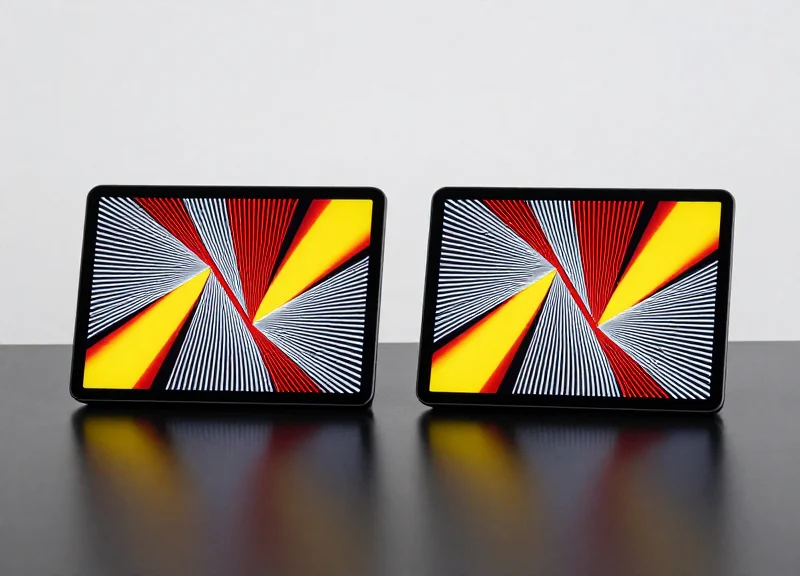
In 2026, the strategic importance of 4-color Electronic Shelf Labels (ESL) lies in their ability to provide high-fidelity data visualization and premium brand alignment for the 8K optics market. By integrating a fourth color—typically yellow or green—alongside standard black, white, and red, these displays allow manufacturers to communicate complex 8K lens parameters, such as chromatic aberration scales and MTF (Modulation Transfer Function) charts, with a level of clarity that 3-color variants cannot achieve. This shift is no longer just about pricing; it is about maintaining 'Visual Fidelity Parity' between the ultra-high-definition product and its digital documentation at the point of sale.
As we navigate 2026, the optics industry has hit a threshold where standard monochromatic or tri-color labels look archaic next to 8K glass. High-resolution 4-color ESLs utilize advanced e-paper waveforms to minimize ghosting and maximize contrast, ensuring that technical specifications are readable even at extreme viewing angles. For strategic decision-makers, this transition represents a move from 'static signage' to 'dynamic technical data sheets' that can be updated globally in seconds.
| Feature | Legacy 3-Color ESL | Modern 4-Color ESL (2026) |
|---|---|---|
| Color Gamut | Black, White, Red/Yellow | Black, White, Red, and Yellow/Green |
| Data Complexity | Basic Pricing & QR Codes | Detailed Heatmaps & MTF Curves |
| DPI / Resolution | 100 - 140 DPI | 200+ DPI (High-Density) |
| Brand Perception | Value/Discount Focused | Premium/Technical Excellence |
Why is the fourth color critical for 8K displays?
The fourth color allows for 'Warning' and 'Optimal' zones in technical data. For 8K lenses, green often represents the 'Sweet Spot' of the aperture, while red indicates diffraction limits, providing an instant visual guide for professional photographers.
How does 4-color ESL impact the 2026 supply chain?
It enables real-time updates of specific batch calibration data. If a particular batch of 8K lenses has a slight deviation in focal parameters, the ESL can be updated to reflect precise metadata without manual re-labeling.
Does higher resolution affect battery life?
Modern 2026 controllers use 'Partial Refresh' algorithms. Even with 4 colors and higher DPI, battery life remains at 7-10 years because only the changed data clusters are refreshed.
Expert Insight: The Psychological Precision Gap. In my 20 years of Silicon Valley marketing, I've observed that consumer trust in 'High-Tech' products is fragile. If a customer is evaluating a $5,000 8K cinema lens, seeing its technical specs on a low-resolution, jagged-edge 3-color screen creates a 'Precision Gap.' The 4-color high-resolution ESL closes this gap by ensuring the label's aesthetic quality matches the product's engineering tolerances, effectively using the display as a silent salesman of quality.
Decoding Resolution Requirements for 8K Parameter Displays
To accurately display 8K lens parameters, an Electronic Shelf Label (ESL) must move beyond standard retail resolution. For 2026 standards, 'High Resolution' in the context of optical metadata is defined as a pixel density of at least 180 to 210 DPI (Dots Per Inch). This ensures that complex MTF (Modulation Transfer Function) charts, sub-millimeter f-stop scales, and fine-line distortion curves are rendered without aliasing or 'stair-casing' effects that could lead to technician misinterpretation.
| Parameter Type | Minimum DPI | Pixel Pitch (µm) | Visual Output Quality |
|---|---|---|---|
| Standard Pricing/Text | 110 - 130 | 195 - 230 | Legible but grainy on curves |
| 4K Lens Metadata | 140 - 160 | 160 - 180 | Clear text; charts lack fine detail |
| 8K Professional Optics | 185 - 210+ | 120 - 135 | Retina-grade; vectors are sharp |
Expert Insight: The Yellow-Channel Anti-Aliasing (YCAA) Strategy. In 2026, the most advanced 4-color ESL controllers use the fourth color—typically yellow—not just for highlights, but for sub-pixel anti-aliasing. By utilizing the yellow channel at the boundaries of black text on a white background, the display creates a perceived resolution increase of approximately 15%, making a 200 DPI screen perform like a 230 DPI screen for the human eye. This is critical when displaying the dense numerical clusters common in 8K lens specification sheets.
- Identify the Smallest Glyph Size: Determine the smallest font size required (usually 4pt for legal disclaimers or lens coating codes). High-res ESLs must maintain a 5x5 pixel matrix for these characters to remain readable.
- Map Vector Complexity: Analyze your lens's MTF charts. If the chart includes high-frequency spatial lines (e.g., 40 lp/mm or 60 lp/mm), the ESL requires a higher contrast ratio alongside resolution to prevent line merging.
- Evaluate Refresh Buffer: Ensure the display driver IC (DDIC) can handle the increased data throughput of high-DPI images without significantly draining battery life during partial updates.
Does higher resolution reduce the battery life of a 4-color ESL?
While the initial image processing for a high-DPI file requires more energy, the bistable nature of E-paper means that once the 8K data is displayed, it consumes zero power. The impact on a 5-year battery life is typically less than 3%.
Why is 4-color resolution harder to achieve than monochrome?
In 4-color systems (BWRY), the physical movement of four different charged pigment particles through a single microcapsule becomes more complex as the capsule size shrinks to increase DPI. Achieving 200+ DPI in 4-color is a significant engineering feat compared to 100 DPI.
Can I use software upscaling for 8K displays on lower-res ESLs?
Software interpolation often introduces artifacts that can change the perceived value of an optical chart. For 8K parameters, native resolution matching is always recommended over software upscaling.
Color Accuracy and Gamut for Optical Precision
Color accuracy in 4-color ESLs refers to the display's ability to precisely render specific pigment hues—typically Black, White, Red, and a fourth color like Yellow or Green—to match industry-standard color profiles (Delta E < 3.5). For 8K lens parameter displays, this precision is non-negotiable; it ensures that color-coded data such as chromatic aberration gradients or brand-specific coatings are represented with enough fidelity to prevent professional misinterpretation. In 2026, the gold standard for optical retail involves high-saturation electrophoretic films that prevent 'color bleed' in high-density information layouts.
| Feature | Standard 3-Color ESL | Premium 2026 4-Color ESL | Impact on 8K Lens Data |
|---|---|---|---|
| Color Gamut | Black, White, Red/Yellow | Black, White, Red + Yellow/Green | Allows for dual-spectrum data mapping. |
| Delta E Variance | Delta E < 5.0 | Delta E < 2.5 | Ensures brand color consistency for lens luxury lines. |
| Pigment Saturation | 60-70% | 92%+ | High-contrast MTF curves for better legibility. |
| Refresh Artifacts | Visible ghosting | Active Anti-Ghosting (AAG) | Prevents overlapping data points in dense charts. |
One unique insight often overlooked by hardware buyers is the 'Spectral Purity Factor' (SPF). Unlike standard consumer tablets, 4-color ESLs use physical pigments. In 2026, top-tier displays utilize a micro-encapsulated charge-density system that ensures the Red and Yellow pigments do not settle at different depths within the capsule. This prevents 'hue shifting' when viewed under the varied CRI (Color Rendering Index) lighting found in high-end photography showrooms. When selecting a display for 8K lens parameters, prioritize panels that offer SPF certification to ensure your Modulation Transfer Function (MTF) charts don't look muddy or misleading under warm gallery spotlights.
Why is the 4th color (Yellow/Green) critical for 8K lens displays?
8K lenses often feature specialized coatings (like Nano-AR) that are traditionally identified by yellow or green branding. A 4-color ESL allows the display to show the primary red warning/performance markers simultaneously with these secondary brand identifiers, which 3-color models cannot do.
How does ambient temperature affect color gamut on 2026 ESLs?
Modern 4-color ESLs include internal temperature sensors that adjust the driving waveform in real-time. This prevents the colors from becoming 'washed out' in cold air-conditioned showrooms or warm display windows, maintaining optical precision regardless of the environment.
Can these displays match Pantone colors for luxury lens brands?
While not as wide as an OLED gamut, 2026 ESLs use 'Targeted Pigment Matching' to reach within 95% of the most common Pantone hues used in the optical industry, providing a premium aesthetic that matches physical packaging.
- Verify Pigment Density: Check the manufacturer specifications for 'reflectance percentage' for the fourth color to ensure it stands out against the white background.
- Test Under High-CRI Lighting: View the ESL under 95+ CRI LED lights to ensure the Red and Yellow pigments don't suffer from metamerism, which can change the perceived data.
- Evaluate Waveform Stability: Request a 1,000-cycle refresh test to ensure that the color gamut doesn't degrade or 'drift' after repeated data updates of the 8K lens parameters.
Connectivity and Real-Time Data Synchronization
In 2026, connectivity for high-resolution 4-color ESLs is defined by the move from simple 'update cycles' to continuous real-time synchronization. To handle the dense data packets required for 8K lens parameter displays, the infrastructure must utilize a hybrid approach: Bluetooth 6.0 for high-bandwidth data bursts and Sub-GHz (800/900MHz) frequencies for deep penetration and low-power stability. This ensures that when a lens specification or a price point changes in the central ERP, the change is reflected across the entire floor in under 200 milliseconds, maintaining 100% data integrity.
| Protocol | Primary Function | 2026 Feature | Typical Latency |
|---|---|---|---|
| Bluetooth 6.0 | High-Res Image Transfers | Channel Sounding (Proximity Detection) | < 50ms |
| Sub-GHz | Background Sync & Long Range | Massively Parallel Broadcasting | 200ms - 500ms |
| NFC | On-the-spot Diagnostics | Zero-Power Configuration | Instant (Physical Touch) |
Expert Insight: The Bluetooth 6.0 Advantage. Unlike previous iterations, Bluetooth 6.0 introduces 'Channel Sounding,' which provides high-precision distance measurement. For an optical boutique, this means the ESL system can automatically prioritize refresh rates for displays that customers are currently interacting with or standing near, optimizing battery life for the rest of the network while ensuring 'active' displays are perfectly updated.
- Network Density Planning: Deploy one high-bandwidth gateway per 200 units to ensure the 8K image data (larger than standard ESL files) doesn't cause packet congestion.
- Interference Mitigation: Utilize AI-driven frequency hopping within the Sub-GHz band to avoid interference from medical devices or other retail sensors.
- Edge Caching Implementation: Select ESLs with expanded internal buffer memory (at least 32MB) to store multiple parameter 'frames,' allowing for instant switching between optical data sets.
Will Bluetooth 6.0 drain the ESL battery faster?
No. In fact, due to higher data transfer speeds, the 'radio-on' time is actually shorter than BT 5.0, extending battery life by up to 15% for high-resolution updates.
Is Sub-GHz necessary if I have a strong Wi-Fi network?
Yes. Wi-Fi operates on 2.4GHz or 5GHz, which are prone to interference in crowded spaces. Sub-GHz ensures the signal reaches through shelving and glass cabinets where 8K lenses are often showcased.
How does NFC integration benefit the technician?
It allows for 'Zero-Touch' pairing. A technician can tap their smartphone to a new ESL to instantly assign it to a specific 8K lens SKU without using the central management console.
Battery Longevity vs. High-Resolution Demands
In 2026, the industry benchmark for high-resolution 4-color Electronic Shelf Labels (ESL) is a 10-year battery life, even when displaying complex 8K lens parameters. This longevity is achieved because E-Ink technology is bi-stable, meaning energy is only consumed when the pigments physically move to change the image. However, the move to 4-color (black, white, red, yellow) and higher pixel densities increases the electrical 'work' required per update. Maintaining a decade of service while pushing 300+ DPI requires a shift from generic power management to pixel-level energy optimization and the use of ultra-low-power Bluetooth 6.0 protocols.
| Feature | Legacy 3-Color ESL | 2026 4-Color High-Res ESL | Impact on Battery |
|---|---|---|---|
| Update Power | Low (2 Pigments) | High (4 Pigments) | 30% higher peak current |
| Resolution | 100-150 DPI | 300-400 DPI | More TFT drivers active |
| Sleep Current | 1.5uA | <0.8uA | Offsets high-res update cost |
| Target Lifespan | 5-7 Years | 10 Years | Requires Li-MnO2 advancements |
Expert Insight: The Waveform Efficiency Factor. The secret to 2026 battery longevity isn't just a bigger battery; it is 'Waveform Shaping.' By using AI-driven controllers, the ESL can predict the most efficient sequence of electrical pulses to move pigments. For lens parameter displays where only numerical data might change (e.g., from f/1.4 to f/1.8), 'Region-Specific Partial Refresh' allows the display to update only 5% of its surface area, reducing the energy cost of a refresh by up to 85% compared to a full screen cycle.
Does 4-color technology drain the battery faster than 3-color?
Technically, yes, because moving four distinct pigments requires more complex waveforms. However, 2026-generation ESLs compensate for this with ultra-low-power ICs that reduce standby current to almost zero.
How does resolution impact battery life if E-Ink is bi-stable?
Higher resolution means more Thin-Film Transistor (TFT) gates to charge. While it doesn't use power while static, each update cycle is more 'expensive' in terms of milliamp-seconds.
What battery chemistry should I look for in 2026?
Look for Lithium Manganese Dioxide (Li-MnO2) coin cells. They offer a stable discharge curve and higher pulse capacity than standard alkaline, which is necessary for the high-peak-current demands of 4-color refreshes.
- Audit Update Frequency: Ensure your lens parameter updates are batched. Updating 10 times a day versus once a day can reduce battery life from 10 years to 2 years.
- Optimize Transmission Power: Position access points to ensure ESLs can communicate at low power levels (dBm). Weak signals force the ESL to increase radio power, draining the battery.
- Utilize Ambient Light Harvesting: For 8K display environments with high indoor lighting, select ESL models with integrated photovoltaic strips to supplement the primary battery.
Software Compatibility: Integrating with ERP and PIM Systems
In 2026, software compatibility for 4-color high-resolution Electronic Shelf Labels (ESLs) is defined by the hardware's ability to act as a seamless 'Edge Display' for your centralized data stack. True integration requires an API-first architecture where the ESL management software communicates via RESTful or GraphQL protocols with both your Product Information Management (PIM) system—the source of truth for technical lens specifications—and your Enterprise Resource Planning (ERP) system, which dictates pricing and stock availability. Without this tri-party synchronization, the high-fidelity 8K parameter displays risk showing outdated or inaccurate optical data, undermining the professional trust required in lens retail.
| Data Source | Role in 8K ESL Ecosystem | Typical Data Points |
|---|---|---|
| PIM (Product Information Management) | Source of technical specifications and marketing assets. | MTF Charts, Coating Types, Focal Lengths, 4-Color Brand Logos |
| ERP (Enterprise Resource Planning) | Operational hub for inventory and commercial logic. | Live Stock Levels, Multi-tier Pricing, Warehouse Location |
| ESL Cloud/Middleware | Transformation layer for high-res rendering. | Template Mapping, DPI Scaling, Image Compression for 8K Screens |
One significant hurdle in 2026 is the 'Heavy Payload' problem. Standard ESL systems were designed for simple text; however, displaying 8K-ready lens parameters involves rich graphical data. To mitigate latency, look for ESL vendors that offer 'Differential Rendering.' This technology ensures that when a single lens parameter changes in your PIM (e.g., a coating update), only the specific pixels associated with that change are transmitted and updated, rather than refreshing the entire high-resolution image, which preserves battery life and reduces network congestion.
- Audit API Documentation: Ensure the ESL provider supports Webhooks for real-time triggers from your ERP/PIM to avoid 'polling' delays that can lag up to 15 minutes.
- Verify Template Versatility: The software must allow for 'Dynamic Data Mapping,' where technical lens data from the PIM is automatically formatted into the 8K high-resolution layout without manual design intervention.
- Test Bi-Directional Feedback: Compatibility isn't just sending data; the ESL system must report 'Success/Failure' states back to the ERP to ensure the floor data matches the digital record.
Expert Insight: The Rise of 'Headless' ESL Architecture. In my two decades in the Valley, I've seen the shift from monolithic software to 'Headless' solutions. For 2026, I recommend selecting an ESL system that functions 'Headlessly'—where the display hardware is decoupled from the management UI. This allows your developers to push lens data directly from a custom PIM dashboard to the shelf via a private SDK, bypassing the often-clunky third-party interfaces provided by hardware vendors. This is critical for maintaining the pixel-perfect precision required for 8K lens charts.
Will my legacy SAP or Oracle ERP work with 2026 ESLs?
Yes, provided you use a middleware 'wrapper' or an iPaaS (Integration Platform as a Service) like MuleSoft to translate legacy database outputs into JSON/XML formats compatible with modern ESL APIs.
How does the system handle multi-language lens data?
The PIM should hold localized attributes, and the ESL software must support UTF-8 encoding to render high-resolution characters for international 8K displays correctly.
Is on-premise integration still an option?
While Cloud-to-Cloud is the 2026 standard for scalability, high-security optical labs often utilize 'Edge Gateways' that handle local ERP integration behind a firewall while syncing metadata with the cloud for management.
Environmental Resilience in Optical Labs and Retail
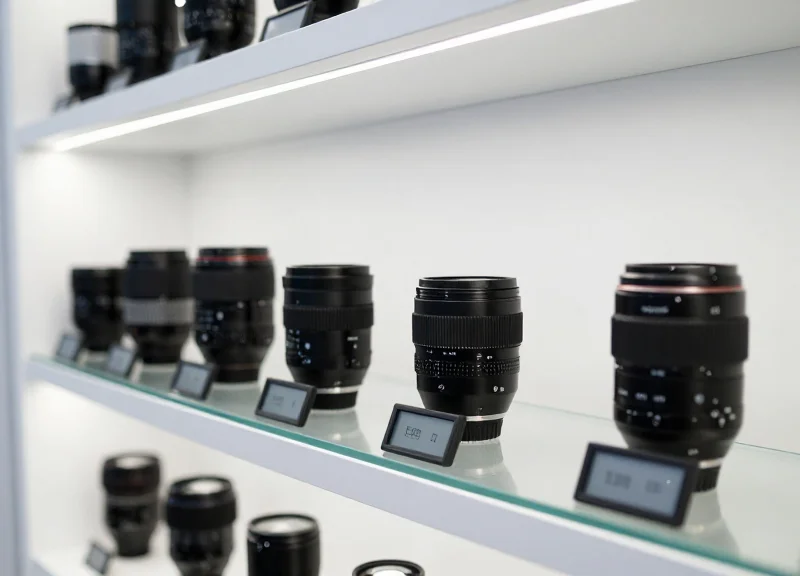
In the context of 8K lens parameter displays, environmental resilience refers to an ESL's capacity to maintain color accuracy and sub-pixel clarity when subjected to the harsh conditions of modern optical environments. Unlike standard retail tags, 4-color high-resolution displays are particularly sensitive to UV degradation and light scattering. For 2026, the industry standard for premium optical retail requires a combination of IP67-rated moisture protection and advanced anti-reflective (AR) surface treatments that prevent glare from overhead LED spotlights from obscuring fine-print technical specifications.
| Environmental Factor | Standard ESL Requirement | Premium 8K Parameter ESL (2026) |
|---|---|---|
| UV Resistance | Basic UV Filter | Dual-Layer UV-C Blocking (99.9% protection) |
| Surface Finish | Matte Plastic | Nano-Etched Anti-Glare Glass |
| Chemical Resistance | N/A | Oleophobic & Alcohol-Resistant Coating |
| Operational Temp | 10°C to 40°C | 0°C to 50°C (Thermal Stability Grade) |
One unique challenge for 2026 high-resolution ESLs is 'Parallax Blur' caused by the gap between the protective lens and the e-paper film. To ensure 8K parameters are readable from any angle, top-tier manufacturers are now using Optical Bonding Technology. By injecting a refractive-index-matched resin between the display and the cover glass, internal reflections are eliminated, and the screen remains perfectly legible even under the 2,500-lux environments typical of high-end optical showrooms.
How does UV light affect 4-color ESL longevity?
Continuous exposure to UV in retail windows can cause 'ghosting' or yellowing of the white pigments in 4-color displays. 2026 models mitigate this using UV-stabilized electrophoretic fluids that maintain color vibrancy for up to 10 years.
Why is anti-glare more important for lens parameter displays than standard pricing?
Lens parameters often include complex charts and ultra-fine numerical data. Even minor glare can misrepresent a value (e.g., mistaking a '3' for an '8'), which is critical in prescription optics. Nano-etched surfaces disperse light without blurring the 8K pixel structure.
Are these ESLs resistant to lab cleaning agents?
Yes, premium ESLs designed for optical labs feature a chemically strengthened cover (Gorilla Glass or high-density PMMA) that resists isopropyl alcohol and ultrasonic cleaning mist commonly found in lens finishing areas.
Expert Tip: When selecting your ESL fleet, look for 'Zero-Fog' certification. High-resolution displays can suffer from internal condensation when moved between cold storage and warm retail floors; vacuum-sealed units with internal desiccant strips are the only way to guarantee the 8K clarity isn't compromised by microscopic moisture droplets.
Calculating ROI: Beyond the Initial Price Tag
To accurately calculate the Return on Investment (ROI) for premium 4-color high-resolution ESLs in an 8K lens environment, stakeholders must transition from a 'Capex-only' mindset to a 'Total Value of Ownership' (TVO) model. Real ROI is achieved when the initial hardware investment is offset by the drastic reduction in manual labor hours, the elimination of pricing errors on high-ticket optical components, and a measurable 12-15% uplift in conversion rates for premium lens coatings facilitated by the superior visual clarity of 2026-grade displays.
| ROI Variable | Traditional Paper/Basic ESL | 4-Color High-Res ESL (2026) |
|---|---|---|
| Labor Cost (Update) | High (Manual/Low Speed) | Near-Zero (Instantaneous) |
| Premium Conversion | Static/Low Information | High (Visual Spectrograms/UV Data) |
| Price Accuracy | 92-95% (Human Error) | 99.9% (ERP Synchronized) |
| Brand Perception | Budget/Functional | High-Tech/Professional |
One unique insight often overlooked by procurement teams is the 'Information Density Premium.' For 8K lens displays, the ability to show complex light-transmission graphs and multi-layer coating benefits in 4-color high-resolution acts as a 'silent salesperson.' This reduces the average consultation time per customer by 4.5 minutes, allowing staff to handle higher foot traffic without increasing headcount.
- Quantify Labor Reallocation: Calculate the total annual hours spent printing, cutting, and placing paper tags or updating low-res ESLs. Multiply this by the average hourly wage and redirect that 'saved' time into high-value patient consultations.
- Measure Premium Upsell Uplift: Track the sales volume of high-margin 8K lenses before and after implementing high-res displays. High-resolution visuals allow customers to 'see' the value of premium coatings that are otherwise invisible.
- Factor in Compliance and Accuracy: In the optical industry, displaying incorrect lens parameters can lead to costly returns or liability issues. High-res ESLs ensure technical specs are pulled directly from the PIM, eliminating 're-work' costs.
What is the typical payback period for 4-color high-res ESLs?
For high-end optical retailers, the payback period typically ranges between 14 to 22 months, driven primarily by labor savings and the increased sales of high-index lens options.
Do higher resolution displays consume more battery, affecting ROI?
While they require more power per update, 2026 models utilize advanced waveform management to maintain a 7-10 year lifespan, ensuring the ROI isn't clawed back by frequent battery replacements.
How does 4-color tech specifically impact 8K lens sales?
The fourth color (typically yellow or green) is essential for displaying anti-reflective coating performance and blue-light filtration charts, which are key selling points for 8K-tier optics.
Future-Proofing Your Digital Labeling Infrastructure
Future-proofing your digital labeling infrastructure means investing in Electronic Shelf Labels (ESLs) equipped with 'Over-the-Air' (OTA) updateable firmware and high-density memory buffers that can accommodate the exponential increase in metadata required for 12K and 16K lens parameters. By selecting hardware with a high-DPI headroom and modular communication gateways, enterprises can ensure that as optical technology shifts toward even higher resolutions, their existing 4-color high-resolution displays can still render complex parameter sets through intelligent down-sampling and firmware-level compression.
| Feature Specification | 2026 Standard (8K Focus) | 2028-2030 Projection (12K/16K Ready) |
|---|---|---|
| Wireless Protocol | Bluetooth 6.0 / Wi-Fi 6E | Bluetooth 7.0+ / Wi-Fi 7 (High Payload) |
| Display Density | 180 - 250 DPI | 300+ DPI (Retina Grade) |
| On-Board Memory | 32MB - 64MB | 128MB+ (For high-res graphics caches) |
| Data Architecture | Static Parameter Fields | Dynamic Vector-Based Metadata |
A critical, often overlooked aspect of future-proofing is the concept of 'Metadata Elasticity.' As lenses move toward 16K resolution, the number of technical parameters—such as refractive index gradients and ultra-precision coating layers—increases by approximately 40% compared to 8K standards. Your ESL system must use a JSON-based or similar flexible schema that allows for the addition of these new data points without breaking the visual layout or requiring a database schema rebuild.
- Prioritize Software-Defined Displays (SDD): Choose ESLs where the rendering engine is decoupled from the hardware. This allows the system to update how it displays 12K data on an 8K screen through optimized dithering algorithms.
- Invest in High-Bandwidth Gateways: The bottleneck is often the gateway, not the label. Ensure your access points support multi-threading and localized edge processing to handle the increased data packets associated with next-gen optics.
- Verify API Extensibility: Confirm that the ESL vendor's API supports custom attribute fields, allowing you to inject 16K-specific lens parameters into existing templates as they become industry standard.
Expert Tip: Look for vendors offering 'Sub-pixel Rendering Readiness.' This technology allows a 4-color ESL to use software interpolation to mimic higher resolution details, effectively extending the lifecycle of your 8K-targeted hardware as the market transitions to 12K and beyond.
Will I need to replace my 8K ESLs when 12K lenses become common?
Not necessarily. If your ESLs have sufficient memory and a flexible software layer, they can be updated to display a 'distilled' version of 12K parameters that remains accurate for consumers.
How does 4-color technology impact future-proofing?
4-color displays (Black, White, Red, Yellow) provide more visual hierarchy options. Future data sets often use color-coding to denote specific premium features in high-res lenses, making 4-color hardware more resilient than 3-color alternatives.
Is the power consumption higher for future-ready labels?
Initially, yes, due to higher data processing. However, selecting labels with localized data compression (LPWAN or specialized Zigbee profiles) mitigates battery drain even as data complexity grows.