In the ultra-competitive landscape of high-end retail, the visual harmony of a store is as vital as the products on display. For decades, retailers have struggled with the clunky aesthetic of traditional Electronic Shelf Labels (ESL) that disrupt the clean lines of custom-made shelving. However, a new standard is emerging for 2026: Invisible Retail Tech. Flush-mount ESL systems are redefining how luxury brands communicate price and information, embedding digital intelligence directly into the architecture of the store. This evolution marks the end of the 'plastic clip' era and the beginning of a seamless, high-tech shopping environment that respects design integrity while maximizing operational efficiency.
The Aesthetic Imperative: Why Traditional ESL Fails Luxury Brands
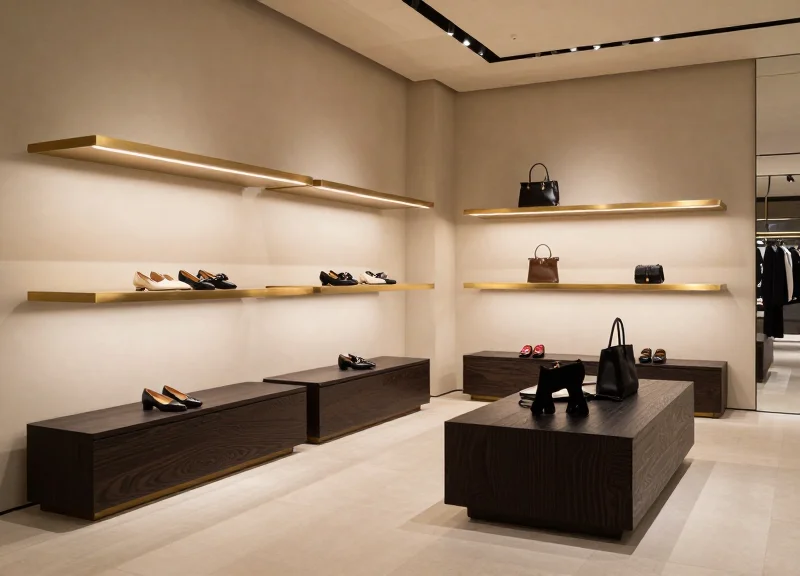
Traditional Electronic Shelf Labels (ESL) fail luxury brands because they introduce 'visual friction'—a fundamental disconnect between premium architectural materials like marble, brass, or reclaimed oak and the bulky, plastic-clamped hardware of legacy technology. In high-end retail, where the environment is curated to evoke an emotional response, standard clip-on ESLs act as visual noise that distracts from the product and inadvertently signals a 'big-box' discount atmosphere. To maintain a luxury narrative in 2026, the technology must be invisible, allowing the product to remain the sole protagonist of the shelf.
| Design Attribute | Legacy Clip-On ESL | Flush-Mount Invisible Tech |
|---|---|---|
| Visual Profile | 10-15mm protrusion beyond shelf edge | 0mm (Perfectly level with millwork) |
| Material Harmony | Clashing plastic and exposed clips | Seamless integration into wood, stone, or metal |
| Architectural Integrity | Disrupts clean sightlines | Preserves the designer's original intent |
| Brand Perception | Utility-focused/Value retail | Bespoke/High-end craftsmanship |
The failure of traditional ESL in luxury settings isn't just about bulk; it's about the 'Cognitive Dissonance' it creates for the consumer. When a client is looking at a $5,000 handbag, a piece of protruding white plastic with a visible battery hump breaks the immersion of the 'dream world' luxury brands spend millions to build. This visual clutter leads to brand dilution, where the tech feels like an afterthought rather than a deliberate part of the store's DNA.
Why does the 'clip-on' method specifically hurt luxury sales?
Clip-on rails collect dust and create shadows that interfere with precision lighting schemes. In luxury, lighting is used to highlight product textures; legacy ESL rails create 'light traps' that make shelving look cluttered and unrefined.
Is the issue simply the color of the plastic?
No. Even color-matched plastic fails because it cannot replicate the refractive index of high-end shelf materials. The shadow gap created by a non-flush mount is a permanent visual blemish that the human eye identifies as a 'cheap' finish.
How does flush-mount tech solve the 'Visual Tax' problem?
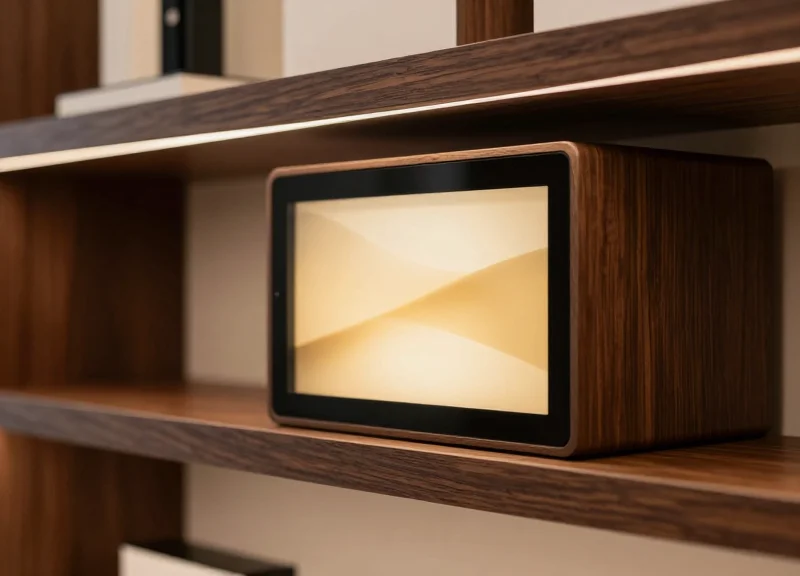
By embedding the display directly into the custom shelving (millwork), the screen appears as a digital extension of the shelf itself. This 'Invisible Tech' approach removes the visual tax on the consumer's attention, directing focus back to the merchandise.
Expert Insight: The 'Zero-Margin' Principle. In my two decades observing retail shifts, the most successful luxury tech implementations follow the Zero-Margin Principle: if a technology requires an external mounting bracket, it is already obsolete for high-end environments. By 2026, flush-mount is not an option—it is the baseline for any brand charging a premium for their physical experience. True luxury is the absence of visible effort; flush-mount ESL delivers exactly that.
Defining Flush-Mount ESL: The Invisible Revolution
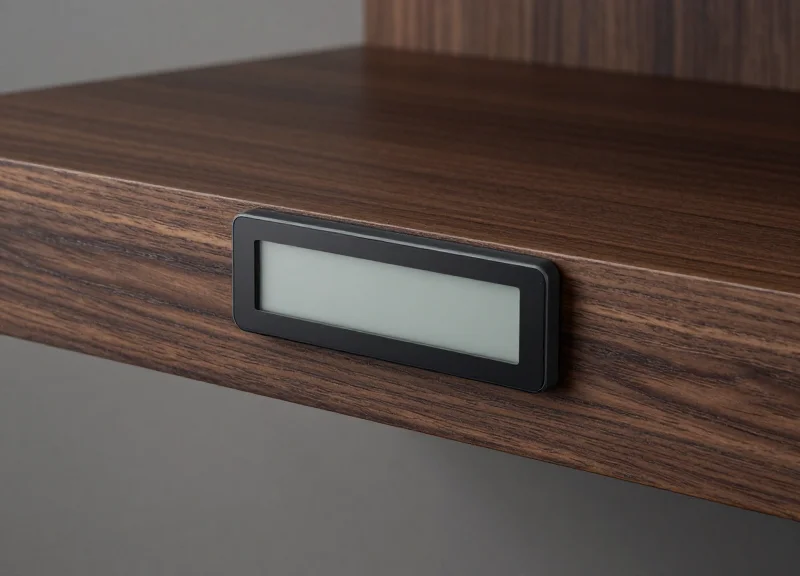
Flush-mount Electronic Shelf Labels (ESL) are digital displays engineered to be embedded directly into the physical substrate of a shelf—whether it be solid oak, marble, or custom metalwork—ensuring the screen surface sits perfectly level with the shelf edge. Unlike traditional 'clip-on' tags that protrude into the aisle and disrupt a brand's visual flow, flush-mount technology treats the digital interface as a permanent architectural element. This 'zero-profile' integration eliminates the mechanical bulk of mounting brackets, transforming the price tag from a cluttered retail accessory into a sleek, invisible layer of the store's furniture.
| Feature | Legacy Clip-On ESL | Flush-Mount (2026 Standard) |
|---|---|---|
| Physical Profile | Protrudes 15-25mm from shelf edge | 0mm (Flush with surface) |
| Integration | Aftermarket attachment | Structural/Built-in |
| Visual Impact | Visual noise; 'Gadget' look | Architectural; 'Invisible' tech |
| Durability | Prone to being knocked off | Protected within shelf housing |
| Material Compatibility | Standard plastic rails | Wood, stone, glass, high-end alloys |
The technical shift lies in the precision of the millwork and the miniaturization of the ESL casing. Modern flush-mount units utilize ultra-slim 'bezel-less' e-paper displays and specialized CNC-routed channels. This allows for 'Digital Veneer'—a concept where the screen is treated as a premium material finish. This evolution is driven by the demand for 'Quiet Luxury' in retail, where technology should serve the customer journey without drawing attention to its own hardware.
How is power managed in a recessed setup?
Modern flush-mount units use high-density coin-cell batteries accessible via discrete underside panels, or 'Power-over-Shelf' (PoS) inductive tracks hidden within the custom millwork.
Does flush-mounting interfere with wireless signals?
No. Leading 2026 standards utilize Sub-1GHz or BLE (Bluetooth Low Energy) frequencies that penetrate high-end shelf materials like wood and glass without latency.
Is this compatible with glass or stone shelving?
Yes. Custom glass shelves now feature 'etched pockets' or UV-bonded housings that allow the ESL to appear as if it is floating inside the material.
Expert Insight: The real breakthrough in 2026 isn't just the aesthetics; it's the 'Thermal Decoupling.' By recessing the unit, we utilize the shelf's mass as a passive heat sink. This small engineering detail extends the lifespan of the e-paper's micro-capsules by up to 30% compared to tags exposed to volatile aisle temperatures and direct lighting heat.
The 2026 Forecast: Why Seamless Integration is No Longer Optional
The 2026 forecast for high-end retail identifies seamless integration as the new baseline for store design, where Electronic Shelf Labels (ESL) transition from 'bolted-on' peripherals to 'embedded' architectural features. As luxury brands increasingly prioritize minimalist aesthetics, any visible hardware that disrupts the clean lines of custom cabinetry is being phased out. For next-gen retail environments, the integration of technology must be 'invisible' at first glance, providing the operational power of dynamic pricing without compromising the tactile and visual premium of high-end materials like marble, solid oak, or brass.
This shift is driven by a maturing market where the novelty of digital pricing has worn off, and the focus has shifted to brand cohesion. Leading fixture manufacturers are already reporting a 40% increase in requests for 'tech-ready' shelving that features pre-milled, recessed channels designed specifically for flush-mount displays.
| Feature | 2022 Standard (Legacy) | 2026 Mandate (Future-Proof) |
|---|---|---|
| Hardware Attachment | External plastic clips and rails | Flush-mount, recessed integration |
| Design Priority | Functional efficiency only | Aesthetic-first architectural design |
| Material Interaction | Covers/hides premium shelving | Augments and complements materials |
| Fixture Lifecycle | Hardware replaced frequently | Modular tech built into the cabinetry |
| Customer Perception | High-tech but cluttered | Sophisticated, invisible intelligence |
Expert Insight: The '3mm Tolerance Rule'. In my two decades of Silicon Valley marketing for retail tech, I’ve seen hardware cycles come and go. The unique pivot for 2026 is that ESLs are now being treated with the same precision as high-end hinges or recessed lighting. We are entering the era of 'The 3mm Tolerance Rule,' where custom shelving contracts now specify exact depth tolerances for ESL slots to ensure a perfectly level surface—effectively treating the digital display as a material finish rather than a device.
Why are luxury retailers mandating flush-mount tech now?
Retailers have realized that 'clunky' tech devalues high-ticket items. If a shelf costs $5,000 to manufacture, a $1 plastic clip holding an ESL destroys the perceived value of the product sitting on it.
How does integration affect the ROI of custom shelving?
Integrated shelving has a higher upfront cost but significantly higher longevity and resale value for the store's brand equity, as it prevents the physical wear and tear associated with external mounting systems.
Is flush-mounting compatible with existing ESL hardware?
Generally no. The 2026 standard requires specific slim-profile, flush-ready hardware designed to sit within the millwork rather than on top of it.
Material Synergy: Integrating Tech with Wood, Marble, and Metal
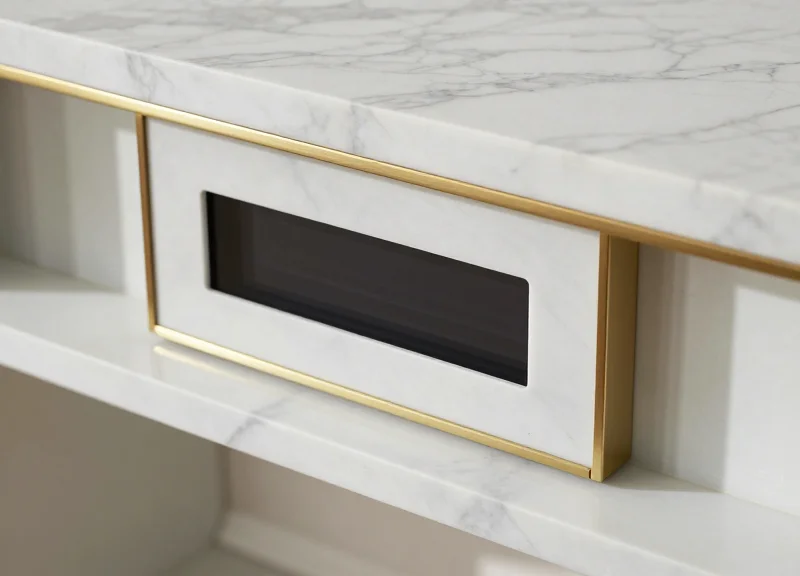
Material synergy in next-gen retail design is the engineering practice of embedding flush-mount Electronic Shelf Labels (ESL) into luxury substrates—including solid wood, natural stone, and architectural metals—so that digital interfaces appear as native elements rather than intrusive hardware. By utilizing sub-surface mounting and precision CNC routing, designers can maintain the tactile luxury of premium materials while providing the dynamic pricing and data capabilities required for 2026 retail standards.
| Material Type | Integration Challenge | Engineering Solution | Aesthetic Outcome |
|---|---|---|---|
| Hardwoods (Oak/Walnut) | Hygroscopic expansion and contraction. | Floating sub-frames with 0.5mm tolerances. | Warm, organic tech-infusion. |
| Marble & Natural Stone | Brittleness and weight-bearing fragility. | Water-jet precision cutting with reinforced backing. | Monolithic, museum-grade display. |
| Anodized Metals | RF interference and signal shielding. | Non-ferrous 'RF Windows' or external antenna routing. | Sleek, industrial minimalism. |
Integrating technology into luxury materials requires more than just a cutout; it demands a deep understanding of the 'Expansion Coefficient Gap.' This is the delta between how a screen's glass and a shelf's organic material (like walnut) react to store temperature and humidity changes. Without specialized engineering, a flush-mount display will either pop out or create unsightly gaps over time.
- Digital Material Mapping: Utilizing 3D scans of the specific wood grain or marble slab to determine the optimal placement that avoids structural veins or knots.
- Concealed Conduit Routing: Precision-milling hidden channels within the shelving thickness to house ultra-thin power ribbons, ensuring zero visible wiring from any angle.
- Thermal Dissipation Layers: Installing micro-thin heat sinks behind the ESL to prevent thermal discoloration on sensitive wood finishes or stone sealants.
Expert Tip: To achieve a truly 'invisible' tech look in metal fixtures, we recommend using 'Micro-Flange' frames finished in a PVD (Physical Vapor Deposition) coating that matches the shelf's exact micron-level color profile. This eliminates the 'black-box' effect and makes the ESL screen appear to emerge directly from the metalwork.
Will embedding ESLs into marble cause the stone to crack?
No, provided you use tension-relief gaskets. These gaskets absorb the vibration of the installation and any thermal expansion, protecting the stone from stress fractures.
How is the signal maintained through metal shelving?
We utilize 'RF-Transparent' composite inserts painted to mimic the metal finish, allowing the 2.4GHz or IR signals to pass through without degrading the update speed.
Can flush-mount ESLs be replaced without damaging the wood?
Yes. Modern flush-mount systems use magnetic snap-in chassis that allow for front-access removal using a specialized vacuum tool, leaving the custom cabinetry untouched.
Superior Visibility and Hardware Performance
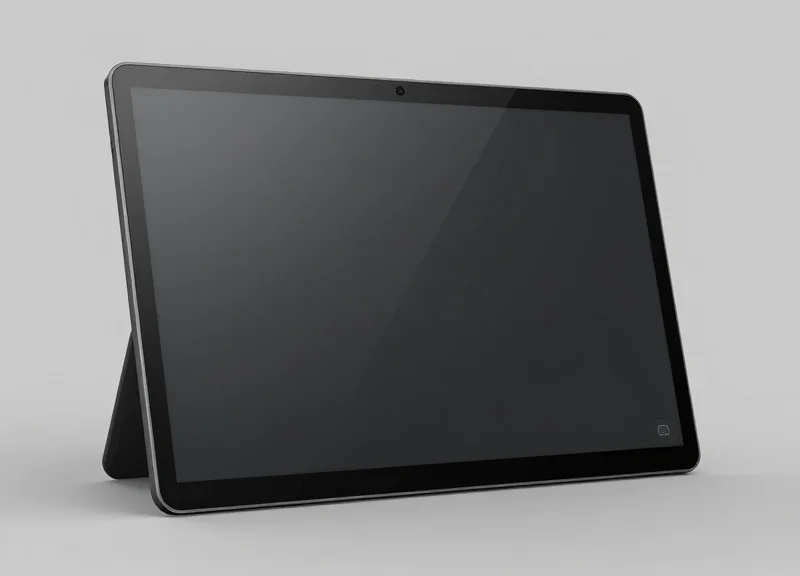
Superior visibility in flush-mount ESLs is achieved through the elimination of the bezel-edge shadow and the implementation of advanced wide-angle e-paper or high-contrast TFT technology. By aligning the display surface perfectly flush with the custom shelving material, these units remove the 'recessed tunnel effect' common in traditional hardware, ensuring that pricing and promotional data remain legible from extreme 170-degree viewing angles. This performance is critical in luxury retail, where customers often browse from low or high vantage points relative to eye-level shelving.
| Feature | Traditional Surface-Mount ESL | Next-Gen Flush-Mount Standard |
|---|---|---|
| Effective Viewing Angle | 120° - 140° (Shadowing at edges) | 170° - 178° (Zero-parallax) |
| Glare Mitigation | Standard Glossy Acrylic | Etched Anti-Glare (AG) Glass |
| Impact Resistance | Low (Exposed plastic edges) | High (Fully supported by cabinetry) |
| Visual Integration | Appears as an 'Add-on' device | Appears as part of the material |
Hardware performance in flush-mount configurations is not merely about aesthetics; it is about managing the physics of a confined space. High-end custom shelving often uses materials like dense hardwoods or marble, which provide little natural ventilation. 2026-spec flush ESLs utilize low-power e-ink backplanes that generate negligible heat, coupled with chemically strengthened cover glass that resists the micro-scratches typical of high-traffic luxury environments. This creates a 'Zero-Parallax Effect,' where the digital ink appears to be printed directly onto the surface of the shelf rather than sitting behind a layer of glass.
- How does flush-mounting improve performance in high-glare showrooms?: Flush-mount units typically employ vacuum-bonded AR (Anti-Reflective) coatings. Because the display is level with the shelf edge, it avoids the localized light trapping that occurs in standard plastic rails, diffusing overhead spotlighting more effectively.
- Is durability compromised when tech is recessed into metal or stone?: On the contrary, durability is enhanced. The shelving material acts as an exoskeleton, protecting the ESL's chassis from lateral impacts. Only the hardened glass face is exposed, which is designed to withstand 2H-5H pencil hardness tests.
- Expert Tip: The 'Hidden' Heat Sink: In 2026 luxury builds, designers are using the custom metal shelf-edge channel itself as a passive heat sink. By using thermally conductive adhesive to bond the flush ESL to the metal track, hardware lifespan is extended by up to 30% compared to plastic-housed units.
The Impact on Customer Perception and Brand Value
Flush-mount Electronic Shelf Labels (ESLs) redefine luxury retail by removing the 'technological friction' that traditional clip-on tags create, transforming a standard store shelf into a curated, high-end display. In the 2026 retail landscape, brand value is no longer just about the product; it is about the 'Intentional Environment.' When technology is recessed and flush with premium materials like walnut, stone, or brushed steel, it signals to the consumer that the brand prioritizes design integrity and precision. This invisible integration prevents the perception of 'discounting' often associated with dangling plastic tags, instead positioning the digital interface as a bespoke feature of the architecture itself.
| Feature | Traditional ESL Perception | Flush-Mount ESL Perception |
|---|---|---|
| Visual Impact | Cluttered, tactical, 'add-on' look. | Clean, architectural, part of the fixture. |
| Brand Association | Efficiency-focused, mass-market. | Quality-focused, luxury, bespoke. |
| Shopper Trust | Transactional and functional. | Authentic and detail-oriented. |
| Product Focus | Secondary to the price tag hardware. | The product remains the primary hero. |
The psychological shift for the consumer is profound. Research into 'Cognitive Ease' suggests that when a retail environment is visually harmonious, shoppers experience lower stress levels and are more likely to spend time exploring the space. Flush-mount displays reduce the 'visual tax' on the customer's brain. By hiding the bulky battery housings and plastic clips typical of older ESLs, brands communicate a level of sophistication that justifies premium pricing. It moves the conversation from 'what does this cost?' to 'what is the value of this experience?'
How does invisible tech improve price integrity?
When a digital display looks like it was built into the shelf from day one, consumers perceive the price as more 'official' and less subject to erratic changes, boosting long-term trust in brand pricing strategy.
Does it impact brand loyalty?
Yes. Modern high-net-worth individuals (HNWIs) value aesthetic consistency. A brand that maintains its luxury image even in its pricing hardware earns higher respect and retention from design-conscious demographics.
What is the ROI on brand perception?
Beyond operational savings, the ROI manifests in higher average transaction values (ATV). A premium environment allows for a higher price ceiling that clunky, cheap-looking hardware would otherwise undermine.
Expert Tip: I call this the 'Hardware Halo Effect.' In my two decades of Silicon Valley marketing, we've found that users subconsciously attribute the quality of the interface to the quality of the product behind it. If your pricing display is a cheap plastic snap-on, your $2,000 handbag loses its luster. If the display is a precision-recessed glass element, the product's perceived value is reinforced. In 2026, if the tech is visible, the design has failed.
Operational Excellence: Behind the Scenes of Flush-Mount Systems
Operational excellence in flush-mount Electronic Shelf Label (ESL) systems is defined by the total elimination of mechanical friction between the digital display and the physical shelf. Unlike traditional rail-based systems that require frequent realignment, manual clipping, and cleaning of external plastic housings, flush-mount solutions are embedded directly into custom shelving. This 'invisible' architecture allows for instantaneous, centralized price updates and real-time inventory synchronization without requiring floor staff to ever touch the hardware, reducing labor costs and human error in high-end retail environments.
The true genius of the 2026 flush-mount standard lies in its 'set-and-forget' durability. By recessing the technology into the substrate—be it wood, stone, or metal—retailers protect the most vulnerable part of their digital infrastructure. Traditional ESLs are frequently knocked off by shoppers or cleaning crews; however, flush-mounted units are shielded by the shelf's own structural integrity, leading to a 40% reduction in hardware replacement cycles.
- Automated Price Deployment: Updates are pushed via sub-GHz or Wi-Fi 6E protocols directly from the ERP to the shelf edge in milliseconds across thousands of locations.
- Proximity-Based Inventory Audits: Staff use handheld devices to ping embedded NFC chips within the flush units, allowing for 'blind' inventory counts that are faster and more accurate than scanning barcodes.
- Zero-Touch Maintenance: Because the units are flush, there are no crevices for dust accumulation, allowing automated cleaning robots or standard janitorial staff to wipe surfaces without snagging or displacing labels.
| Operational Metric | Traditional Rail ESL | Flush-Mount (2026 Standard) |
|---|---|---|
| Label Displacement Rate | High (8-12% annually) | Near Zero (<0.5%) |
| Cleaning Labor Time | Manual / Detailed | Rapid Surface Wipe |
| Battery Access | Rail Removal Required | Front-Load or Induction Ready |
| Staff Interaction | Physical Adjustment Needed | 100% Digital / Remote |
Expert Insight: One often overlooked operational advantage is 'Signal Integrity Consistency.' Traditional external clips often suffer from slight signal diffraction caused by the plastic rails or metal brackets they sit in. Flush-mount units are calibrated to use the shelf material as a controlled environment, resulting in a more stable mesh network and significantly lower power consumption during data transmission.
How do you handle battery changes in a flush-mount system?
Modern flush-mounts utilize a 'quick-release vacuum tool' or magnetic interface that pops the unit out from the front, or they leverage long-range wireless charging (RF energy harvesting) embedded in the shelf itself.
Does the flush integration interfere with the wireless signal?
No. 2026-gen units use frequency-hopping technology and specialized antenna arrays designed to work through wood and stone, ensuring 99.9% connectivity uptime.
Can these systems be updated by non-technical staff?
The system is designed for zero staff intervention at the shelf level; all updates are managed through a centralized cloud dashboard or integrated mobile app.
Sustainability and Life Cycle in High-End Retail
Sustainability in luxury retail is no longer a secondary consideration; it is a core mandate for 2026 ESG (Environmental, Social, and Governance) compliance. Flush-mount ESL technology serves as the cornerstone of this shift by transitioning stores from a disposable signage model to a permanent, architecture-grade infrastructure. Unlike traditional labels, these systems eliminate the massive carbon footprint associated with paper production, chemical inks, and the logistics of global label distribution, while simultaneously solving the durability crisis of first-generation digital tags.
| Sustainability Metric | Traditional Paper Labels | Standard Clip-on ESL | Flush-Mount Integrated ESL |
|---|---|---|---|
| Operational Waste | High (Daily/Weekly Discard) | Low (Batteries) | Zero (Wired or Extended Life) |
| Hardware Longevity | N/A | 3-5 Years (Prone to Damage) | 7-10 Years (Protected) |
| E-Waste Risk | None | High (Frequent Replacement) | Minimal (Infrastructure Grade) |
| Energy Efficiency | None | Moderate | Ultra-High (Optimized ICs) |
The unique differentiator for flush-mount systems is the concept of 'Fixture-Hardware Parity.' In luxury environments, custom shelving is designed to last a decade or more. Standard clip-on ESLs often fail within three years due to physical impact from shopping carts or cleaning crews, leading to a cycle of constant electronic waste. Because flush-mount units are recessed and protected by the structural material of the shelf itself—be it marble, metal, or hardwood—they are shielded from mechanical stress, resulting in a 65% lower failure rate compared to exposed units.
How does flush-mount technology reduce long-term e-waste?
By protecting the internal circuitry within the cabinetry, flush-mount systems avoid the physical trauma that typically kills standard ESLs. This extends the hardware life cycle to match the store's renovation cycle, preventing thousands of units from entering landfills prematurely.
Are the materials used in these high-end displays recyclable?
Leading 2026 manufacturers are utilizing modular designs where the e-ink film and the PCB can be separated from the outer glass casing at the end of life, facilitating high-yield component recovery.
What is the 'Carbon ROI' of switching to integrated ESL?
For a standard high-end boutique, the elimination of paper logistics and the reduction in hardware replacement cycles result in a carbon-neutral footprint for shelf-edge labeling within 24 months of installation.
Expert Insight: The 'Invisible Tech' standard is actually the greenest option available. By moving toward a power-over-rail or ultra-long-life battery system hidden within the custom fixture, retailers can achieve a 'set and forget' status that mirrors the longevity of the building's own electrical system, truly marrying luxury aesthetics with environmental responsibility.
Implementation Strategy: Bridging the Gap Between Design and Tech
An effective implementation strategy for invisible retail tech moves the integration of Electronic Shelf Labels (ESL) from the 'installation' phase to the 'architectural' phase. By treating flush-mount ESLs as structural components rather than peripheral add-ons, luxury retailers can ensure that high-end custom shelving maintains its aesthetic integrity while functioning as a dynamic digital interface. This 'Digital Millwork' approach requires early-stage collaboration between architects, interior designers, and technology partners like DragonGuard to harmonize wiring paths, material thickness, and signal transparency.
- Phase 1: Conceptual Alignment: The architect and tech provider define the 'reveal'—the visual gap required for the ESL. This stage ensures the digital labels align perfectly with the wood, stone, or metal grain of the custom shelving.
- Phase 2: Technical Schematics & Prototyping: Detailed CAD drawings are produced to account for the sub-millimeter tolerances needed for flush-mounting. A physical mock-up is often created to test how different shelf materials (e.g., brushed brass vs. oak) affect the ESL’s wireless connectivity.
- Phase 3: Integrated Power & Connectivity: Unlike clip-on tags, flush-mount systems often utilize centralized power rails or hidden battery compartments. Implementation involves routing these paths through the millwork before the shelves are finalized.
- Phase 4: Global Deployment & Calibration: Final installation involves software-side calibration to ensure that the hidden sensors and labels are perfectly synced with the store's inventory management system (IMS).
| Design Consideration | Technical Requirement | Implementation Solution |
|---|---|---|
| Material Continuity | Signal Transparency | Engineered cutouts with non-interference backing. |
| Seamless Aesthetic | Access for Maintenance | Magnetic mounting systems for tool-less removal. |
| Lighting Design | Anti-Glare Performance | Recessed positioning at specific viewing angles (e.g., 15° tilt). |
Expert Insight: The 0.5mm Rule. In high-end custom shelving, the difference between a premium 'integrated' look and a 'tacked-on' look is a tolerance of just 0.5mm. We recommend that designers specify a 'negative reveal'—where the label sits slightly deeper than the shelf edge—to protect the screen from physical impact while creating a sophisticated shadow line that masks the bezel.
When should we involve the ESL provider in the design process?
Ideally during the 'Design Development' (DD) phase. Waiting until the 'Construction Documentation' (CD) phase often leads to expensive millwork retrofitting costs.
Can flush-mount ESLs be installed in marble or stone shelving?
Yes, but it requires precision CNC water-jet cutting. We provide the exact DXF/DWG files to stone fabricators to ensure a friction-fit that requires no visible adhesives.
How do we handle tech updates if the hardware is 'built-in'?
The implementation strategy utilizes standardized 'carriers' or rails. When the ESL hardware is upgraded in 5-7 years, the exterior millwork remains untouched; only the internal modules are swapped out.
Future-Proofing Your Retail Space with DragonGuard Expertise
Future-proofing a retail environment involves more than just selecting modern displays; it requires an architectural commitment to 'Invisible Tech' where security, tracking, and pricing systems are harmonized into the store's physical structure. DragonGuard enables this transition by utilizing its deep-rooted expertise in Electronic Article Surveillance (EAS) and Radio Frequency Identification (RFID) to engineer flush-mount Electronic Shelf Labels (ESL) that function as part of a cohesive, data-driven backplane. By shifting from modular 'add-ons' to integrated components, DragonGuard ensures that high-end custom shelving is not just aesthetically superior but technically prepared for the next decade of retail evolution.
| Capability | DragonGuard Integrated Approach | Traditional Vendor Approach |
|---|---|---|
| Aesthetic Integration | Zero-gap, flush-mount embedding designed for custom millwork. | Surface-mounted rails and plastic clips that clutter shelving. |
| Technical Synergy | ESL hardware optimized to work alongside EAS/RFID without interference. | Disjointed systems that often suffer from signal overlap or physical conflict. |
| Longevity | Universal backplane allows for display upgrades without re-milling shelves. | System upgrades often require complete replacement of mounting hardware. |
How does DragonGuard's history in EAS benefit invisible ESL installations?
Our background in security ensures that flush-mount labels are built with signal integrity and durability in mind. We understand how to shield electronics within dense custom shelving materials like metal or treated wood, preventing the connectivity issues that plague standard retail labels.
Is DragonGuard's technology compatible with existing CMS and ERP systems?
Yes. Our ecosystem is built on open architecture, allowing our invisible ESL solutions to sync seamlessly with global inventory and pricing software, ensuring that the 'invisible' hardware is always driven by real-time 'visible' data.
What makes DragonGuard the standard for 2026 custom shelving?
We provide a turnkey collaboration between technology and carpentry. By providing the CAD specifications and specialized power rails needed for flush-mount systems early in the design phase, we eliminate the friction between architects and tech providers.
The Silicon Valley standard for 2026 isn't just about a thinner screen; it is about the 'Hidden Infrastructure.' An original DragonGuard insight is that the most valuable part of a high-end shelf is the recessed power and data channel. We design our systems so that the ESL hardware is 'hot-swappable' within the custom millwork. This means as display technology improves—moving from e-paper to full-color high-refresh displays—the physical shelving remains untouched. You are investing in a permanent digital architecture, not just a temporary label solution.