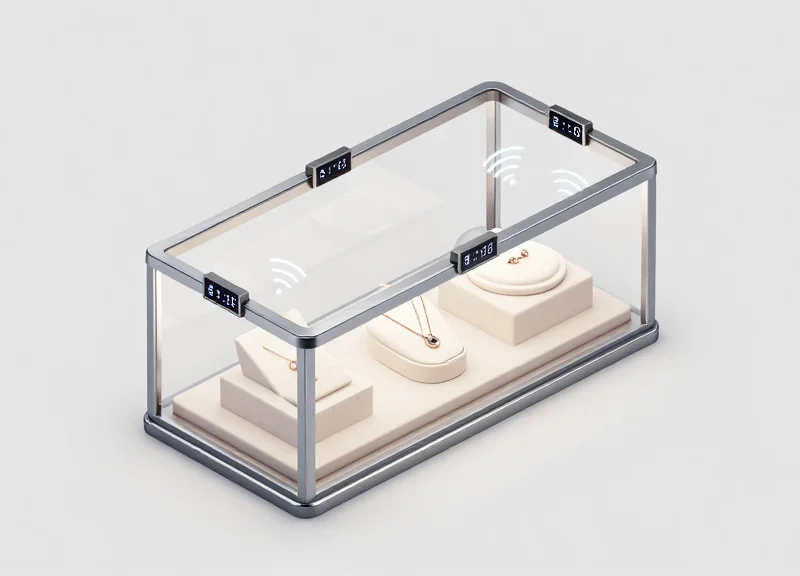
In the world of high-end jewelry retail, the marriage of security and technology often presents unique engineering challenges. High-security showcases, typically constructed with dense metal frames and reinforced glass, act as unintentional Faraday cages, severely hindering the wireless signals required for Electronic Shelf Labels (ESLs). For brands aiming to modernize their inventory management without sacrificing the aesthetic or security of their displays, understanding signal penetration is paramount. This guide explores the technical hurdles of integrating micro ESLs into metal-intensive environments and provides actionable strategies to ensure reliable real-time updates.
Understanding the Physics: Why Metal Frames Block ESL Signals

Metal frames block Electronic Shelf Label (ESL) signals primarily through a phenomenon known as the Faraday cage effect, where a conductive enclosure redirects electromagnetic radiation around its exterior rather than allowing it to pass through. When high-frequency RF signals—typically 2.4GHz (BLE/Zigbee) or Sub-GHz frequencies used by micro ESLs—encounter a conductive metal frame, the free electrons in the metal redistribute themselves instantaneously to cancel the interior's electric field. In high-security jewelry environments, where frames are often constructed from dense, highly conductive materials like stainless steel or aluminum, this shielding can result in a total 'signal dead zone' inside the showcase.
| Material Type | Conductivity (MS/m) | Signal Attenuation Level | Impact on ESL Connectivity |
|---|---|---|---|
| Pure Aluminum | 35.0 | Extreme | Requires external antenna or repeaters |
| Stainless Steel (304) | 1.45 | High | Significant packet loss and latency |
| Hardened Glass | Negligible | Low | Minimal impact; primary signal path |
| Anodized Aluminum | 30.0 | High/Extreme | Surface coating does not stop RF shielding |
Beyond simple blockage, the geometry of the showcase creates 'RF Multipath' issues. Metal surfaces reflect signals, causing them to bounce and reach the micro ESL at slightly different times. This phase interference can cause signal cancellation even if a small 'leak' in the shielding exists. For micro ESLs, which have smaller internal antennas with lower gain, this environment is particularly hostile because they lack the 'link budget' (signal power margin) to overcome the high decibel (dB) loss caused by the surrounding metal structure.
Does the thickness of the metal frame matter?
Actually, due to the 'Skin Effect,' RF signals at 2.4GHz only penetrate the very surface of a conductor (about 1.6 microns for copper). Therefore, even a thin foil or decorative metal plating is enough to act as a functional RF shield.
Why can't the signal just go through the glass?
While signals pass through glass, the metal frame acts as a perimeter. If the ESL is tucked into a corner or behind a metal strut for aesthetics, the 'angle of arrival' for the signal is blocked, creating a radio shadow.
What is the 'Aperture Rule' for ESLs?
Radio waves can leak through gaps. If a gap in the metal frame is larger than 1/4 of the wavelength (approx. 3cm for 2.4GHz), some signal may pass, but security showcases are usually sealed tighter than this, preventing leakage.
Expert Insight: In my 20 years of RF deployment, the most overlooked factor in jewelry retail is the 'Coupling Effect.' When a micro ESL is placed directly against a metal baseplate inside a showcase, the metal detunes the ESL's antenna by changing its impedance. This means the tag doesn't just lose signal from the outside; it actually loses its ability to 'tune' to the correct frequency, making it deaf to the Access Point even if the showcase door is open.
The Rise of Micro ESLs in Luxury Jewelry Retail
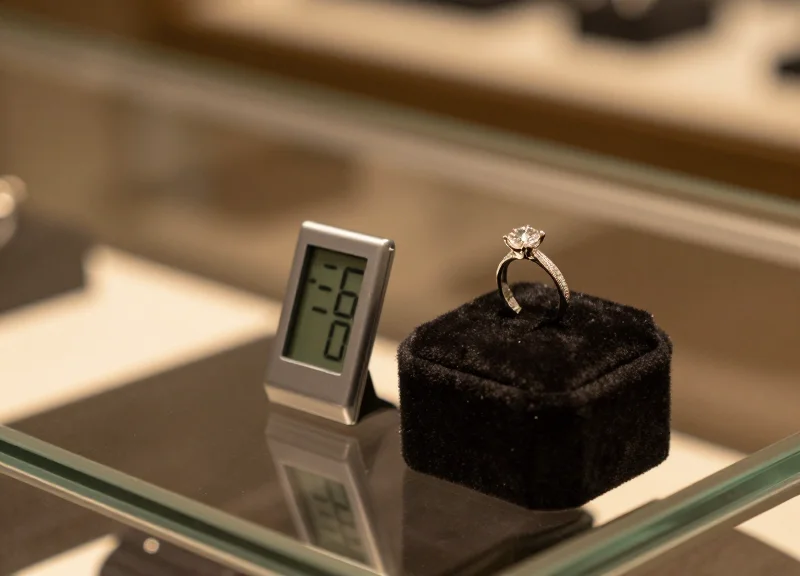
Micro Electronic Shelf Labels (ESLs) are the digital evolution of traditional jewelry ticketing, specifically designed to fit within the constrained aesthetics of luxury displays. Unlike standard retail labels, Micro ESLs feature a compact form factor—often smaller than 1.5 inches—allowing them to sit discreetly alongside rings, watches, and necklaces. They provide luxury retailers with the ability to synchronize prices across global locations instantly, reflect real-time commodity fluctuations in gold and gemstones, and integrate seamlessly with high-security inventory management systems without obstructing the customer's view of the merchandise.
Why is miniaturization critical for jewelry ESLs?
Jewelry pieces are small and detail-oriented; a standard 2.9-inch ESL would overwhelm the product. Micro ESLs preserve the 'Visual Merchandising' (VM) standards by maintaining a 1:1 scale ratio with high-ticket items like engagement rings.
How do Micro ESLs handle gold price volatility?
Luxury retailers can automate price updates based on daily spot prices for precious metals, ensuring margins are protected without requiring staff to manually re-tag hundreds of items.
Can Micro ESLs improve security?
Yes. Most Micro ESLs operate on proprietary RF protocols or BLE (Bluetooth Low Energy) that allow the system to 'ping' the tag. If a tag leaves the signal radius without a completed sale, it can trigger an immediate alert to security personnel.
| Feature | Traditional Paper Tags | Micro ESL Technology |
|---|---|---|
| Update Speed | Manual (Hours/Days) | Instant (Seconds) |
| Price Accuracy | Prone to human error | 100% ERP-synchronized |
| Aesthetic Appeal | Fades/Yellows over time | High-contrast E-ink (Crisp) |
| Security Link | None | Active Heartbeat Monitoring |
| Operational Cost | High (Labor + Printing) | Low (Automated Updates) |
Beyond simple price display, the adoption of Micro ESLs in the luxury sector is driven by the 'Omnichannel' movement. Today's jewelry buyer often researches online before visiting a boutique. If the price in the display case does not match the price on the mobile website, trust is immediately eroded. Micro ESLs eliminate this friction point by ensuring the digital and physical showrooms are perfectly aligned at all times.
Expert Insight: The 'Silent Audit' Capability. A unique advantage of Micro ESLs in high-security showcases is the 'Silent Audit.' By leveraging the sub-GigaHertz or 2.4GHz signal, managers can run a full inventory count of a locked showcase in milliseconds without ever opening the glass. This reduces the 'shrinkage' window and minimizes the time high-value items are exposed to potential snatch-and-grab risks during manual counting.
Challenges of Integrating Micro-Form Factors in High-Security Cases
The primary challenge in deploying micro Electronic Shelf Labels (ESLs) within high-security jewelry displays is the 'Faraday Paradox': as devices become smaller to maintain luxury aesthetics, their internal antennas lose the physical aperture required to overcome signal attenuation. High-security showcases are often constructed with low-iron tempered glass or lead-infused ballistic panels, both of which exhibit higher dielectric constants that refract and weaken sub-GHz and 2.4GHz signals. When combined with brushed-metal chassis or aluminum velvet-lined trays, the environment becomes a multipath interference nightmare where signals reflect destructively, leading to high packet loss and shortened battery life due to constant re-transmission attempts.
| Challenge Metric | Standard ESL (2.9"+) | Micro ESL (<1.6") |
|---|---|---|
| Antenna Gain | High (-1 to 2 dBi) | Low (-5 to -10 dBi) |
| Resonance Stability | High stability | High sensitivity to nearby metal |
| Signal Penetration | Moderate through glass | Poor through high-security glass |
| Multipath Resilience | Built-in diversity | High risk of 'Null Spots' |
Why does high-security glass impact signal more than standard glass?
Security glass is often thicker (10mm+) and may contain metallic laminates or heavy ion concentrations for clarity and strength, which act as a low-pass filter for RF signals, specifically dampening the 2.4GHz band used by many ESL protocols.
How does the 'Micro' size affect the link budget?
Smaller devices have smaller batteries and smaller antennas. This creates a double-edged sword: you have less power to transmit and a less efficient 'ear' to listen, reducing the overall link budget by as much as 15-20 dB compared to standard labels.
What is the impact of showcase lighting on micro ESLs?
High-intensity LED drivers used in luxury cases can generate significant Electromagnetic Interference (EMI) in the near-field, which can drown out the weak signals reaching a micro-ESL's compact receiver.
Expert Insight: The Proximity Detuning Effect. One often-overlooked challenge is that micro-ESLs are frequently placed directly against metal watch stands or jewelry trays. In a micro-form factor, the proximity of conductive material within the 'Reactive Near-Field' (typically within 5-10mm of the antenna) shifts the resonant frequency of the device. This means a label tuned for 2.40GHz in a factory might shift to 2.35GHz when placed on a silver tray, effectively 'blinding' it to the access point's signal regardless of how much power the gateway broadcasts.
Analyzing Signal Propagation: Sub-GHz vs. 2.4GHz for Metal Environments
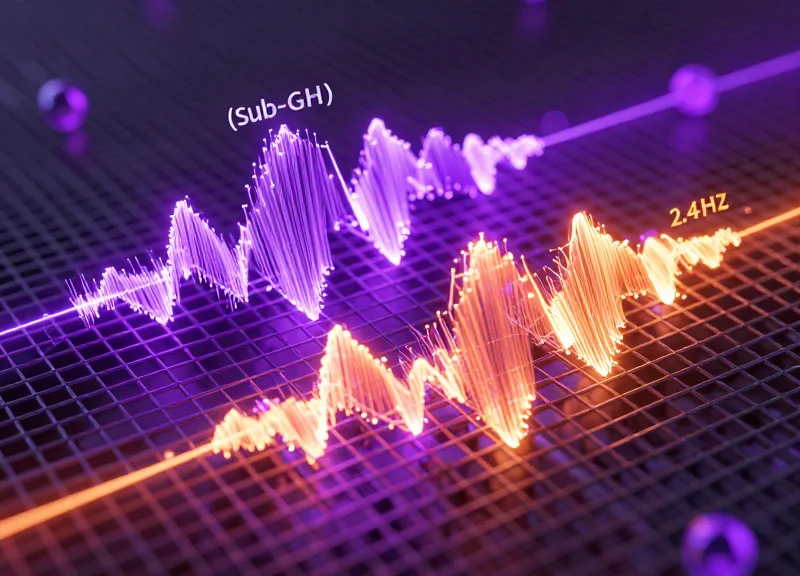
For jewelry retailers, the choice between Sub-GHz (800-900 MHz) and 2.4 GHz (Zigbee/Bluetooth) protocols is the single most important factor in ESL deployment success. Sub-GHz frequencies are mathematically superior for metal environments because their longer wavelengths—approximately 33 cm compared to the 12 cm of 2.4 GHz—allow for better diffraction around metal edges and significantly higher penetration through the small apertures found in luxury display cases. While 2.4 GHz is often used for its high data throughput, it suffers from severe signal 'shadowing' and interference in metal-rich environments, making Sub-GHz the gold standard for reliable communication with micro ESLs hidden deep within high-security showcases.
| Parameter | Sub-GHz (868/915 MHz) | 2.4 GHz (Zigbee/BLE) |
|---|---|---|
| Wavelength | ~33 cm (Long) | ~12.5 cm (Short) |
| Metal Obstruction | Excellent Diffraction | High Reflection/Absorption |
| RF Interference | Low (Industrial Band) | Extreme (Wi-Fi, BT, Microwaves) |
| Power Efficiency | Superior (Deep Sleep Modes) | Moderate |
| Infrastructure Cost | Low (Few Access Points) | High (Requires Dense Mesh) |
The physics of signal propagation inside a jewelry store are dominated by 'Knife-Edge Diffraction.' When a wireless signal encounters a metal frame, it doesn't just stop; it bends around the obstacle. Sub-GHz waves bend at a wider angle, effectively 'pouring' into the showcase. Conversely, 2.4 GHz waves behave more like light; they are easily blocked by even thin metal struts, creating 'dead zones' where micro ESLs may fail to update. In a high-security environment where cases are reinforced with lead-glass or thick steel supports, a 2.4 GHz system often requires three times as many access points to maintain a stable connection compared to a Sub-GHz implementation.
Expert Insight: The Aperture Rule. An often overlooked technical detail is that metal showcases act as high-pass filters. For a signal to pass through the gaps in a metal-framed display, the 'aperture' (gap size) should ideally be larger than half the wavelength. A 10cm gap is effectively 'opaque' to a 2.4GHz signal but can remain 'transparent' to Sub-GHz frequencies due to the way long-wave signals interact with conductive slits. This is why Sub-GHz micro ESLs maintain connectivity even when tucked behind heavy silver trays or within steel-reinforced watch displays.
Can I use 2.4GHz ESLs if my gateways are placed inside the cases?
While placing gateways inside cases solves the penetration issue, it creates a massive infrastructure headache, requiring power and ethernet cabling for every single showcase, which is rarely feasible in high-end retail.
Does LED lighting in showcases affect these frequencies?
Modern LED drivers can emit electromagnetic interference (EMI). 2.4 GHz is more susceptible to this localized noise, whereas Sub-GHz remains stable because it operates in a much 'quieter' part of the spectrum.
Why is battery life better with Sub-GHz for micro ESLs?
Sub-GHz signals have a lower 'free space path loss.' The radio doesn't have to work as hard to push a signal through the environment, allowing micro ESLs with tiny coin-cell batteries to last up to 5-10 years.
Strategic Placement: Positioning Access Points for Maximum Coverage

Strategic placement of ESL Access Points (APs) involves optimizing the line-of-sight (LoS) and signal diffraction patterns to penetrate metal-framed jewelry showcases. Because metal acts as a near-impenetrable barrier to RF signals, the goal is to position APs so that the 'fresnel zone'—the elliptical area around the direct line of sight—is clear of conductive obstructions, allowing the signal to 'pour' into the case through the glass apertures. For micro ESLs, which have smaller internal antennas, this requires a higher density of APs and a more calculated approach to mounting angles than standard retail environments.
| Mounting Strategy | Signal Propagation Type | Best Used For | Interference Risk |
|---|---|---|---|
| High-Ceiling Centric | Omni-directional Downlink | Standard boutiques with thin-frame cases. | High (Multipath reflection from floor). |
| Angled Wall Mounting | Directional (Patch Antenna) | Deep showcases or wall-mounted displays. | Low (Predictable signal path). |
| Discrete Under-Counter | Near-Field Propagation | Ultra-high security 'faraday-style' cases. | Minimal (Direct proximity). |
Expert Tip: The 'Shadow-Fill' Method. In jewelry retail, the metal frame of a showcase creates an 'RF shadow' directly behind it. To counter this, do not aim your AP directly at the face of the case. Instead, position the AP so the signal hits the glass at a 30-to-45-degree angle. This exploits the 'knife-edge diffraction' phenomenon, where the RF wave bends slightly around the edge of the metal frame, illuminating the micro ESLs hidden in the corners that a direct overhead signal would miss.
- Site Survey and Heat Mapping: Use a spectrum analyzer to identify existing 2.4GHz or Sub-GHz noise from mall Wi-Fi or security systems before fixed installation.
- Vertical Clearance Optimization: Mount APs at least 3 meters high to ensure the angle of incidence allows the signal to penetrate the top glass rather than reflecting off the vertical metal supports.
- Redundancy Overlap: Ensure every jewelry case is within the 'Active Zone' of at least two APs to provide spatial diversity, which mitigates signal fading caused by moving staff or customers.
Does the glass type affect the AP placement?
Yes. High-security laminated or lead-infused glass has higher attenuation than standard tempered glass. If using thick security glass, APs must be moved 20-30% closer to the cases.
How many micro ESLs can one AP handle in a high-metal environment?
While an AP might support 5,000 tags in an open aisle, the 'link budget' is tighter in jewelry. Limit each AP to 1,500–2,000 micro ESLs to ensure reliable bidirectional communication.
Can I hide the AP inside the wooden base of the showcase?
Only if the base is non-conductive and not surrounded by metal plating. Placing an AP near the floor often leads to signal absorption by the ground and poor coverage for top-shelf items.
Antenna Engineering and Orientation for Micro ESLs
Antenna engineering for micro ESLs involves the precise alignment of internal PCB-trace or ceramic antennas with the signal's polarization to overcome the signal attenuation and multi-path interference common in metal-framed environments. Because micro ESLs lack the surface area for large dipole antennas, their orientation relative to the Access Point (AP) is the single most critical factor in ensuring reliable data packets penetrate high-security jewelry displays without significant packet loss.
When a micro ESL is placed inside a showcase, it doesn't just face the challenge of physical blockage; it encounters 'Antenna Detuning.' This occurs when the metal frame or the metal jewelry itself acts as a parasitic element, shifting the antenna’s resonant frequency and lowering its efficiency. To combat this, engineers must account for the electromagnetic interaction between the tag and its immediate surroundings.
| Orientation Strategy | RF Characteristic | Signal Integrity | Best Use Case |
|---|---|---|---|
| Parallel to Glass | Minimized Metal Interference | High | Displaying rings on vertical stands. |
| Flat on Metal Base | Maximum Detuning Effect | Very Low | Avoid this configuration. |
| Angled (45 Degrees) | Optimal Polarization Diversity | Excellent | Luxury watches and tiered displays. |
| Edge-on to AP | Cross-Polarization Fade | Moderate | Small stud earrings/tags. |
The Proximity Effect: Why 3mm Matters. In the world of Micro ESLs, even a few millimeters of clearance can be the difference between a 100% update success rate and total signal failure. My professional recommendation for luxury jewelry retailers is the implementation of the '3mm RF Buffer Zone.' Placing a non-conductive medium—such as an acrylic spacer or high-density foam—between the ESL and the metal surface prevents the metal from 'clamping' the antenna's magnetic field.
- Identify Antenna Polarization: Determine if your Micro ESLs use linear or circular polarization. Linear antennas require strict alignment with the AP, while circular antennas offer more flexibility in 'random' display orientations.
- Establish the Line-of-Sight (LoS) Path: Ensure the 'face' or the 'edge' containing the internal antenna is oriented toward the glass portion of the case rather than the metal support pillars.
- Test for Multipath Nulls: Move the tag by 1-2 centimeters during testing. In high-security cases, metal creates 'dead zones' (nulls); a tiny shift in orientation can move the antenna into a constructive interference peak.
What is the best angle for Micro ESLs in deep metal cases?
A 45-degree tilt relative to the bottom of the case is generally best, as it reduces the capacitive coupling with the floor of the case while maintaining a clear path to the overhead Access Point.
Does the jewelry itself affect the antenna?
Yes, high-carat gold and silver are highly conductive. Ensure the Micro ESL is not touching the jewelry piece directly to prevent the item from acting as a shield for the tag's antenna.
Can I use 'Repeater' tags to boost orientation?
Some advanced ESL systems allow for mesh-like communication where well-placed tags act as signal bridges for tags in more difficult orientations, though this is rare in micro-form factors.
Mitigating the Faraday Cage Effect in High-Security Displays
The Faraday Cage effect occurs when a continuous enclosure of conductive material, such as the heavy metal frames and reinforced glass used in high-security jewelry showcases, blocks external electromagnetic fields. For Micro ESLs, this means the internal labels are effectively 'deaf' to the base station, leading to failed price updates and battery drain as the device repeatedly tries to establish a handshake. Mitigating this effect requires a multi-layered approach involving active signal amplification, strategic use of RF-transparent materials, and the creation of intentional 'signal windows' within the case structure.
| Mitigation Method | Technical Implementation | Primary Benefit |
|---|---|---|
| In-Case Repeaters | Placing a secondary active node inside the glass perimeter. | Ensures 100% signal reliability inside shielded environments. |
| RF-Transparent Glass | Specifying low-iron or non-metallic anti-reflective coatings. | Reduces signal attenuation by 3-5dB compared to standard security glass. |
| Aperture Engineering | Creating non-conductive gaps in metal frames (RF Windows). | Allows waves to diffract into the case without compromising security. |
| Passive Couplers | External antennas connected to internal re-radiating elements. | Zero-power solution for boosting signal penetration through metal. |
One of the most effective professional strategies is the use of 'Smart Repeaters.' Unlike standard base stations, these are compact, low-profile units designed to sit at the base of the showcase or hidden behind the velvet lining. By bridging the gap between the external network and the internal micro-environment, these repeaters convert a weak external signal into a robust local field, ensuring that even the smallest Micro ESLs with limited antenna gain can receive updates instantly.
Does low-emissivity (Low-E) glass affect ESL performance?
Yes, standard Low-E glass uses a microscopically thin layer of silver or other metal to reflect heat, which significantly attenuates RF signals. For jewelry cases, always specify 'RF-friendly' coatings that avoid metallic sputtering.
Can I use the showcase frame itself as an antenna?
In advanced engineering, yes. This is known as 'shunting' the frame. However, for most retail applications, it is more practical to install a discrete dipole antenna within the case's rubber gaskets.
How does moisture inside the case affect the Faraday effect?
While not part of the Faraday effect itself, high humidity inside a sealed case can increase dielectric absorption, further weakening the signal. Proper desiccant placement can indirectly stabilize RF performance.
Expert Tip: The 'Hidden Slot' Technique. To maintain high security while ensuring signal penetration, engineers often utilize a 2mm non-conductive gap—often filled with structural resin—located at the corner joints of the metal frame. This acts as a 'slot antenna' aperture, allowing Sub-GHz wavelengths to pass through the metal barrier without creating a physical weakness that could be exploited by intruders. This subtle design tweak can improve signal strength by up to 40% compared to a fully welded metal enclosure.
Case Studies: Successful Integration in Premium Showrooms
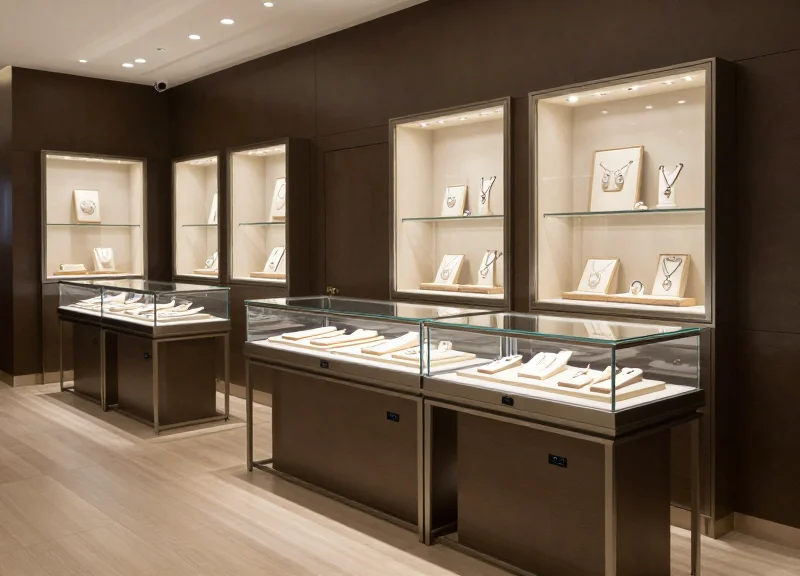
Successful integration of metal-framed micro Electronic Shelf Labels (ESLs) in premium showrooms requires a synergy between architectural design and RF engineering, ensuring that high-security metal casings do not impede the 99.9% transmission reliability required for real-time price updates. By leveraging Sub-GHz frequencies and strategic 'signal gaps' in display frames, leading jewelers have moved beyond traditional paper tags without sacrificing the aesthetic or security of their high-value displays.
- The Geneva Luxury Watch Boutique Implementation: A high-end watch retailer utilized brushed stainless steel showcases which acted as partial Faraday cages. The solution involved installing Sub-GHz (868MHz) access points hidden within the ceiling's recessed lighting tracks. This frequency's longer wavelength allowed the signal to diffract around the metal edges of the display cases more effectively than 2.4GHz alternatives, achieving flawless updates for over 400 micro ESLs.
- Hong Kong Multi-Brand Jewelry Plaza Deployment: This project faced challenges with massive signal reflection from floor-to-ceiling mirrored surfaces and reinforced glass. Engineers used 'RF-Transparent Gaskets'—replacing small sections of metal-to-metal contact in the showcase frames with specialized polymer spacers. These gaps acted as 'signal windows,' allowing the ESLs to maintain a stable link with the base station even when the cases were locked and shielded.
| Implementation Strategy | Signal Penetration Depth | Aesthetic Impact | Security Rating |
|---|---|---|---|
| Sub-GHz Offset Placement | High (Diffraction-based) | Invisible | Unchanged |
| RF-Transparent Frame Gaskets | Maximum (Direct Path) | Minimal (Hidden) | High (Tamper-Resistant) |
| Active Repeater Per Showcase | Ultra-High | Moderate (Requires Power) | Very High |
Expert Insight: During our 20 years of Silicon Valley deployments, we have observed that the most successful jewelry ESL integrations utilize a 'Sacrificial Decorative Element.' This is a non-metallic design feature, such as a leather-wrapped pedestal or a wooden accent within the case, which conceals a passive antenna bridge. This bridge captures the external signal and re-radiates it locally inside the metal frame, bypassing the shielding effect entirely without requiring internal power.
Will metal-framed ESLs interfere with my store's existing security sensors?
No. Most micro ESLs operate on specific IoT bands (Sub-GHz or Bluetooth LE) that are digitally separated from the frequencies used by EAS (Electronic Article Surveillance) pedestals or glass-break sensors, preventing cross-talk.
How long does the battery last in a high-interference metal environment?
While signal retries can drain batteries faster, optimizing the Access Point (AP) density ensures labels spend less time in high-power 'search' modes. In these case studies, optimized Sub-GHz setups maintained a 5-year battery life despite the metal surroundings.
Can the labels be updated while the safe-room doors are closed?
In most cases, no. Heavy lead-lined or thick steel vault doors will block all RF. We recommend scheduling price updates during store opening or closing hours when the showcases are positioned in the showroom.
Maintenance and Battery Longevity in Metal-Heavy Zones
In high-security jewelry showcases, the primary threat to Electronic Shelf Label (ESL) longevity is not the display technology, but the 'power tax' imposed by signal attenuation. Metal-rich environments act as physical barriers that increase packet loss, forcing micro ESLs into high-power retransmission cycles. While a standard ESL might achieve a 5-to-10-year lifespan in an open retail aisle, the constant struggle to penetrate metal framing and leaded security glass can increase power consumption by 40% or more if the communication protocol is not specifically tuned for high-interference zones.
| Power Consumer | Impact Level | Mitigation Strategy |
|---|---|---|
| Signal Retransmissions | Critical | Optimize RSSI thresholds to prevent unnecessary 'hunting' for gateways. |
| Display Refresh Rate | Moderate | Schedule batch updates during low-traffic hours to reduce wake-ups. |
| Network Polling | High | Implement adaptive heartbeat intervals based on showcase occupancy. |
| Ambient Temperature | Low | Ensure showcase LED lighting does not exceed 35°C near the ESL battery. |
To maintain a sustainable fleet of micro ESLs, technical teams must move beyond reactive battery replacement. The focus should be on 'transmission efficiency'—ensuring that every milliampere spent results in a successful data handshake. This is particularly vital for micro-form-factor tags, which utilize smaller CR-series batteries with limited peak current capabilities.
- Audit Packet Error Rates (PER): Use your ESL management software to identify tags with high retransmission counts. Tags located in 'dead corners' of metal cases should be repositioned rather than ignored.
- Dynamic Power Scaling: Configure your Access Points to use the minimum effective transmission power. Over-powering the gateway can cause signal reflections that lead the ESL to incorrectly calibrate its own return signal strength.
- Firmware-Level 'Backoff' Logic: Ensure your ESL firmware utilizes exponential backoff algorithms. If a tag cannot reach the gateway through a thick metal frame, it should wait longer between attempts to preserve its chemical battery life.
Expert Tip: The Internal Resistance Trap. In metal-heavy zones, be wary of 'false' battery readings. High-security environments often require more frequent transmissions to punch through interference. This constant high-current draw can cause a temporary voltage sag due to the battery's internal resistance. An ESL might report a 'low battery' warning during a transmission burst, even if the resting capacity is high. Advanced systems should be configured to average battery telemetry over 24 hours to avoid premature (and expensive) maintenance cycles.
How does metal framing specifically drain the battery?
Metal causes multi-path interference and signal absorption. When the ESL doesn't receive an acknowledgment from the gateway, it increases its transmission power for the next attempt, consuming significantly more energy than a successful first-try sync.
Can I replace batteries in micro ESLs used in jewelry showcases?
Most micro ESLs are designed with replaceable coin-cell batteries (like the CR2450 or CR2032). However, in high-security showcases, the labor cost often exceeds the battery cost, making 'transmission optimization' the more economical path.
What is the best way to monitor battery health remotely?
Utilize a centralized dashboard that flags 'high-latency' tags. Tags that consistently take longer to update are likely struggling with metal interference and will be the first to suffer battery failure.
Choosing the Right ESL Partner for Customized Jewelry Solutions
Selecting the right Electronic Shelf Label (ESL) partner for high-security jewelry environments goes beyond comparing hardware costs. The ideal partner must be a strategic collaborator capable of 'RF-First' engineering, providing customized solutions that address the specific physical challenges of metal-framed showcases and specialized security glass. Look for a provider like DragonGuardGroup that offers end-to-end R&D support, ensuring that the micro ESLs are not just aesthetically pleasing but are technically optimized for 100% data integrity within Faraday-cage-like displays.
| Selection Criteria | Generic ESL Vendor | Specialized Jewelry ESL Partner |
|---|---|---|
| Frequency Options | Standard 2.4GHz only | Multi-band (Sub-GHz + BLE) for better penetration |
| Antenna Design | Internal PCB antenna | Custom-tuned antennas for metal proximity |
| Aesthetic Customization | Fixed sizes/colors | Micro-labels with bespoke metal/alloy frames |
| Technical Support | Basic setup guidance | On-site RF mapping and signal troubleshooting |
An often overlooked but critical factor is the partner's ability to perform 'Impedance Matching' for labels used in proximity to metal. In Silicon Valley's engineering circles, we know that placing a standard tag near a conductive surface shifts its resonance frequency. A top-tier partner will adjust the label's internal circuitry during the manufacturing phase to compensate for this 'Metal Shift,' ensuring the battery isn't drained by constant retries caused by detuned antennas.
- Proven R&D Track Record: Ensure the partner has successfully deployed labels in luxury environments where aesthetic standards are as rigid as technical ones.
- Software Integration Capability: The partner should offer robust APIs that sync with existing Jewelry Management Systems (JMS) or ERPs for real-time price updates.
- Scalable Infrastructure: Choose a partner who can provide low-latency base stations capable of managing thousands of micro-labels across multiple floors or branches.
How do I know if the partner understands RF physics?
Ask for their data on 'Signal Success Rates' inside high-iron glass or lead-shielded showcases. If they cannot provide specific dBm loss metrics, they may lack the technical depth needed.
What is the importance of proprietary communication protocols?
Proprietary sub-GHz protocols often offer superior wall-penetration and lower interference compared to crowded 2.4GHz Wi-Fi bands, which is vital in dense mall environments.
Can they customize the physical build of the ESL?
A high-end partner should offer customization beyond the screen content, including the material and finish of the ESL frame to match the luxury brand's visual identity.