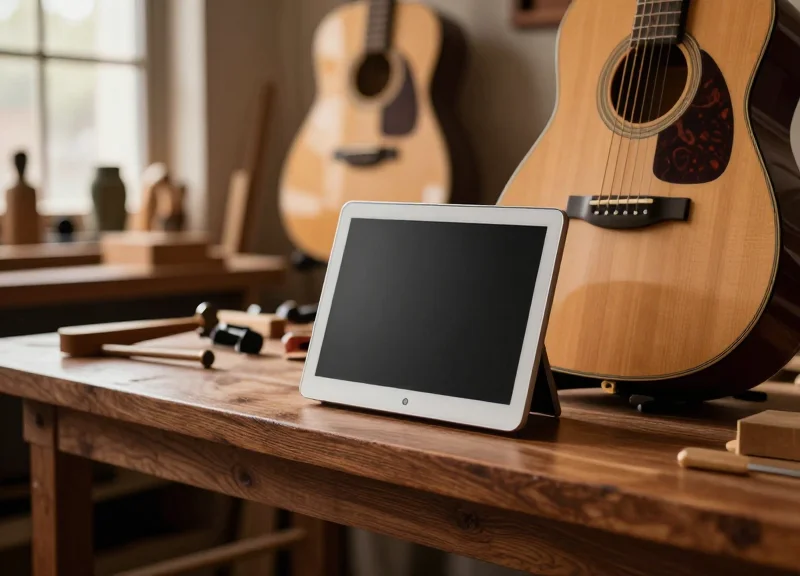
For high-end luthier shops, every square inch of the showroom must reflect the craftsmanship and heritage of the instruments on display. Traditional paper tags often fail to keep pace with fluctuating market values and complex inventory data, yet many digital solutions feel too sterile for a workshop steeped in tradition. This guide provides a strategic framework for selecting Electronic Shelf Labels (ESL) that integrate seamlessly into the artisanal environment, allowing luthiers to maintain real-time pricing and provenance data without compromising the shop's aesthetic soul.
The Modern Luthier's Challenge: Tradition vs. Digital Efficiency
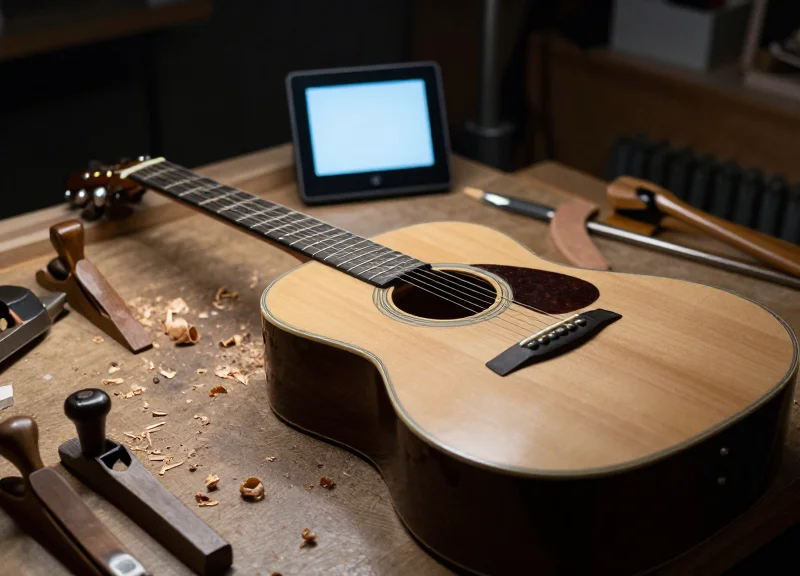
Modern luthier shops face a unique strategic paradox: the need to preserve an 'old-world' atmosphere of craftsmanship while managing the complex logistical demands of a global luxury market. The challenge lies in integrating digital efficiency—specifically Electronic Shelf Labels (ESL)—into an environment where paper tags and handwritten notes are often seen as part of the brand's heritage. To succeed, high-end shops must leverage technology that provides real-time data on rare tonewoods and custom components without compromising the tactile, sensory experience that justifies a five-figure price tag.
| Traditional Workflow Component | The Digital Efficiency Conflict | The ESL Solution Benefit |
|---|---|---|
| Handwritten Spec Tags | Inaccurate data on wood moisture or age | Real-time sensor sync for climate-sensitive materials |
| Manual Price Adjustments | Delayed response to fluctuating rare wood markets | Instant global price updates via centralized ERP |
| Aesthetic 'Vibe' | Standard plastic digital displays look 'cheap' | Customizable E-ink mimics paper texture and warmth |
For the elite luthier, the instrument's 'heritage'—its provenance, the forest it came from, and its drying process—is its greatest selling point. Traditional inventory methods often fail to communicate this depth of information to the customer at the point of sale. Digital efficiency shouldn't just be about speed; it's about providing a transparent, data-rich environment that confirms the instrument’s value to a discerning collector.
Can digital labels coexist with wood shavings and high humidity?
Yes. Industrial-grade ESL units are IP-rated to withstand the fine dust of a workshop and the high humidity levels (45-55%) required for stable tonewood storage.
Does digital technology detract from the 'handcrafted' brand image?
Only if implemented poorly. High-end ESLs use E-ink technology with zero backlighting, making them look like printed parchment rather than a smartphone screen, preserving the shop's aesthetic.
Why not just use traditional QR codes on paper?
Paper lacks bi-directional communication. An ESL can flash an LED to alert a builder to a specific wood batch that has reached optimal aging, something a static QR code cannot do.
Expert Insight: The 'Invisible Tech' Strategy. My twenty years in Silicon Valley have taught me that luxury tech is best when it is invisible. For a luthier, the goal isn't to show off a digital screen; it is to use the ESL as a 'Digital Heritage Portal.' By using wooden-bezel ESL frames, you can display real-time moisture content and 'years-since-harvest' data directly next to a cello scroll or guitar neck. This turns a technical inventory tool into a high-end storytelling device that increases the perceived value of the craftsmanship.
Visual Harmony: Choosing ESLs That Complement Fine Woodwork
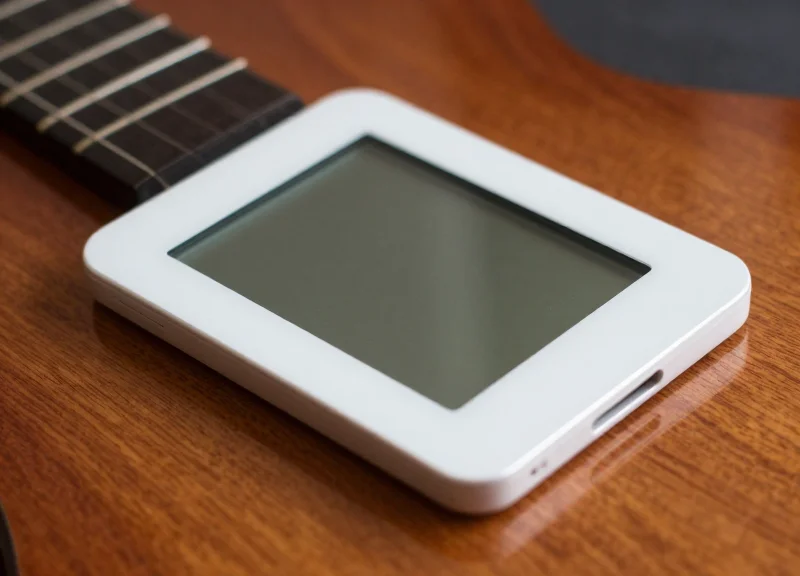
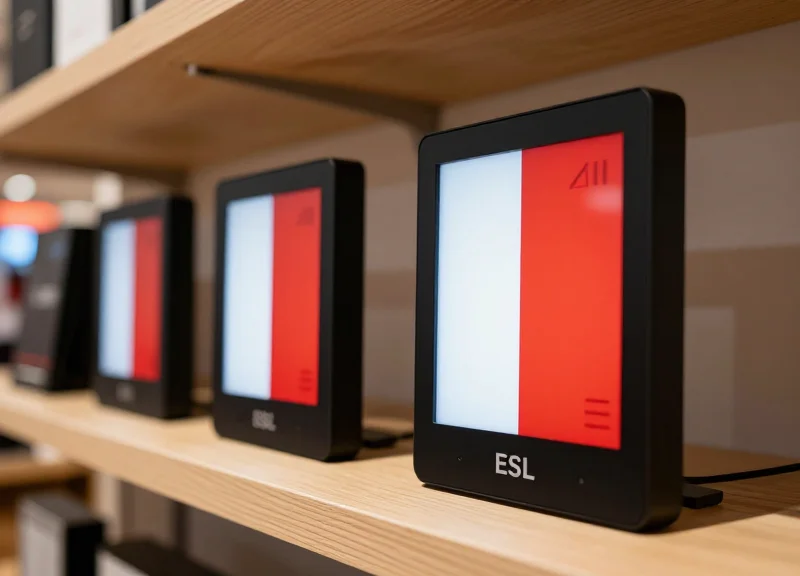
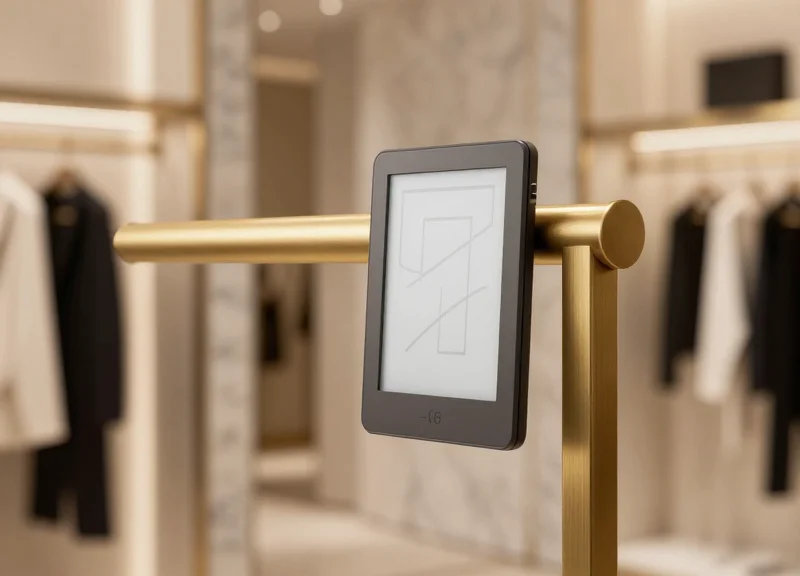
In the context of a high-end luthier shop, visual harmony is achieved when digital price and information tags utilize E-ink (e-paper) technology to mimic the reflective properties of physical media, thereby eliminating the distracting glow associated with LCD or LED screens. To ensure these devices complement fine woodwork, shop owners should prioritize high-contrast ratios (minimum 7:1) and anti-glare glass coatings that maintain legibility under the warm, focused spotlighting common in boutique showrooms. By selecting ultra-slim form factors and matte-finish bezels, the ESL transitions from a functional inventory tool into a sophisticated digital placard that honors the instrument's craftsmanship.
| Feature | Standard Retail ESL | Luthier-Grade Aesthetic ESL |
|---|---|---|
| Display Tech | Basic TN/STN LCD | Bi-stable E-paper (E-ink) |
| Visual Profile | Backlit / High-Glow | Reflective / Paper-like |
| Bezel Material | White/Grey ABS Plastic | Anodized Aluminum or Wood-Composite |
| Viewing Angle | Limited (60-90°) | Near-Perfect (180°) |
| Light Interference | Significant Screen Glare | Diffuse Reflection (Matte finish) |
The primary design challenge is 'The Digital Intrusion'—the phenomenon where a plastic-looking device cheapens a $10,000 custom guitar. To mitigate this, look for ESL providers that offer 'Bezel-Free' or 'Slim-Frame' designs. High-end luthiers often utilize 3D-printed or CNC-milled wooden shrouds (such as walnut or mahogany) to encase the ESL. This allows the digital display to appear 'inlaid' into the display rack or instrument stand rather than merely clipped onto it.
- Color Palette Selection: While standard ESLs are black and white, premium models offer 3-color (Black, White, Red/Yellow) or 7-color palettes. For luthiers, the Red/Yellow spectra are invaluable for highlighting tonewood heritage or 'Sold' status without breaking the warm color temperature of the shop.
- Resolution and Typography: A high-DPI (Dots Per Inch) screen is critical. Low-resolution tags create pixelated text that feels 'tech-heavy.' High-DPI displays allow for the use of Serif fonts (like Garamond or Baskerville), which align with the traditional branding of heritage luthiers.
- Mounting Stealth: The best aesthetic results come from magnetic or flush-mount systems. Avoid bulky plastic clips; instead, utilize rare-earth magnets integrated into the instrument stands for a 'floating' information display.
Expert Insight: The 'Metamerism Neutrality' Factor. In my 20 years of retail tech strategy, I have found that the most common mistake is ignoring how shop lighting affects digital ink. High-end luthier shops typically use high-CRI (Color Rendering Index) lighting to show off wood grain. Standard ESL plastics often have 'metameric' properties that look blueish-grey under 3000K warm lights. Always request samples to ensure the 'white' of the E-ink matches the 'white' of your physical signage under your specific shop lights.
Can I use standard retail ESLs in a boutique shop?
Technically yes, but the glossy plastic and low-contrast screens often clash with the organic textures of exotic woods. It is recommended to at least customize the housing.
Will the display fade under shop lights?
No. E-ink technology is chemically stable and does not suffer from the 'burn-in' or fading issues of OLED or LCD, making it ideal for long-term instrument displays.
Does the ESL require a power cord that ruins the display?
No, modern ESLs are battery-powered (lasting 5-10 years) and communicate wirelessly, ensuring no unsightly wires disrupt the visual harmony of your woodwork.
Real-Time Provenance: Displaying Instrument Heritage and Specs

In the world of high-end lutherie, 'provenance' is the currency of value. Real-time provenance via Electronic Shelf Labels (ESLs) refers to the ability to display a curated, living history of an instrument—ranging from the specific harvest date of the Adirondack spruce top to the humidity-controlled environment it has inhabited since completion. Unlike static paper tags that quickly become outdated or cluttered, ESLs allow luthier shops to present a sophisticated digital narrative that justifies premium pricing through transparent, verified data.
| Data Field | Traditional Paper Tag | Advanced ESL Display |
|---|---|---|
| Material Specs | Generic (e.g., 'Maple') | Specific (e.g., '5A Quilted Maple, Aged 15 Years') |
| Artisan Credit | Often omitted for space | Full luthier signature & workshop role |
| Price Stability | Manual updates (messy) | Real-time sync with global market/inventory |
| Rich Media | None | QR links to build-logs or sound samples |
To effectively bridge the gap between craftsmanship and consumer, the ESL must act as a gateway to the instrument's soul. By integrating the display with your workshop's ERP or inventory management system, you can automate the presentation of technical specifications that matter most to collectors.
Can ESLs show the specific curing age of the tonewood?
Yes. By pulling data from your wood locker inventory, the ESL can dynamically calculate and display the exact number of years the tonewood has been air-dried or torrefied, a key selling point for discerning players.
Is it possible to track the 'shop life' of the instrument?
Advanced systems can track how long an instrument has been on the floor and even display its maintenance history, such as the last time it was re-strung or its setup was adjusted by the master luthier.
How does this impact the customer's perceived value?
Transparency builds trust. When a customer sees a verified digital record of the instrument's journey from raw billet to finished masterpiece, the 'sticker shock' often transforms into an appreciation for the labor-intensive process.
Expert Insight: The 'Micro-Climate' Proof Point. In my 20 years of tech-marketing strategy, the most successful luxury implementations solve a 'hidden' anxiety. For luthiers, that's wood stability. An original, high-value strategy is to sync your shop's IoT hygrometers with your ESLs. Imagine a tag that displays a small 'Climate Certified' badge, showing the buyer that this specific guitar has been kept at a steady 45% humidity for its entire showroom life. This level of real-time data integration doesn't just sell a guitar; it sells the shop's professional integrity.
Technical Integration: Connecting ESLs to Your Workshop CRM
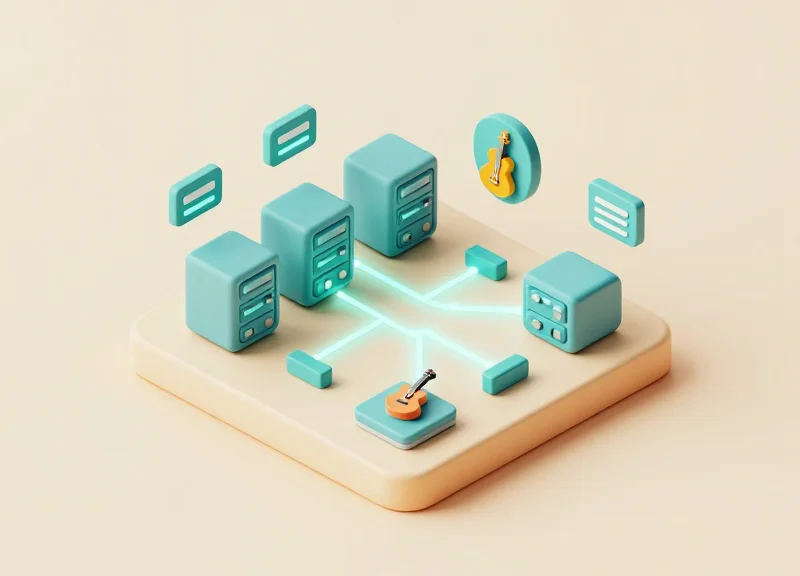
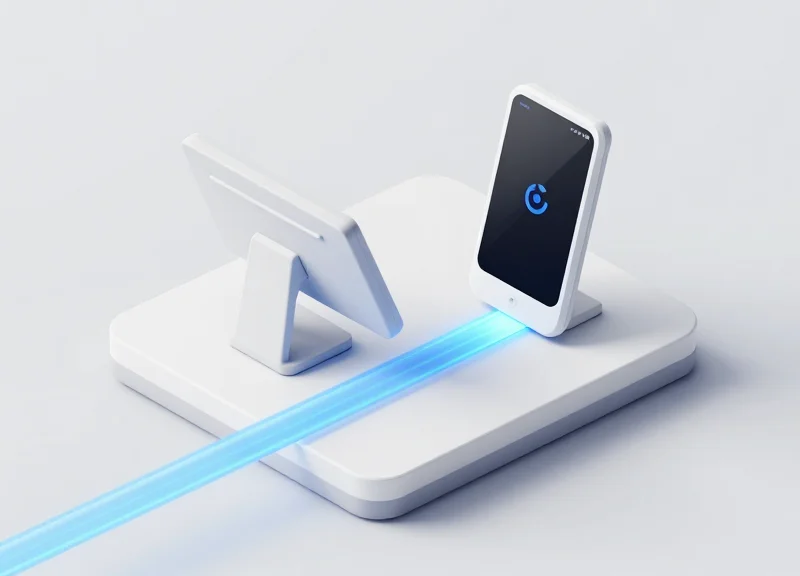
Connecting Electronic Shelf Labels (ESLs) to a luthier's Workshop CRM is achieved through a centralized gateway that bridges your inventory database with the e-paper display via RESTful APIs or Webhooks. Unlike standard retail environments, luthier integration requires mapping complex metadata—such as tonewood moisture content, artisan builder hours, and historical restoration logs—directly from your internal management software to the display tags, ensuring that the physical provenance displayed to a client is a real-time reflection of your digital records.
- API Handshake Configuration: Identify the API endpoints of your CRM (such as Airtable, custom SQL databases, or luxury retail ERPs). You will need to generate an API key and set up a secure HTTPS connection to the ESL cloud controller.
- Data Field Mapping: Map CRM variables (e.g., 'Neck_Profile', 'Fret_Condition', 'Build_Date') to the template placeholders on the ESL software. This ensures that when a luthier updates a spec in the back office, the tag updates within seconds.
- Gateway Hub Deployment: Install a Sub-GigaHz or Bluetooth Low Energy (BLE) gateway in the showroom. This hardware receives the cloud data and broadcasts the encrypted update signal to the individual labels.
- Automated Sync Triggers: Configure Webhooks so that any change in the 'Status' field of your CRM (e.g., from 'Available' to 'Under Deposit') immediately changes the tag's layout to reflect the new status.
| Sync Method | Latency | Best Use Case | Battery Impact |
|---|---|---|---|
| Webhook (Real-time) | < 30 Seconds | High-traffic boutiques with frequent sales | Moderate |
| Polling (Interval) | 1 - 6 Hours | Static heritage displays / Museum pieces | Low |
| Manual Batch | On Demand | One-off custom builds or private viewings | Very Low |
{ "item_id": "STRAT-1954-PRE", "display_data": { "price": "$45,000", "provenance": "Ex-Studio A", "humidity_optimized": "48%", "status": "In-Stock" }, "action": "update_template_4" }- Expert Tip: The 'Micro-Climate' Sync: An original strategy for high-end shops is to integrate IoT hygrometers with your CRM. If your workshop’s humidity fluctuates, the CRM can trigger an ESL update to display a 'Stable Environment' badge, providing scientific peace of mind to collectors of vintage spruce or rosewood.
- How do I handle custom builds?: For instruments still in production, the ESL can be programmed to show a 'Progress Bar' based on your CRM's 'Stage of Completion' field (e.g., 'In Finishing' or 'Final Setup').
- Can I use multiple CRMs?: Yes, using middleware like Zapier or Make.com, you can aggregate data from a sales CRM (HubSpot) and a workshop tool (Trello/Asana) to feed a single ESL tag.
Customer Engagement via QR Codes and Dynamic Content
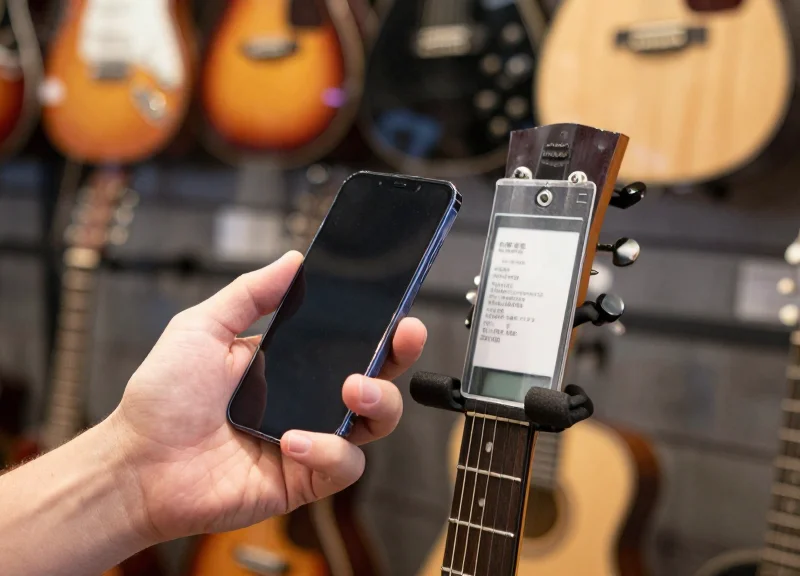
In the world of high-end luthiery, a purchase is rarely a transaction; it is an emotional investment. Electronic Shelf Labels (ESLs) equipped with dynamic QR codes serve as the bridge between the physical instrument and its digital soul. By scanning a tag, a customer moves from observing wood and wire to experiencing the full narrative of the instrument—from the specific forest where the spruce was harvested to the nuanced tonal profile recorded during its final setup. This 'Phygital' (physical-digital) interaction creates a deeper sense of transparency and trust, which is essential when justifying the premium price points of boutique instruments.
- Lossless Audio Samples: Link customers directly to high-fidelity recordings of the specific instrument being viewed, allowing them to hear its unique resonance through professional headphones even in a busy showroom.
- Build-Process Time-Lapses: Provide a behind-the-scenes look at the craftsmanship, showing the internal bracing, hand-rubbed finishes, and the artisan's journey in creating that specific piece.
- Interactive Certification: Instant access to digital certificates of authenticity and CITES documentation for exotic tonewoods, ensuring the buyer of the instrument's legal and ethical provenance.
One unique advantage of modern ESL systems is the ability to rotate QR content dynamically. For instance, a luthier can update the destination URL of a QR code based on the instrument's status—moving from a 'Work in Progress' video while the guitar is being built to a 'Owner's Manual and Maintenance' portal once the sale is finalized. This ensures the digital label remains relevant throughout the entire lifecycle of the product.
| Feature | Traditional Paper Tags | Dynamic ESL with QR |
|---|---|---|
| Information Depth | Limited to price/basic specs | Unlimited via digital landing pages |
| Customer Engagement | Passive / Static | Active / Multimedia interaction |
| Verification | Manual / Paper-based | Instant digital authentication |
| Lead Generation | None | Direct capture of customer interest |
Expert Tip: Implement 'Sonic DNA' tracking. Use the QR code to link to a real-time humidity log of the shop's environment. For a high-end collector, seeing that an instrument has been maintained at a perfect 45% humidity for its entire life on the floor is a more powerful selling point than any sales pitch. This technical transparency is what separates elite luthier shops from standard retail outlets.
Can I track how many customers scan my instruments?
Yes. Most enterprise ESL platforms provide analytics on QR scans, allowing you to see which instruments generate the most digital engagement, even if they haven't sold yet.
Do I need a separate app for the customers?
No. Modern smartphones scan QR codes natively through the camera app, making the transition from the physical tag to your workshop's digital content frictionless.
Is the QR code too small to scan easily?
High-resolution e-paper displays (300 DPI) allow for crisp, high-contrast QR codes that are easily scannable from several feet away, even in low-light showroom conditions.
Hardware Durability and Longevity in Workshop Environments
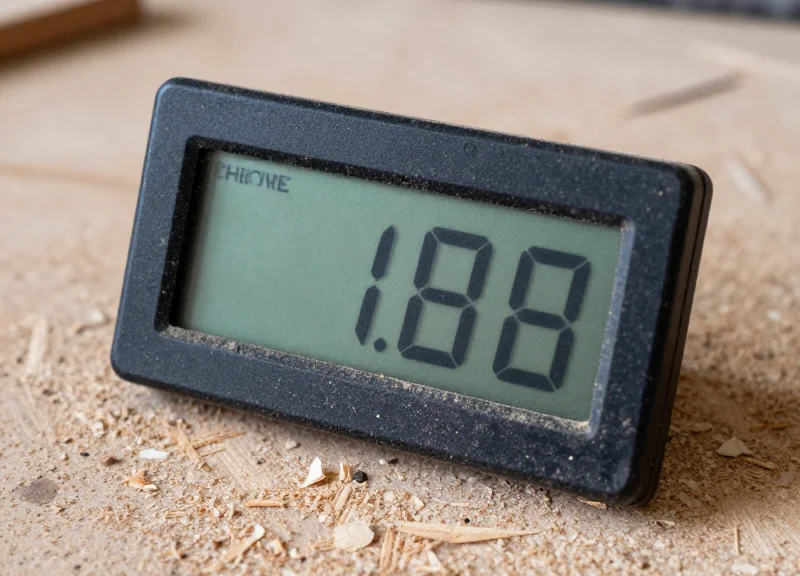
In a high-end luthier shop, the environment is fundamentally more aggressive toward electronics than a standard retail space. Hardware durability for Electronic Shelf Labels (ESLs) is defined by their ability to maintain operational integrity amidst fine airborne particulates, varying humidity levels used for wood seasoning, and the occasional exposure to volatile organic compounds (VOCs) from finishes. To ensure a ten-year lifecycle, shop owners must look beyond consumer-grade plastic and focus on units with a minimum IP67 rating, which guarantees total protection against the fine 'tonewood dust' that can penetrate and short-circuit standard electronic displays.
| Feature | Standard Retail ESL | Luthier Workshop Grade |
|---|---|---|
| IP Rating | IP20 - IP30 (Minimal) | IP65 - IP67 (Dust/Water Tight) |
| Casing Material | Thin Polycarbonate | Reinforced ABS or UV-Stabilized Resin |
| Battery Life | 3 - 5 Years | 7 - 10 Years (Low-frequency updates) |
| Screen Protection | Bare E-ink Film | Tempered Glass or Anti-Scratch Acrylic |
| Vibration Resistance | None | Shock-mounted Internal PCB |
The 'Sawdust Ingress' factor is the primary killer of digital displays in workshops. Fine dust from sanding ebony or rosewood acts as both an insulator and an abrasive. While standard ESLs rely on snap-fit casings that allow micro-particles to enter, workshop-grade units utilize sonic-welded seams or internal gaskets. This sealing not only protects the circuitry but also prevents the 'internal clouding' of the screen, ensuring that the heritage data and provenance of your instruments remain crystal clear for decades.
How does humidity affect ESL longevity in a luthier shop?
Luthier shops typically maintain a stable 45-50% humidity. High-quality ESLs are designed to operate within this range without condensation forming behind the lens, provided they feature a sealed environment or nitrogen-purged housing.
Can wood finishing solvents damage the ESL displays?
Yes, overspray from nitrocellulose or poly finishes can mar plastic screens. It is vital to select hardware with tempered glass overlays or use custom-milled wooden frames that provide a recessed 'bezel' to protect the screen surface from accidental chemical contact.
What is the real-world battery expectation for these tags?
Since luthier inventory moves slower than grocery items, update frequency is low. With a high-capacity lithium thionyl chloride battery, a workshop ESL can easily exceed 10 years of operation, effectively becoming a 'set and forget' asset.
Expert Tip: Consider the 'Vibration Fatigue' of your mounting solutions. High-frequency vibrations from power tools can cause micro-fractures in standard solder joints over several years. I recommend utilizing silicone-dampened mounting brackets or adhesive magnets with high shear strength. This decoupling of the ESL from the workshop's physical structure ensures that the delicate internal drivers of the E-paper display are never subjected to the resonance frequencies of the shop's machinery, significantly extending the MTBF (Mean Time Between Failure) of your digital infrastructure.
Strategic Placement: Mounting Solutions for Rare Instruments
In high-end luthier shops, strategic placement for Electronic Shelf Labels (ESLs) requires a 'Safety-First, Data-Second' approach. Successful mounting ensures that digital hardware provides essential heritage data and pricing without ever compromising the structural integrity or the delicate nitrocellulose and spirit-varnish finishes of rare instruments. The ideal solution utilizes non-invasive, ph-neutral materials that create a 'buffer zone' between the electronic unit and the wood, maintaining a clear line of sight for the customer while preserving the instrument's physical story.
| Mounting Style | Attachment Method | Best Application | Finish Safety |
|---|---|---|---|
| Floating Bracket | Attaches to wall-hook/slatwall | Hanging guitars and violins | Excellent (No contact with instrument) |
| Inert Felt Clamps | Low-tension grip on display stand | Floor-standing cellos or double basses | High (Requires silicone-free padding) |
| Magnetic Base | Magnetic contact to steel display racks | Modern metal-body or hybrid instruments | Medium (Requires felt barrier) |
| Tilted Pedestal | Freestanding on display shelf | Small woodwind or boutique accessories | Perfect (Zero physical contact) |
Expert Tip: For instruments finished with traditional nitrocellulose lacquer, avoid any mounting hardware containing plasticizers or low-grade rubber. Over time, these chemicals can 'off-gas,' leading to permanent melting or discoloration of the lacquer. Always specify inert cork or medical-grade, silicone-free felt for any surface that may come into indirect contact with the instrument's body.
- The 30-Degree Glare Rule: Position ESLs at a 30-degree upward tilt. This angle minimizes glare from overhead workshop lighting while ensuring the E-ink display remains readable from a standing height of 5 to 6 feet.
- Proximity to F-Holes and Rosettes: Never mount an ESL directly over an acoustic soundhole. This maintains the visual 'breath' of the instrument and prevents any risk of the unit falling into the body cavity during handling.
- The 'Story-First' Alignment: Place labels to the lower right of the instrument. In Western reading patterns, the eye naturally scans from the headstock down to the body; placing the ESL at the end of this visual journey allows the craftsmanship to speak before the data does.
Will ESL magnets affect electric guitar pickups?
Modern ESLs use very low-power magnets for mounting or internal components. Unless placed directly against a high-output pickup for extended periods, there is zero risk of degaussing or signal interference.
How do I mount labels on glass display cases?
Use transparent UV-rated adhesive strips or vacuum-sealed suction mounts on the exterior of the glass to keep the internal environment pristine for humidity-controlled instruments.
Are ESLs safe for vintage instruments with 'crazing' finishes?
Yes, provided you use 'Zero-Contact' floating brackets. For vintage pieces with existing finish cracks (crazing), physical contact should be avoided entirely to prevent flakes from being lifted by adhesive or friction.
ROI Analysis: The Business Case for Digital Labels in Luxury Retail
Investing in Electronic Shelf Labels (ESL) for luxury luthier shops yields a significant return on investment (ROI) by replacing the hidden recurring costs of manual price updates, specialized card-stock printing, and labor-intensive inventory management with a centralized, automated system. In the high-end instrument market, where a single cello or vintage guitar can command five or six figures, the business case extends beyond simple efficiency; it is about 'Brand Protection.' The labor savings alone—often reclaiming up to 75% of the time previously spent on tag maintenance—allows master craftsmen to focus on lutherie rather than administrative overhead, while simultaneously eliminating the prestige-damaging risk of displaying outdated provenance or incorrect pricing on a masterpiece.
| Cost Variable | Traditional Paper Labels (3-Year) | ESL System (3-Year) | ROI Driver |
|---|---|---|---|
| Direct Labor | High: ~4 hours/month for updates | Minimal: < 5 minutes/month | Staff Productivity |
| Material Costs | Recurring: Premium card & ink | Initial hardware cost only | Waste Reduction |
| Error Mitigation | High: Human error in manual tags | Zero: Direct sync with ERP/CRM | Legal/Brand Safety |
| Customer Engagement | Static: Basic info only | Dynamic: QR links to audio samples | Increased Conversion |
A unique financial insight often overlooked in generic retail is the 'Provenance Correction Cost.' In luthier shops, as wood ages or new historical data about a vintage instrument is discovered, paper tags must be physically replaced across all showrooms. This 'hidden' cost includes the time spent verifying data across disparate spreadsheets. ESLs provide a digital audit trail, ensuring that the heritage data displayed on the floor is always the 'Single Source of Truth' from your workshop's database.
- Direct Labor Reclamation: Calculate the hourly rate of your specialized staff. Moving from 50 manual updates a month to zero creates an immediate monthly cash-flow benefit.
- Margin Protection via Dynamic Pricing: In environments with fluctuating material costs (e.g., rare tonewoods or imported components), ESLs allow for real-time margin adjustments across the entire inventory without manual intervention.
- Reduction in 'Tapered Interest': High-end clients often lose interest if a tag looks worn or outdated. ESLs maintain a 'perpetual newness' aesthetic that justifies premium pricing.
How long does it typically take to see a full return on an ESL investment?
For boutique luthier shops with 50+ high-value items, the break-even point typically occurs within 14 to 18 months, primarily driven by labor savings and the elimination of custom printing costs.
Do ESLs increase the resale value of the shop itself?
Yes. Modernizing the retail infrastructure demonstrates a scalable, data-driven business model to potential investors or buyers, increasing the 'goodwill' valuation of the business.
Can ESLs help with insurance compliance for rare instruments?
Absolutely. By ensuring that insurance-mandated information (like humidity requirements or serial numbers) is always accurately displayed and synced with the database, you reduce the risk of claim denials due to clerical errors.
Future-Proofing Your Shop with Scalable ESL Infrastructure
Future-proofing your shop with scalable Electronic Shelf Label (ESL) infrastructure means investing in a unified software architecture and hardware ecosystem that expands without requiring a complete system overhaul. For high-end luthiers, this involves selecting platforms that utilize cloud-based management and standardized wireless protocols (such as Sub-GHz or BLE), ensuring that as your collection grows—or as you move from a private studio to a multi-city heritage brand—your digital labels, gateways, and data integrity remain consistent and backward-compatible.
In the luxury instrument market, growth often means moving beyond a single workbench. Scalability ensures that the rich 'heritage display' you have built for your flagship location can be replicated across satellite showrooms or partner galleries with the click of a button. By decoupling the management software from the physical hardware, you ensure that future label generations with higher resolutions or faster refresh rates can coexist with your original investment.
| Feature | Small Boutique Setup | Multi-Location Heritage Brand |
|---|---|---|
| Management | Local PC/Mobile App | Centralized Cloud Dashboard |
| Infrastructure | Single Wireless Gateway | Mesh-Networked Access Points |
| Data Integration | Manual Spreadsheet Sync | Live ERP/Inventory API Integration |
| Update Speed | Near-Instant | Scheduled Batch Transfers |
One critical aspect of future-proofing is API interoperability. As your shop evolves, you may introduce advanced humidity sensors, high-fidelity audio stations, or even blockchain-based certificates of authenticity. Your ESL system must serve as an open node in this 'Luthier 4.0' ecosystem, capable of pulling data from varied sources to display the most accurate, real-time specifications of your instruments.
Can I add newer label models to my existing gateway later?
Yes, provided you choose a system built on standard communication protocols. Top-tier providers ensure that their gateways are backward-compatible, allowing you to mix older monochrome displays with newer full-color or high-definition models as they hit the market.
What is the benefit of a Cloud-based ESL controller for luthiers?
A cloud controller allows you to manage the 'heritage data' of your instruments from anywhere. If you are at a guitar show in Nashville but your shop is in London, you can update pricing or provenance details globally through a single secure interface.
How do I prevent my tech from becoming 'outdated' in five years?
Focus on 'Over-the-Air' (OTA) firmware updates. Choose vendors that regularly push software improvements to the labels themselves, extending their functional life and adding new display capabilities without requiring physical replacement.
Expert Insight: The Digital Provenance Lock. To truly future-proof a heritage brand, select an ESL system that supports 'persistent metadata.' This means even if an instrument is sold and the physical label is repurposed, the system retains a digital twin of that label's display history. This creates an immutable archive of every instrument that has passed through your shop, effectively building a digital museum of your life's work that can be accessed by future generations of luthiers or collectors.