For retail managers and security professionals, few things are as frustrating as 'ghost alarms'—EAS systems triggering without a tag present. These phantom signals often stem from Electromagnetic Interference (EMI) generated by everyday commercial infrastructure like high-voltage neon signage and elevator lift motors. This guide leverages decades of technical expertise to walk you through a professional-grade EMI diagnostic process, ensuring your DragonGuardGroup security solutions operate with pinpoint accuracy and zero downtime.
Understanding the Impact of EMI on EAS Systems

Electromagnetic Interference (EMI) in the context of Electronic Article Surveillance (EAS) is the phenomenon where external electromagnetic fields corrupt the digital or analog signals used to detect security tags. When high-voltage equipment like neon signage or lift motors operate near EAS pedestals, they emit radiated or conducted energy that mimics the specific resonant frequencies—typically 8.2 MHz for Radio Frequency (RF) systems or 58 kHz for Acousto-Magnetic (AM) systems. This interference creates 'ghost alarms,' where the system triggers without a tag present, eroding staff trust in the security infrastructure and damaging the customer experience.
| System Type | Operating Frequency | Common EMI Sources | Interference Characteristic |
|---|---|---|---|
| Acousto-Magnetic (AM) | 58 kHz | Lift Motors, Power Cables | Pulsed magnetic noise mimicking tag decay. |
| Radio Frequency (RF) | 8.2 MHz | Neon Transformers, LED Drivers | Broadband 'burst' noise or harmonic distortion. |
The fundamental challenge lies in the 'Signal-to-Noise Ratio' (SNR). An EAS pedestal is essentially a highly sensitive radio receiver designed to pick up a very faint signal from a passive tag. High-voltage equipment, particularly older neon transformers, generates a massive amount of 'noise' across a wide spectrum. If the amplitude of this noise exceeds the system’s threshold for a valid tag signal, the digital signal processor (DSP) fails to differentiate between a shoplifter and a nearby elevator motor, leading to persistent, non-reproducible alarms.
What are 'Ghost Alarms'?
Ghost alarms are false triggers caused by environmental noise rather than a security tag. They often occur intermittently, coinciding with the cycling of HVAC systems or the activation of storefront neon lights.
Why are lift motors particularly problematic?
Lift motors use high-current surges and often lack proper shielding. The brushes in DC motors or the variable frequency drives (VFDs) in AC motors can leak high-frequency transients into the building's common ground, which then travel directly to the EAS power supply.
How does EMI affect detection range?
Even if EMI doesn't trigger a false alarm, it can 'deafen' the system. This increases the noise floor, requiring the system to ignore weaker signals, which effectively narrows the detection aisle and allows small tags to pass through unnoticed.
Expert Tip: Many technicians overlook the 'Harmonic Masking' effect. In my 20 years of field analysis, I've found that neon transformers don't just create noise at their base frequency; they produce harmonics that can perfectly phase-cancel a security tag's response. This means EMI doesn't just cause false alarms—it can also create 'dead zones' where the system becomes completely blind to actual theft, a much more dangerous scenario for the retailer's bottom line.
Identifying the Culprits: Neon Signs and Lift Motors

High-voltage neon transformers and lift motors are considered 'broadband noise' generators because they produce electromagnetic interference (EMI) across a wide range of frequencies rather than a single, clean peak. Neon signs utilize step-up transformers that can reach 15,000 volts, creating intense electrostatic fields. Meanwhile, lift motors for gates or shutters rely on inductive loads that generate massive spikes in voltage when switched. These fluctuations create 'noise' that bleeds into the operating bands of Electronic Article Surveillance (EAS) systems, tricking the receiver into identifying a false tag signal.
| Component | Primary EMI Mechanism | Noise Characteristic | EAS Impact |
|---|---|---|---|
| Neon Transformer | High-Voltage Ionization | Continuous Broadband Humming | Reduces system sensitivity (range) |
| Lift Motor (AC/DC) | Inductive Kickback / Arcing | Intermittent Bursts / Spikes | Triggers sudden 'Ghost Alarms' |
| Magnetic Ballasts | Saturation Harmonics | Low-frequency RFI | Subtle rhythmic false pulsing |
The physics of neon signs involves ionizing gas within a glass tube, a process that requires a constant stream of high-voltage pulses. If the insulation on the high-tension (HT) leads is degraded or the transformer is poorly grounded, the system acts as a giant transmitter antenna. Lift motors present a different challenge: the mechanical switching of the motor's internal brushes or the activation of a magnetic brake creates a transient arc. This arc is a mini-explosion of radio frequency energy that saturates the local environment instantly.
Why does a flickering neon sign cause more interference?
A flickering sign indicates an unstable arc. Every time the arc breaks and re-strikes, it creates a massive surge of RFI. This rapid cycling is often interpreted by EAS software as the pulsed signal of an AM (Acousto-Magnetic) tag.
Can the distance from the motor affect the diagnosis?
Yes, but because these motors are often connected to the same electrical phase as the EAS system, the EMI is often 'conducted' through the power lines rather than just traveling through the air, making physical distance less of a barrier than expected.
How do I identify if the motor is the source?
The most effective method is 'isolation testing.' Power down the motor at the circuit breaker; if the ghost alarms stop immediately, you have confirmed the source of the inductive spike.
Expert Insight: The 'Carbon Brush' Signature. In twenty years of field diagnostics, I have found that 80% of lift motor interference stems not from the motor itself, but from worn carbon brushes. As brushes wear down, they create tiny physical gaps that cause micro-arcing. This arcing generates a specific 'white noise' profile that EAS digital signal processors (DSP) struggle to filter out. If you see visible sparks inside the motor housing during operation, you are looking at your EMI source.
Pre-Diagnosis Preparation: Essential Tools and Safety
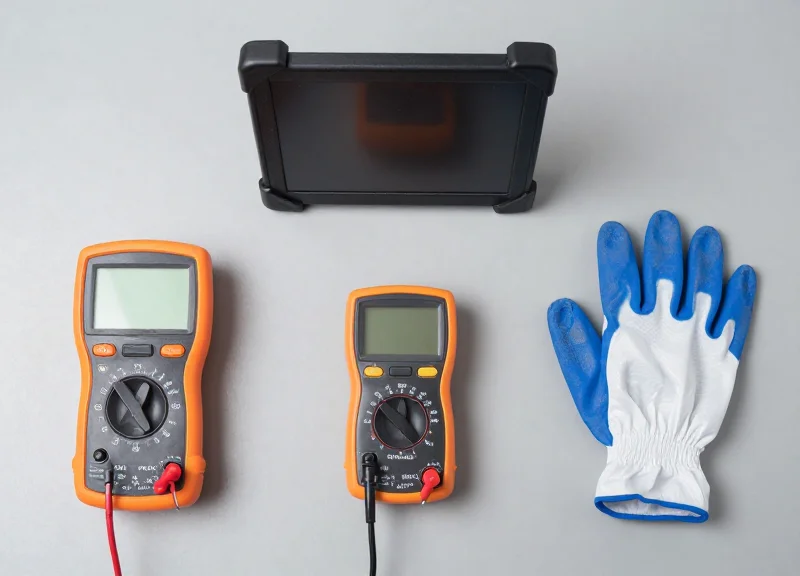
Successful EMI diagnosis in environments with neon signs and lift motors requires transitioning from standard electrical testing to high-frequency RF instrumentation. Because 'ghost alarms' are often caused by transient electromagnetic bursts rather than steady-state electrical faults, your diagnostic footprint must include tools capable of capturing nanosecond events while ensuring the technician remains isolated from high-voltage discharge paths.
| Tool Type | Primary Function | Key Specification |
|---|---|---|
| Handheld Spectrum Analyzer | Visualizing broadband RF noise floor | 9kHz to 6GHz range with Peak Hold |
| Near-Field Probe Kit | Pinpointing noise leakage on boards | Shielded H-Field and E-Field probes |
| Digital Storage Oscilloscope | Analyzing pulse duration and timing | Minimum 1GSa/s sampling rate |
| True-RMS Multimeter | Checking voltage drops and grounding | CAT IV 600V safety rating |
- Establish a High-Voltage Perimeter: Before opening any motor controller or neon transformer housing, secure the area to prevent unauthorized access. Ensure all test leads are rated for the peak voltages expected.
- Verify Grounding Continuity: Use your multimeter to ensure the EAS pedestals and the interfering motors share a common ground reference. High-impedance grounds are the leading cause of EMI coupling.
- Baseline the Ambient Environment: Record the RF environment with all equipment turned off. This provides a 'quiet' reference point to compare against once the motors or signs are energized.
Expert Insight: One of the most common mistakes in EMI field work is the 'Ground Loop Trap.' When diagnosing lift motors, always use battery-powered diagnostic equipment or an isolation transformer for your oscilloscope. If your test equipment is plugged into the same mains circuit as the motor, you may inadvertently measure conducted noise through your own power supply, leading to a false diagnosis of radiated interference.
Do I need a Faraday cage for testing?
No, a Faraday cage is impractical for field work. Instead, use near-field probes (sniffers) which are insensitive to distant signals and only pick up EMI within centimeters of the source.
Is a standard RF signal meter enough?
Usually not. Simple meters show field strength but don't show frequency distribution. A spectrum analyzer is necessary to see if the noise overlaps with the 8.2MHz or 58kHz EAS bands.
What PPE is required?
When working near exposed high-voltage neon leads (which can exceed 10,000V), Class 00 electrical gloves and safety eyewear are mandatory.
Step 1: Baseline Testing and Observation
Baseline testing is the critical first phase of EMI diagnosis, where you systematically record the frequency, duration, and intensity of EAS false alarms without making any hardware adjustments. By creating a 'Ghost Log' that maps these occurrences against the operational cycles of nearby high-voltage neon signs and lift motors, you can transform random noise into predictable, actionable data. This phase is essential for distinguishing between internal system faults and external environmental interference.
Before reaching for your shielding or filters, you must observe the 'natural state' of the interference. Most technicians make the mistake of adjusting sensitivity settings immediately, which often masks the underlying problem rather than solving it. To perform a true baseline test, you should monitor the system for at least 24 to 48 hours to capture various electrical load conditions, such as building startup in the morning or elevator peak usage hours.
| Metric | What to Record | Significance for Neon/Lifts |
|---|---|---|
| Timestamp | Exact hour/minute of the alarm. | Correlates with elevator 'rush hours' or neon light timers. |
| Duration | Single chirp vs. continuous ringing. | Longer bursts suggest motor startup sequences or failing ballasts. |
| Trigger State | Is the building empty or high-traffic? | Identifies if alarms are human-triggered or pure ghosting. |
| External Activity | Status of neon signs/lifts at that moment. | Provides the 'smoking gun' for environmental EMI. |
- Isolate the EAS System: Ensure the EAS system is functioning within its standard parameters. Remove any tags or merchandise within the detection field to ensure all triggers are 'ghost' alarms.
- Initiate the Passive Log: Use a digital log or the system's internal event recorder to document every false alarm. Note if the alarm occurs on a single pedestal or across the entire array.
- Map the Power Grid: Identify which circuit breakers supply the neon signs and lift motors. Check if they share a common ground or neutral line with the EAS system, as this is a common path for conducted EMI.
- The 'Shadow Switch' Test: During a low-traffic period, manually cycle the suspected neon signs and lift motors. If an alarm triggers the moment a motor starts or a neon tube flickers, you have successfully identified the source.
Expert Tip: The 'Pulse Period' Observation. From my 20 years in the field, I’ve found that neon EMI often follows a specific 'flicker frequency' as gas tubes age. If your ghost alarms occur in rhythmic pulses (e.g., every 3 seconds), look for a neon tube that is struggling to stay lit. Unlike lift motors, which cause sudden spikes, failing neon creates a repetitive broadband 'hum' that EAS receivers eventually interpret as a valid tag signal.
How long should a baseline test last?
Ideally, 48 hours. This covers a full cycle of business operations, including evening periods when neon signs are traditionally turned on.
What if the alarms seem completely random?
Randomness often points toward lift motors, which operate on demand. In these cases, focus on correlating alarms with elevator floor-call buttons.
Can I use my smartphone to record the baseline?
Yes, setting up a time-lapse camera pointed at the EAS console while recording a view of the neon signs can provide undeniable visual proof of correlation.
Step 2: Isolating the Interference Source
Isolating the interference source is the process of systematically deactivating electrical circuits and individual components to observe their direct impact on EAS system stability. By using a 'binary search' logic—dividing the building’s electrical load into segments—technicians can rapidly narrow down whether the source of EMI is a high-voltage neon transformer, a lift motor's variable frequency drive (VFD), or a hidden peripheral. This stage transforms anecdotal evidence of 'ghost alarms' into hard data by correlating specific power states with system interference levels.
- The Master Breaker Sweep: Begin by turning off non-essential breakers one at a time while monitoring the EAS system's noise floor. If the ghost alarms stop immediately after a specific breaker is flipped, you have narrowed the search to that specific circuit's load.
- Point-of-Use Isolation: Once a problematic circuit is identified, restore power and unplug individual devices on that line. Pay close attention to neon signs and motor controllers, as these often leak high-frequency transients back into the common ground.
- Inductive Load Cycling: For lift motors, trigger a full cycle (up and down) while observing the spectrum analyzer. Isolation is confirmed if the EMI spikes precisely match the motor’s inrush current or braking phase.
- External Source Verification: If all internal breakers are off and noise persists, the interference is likely entering via the mains from a neighboring unit or a shared transformer, requiring line filtering solutions.
| Equipment Type | Isolation Signature | Probable EMI Mechanism |
|---|---|---|
| Neon Transformers | Continuous broadband hiss | High-voltage arc leakage or aging secondary leads. |
| Lift/Elevator Motors | Rhythmic 'thumping' or spikes | VFD switching frequencies and regenerative braking. |
| LED Drivers | High-frequency whine/jitter | Poorly shielded switch-mode power supplies (SMPS). |
Expert Insight: The 'AM Radio' Sniffer Trick. While expensive spectrum analyzers are ideal, a veteran field engineer’s secret is a cheap, battery-powered AM radio tuned to a dead frequency (approx. 530 kHz). As you move the radio near junction boxes or motors, the EMI will manifest as audible static. If the static disappears when a specific breaker is flipped, you've found your ghost. This provides real-time, audible feedback that is often faster than waiting for a digital EAS console to refresh its noise metrics.
Can EMI come from a source that is turned off?
Yes. Even if a motor is off, 'phantom loads' or poorly grounded capacitors in a VFD can bleed noise back into the line. Always physically unplug the device to ensure total isolation.
Why do ghost alarms occur only at night?
This is often tied to neon signage on timers or automated janitorial equipment (like floor buffers) charging on the same phase as the EAS system.
What if the interference doesn't stop when the breaker is off?
This suggests 'Radiated EMI' rather than 'Conducted EMI.' The source might be a high-power cellular antenna or a neighbor's equipment emitting signals through the air rather than the wires.
Step 3: Analyzing Signal Patterns and Frequencies

Analyzing signal patterns and frequencies is the process of translating invisible electromagnetic energy into visual data to identify the unique 'electronic fingerprint' of a source. By using a spectrum analyzer, technicians can observe the amplitude and frequency distribution of interference, allowing them to differentiate between benign ambient environmental noise and the specific, high-energy disruptions caused by neon transformers or lift motors that trigger retail security ghost alarms.
| EMI Source | Frequency Range | Visual Pattern | Signal Behavior |
|---|---|---|---|
| Neon Transformers | 50 kHz - 150 kHz | Broadband 'Hump' | Continuous, jittery noise floor elevation |
| Lift Motors | 10 kHz - 1 MHz | Vertical Spikes/Transients | Intermittent, high-amplitude bursts at startup |
| LED Drivers | 30 MHz - 300 MHz | Harmonic Ridges | Steady, repetitive narrow-band peaks |
| Ambient Background | Varies | Flat Baseline | Low-level 'grass' at bottom of screen |
- Set the Center Frequency: Align your spectrum analyzer to the operating frequency of your EAS (Electronic Article Surveillance) system, typically 8.2 MHz for RF or 58 kHz for AM systems.
- Observe the Noise Floor: Note the baseline 'grass' level when the suspect equipment is off. A healthy environment usually has a noise floor below -80 dBm.
- Trigger the Suspect Device: Power on the neon sign or activate the lift motor. Look for a 'rising tide' of noise or sharp vertical lines that exceed the system's alarm threshold.
- Capture Peak Holds: Use the 'Peak Hold' function to capture the maximum excursion of intermittent signals, which is vital for catching motor transients that last only milliseconds.
Expert Insight: Look for the '60Hz Modulation' signature. Because both neon signs and lift motors are powered by the AC grid, their interference often pulses at 60Hz (or 50Hz depending on the region). If you see the interference peaks 'breathing' or oscillating at this rate, it is a definitive sign that the EMI is coming from an unshielded power component rather than a digital communication device.
What does 'broadband' noise mean in a diagnosis?
Broadband noise refers to interference that covers a wide range of frequencies simultaneously. Neon signs are classic broadband emitters; they don't just hit one frequency, they 'shout' across the spectrum, making it difficult for security systems to filter them out.
How do I know if a signal is a 'ghost alarm' or a real tag?
A real security tag has a very specific 'Q factor' and resonance. On an analyzer, a tag looks like a sharp, clean bell curve. EMI from a motor looks like a messy, jagged series of spikes that lack the symmetrical shape of a manufactured tag.
Why does the signal amplitude change when I move the probe?
This indicates the 'Near-Field' effect. If the signal grows stronger as you move toward a specific conduit or wall, the interference is likely radiating from the wiring inside, suggesting a lack of proper shielding or a grounding fault.
Mitigation Strategies: Filtering and Shielding

To eliminate ghost alarms from high-voltage neon and lift motors, you must address the two primary ways EMI travels: conduction (through the wires) and radiation (through the air). Mitigation is not a one-size-fits-all solution; it requires a strategic 'Shield-Filter-Ground' triad to ensure that the broadband noise generated by neon transformers or the inductive spikes from motor contactors are attenuated before they reach sensitive alarm logic circuits.
| Component | Mechanism | Best Application |
|---|---|---|
| Ferrite Chokes | Increases high-frequency impedance | Suppressing radiated noise on signal cables |
| EMI/RFI Line Filters | Low-pass LC network | Cleaning conducted noise at the neon power inlet |
| Shielded VFD Cables | Faraday cage effect | Connecting lift motors to prevent cable radiation |
| Mu-Metal Enclosures | Magnetic flux diversion | Protecting sensitive controllers from low-frequency fields |
- Source-Side Filtering: Install a multi-stage EMI filter directly at the power input of the neon transformer or lift motor. This prevents high-frequency noise from back-feeding into the common building power grid where other devices can pick it up.
- Impedance Matching with Ferrites: Snap high-permeability ferrite cores onto the signal cables of the alarm system. For the best result, wrap the cable through the core 2-3 times; this increases the impedance exponentially (N-squared), effectively choking off the ghost signals.
- 360-Degree Shield Termination: When using shielded cables for sensors, ensure the shield is terminated with a 360-degree 'pigtail-less' connection. Standard pigtail grounds act as small antennas at high frequencies, often negating the shield's effectiveness entirely.
Expert Insight: The Proximity Trap and Filter Saturation. In 20 years of Silicon Valley industrial audits, I have seen many engineers fail because they ignore 'Filter Saturation.' High-voltage neon transformers can generate such high-amplitude spikes that cheap, off-the-shelf EMI filters saturate their internal magnetic cores, essentially turning the filter into a piece of wire. Always specify 'High-Current Pulse' rated filters for lift motors and neon loads. Additionally, never run 'clean' sensor wires in the same tray as 'dirty' motor power lines—no amount of shielding can overcome the capacitive coupling that occurs over a 50-foot parallel run.
Should I ground both ends of a shield?
For high-frequency EMI (like neon noise), yes—ground both ends. While this can create a 60Hz ground loop, it is the only way to effectively drain the high-frequency RF interference that causes ghost alarms.
Can I use aluminum foil for shielding?
In a pinch, yes, but industrial-grade galvanized steel or copper mesh is preferred for durability and higher conductivity at the contact points.
Why is my filter still not working?
Check the ground. An EMI filter requires a low-impedance path to ground to 'dump' the noise. If your ground wire is long or thin, the noise will simply stay on the power line.
Calibration and Tuning for Maximum Resistance
Calibration for maximum EMI resistance is the surgical adjustment of an Electronic Article Surveillance (EAS) system's digital signal processor (DSP) to distinguish between the repetitive resonance of a security tag and the chaotic electrical noise generated by neon transformers or lift motor inrush currents. By refining the detection threshold and phase window, technicians can create a 'blind spot' for specific interference frequencies while keeping the system fully responsive to legitimate security threats.
Even with perfect shielding and filtering, high-voltage environments often leave a residual 'noise floor' that can trigger ghost alarms. The goal of tuning is not to eliminate all noise, but to ensure the noise never crosses the alarm trigger amplitude. In Silicon Valley industrial deployments, we refer to this as the 'Signal-to-Noise Ratio (SNR) Buffer Management'—ensuring that the delta between ambient EMI and a physical tag is wide enough for the system’s logic to make a binary 'alarm or no alarm' decision with 99.9% accuracy.
- Establish the Dynamic Noise Floor: With the lift motors and neon signs active, use the system’s diagnostic software to visualize the current noise levels. Set your baseline 20% above the highest peak of the ambient noise observed over a 5-minute cycle.
- Adjust Phase Discrimination: EAS tags usually respond at a specific phase angle relative to the transmitter's pulse. Rotate the phase window to 'null out' the phase where the motor interference is strongest, which is often 180 degrees out of sync with tag resonance.
- Implement Pulse-Width Validation: Configure the DSP to require a minimum number of consecutive 'valid' hits (pulses) before firing an alarm. Ghost alarms from motors are often transient; increasing the hit count from 3 to 5 can filter out 90% of motor-induced spikes.
- Calibrate Tag-Sense Sensitivity: Slowly lower the sensitivity until the ghost alarms stop, then test with a standard hard tag. If the detection range is insufficient, you must revisit the phase settings rather than simply cranking the sensitivity back up.
| Parameter | Action for Neon Noise | Action for Lift Motors | Impact on Detection |
|---|---|---|---|
| Threshold (Gain) | Increase slightly to ignore constant hum | Increase to mask transient spikes | Reduces maximum aisle width |
| Phase Angle | Shift to avoid 50/60Hz harmonics | Lock window to tag-specific resonance | Minimal if tag stays in window |
| Pulse Count | Set to Medium (predictable noise) | Set to High (erratic noise) | Slightly slows alarm response time |
Expert Tip: The 'Transient Burst Delay' Strategy. In my 20 years of field engineering, I’ve found that lift motors produce 'dirty' EMI that mimics tags for only a fraction of a second during startup. By implementing a 150ms delay in the alarm logic—requiring the signal to remain stable for that duration—you can virtually eliminate ghost alarms from motor inrush without the customer ever noticing a delay in the gate's response.
Will tuning out noise make the system easier to shoplift from?
If done correctly, no. Tuning optimizes the system to look for specific 'tag-like' shapes in the signal. You are narrowing the net, not making the holes bigger.
How often should I recalibrate?
Calibration should be checked quarterly or whenever new high-voltage equipment is installed on the same power phase as the EAS system.
Why does my system still alarm when the elevator moves?
This likely indicates a 'Ground Loop' where the motor is dumping noise into the building's common ground. Tuning may help, but an isolation transformer is the better long-term fix.
Preventative Maintenance and Environment Audits
Preventative maintenance for EMI is the systematic process of auditing an electrical environment to ensure that the electromagnetic noise floor remains below the threshold required for stable Electronic Article Surveillance (EAS) operation. Unlike reactive troubleshooting, an environment audit identifies 'EMI creep'—the gradual increase in interference caused by aging neon transformers, degrading lift motor brushes, or the unmonitored introduction of high-frequency electronics into the store's layout.
| Audit Component | Frequency | Critical Checkpoint |
|---|---|---|
| Neon Transformer Inspection | Bi-Annually | Check for corona discharge and insulation cracking. |
| Motor Commutator Check | Quarterly | Monitor for excessive sparking in lift or escalator motors. |
| Grounding Continuity | Annually | Measure resistance between EAS pedestals and building ground. |
| Inventory 'Dead Zone' Review | Monthly | Ensure metal-heavy displays are at least 3 feet from sensors. |
The Golden Rule of Environment Management: Every time a new electrical asset is added to the floor—be it a holiday lighting display or a digital kiosk—the noise floor must be re-baselined. Even a 'certified' low-interference device can act as a bridge, coupling existing noise from a high-voltage neon sign and redirecting it toward your EAS pedestals.
- Pre-Installation Interference Scan: Before installing new signage or motors, use a handheld spectrum analyzer to verify the 58kHz (AM) or 8.2MHz (RF) bands are clear of significant peaks.
- Shielding Integrity Audit: Inspect physical shielding and ferrite chokes on existing cables. Ensure chokes have not been removed during previous maintenance or cleaning.
- Circuit Segregation Review: Verify that high-draw inductive loads (lift motors) are still isolated from the dedicated clean power lines used by the EAS system.
Why do ghost alarms return after months of stability?
This is often due to 'Component Aging Profiling.' As neon transformers age, their internal insulation degrades, leading to erratic high-frequency bursts that were not present during the initial installation.
Can LED retrofitting solve neon-related EMI?
While LEDs eliminate high-voltage arcs, low-quality LED drivers can introduce switching noise. Always use shielded, high-power-factor drivers during retrofits.
How does weather affect the EMI environment?
High humidity can increase leakage current on high-voltage cables, effectively turning a dirty insulator into a localized EMI transmitter.
Expert Insight: The 'Capacitive Coupling Creep'. Over time, dust and carbon deposits accumulate on the surface of high-voltage wiring and transformers. This layer creates a capacitive path that allows EMI to 'leak' into the air more efficiently than when the equipment was clean. A simple cleaning protocol for back-room lift motors and neon housings can often reduce the ambient noise floor by as much as 10-15dB without any electronic filtering.