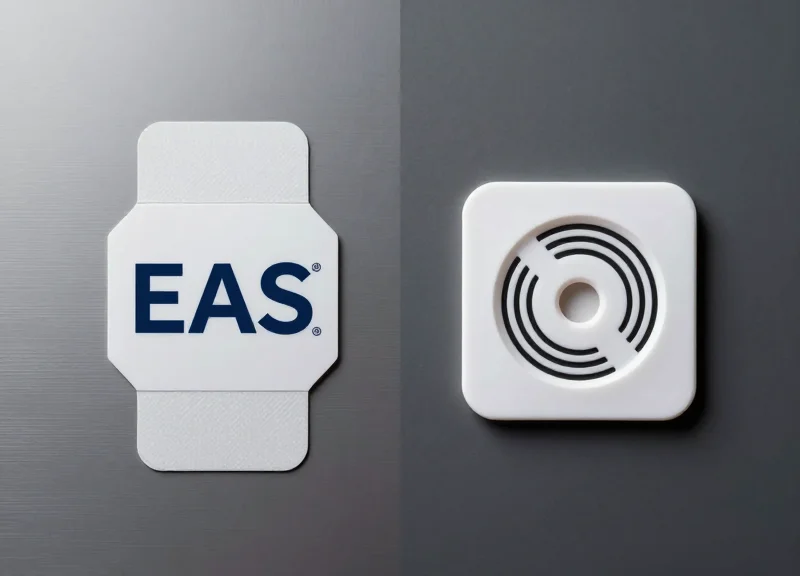

In the high-stakes world of retail loss prevention, professional shoplifting syndicates are increasingly using illegal interference devices, commonly known as jammers, to bypass EAS and RFID security gates. These devices emit signals designed to drown out tag responses, rendering traditional security systems invisible. At DragonGuardGroup, we understand that staying ahead of these sophisticated threats requires a deep technical understanding of signal patterns. This guide provides a comprehensive breakdown of how to distinguish between environmental noise and malicious interference, ensuring your real-time alert systems provide the protection your inventory deserves.
Understanding the Physics of EAS and RFID Interference

Electronic Article Surveillance (EAS) and Radio Frequency Identification (RFID) rely on the fundamental principles of electromagnetic resonance and backscatter modulation. Interference occurs when an external source emits energy at the same resonant frequency—typically 58 kHz for Acousto-Magnetic (AM) systems, 8.2 MHz for Radio Frequency (RF) systems, or 860-960 MHz for UHF RFID—effectively 'blinding' the receiver. By elevating the ambient noise floor or introducing phase-shifted signals, illegal jammers prevent the system from distinguishing a legitimate tag's response from background electromagnetic interference (EMI).
| System Type | Operating Frequency | Modulation/Physics | Typical Interference Method |
|---|---|---|---|
| AM (Acousto-Magnetic) | 58 kHz | Magnetostrictive Resonance | Pulse-jamming or magnetic shielding |
| RF (Radio Frequency) | 8.2 MHz | LC Tank Circuit Resonance | Frequency Sweeping or Gaussian Noise |
| UHF RFID | 860 - 960 MHz | Backscatter Coupling | Narrowband Carrier Injection (CW) |
To identify illegal interference, one must understand the 'Signal-to-Noise Ratio' (SNR) threshold of a standard retail environment. In a clean environment, an EAS pedestal expects a specific decay envelope after a pulse is transmitted. A jammer disrupts this by either providing a constant high-power signal that saturates the Analog-to-Digital Converter (ADC) or by emitting a 'comb' of frequencies that mimics multiple tags, causing a buffer overflow in the signal processor. Expert Tip: Modern illegal jammers often use 'Smart Jamming'—they don't stay on constantly but pulse in sync with the pedestal's interrogation window, making them invisible to legacy spectrum analyzers but detectable through high-speed temporal analysis.
What is the 'Blind Spot Delta' in retail security?
The Blind Spot Delta refers to the specific decibel range where an intentional jamming signal is strong enough to mask a tag but low enough to avoid triggering standard 'high noise' environment alerts.
Can passive shielding be considered interference?
While not an active signal, passive shielding (like foil-lined bags) creates a 'Faraday Cage' effect, which prevents electromagnetic waves from reaching the tag, essentially creating a localized zone of zero-signal interference.
How do digital signal processors (DSP) distinguish between noise and jammers?
DSPs look for statistical anomalies; natural EMI is usually stochastic (random), whereas illegal jammers often exhibit periodic patterns or specific spectral peaks that do not align with common household or industrial machinery.
The Mechanics of Illegal Jamming Devices
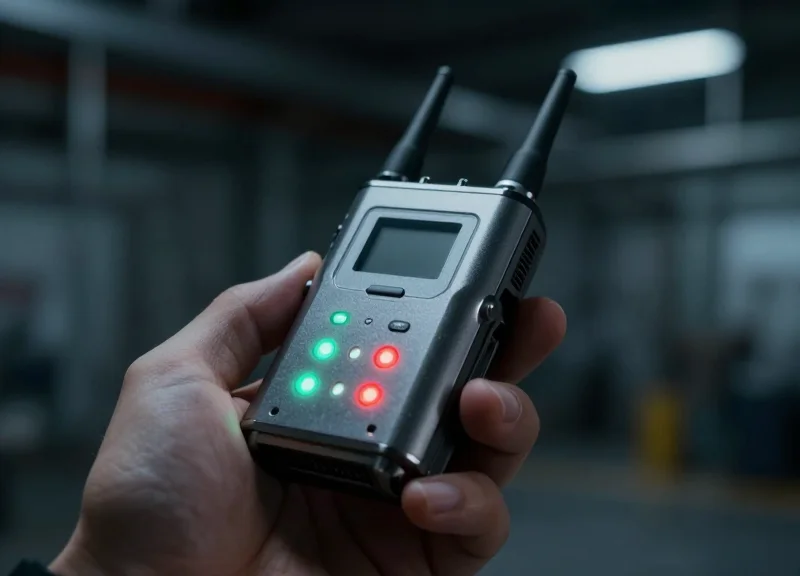
At its core, an illegal jamming device is a radio frequency (RF) transmitter designed to disrupt legitimate communication by intentionally decreasing the Signal-to-Noise Ratio (SNR) of a target receiver. In a retail environment, these devices—often disguised as 'booster bags' or handheld 'zappers'—flood the frequency bands used by Electronic Article Surveillance (EAS) and RFID systems with 'white noise' or modulated interference. When the power level of the jammer's noise exceeds the power level of the EAS tag’s response signal at the receiver's antenna, the system becomes 'blinded,' allowing tagged merchandise to pass through the exit undetected.
| Jamming Method | Technical Execution | Impact on Retail Security |
|---|---|---|
| Barrage Jamming | Broadcasting high-power noise across a wide frequency spectrum simultaneously. | Overwhelms multiple systems at once (e.g., Wi-Fi, EAS, and Bluetooth). |
| Spot Jamming | Concentrating all output power onto a single, specific frequency. | Extremely effective at disabling a specific RFID band with low power consumption. |
| Sweep Jamming | Rapidly cycling a narrow-band signal across a range of frequencies. | Difficult to detect for legacy sensors that look for constant noise signatures. |
Expert Insight: The most sophisticated illegal jammers today utilize 'Reactive Jamming.' Unlike constant noise generators, these devices remain silent until they detect an interrogation pulse from a store's EAS pedestal. They then fire a synchronized micro-burst of interference that cancels out the tag's response. This 'surgical' approach makes them nearly invisible to basic spectrum analyzers that are calibrated to look for sustained noise floors.
- Interrogation Pulse Detection: The jamming device monitors the environment for the specific 'wake-up' signal sent by the EAS or RFID reader.
- Signal Overpowering (The Capture Effect): The jammer emits a signal at the same frequency but with significantly higher amplitude, exploiting the 'capture effect' where the receiver locks onto the strongest signal present.
- Information Masking: The legitimate data packet from the security tag is buried under the jammer's noise, preventing the receiver's processor from decoding the 'alarm' trigger.
- Creation of the Communication Void: A localized 'dead zone' is established around the shoplifter, typically extending 1-3 meters, effectively cloaking any active tags within that radius.
Can these devices be detected without specialized hardware?
Rarely. Because many modern jammers use pulsed or swept waveforms, they do not trigger standard 'high noise' threshold alarms on older EAS systems. Dedicated Signal Intelligence (SIGINT) sensors are required for reliable detection.
Why are portable jammers so effective against fixed store pedestals?
This is due to the 'Inverse Square Law.' Because the jammer is physically closer to the security tag than the store's pedestal, the jammer requires very little power to overwhelm the tag's signal at the point of origin.
Identifying Signature Patterns of Malicious Signals

Identifying malicious signal signatures involves isolating non-stochastic RF energy that deviates from the expected operational parameters of EAS (Electronic Article Surveillance) or RFID systems. Unlike environmental interference, which is typically random or tied to specific machinery cycles, malicious jamming exhibits deterministic characteristics—specifically high spectral power density and consistent temporal patterns. By utilizing digital signal processing (DSP) to analyze the 'Entropy Gap,' security systems can distinguish between a flickering LED driver and a sophisticated portable jammer attempting to mask a tag signal.
| Signal Type | Waveform Characteristic | Duty Cycle | Behavioral Indicator |
|---|---|---|---|
| Continuous Wave (CW) | Constant Amplitude | 100% | Locks the receiver front-end; zero noise floor fluctuation. |
| Pulsed Malicious | Rectangular Pulse | 10% - 50% | Rhythmic repetition designed to mimic EAS burst patterns. |
| Broadband Noise | High Floor Rise | Variable | Masks multiple frequencies simultaneously; low spectral entropy. |
| Ambient/EMI | Stochastic/Jagged | < 5% | Random spikes tied to electrical transients or Wi-Fi bursts. |
A critical differentiator in modern signal identification is Duty Cycle Analysis. Intentional jammers, particularly those used in retail theft, must maintain a high duty cycle to ensure the security gate is 'blinded' during the exact moment a shoplifter passes through. While standard RFID readers pulse at specific intervals (e.g., 50Hz to 60Hz), a malicious device often produces a saturated signal that persists significantly longer than the standard 1.6ms burst window. If the detected energy persists beyond the 2ms threshold with a consistent amplitude, it is statistically likely to be an intentional interference event.
def detect_malicious_burst(signal_data, threshold_db, max_pulse_duration_ms):
    # Identify segments above power threshold
    bursts = [s for s in signal_data if s.power > threshold_db]

    for burst in bursts:
        if burst.duration > max_pulse_duration_ms:
            # Potential CW Jamming detected
            trigger_alert(severity='HIGH', type='CONTINUOUS_WAVE')
        elif burst.is_periodic(interval=0.02):
            # Pulsed jammer mimicking 50Hz EAS frequency
            trigger_alert(severity='CRITICAL', type='PULSED_JAMMER')
How do you distinguish a jammer from a faulty ballast?
A jammer maintains a precise frequency lock or a intentional sweeping pattern, whereas a faulty ballast produces 'dirty' power with significant harmonic distortion and jitter that doesn't follow a rhythmic pulse protocol.
Why is the 'Entropy Gap' important for identification?
Natural noise is highly disordered (high entropy). Malicious signals, being synthesized by a circuit, possess high order (low entropy). Measuring the randomness of the signal's phase noise can reveal an artificial origin even if the power levels are low.
Can 'Jammer-Sensing' tags help in identification?
Yes, some advanced tags now include passive 'wake-up' circuits that only trigger when a specific jamming frequency is detected, providing a secondary verification layer beyond the main antenna's DSP.
Expert Tip: Look for the Jitter Signature. While low-cost jammers are effective, they often lack high-quality oscillators. This results in 'Frequency Drift' or 'Jitter.' By monitoring the stability of the interference carrier frequency over a 500ms window, you can identify the unique thermal signature of the jamming device's hardware, allowing you to create a 'fingerprint' for that specific device even if the intruder leaves and returns later.
Dynamic Thresholding: Filtering Environmental EMI
Dynamic thresholding is an advanced signal processing method that automatically adjusts a receiver's detection sensitivity in response to changes in the ambient noise floor. Unlike static systems that trigger alerts at a fixed decibel level, dynamic thresholding uses real-time statistical analysis to filter out background Electromagnetic Interference (EMI)—such as the transient pulses from elevator motors, neon sign ballasts, and power line surges—ensuring that real-time alerts are reserved strictly for malicious jamming signatures.
| Feature | Static Thresholding | Dynamic Thresholding |
|---|---|---|
| Trigger Point | Fixed dB level (Manual set) | Variable (Algorithmic adjustment) |
| False Positives | High (Triggered by EMI spikes) | Low (Filters environmental noise) |
| Detection Sensitivity | Fixed; often lowered to avoid noise | Maintains high sensitivity relative to floor |
| Environment Adaptation | None; requires manual recalibration | Autonomous adaptation to 24/7 noise cycles |
To effectively isolate a threat from the chaos of a modern retail or industrial environment, the system must perform a multi-stage validation process. This prevents 'alarm fatigue' by ensuring security personnel only react to signals that exhibit the specific characteristics of illegal interference discussed in previous sections.
- Baseline Ambient Noise Floor Calculation: The system continuously samples the RF environment during 'quiet' periods to establish a statistical mean of the background energy across specific frequency bands.
- Sliding Window Variance Analysis: By using a moving time window, the algorithm distinguishes between short-lived transients (like a light switch spark) and sustained interference energy characteristic of a jammer.
- Frequency-Domain Feature Extraction: The system applies a Fast Fourier Transform (FFT) to identify if the noise is broadband (EMI) or narrowband/chirped (Malicious), adjusting the threshold mask accordingly.
- Recursive Least Squares (RLS) Filtering: Adaptive filters are applied to 'subtract' known repetitive noise patterns—like the 60Hz hum of a power transformer—from the incoming signal stream.
Expert Insight: The 'Hidden' Impact of LED Driver Noise. Many engineers overlook the fact that modern LED lighting arrays use high-frequency switching drivers that can generate significant EMI in the 8.2MHz (EAS) and 13.56MHz (RFID) bands. A truly sophisticated system uses Time-Frequency Masking. By identifying the specific harmonic intervals of the LED driver's pulse-width modulation (PWM), the system can effectively 'blind' itself to those specific micro-intervals while remaining fully alert to jamming signals occurring in the gaps between the LED pulses.
Can an elevator motor really trigger a security alert?
Yes. Large inductive loads like elevator motors create wide-spectrum electromagnetic 'bursts' during startup and braking. Without dynamic thresholding, these bursts often exceed static sensitivity limits, causing frequent false positives.
Will filtering EMI make the system slower to react?
No. Modern DSPs (Digital Signal Processors) perform these calculations in microseconds, allowing the system to filter noise and trigger a specialized alert for a jammer in less than 100 milliseconds.
Does the system need to be retrained for different store layouts?
Ideally, the system should be self-learning. It maps the 'EM profile' of its specific location over the first 48 hours of operation, identifying recurring environmental triggers and automating the filter parameters.
Implementing Real-Time Special Alert Logic

Implementing real-time special alert logic involves the seamless integration of edge-side signal detection with cloud-based or local push notification services. The primary objective is to transform a detected 'interference event' into a 'silent alarm' that reaches Loss Prevention (LP) personnel in under three seconds. This requires a robust conditional workflow that evaluates signal confidence levels, duration, and historical store traffic patterns to ensure that notifications are both actionable and accurate, minimizing the risk of false positives that lead to alert fatigue.
- Signal Confidence Evaluation: Before an alert is triggered, the system runs a weighted scoring algorithm (Signal Confidence Score). It combines the signal’s Signal-to-Noise Ratio (SNR) with the duration of the interference (e.g., >500ms) to ensure it is a malicious jammer rather than momentary environmental noise.
- Event Encapsulation: The system packages the event into a JSON payload containing the pedestal ID, time-stamp, signal type (e.g., Pulsed vs. Continuous), and a link to the nearest CCTV camera snapshot.
- Asynchronous Notification Routing: The payload is sent via a secure WebSocket or MQTT protocol to a central server. This server pushes the alert to mobile applications via Firebase Cloud Messaging (FCM) or Apple Push Notification service (APNs) for immediate LP response.
| Alert Tier | Signal Duration | Action Taken | Notification Type |
|---|---|---|---|
| Tier 1: Suspicious | 200ms - 500ms | Log event; Flag for review | Silent Dashboard Update |
| Tier 2: Probable Jamming | 500ms - 2s | Trigger mobile push to LP | Vibration/Silent Notification |
| Tier 3: Critical Interference | > 2s | Full alert + Video lock-on | High-Priority Mobile Alert |
{
  "alert_id": "INT-9982",
  "device_id": "PEDESTAL_NORTH_04",
  "alert_level": "CRITICAL",
  "signal_type": "BROADBAND_JAMMER",
  "confidence_score": 0.94,
  "timestamp": "2023-10-27T14:22:01Z",
  "cctv_link": "https://security.store.com/live/cam04"
}
Expert Insight: The 'Three-Second Rule' for Mobile Response. In Silicon Valley retail tech deployments, we found that the efficacy of an interference alert drops by 60% if the latency from detection to device vibration exceeds 3 seconds. To achieve this, avoid heavy REST API polling; instead, utilize a dedicated MQTT broker for edge-to-mobile communication. This ensures that the LP officer receives the alert while the suspect is still physically within the detection zone, rather than after they have reached the parking lot.
How do you prevent 'Alert Fatigue' among staff?
We implement 'Alert Cooling.' If multiple interference signals are detected within 10 seconds (e.g., from a single powerful device), the system aggregates them into a single incident report rather than sending 10 individual notifications.
Can these alerts be integrated with third-party VMS?
Yes. Most modern systems use Webhooks to trigger a 'Bookmark' or 'Event Tag' in Video Management Systems like Milestone or Genetec, allowing LP to instantly review the video footage associated with the alert.
Is it possible to have different alerts for different times of day?
Absolutely. Logic should be time-aware. During store opening/closing hours, the threshold for a 'Tier 3' alert may be lowered as environmental noise typically decreases.
The Role of Digital Signal Processing (DSP) in Modern EAS

Digital Signal Processing (DSP) is the technology that enables Electronic Article Surveillance (EAS) systems to move beyond simple threshold-based detection to complex pattern recognition. By utilizing high-speed chipsets (such as ARM Cortex or specialized FPGAs), modern EAS systems sample incoming electromagnetic waves hundreds of thousands of times per second. This process converts analog signal fluctuations into discrete binary data, allowing the system to perform mathematical operations—like Fast Fourier Transform (FFT) and cross-correlation—to verify the unique 'resonance signature' of a security tag while simultaneously identifying the high-energy noise characteristic of illegal jamming devices.
| Feature | Legacy Analog EAS | Modern DSP-Driven EAS |
|---|---|---|
| Detection Logic | Amplitude-based (Simple volume) | Frequency Domain Analysis (Pattern match) |
| Interference Handling | False alarms from neon/power lines | Digital filtering & noise cancellation |
| Jammer Detection | System goes 'blind' or stays silent | Identifies 'Jamming signature' in real-time |
| Processing Latency | Near zero (but inaccurate) | 5ms to 15ms (High accuracy) |
In the context of illegal interference, the DSP’s primary job is to maintain the 'Signal-to-Noise Ratio' (SNR). When a malicious jammer floods the environment, a standard receiver is overwhelmed. However, a DSP-enabled system identifies that the noise floor has risen abnormally across specific bands. It then switches its internal logic from 'Listen for Tag' mode to 'Alert for Interference' mode in less than 50 milliseconds, ensuring that the security breach is flagged before the perpetrator can exit the premises.
- Analog-to-Digital Conversion (ADC): The raw electromagnetic signal from the antenna is sampled at high frequencies to create a high-fidelity digital representation of the storefront environment.
- Digital Filtering & Decimation: Unwanted frequencies (like 50/60Hz power hum) are mathematically stripped away using Finite Impulse Response (FIR) filters.
- Feature Extraction: The system identifies specific 'features' such as pulse width, decay rates, and phase shifts to confirm if the signal is a tag or a malicious pulse.
- Threshold Verification & Alerting: If the extracted features match an interference profile rather than a tag profile, the DSP triggers a specific 'Interference Alert' interrupt to the main processor.
Expert Insight: The 'Ghost Signal' Protocol. A unique advantage of top-tier DSP implementations is the ability to use 'Predictive Noise Shaping.' By analyzing the environment's baseline noise for several hours, the DSP creates a dynamic 'quiet map.' When an illegal jammer is activated, it doesn't just create noise; it disrupts this map. Advanced systems can detect the absence of expected background noise patterns—a phenomenon called 'shadowing'—which often reveals sophisticated jammers that attempt to hide their presence by mimicking environmental EMI.
Multi-Frequency Scanning and Jammer Immunity
Multi-frequency scanning is a strategic defensive architecture that utilizes diverse spectral bands—rather than a single fixed frequency—to ensure Electronic Article Surveillance (EAS) and security sensors remain operational even when targeted by malicious jamming devices. By spreading signal transmission across a wider bandwidth or hopping between channels, these systems mitigate the impact of narrow-band interference, effectively 'outrunning' the jammer's ability to saturate a specific frequency and maintaining a high Signal-to-Interference-Plus-Noise Ratio (SINR).
| Feature | Standard Single-Band System | Agile Multi-Frequency System |
|---|---|---|
| Jammer Vulnerability | High: Single-point failure if the target frequency is saturated. | Low: Immunity through spectral redundancy and agility. |
| Signal Integrity | Easily compromised by environmental EMI or cheap jammers. | Maintains integrity by shifting to 'clean' channels instantly. |
| Detection Range | Can be severely reduced during active interference. | Consistent range due to optimized frequency selection. |
| Operational Logic | Fixed Frequency (e.g., 58kHz or 8.2MHz). | Frequency Hopping Spread Spectrum (FHSS) or Dual-Band. |
The core of jammer immunity lies in Frequency Hopping Spread Spectrum (FHSS). Unlike static systems that are sitting ducks for a tuned noise generator, FHSS systems switch carrier frequencies according to a pseudo-random sequence known only to the transmitter and receiver. This creates a moving target. If a jammer attempts to block a specific narrow-band frequency, the system has already moved to a new channel by the time the interference is detected. This 'dwell time'—the duration a signal stays on one frequency—is often measured in milliseconds, making it computationally expensive and physically difficult for illegal jammers to track and intercept.
- Continuous Spectral Environment Analysis: The system monitors the noise floor across multiple bands (e.g., 58kHz, 66kHz, and 82kHz) to identify which channels are currently clear of both environmental EMI and malicious signals.
- Dynamic Channel Allocation: Upon detecting a spike in noise on the primary channel, the system triggers an immediate switch to a secondary or tertiary frequency to maintain tag-detection capability.
- Pseudo-Random Synchronization: The receiver and transmitter use a pre-shared cryptographic key to determine the next hop, ensuring the jammer cannot predict the next frequency in the sequence.
- Integrity Verification (Parity Checking): The system cross-references data packets received across multiple frequencies to ensure the signal is a legitimate tag response and not a 'replay attack' generated by a jammer.
Expert Insight: The 'Swiss Cheese' Defense Strategy. In 20 years of Silicon Valley hardware security, the most effective systems I have seen don't just 'fight' the jammer; they treat interference as a data point. By using multi-frequency scanning, you create a 'Swiss Cheese' model where the jammer's noise has holes. Because no portable jammer can saturate the entire relevant spectrum without massive power requirements (which would trigger thermal shutdowns or immediate RF detection), there are always 'holes' in the interference. A multi-frequency system is designed specifically to find and exploit those holes in real-time.
Integrating ESL and RFID for Secondary Verification

Secondary verification through ESL and RFID integration involves the automated cross-referencing of Electronic Article Surveillance (EAS) signal disruptions with item-level data. When a potential jammer or illegal interference signal is detected, the system does not simply trigger a generic alarm; instead, it queries the RFID inventory management system and ESL status pings to determine if a specific product removal event is occurring simultaneously. This multi-layered approach transforms a 'signal anomaly' into an 'actionable security event' by providing the missing context: what exactly is being taken while the system is under interference.
| Data Source | Role in Security | Interference Response |
|---|---|---|
| ESL (Electronic Shelf Label) | Point-of-Presence Verification | Detects localized 2.4GHz or Sub-GHz jamming affecting heartbeat signals. |
| RFID (Item-Level Tagging) | Inventory State Confirmation | Identifies specific missing SKUs passing through 'blinded' zones. |
| Special Alert Logic | Correlation Engine | Triggers high-priority alerts only when signal loss and item removal overlap. |
- Signal Anomaly Trigger: The DSP identifies a pattern consistent with a wide-band jammer or illegal pulse noise intended to mask EAS pedestals.
- RFID Buffer Analysis: The system instantly scans the RFID gate buffer for 'Missing-in-Transit' tags—items that were in proximity but are no longer being read despite no point-of-sale transaction.
- ESL Heartbeat Check: The access point attempts a rapid ping to ESLs in the high-value zone. Failure to receive an ACK (Acknowledgement) confirms localized RF suppression.
- Unified Alert Dispatch: An alert is sent to security personnel containing the specific shelf location and the exact items suspected of being stolen.
Expert Insight: The 'Shadow Heartbeat' Technique. Most security systems treat ESL and RFID as separate silos. However, a 'Shadow Heartbeat' configuration uses the ESL's own communication frequency as a canary in the coal mine. Because ESLs communicate frequently to update prices or status, any sudden drop in 'check-in' rates from a specific shelf cluster acts as a localized sensor for interference. By mapping RFID tag IDs to these ESL clusters, we can create a spatial security map that detects exactly where a jammer is being deployed, even if the primary EAS gates are completely overwhelmed.
Does this integration require additional hardware?
Usually no. Most modern RFID readers and ESL Access Points (APs) can share data via a centralized IoT gateway or cloud-based management software using standard APIs.
How does this reduce false alarms?
It filters out environmental EMI. If a motor or neon sign causes signal noise but all ESLs are checking in and no RFID tags are moving, the system classifies it as environmental noise rather than an intentional attack.
Can this detect 'Shielded Bags' (Booster Bags)?
Yes. While a booster bag blocks RFID signals, the sudden 'disappearance' of a tag from the shelf-side reader without a corresponding POS exit triggers a discrepancy alert when cross-referenced with the ESL's presence sensor.
Regulatory Compliance and Ethical Signal Management
Regulatory compliance in signal management refers to the strict adherence to electromagnetic spectrum laws—such as FCC Part 15 in the US and ETSI/CE standards in Europe—which permit the passive detection and analysis of interference while strictly prohibiting the unauthorized transmission of signals that disrupt licensed communications. To remain compliant, security systems must distinguish between 'passive monitoring,' which is generally legal for security purposes, and 'active jamming,' which is a federal offense in most jurisdictions. Ethical signal management extends this by ensuring that signal data collection does not infringe upon individual privacy or violate data protection mandates like GDPR.
| Region | Regulatory Body | Primary Standard | Legal Focus |
|---|---|---|---|
| United States | FCC | Part 15 & Section 333 | Prohibits willful interference; governs low-power unlicensed devices. |
| European Union | ETSI / EC | RED (2014/53/EU) | Ensures efficient use of radio spectrum and avoids harmful interference. |
| United Kingdom | Ofcom | Wireless Telegraphy Act | Regulates the use of radio frequencies and penalizes illicit jammer usage. |
| Global | ITU | Radio Regulations | International treaty governing the use of the radio-frequency spectrum. |
Expert Insight: The Digital Forensics Compliance Loop. A common pitfall for security teams is focusing solely on signal neutralization. In a professional Silicon Valley deployment, true compliance is achieved through 'Forensic Logging.' By capturing the spectral signature and timestamp of an illegal interference event without demodulating private data, you create a legally defensible audit trail. This transforms your security system from a reactive tool into a compliance-first evidentiary platform that can be shared with law enforcement without violating wiretapping or privacy laws.
Is it legal to detect and alert on signal jammers?
Yes, passive detection and alerting are legal in nearly all jurisdictions. It is considered a protective measure for your own frequency environment, provided you do not transmit a counter-signal to disable the offender's device.
Does signal analysis violate privacy laws like GDPR?
Signal analysis is compliant as long as the system analyzes the physical properties of the wave (frequency, amplitude, duration) rather than capturing or decrypting the data packets contained within those waves.
What are the penalties for non-compliant signal management?
Violations of FCC or CE standards can lead to massive fines (often exceeding $10,000 per day), seizure of equipment, and in some cases, criminal prosecution for endangering public safety communications.
- Verify Equipment Certification: Ensure all signal detection hardware carries valid FCC ID or CE markings to guarantee it operates within power and frequency limits.
- Implement Data Anonymization: Configure your alert system to log 'Signal Events' rather than 'User Data.' Avoid recording MAC addresses or SSID identifiers unless they are directly linked to a detected threat.
- Define Response Protocols: Establish clear SOPs (Standard Operating Procedures) that focus on manual intervention by personnel rather than automated electronic countermeasures.
- Regular Spectral Audits: Perform quarterly audits of your RF environment to ensure your own infrastructure isn't drifting into prohibited bands or creating unintentional noise for neighbors.