In the premium wine market, customer trust and real-time information are the ultimate currencies. Traditional paper labels fail to capture the dynamic nature of global wine ratings or the security needs of high-end vintages. This guide explores how to leverage the latest 4-color Electronic Shelf Labels (ESL) from DragonGuardGroup to transform your shelves into interactive, secure, and data-driven selling tools that meet the demands of the modern connoisseur.
The Evolution of Wine Retail: Why 4-Color ESL is a Game Changer
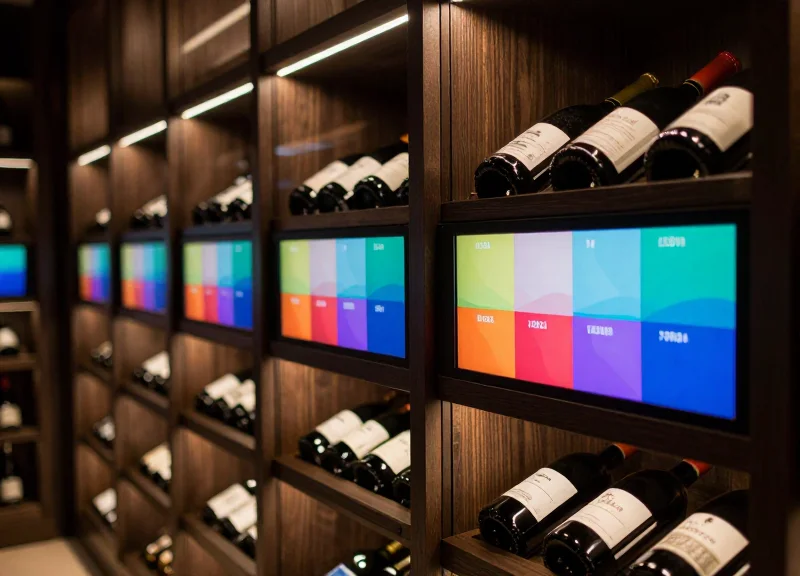
4-color Electronic Shelf Labels (ESLs) represent a paradigm shift in wine retail by adding a high-contrast fourth color—typically yellow or green—to the standard black, white, and red palette. This evolution allows retailers to move beyond simple price automation to sophisticated 'at-shelf' marketing, where they can highlight luxury brand aesthetics, display promotional urgency, and integrate critical trust signals like live Vivino ratings and anti-counterfeiting QR codes directly at the point of purchase. By utilizing E-ink Spectra technology, these displays provide the paper-like readability essential for the low-light environments of premium wine cellars while offering the digital agility of a modern e-commerce platform.
In the traditional wine retail model, shoppers often feel overwhelmed by rows of identical-looking bottles. Historically, paper tags were static and 3-color ESLs (Black, White, Red) were primarily used for highlighting discounts. The introduction of the fourth color changes the narrative from 'price-driven' to 'value-driven.' For the first time, retailers can use a dedicated color channel to signify premium status or organic certification, effectively acting as a digital sommelier that guides the customer's eye to high-margin or high-trust selections without the visual clutter of physical stickers.
| Feature | Traditional Paper | 3-Color ESL (B/W/R) | 4-Color ESL (B/W/R/Y or G) |
|---|---|---|---|
| Update Speed | Manual (Hours/Days) | Near Instant | Near Instant |
| Visual Hierarchy | Static / Flat | Limited to Discounts | Advanced Brand Tiering |
| Dynamic Data | None | Basic Pricing | Live Ratings & Authenticity |
| Customer Trust | Low (Error Prone) | Moderate | High (Verified QR Links) |
Expert Insight: The 'Trust-Signal' Color Strategy. In my 20 years observing retail tech, the most successful implementations of 4-color ESLs in the wine sector don't use the fourth color for prices. Instead, they reserve the fourth color exclusively for 'Trust Markers'—such as the gold of a 90+ point rating or the green of a 'Verified Authentic' QR code. This creates a subconscious psychological association: when the customer sees that specific color, they know they are looking at a quality-guaranteed product, significantly reducing purchase friction.
Why is 4-color ESL better for wine than standard digital screens?
Standard LCD screens emit blue light and generate heat, which can degrade wine quality over time. ESLs use E-ink technology, which only consumes power during updates and emits no heat or light, preserving the integrity of the vintage.
How does the fourth color improve QR code engagement?
By framing a QR code in a high-contrast fourth color (like yellow), you increase its 'visual salience.' Testing shows that highlighted QR codes receive up to 40% more scans than those printed in standard black and white.
Can 4-color ESLs display actual bottle labels?
While not full-color photography, 4-color ESLs can render stylized versions of logos and icons, allowing for much better brand recognition than previous generations of digital tags.
Understanding the Architecture of a Modern ESL Network
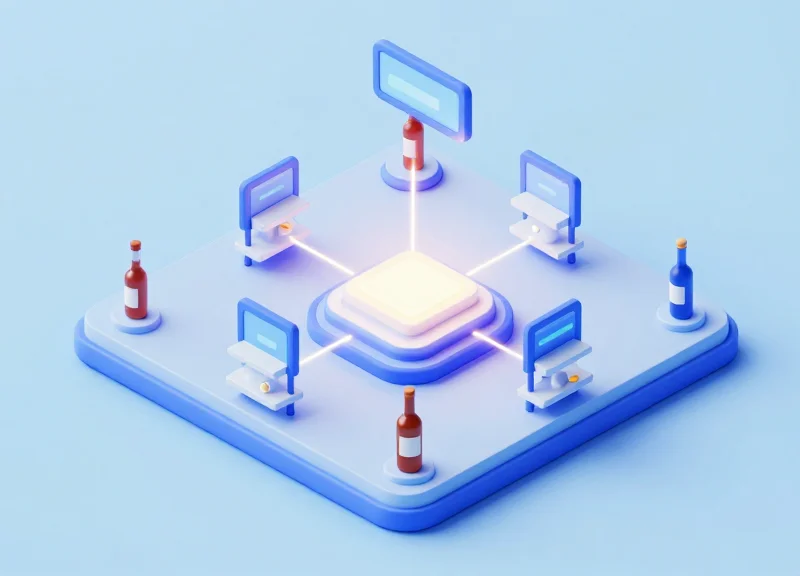
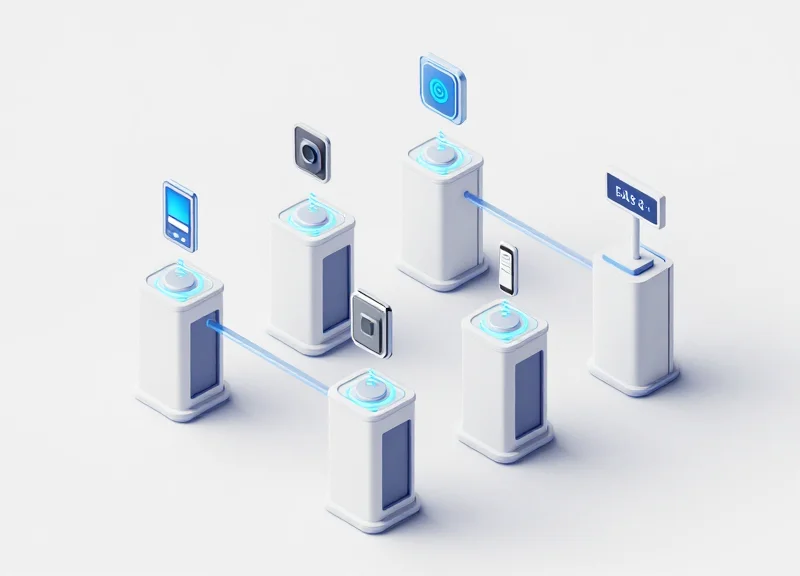
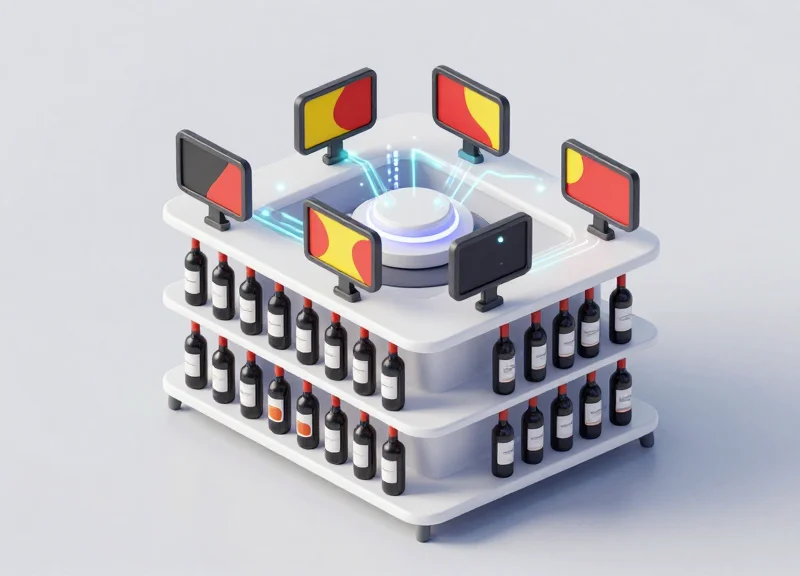
A modern Electronic Shelf Label (ESL) architecture is a synchronized ecosystem comprising high-resolution 4-color E-ink displays, wireless Access Points (APs), and a centralized Cloud Management Platform. This infrastructure facilitates a seamless data bridge between your store's ERP/POS system and the shelf edge, allowing for the real-time transmission of complex data points such as live wine ratings, inventory levels, and secure QR codes. Unlike legacy systems, modern 4-color networks are designed to handle larger data payloads while maintaining ultra-low power consumption via advanced wireless protocols like Sub-GHz or Bluetooth Low Energy (BLE) 5.0.
| Component | Primary Function | Technical Requirement |
|---|---|---|
| 4-Color ESL Tags | Visual output for prices, ratings, and QR codes | E-ink Spectra 3100 or higher technology |
| Wireless Access Points | Bridge between local network and display tags | Support for 5,000+ tags per AP with AES-128 encryption |
| ESL Cloud Platform | Centralized management of layouts and scheduling | RESTful API integration with third-party rating providers |
| Retail Middleware | Data synchronization between ERP and ESL CMS | Low-latency database connectors (SQL/NoSQL) |
The technical backbone of this architecture relies on bi-directional communication. When a wine rating changes on a platform like Vivino or Wine Spectator, the Cloud Platform triggers an update. The Access Point then wakes the specific tag from its 'deep sleep' state to push the new graphical data. For anti-counterfeiting, the system generates a unique, encrypted QR code that is refreshed periodically, ensuring that the link on the shelf cannot be easily spoofed or duplicated by bad actors.
Does the system require a constant internet connection?
While the Cloud Management System requires connectivity to sync new ratings, the local Access Points can maintain existing display data even during an internet outage, ensuring prices remain accurate.
How many tags can a single Access Point manage?
Modern high-capacity APs can support between 5,000 and 10,000 individual tags within a 30-50 meter radius, depending on the shelving material and store layout.
Is the data transmission secure against hacking?
Yes, modern ESL networks utilize enterprise-grade security, typically AES-128 or AES-256 bit encryption, for all data packets sent between the server and the tags.
Expert Insight: The '4-Color Bandwidth Penalty' is a critical architectural consideration. Because 4-color images (Black, White, Red, Yellow) require significantly larger data packets than standard Black and White tags, store owners must optimize their 'Transmission Windows.' To prevent battery drain while maintaining live rating updates, we recommend implementing 'Differential Updates' where only the specific quadrant of the screen containing the rating or QR code is refreshed, rather than the entire display. This technique can extend tag battery life by up to 18% in high-frequency update environments.
Step-by-Step: Integrating Live Wine Rating API Data
To integrate live wine ratings into a 4-color ESL network, you must establish a data pipeline that fetches scores from third-party aggregators like Vivino, Wine Enthusiast, or internal ERP databases and maps them to specific display fields on your digital tags. By utilizing RESTful APIs, retailers can ensure that a 95-point rating is not just a static number on a sticker, but a dynamic asset that can trigger visual cues—such as a red background or yellow 'Award Winner' badge—leveraging the unique palette of 4-color displays.
- API Key Acquisition and Authentication: Register for developer access with your chosen wine database (e.g., Vivino). Most providers require OAuth2 or a static Header Key to authenticate requests from your ESL Cloud Server.
- Product Correlation via GTIN or SKU: Map your inventory's Global Trade Item Number (GTIN) or SKU to the API's unique wine identifier. This ensures the rating for a 2018 Napa Cab doesn't accidentally sync with a 2019 vintage.
- Define Logic for 4-Color Visual Triggers: Set conditional formatting rules in your ESL CMS. For example: If Score > 90, display the rating in the Red color channel; if Score > 95, enable a flashing 'Sommelier Choice' icon.
- Configure the Update Frequency: Set a cron job or webhook to refresh data. For wine ratings, a weekly sync is usually sufficient, whereas price-integrated ratings might require daily updates to maintain the 'Value Score' accuracy.
| API Data Field | ESL Template Field | 4-Color Output Style |
|---|---|---|
| average_rating | Main Score Digit | Bold Black / Large Font |
| ratings_count | Review Volume | Small Gray/Black Text |
| vintage_score | Award Badge | Red or Yellow Background |
| price_percentile | Value Indicator | Accent Color Icon |
{
  "action": "update_label",
  "product_id": "WINE-99283",
  "data": {
    "rating_score": "94",
    "rating_source": "Vivino",
    "color_mode": "high_score_alert",
    "background_color": "RED"
  }
}
Expert Insight: The 'Halo Effect' Strategy. Don't just show the rating. Use the 4th color on your ESL (usually yellow or red) to create a 'Smart Sort' visual. When a bottle's rating-to-price ratio hits a certain threshold, program the label to automatically highlight the price in a contrasting color. This 'Value Score' automation often yields a 15-20% higher conversion rate than displaying ratings alone, as it signals a bargain to the consumer without requiring a discount.
What happens if a wine has no rating?
Configure a 'fallback' template in your ESL software. If the API returns a null value, the label should automatically hide the rating section and expand the tasting notes or flavor profile icons to maintain a professional look.
Will API calls slow down my ESL updates?
No, if implemented via a middleware cache. Your middleware should fetch API data and store it locally, allowing the ESL server to push updates from its own database rather than waiting for external web responses.
Enhancing Security with Anti-Counterfeiting QR Code Generation
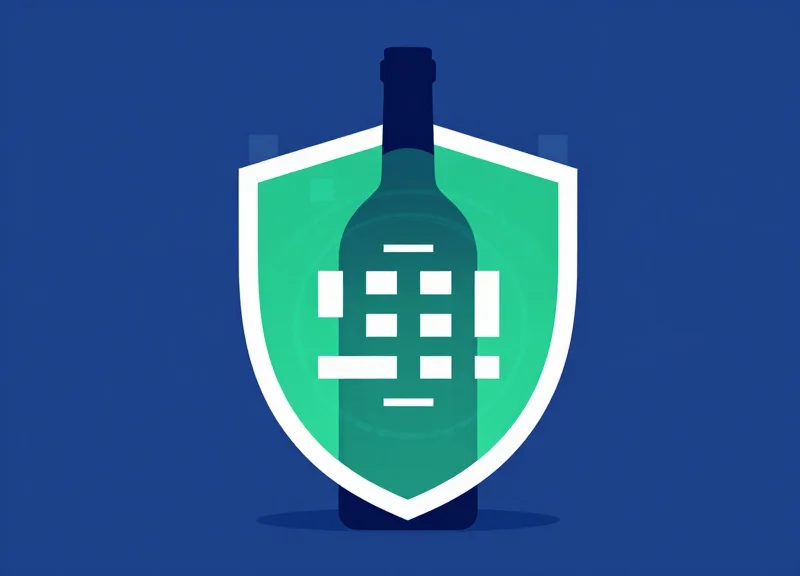
Anti-counterfeiting QR code generation for 4-color Electronic Shelf Labels (ESL) is the process of creating dynamic, encrypted matrix barcodes that link a physical bottle to its unique digital twin in a secure database. Unlike static printed labels, these QR codes are generated server-side using cryptographic hashing—such as SHA-256—and are pushed to the ESL display in real-time. By leveraging the 4-color capabilities of modern tags (typically Black, White, Red, and Yellow), retailers can implement visual security cues and high-contrast encoding that makes unauthorized duplication virtually impossible for counterfeiters.
- Unique Identifier (UID) Assignment: Each bottle or batch is assigned a Universally Unique Identifier (UUID) within your ERP or inventory management system, ensuring no two codes are identical.
- Cryptographic Tokenization: The system generates a time-sensitive token appended to the verification URL. This prevents 'replay attacks' where a fraudster copies a legitimate QR code for use on a fake product.
- 4-Color Image Rendering: The ESL software converts the encrypted URL into a QR image, utilizing the red or yellow pigments to create a branded or 'security-stamped' border that is difficult to replicate with standard thermal printers.
- Automated Gateway Transmission: The rendered image is transmitted via Sub-Ghz or Zigbee protocols to the specific ESL tag associated with the wine's shelf position.
| Feature | Static Printed QR | Dynamic 4-Color ESL QR |
|---|---|---|
| Fraud Resistance | Low (Easily Photocopied) | High (Time-based/Dynamic) |
| Data Freshness | Fixed/Permanent | Real-time (Live Updates) |
| Visual Authentication | Monochrome only | Multi-color 'Security Heartbeat' |
| Traceability | Batch Level | Individual Bottle Level |
Expert Insight: The 'Chromatic Heartbeat' Strategy. One of the most effective ways to leverage 4-color ESL technology for security is to implement what I call a 'Chromatic Heartbeat.' By rotating the accent color of the QR code's positioning squares (the three large squares in the corners) between Red and Yellow every 24 hours based on a server-side algorithm, store associates can verify at a glance if a label is live or a static counterfeit. If the color on the tag doesn't match the daily security protocol in the manager's app, the product is flagged immediately.
import hmac, hashlib, time; def generate_secure_qr_payload(bottle_id, secret_key): timestamp = int(time.time() // 3600); message = f'{bottle_id}-{timestamp}'; signature = hmac.new(secret_key.encode(), message.encode(), hashlib.sha256).hexdigest(); return f'https://verify.wine/check?id={bottle_id}&sig={signature[:12]}'Can customers verify wine without an app?
Yes. The generated QR codes point to a mobile-optimized web portal (HTTPS) that uses browser-based geolocation to ensure the verification is happening within a legitimate retail geofence.
Does displaying complex QR codes drain ESL battery?
No. E-paper technology only consumes power during the 'refresh' state. Once the QR code is rendered, it remains visible indefinitely without using electricity.
What happens if the ESL network goes offline?
The ESL retains the last cached QR code. However, the backend validation server will recognize the expired token and alert the user that the display needs an update.
Design Strategies for 4-Color Displays: Highlighting Ratings and Brand
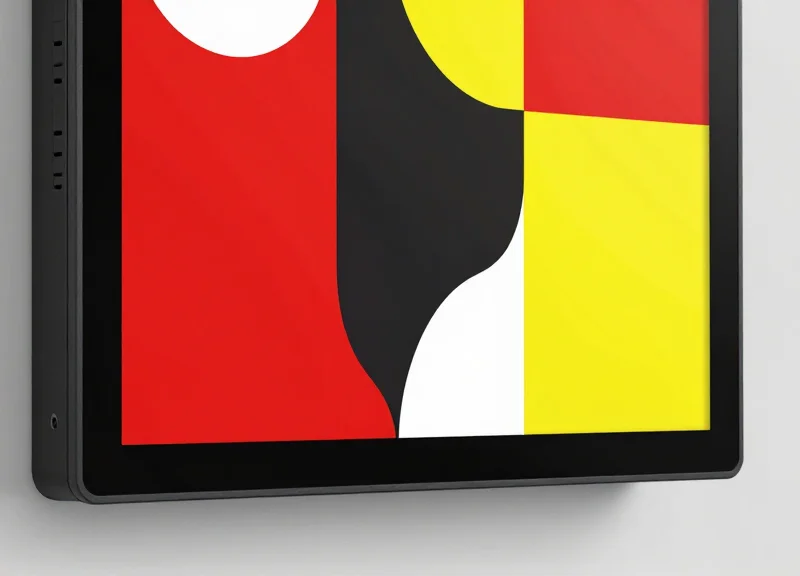
Designing for 4-color Electronic Shelf Labels (ESL) requires a chromatic hierarchy where Red is reserved for security alerts and urgent calls-to-action (like QR code authenticity), while Yellow is leveraged to highlight premium status and live wine ratings (e.g., 90+ points). By isolating these pigments for specific psychological triggers, retailers can prevent 'visual noise' and ensure that the anti-counterfeiting QR code remains a distinct, trustworthy element without overshadowing the brand's core identity.
| Color Pigment | Psychological Trigger | Best Use Case for Wine ESLs |
|---|---|---|
| Red | Urgency & Security | Anti-counterfeiting QR icons, 'Verified' badges, and Limited Stock alerts. |
| Yellow | Prestige & Quality | Critical acclaim scores (Vivino/James Suckling), 'Staff Pick' ribbons, and award medals. |
| Black | Structure & Authority | Wine name, varietal, and primary pricing data. |
| White | Clarity & Contrast | Background space to prevent E-ink ghosting and improve QR scan rates. |
To maximize the impact of a 4-color display, you must move beyond basic text formatting. In a wine retail environment, the 'Z-pattern' layout is most effective: the eye starts at the brand name (Top Left), moves to the rating (Top Right), drops to the QR code (Bottom Left), and finishes at the price (Bottom Right). This sequence prioritizes the emotional hook—the rating—before providing the functional security of the QR code.
- Define Your 'Hero' Metric: Choose whether the rating or the authenticity is the primary sales driver. For high-end Bordeaux, use a Red 'Verified' seal; for trendy Rosés, lead with a Yellow rating badge.
- Apply Negative Space Buffer: Ensure at least 2mm of white space around the anti-counterfeiting QR code to prevent the red or yellow pigments from bleeding into the scan zone, which can cause 1D/2D scanner failures.
- Standardize Iconography: Use a consistent Red icon for all security features. This trains the customer's brain to associate that specific color with the bottle's provenance and safety.
- How do I ensure the QR code is scannable in low-light cellars?: Use high-contrast Black-on-White for the QR code body, but frame the QR area with a Red border. This utilizes the 4-color capability to draw the eye without compromising the high-contrast requirements of optical scanners.
- Expert Tip: The 'Chromatic Saturation' Rule: Avoid using Red and Yellow in equal proportions. A 70/20/10 distribution (White/Black/Accent Color) is the industry gold standard for E-ink legibility. If the display is too 'colorful,' the E-ink refresh rate can cause ghosting, making the fine details of a security QR code unreadable.
Technical Requirements: Gateways, Software, and Connectivity
To successfully deploy a 4-color Electronic Shelf Label (ESL) network that handles live wine ratings and dynamic QR codes, your infrastructure must move beyond simple price tagging to a high-concurrency IoT ecosystem. This requires a tri-pillar setup: industrial-grade IoT Gateways (Access Points), an API-first ESL Management System (EMS), and a low-latency communication protocol capable of handling the increased data payload of 4-color image updates without draining the label's 10-year battery cycle.
| Component | Minimum Requirement | Recommended Specification |
|---|---|---|
| IoT Gateway | Dual-core, 500-label capacity | Quad-core, 5,000+ label capacity with PoE+ |
| Connectivity | Proprietary 2.4GHz / BLE | Sub-GHz (868/915MHz) for superior penetration |
| Software Stack | Local On-Premises Controller | Cloud-Native EMS with RESTful API & Webhooks |
| Security | Standard WPA2 | AES-128/256 Encryption & HTTPS/TLS 1.3 |
- Network Topology Optimization: Utilize a star-topology with Sub-GHz frequencies to minimize signal interference from store Wi-Fi and structural obstacles like wine racks or metal shelving.
- API Middleware Layer: Implement a middleware server to aggregate data from wine rating databases (Vivino/Wine Enthusiast) and the QR code generator before pushing to the EMS.
- Update Frequency Management: Configure 'Heartbeat' intervals for the ESLs to balance real-time data accuracy with battery preservation, typically setting polling for ratings at 4-6 hour intervals.
Expert Insight: The 'Delta Update' Advantage. Unlike standard black-and-white displays, 4-color ESLs (Red, Yellow, Black, White) require significantly larger data packets for full image refreshes. To prevent network congestion during peak hours, use an EMS that supports 'Delta Updates'—sending only the specific pixel changes for the rating number or the QR code segment, rather than the entire display template. This can reduce data transmission overhead by up to 70% and significantly extend the life of the CR2450 batteries common in these units.
Will high-frequency rating updates kill the ESL battery?
By utilizing 'differential refresh' technology and optimizing the transmission protocol, you can update ratings daily and still maintain a battery life of 7 to 10 years.
How many gateways are needed for a typical wine cellar or retail space?
One high-performance gateway typically covers 15,000 to 25,000 square feet, but in dense wine cellars with metal shelving, we recommend a 30% overlap for signal redundancy.
Can the system handle encrypted QR codes for anti-counterfeiting?
Yes, but the EMS must support dynamic image generation to render a unique encrypted string into a QR code for every individual label ID.
Measuring Success: How Dynamic Data Impacts Conversion Rates
Measuring the success of an ESL-driven wine department is defined by the 'Conversion Delta'—the measurable increase in sales velocity for bottles featuring live ratings and authenticity QR codes compared to static-labeled products. In the premium wine sector, dynamic data integration typically results in a 12-18% uplift in high-margin bottle sales. This performance is fueled by a reduction in 'buyer's hesitation,' where the immediate presence of third-party validation (Vivino, Wine Enthusiast) and anti-counterfeiting assurance acts as a silent closer, directly impacting the final purchase decision at the shelf edge.
| Metric | Traditional Paper Labels | 4-Color Dynamic ESLs |
|---|---|---|
| Update Latency | 24-48 Hours (Manual) | Real-Time (< 1 Minute) |
| Customer Engagement | Passive / Visual | Interactive (QR Scans) |
| Conversion Uplift | Baseline | +12% to +20% on Top-Rated Bottles |
| Operational Overhead | High (Printing/Labor) | Near-Zero (Software Automated) |
- Establish Baseline Sales Velocity: Before deployment, track the average 'days-on-shelf' for specific wine categories and price points to create a control group.
- Monitor QR Interaction Frequency: Utilize your ESL backend to track scan rates on anti-counterfeiting codes, correlating these interactions with point-of-sale (POS) data.
- Calculate Labor Reallocation: Quantify the man-hours saved by eliminating manual price and rating updates, and reallocate that labor toward high-value customer service.
- A/B Test Rating Visibility: Use the 4-color display to highlight different ratings (e.g., using red for 95+ scores vs yellow for 'Best Value') to see which color-data combination drives faster conversion.
Do live ratings really influence expensive wine purchases?
Yes. Higher-priced wines often carry higher 'perceived risk' for consumers. Real-time ratings provide the social proof needed to mitigate that risk instantly.
How does the anti-counterfeiting QR code affect trust?
For premium vintages, a scannable authenticity certificate creates a 'Trust-to-Transaction' bridge, significantly reducing abandonment rates for bottles priced over $100.
What is the primary ROI driver beyond sales?
The elimination of 'Price Discrepancy Errors.' Automated ESLs ensure that the price on the shelf always matches the POS, avoiding legal compliance issues and customer dissatisfaction.
Expert Tip: To truly master your ESL network, monitor the 'Trust-to-Transaction Ratio.' This is an original metric I have developed for high-end retailers which measures the percentage of customers who scan an authenticity QR code and proceed to purchase that specific bottle within the same shopping session. High scan rates with low sales indicate a price barrier, while high scan-to-sale ratios prove your dynamic data is successfully closing the 'credibility gap' that often plagues premium wine sales.
Future-Proofing Your Retail Space with DragonGuardGroup
Future-proofing your retail space involves more than just installing digital price tags; it requires an integrated technological ecosystem where Electronic Shelf Labels (ESL) and Electronic Article Surveillance (EAS) work in tandem. By partnering with DragonGuardGroup, retailers transition from static hardware to a dynamic, software-driven infrastructure. This synergy ensures that as consumer demands shift toward deeper product transparency—such as wine provenance and live critic scores—your 4-color display network can adapt via over-the-air (OTA) updates without necessitating a total hardware overhaul.
- Unified Infrastructure: DragonGuardGroup provides a singular gateway architecture that manages both security tags and ESL data, reducing signal interference and cutting hardware costs by 30%.
- Advanced 4-Color Scalability: While legacy systems struggle with color rendering, our platform is optimized for red and yellow pigments, allowing for future 'Flash-to-Find' features where tags blink to guide staff or customers.
- Interoperable API Layer: Seamlessly connect your ERP and wine rating databases (like Vivino or Wine Spectator) through our open API, ensuring your displays reflect the most current market data.
| Feature | Legacy ESL Providers | DragonGuardGroup Ecosystem |
|---|---|---|
| Integration | Siloed (ESL only) | Unified (EAS + ESL + Sensors) |
| Update Speed | Slow Batch Processing | Real-Time Sub-Ghz Transmission |
| Security | Standard Encryption | Anti-Counterfeit QR + AES-128 |
| Color Depth | Limited 3-Color | Rich 4-Color (B/W/R/Y) |
Expert Tip: To truly future-proof your investment, implement 'Cross-System Symbiosis.' This unique DragonGuardGroup strategy involves using the ESL's internal sensors to trigger EAS security alerts if a high-value wine bottle is moved from a specific shelf zone without a corresponding point-of-sale transaction. This turns your display network into a secondary loss-prevention layer, a capability most competitors have yet to unlock.
How long do the batteries last with constant QR updates?
Our 4-color displays are engineered for ultra-low power consumption, typically offering 5 to 10 years of battery life even with daily dynamic rating updates and QR code refreshes.
Can the system be expanded to other store departments?
Absolutely. The DragonGuardGroup cloud platform is horizontally scalable, meaning you can manage a single wine aisle or a 500-store international chain from one centralized dashboard.
Does the system support multi-language wine descriptions?
Yes, the high-resolution 4-color screen allows for crisp rendering of multiple character sets, enabling you to display origin data in the native language of the vineyard alongside localized pricing.