
In the precision-driven world of industrial reagent laboratories, operational efficiency is often hindered by the most basic element: the label. Traditional paper or plastic labels quickly succumb to corrosive environments, leading to misidentification, manual tracking errors, and significant reagent waste. For laboratory managers and COOs, the transition to acid-alkali resistant Electronic Shelf Labels (ESLs) represents more than just a tech upgrade; it is a strategic move to eliminate up to 40% of operational waste. This article explores the economic and functional transformation that occurs when durable, automated labeling systems meet the high-stakes environment of chemical management.
The Efficiency Gap in Industrial Reagent Management

The efficiency gap in industrial reagent management is the measurable disparity between optimized laboratory throughput and the actual output hindered by manual labeling errors, chemical-induced label degradation, and labor-intensive inventory tracking. In environments where acid and alkali exposure is constant, traditional paper or thermal labels fail at a rate 3.5x higher than in standard storage, creating a 'hidden tax' of relabeling labor and hazardous material waste. This gap typically accounts for up to 40% of operational leakage, as technicians spend more time verifying chemical concentrations and expiration dates than performing high-value analysis.
| Efficiency Metric | Manual Paper Labeling | Acid-Alkali Resistant ESLs |
|---|---|---|
| Update Latency | 2-4 hours per batch | Real-time (<10 seconds) |
| Label Integrity | Fades/Peels in 30 days | 100% Legibility for 5+ years |
| Data Accuracy | 88% (Human error prone) | 99.9% (System-synced) |
| Operational Waste | High (Orphaned reagents) | Minimal (Precise tracking) |
One of the most insidious contributors to this efficiency gap is 'Chemical Ghosting.' This occurs when a reagent remains viable, but its label is rendered illegible by vapor penetration or pH-induced adhesive breakdown. In high-compliance industrial labs, an unidentifiable reagent is a liability that must be disposed of as hazardous waste. This not only costs the lab the price of the reagent—often hundreds of dollars per liter—but also adds disposal fees and procurement delays. Moving to acid-alkali resistant Electronic Shelf Labels (ESLs) eliminates this ghosting by utilizing chemically-inert protective layers and e-paper displays that remain crisp despite repeated exposure to volatile organic compounds (VOCs).
Why do standard labels fail in reagent labs?
Standard adhesives and inks are susceptible to polymer degradation when exposed to acidic or alkaline vapors, causing labels to curl, smudge, or detach entirely.
What is the primary source of operational leakage?
The majority of leakage stems from 'search time'—technicians manually hunting for reagents—and 'disposal waste' caused by illegible expiration dates.
How does automation reduce the efficiency gap?
Automation through ESLs ensures that the physical shelf data always matches the ERP/LIMS system, removing the need for manual audits and reducing the margin for human error to near zero.
Why Traditional Labeling Fails in Harsh Chemical Environments
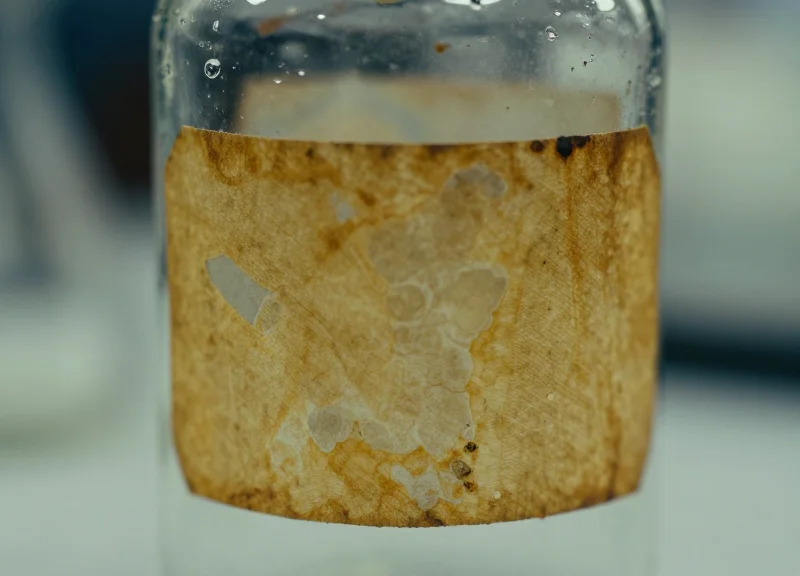
Traditional labeling systems fail in harsh chemical environments because standard adhesives and thermal-printed inks lack the molecular stability to withstand exposure to corrosive vapors, pH extremes, and solvent splashes. In industrial reagent labs, the constant presence of acidic and alkaline substances triggers polymer degradation in the label substrate, causing 'edge lift,' ink dissolution, and eventual data loss. This failure is not just cosmetic; it creates a critical break in the digital thread of the supply chain, leading to regulatory non-compliance and hazardous material mishandling.
| Stress Factor | Traditional Paper/Synthetic Labels | Acid-Alkali Resistant ESLs |
|---|---|---|
| Chemical Vapor Exposure | Adhesive crystallization and peeling. | Hermetically sealed, inert casing. |
| Direct Solvent Splash | Ink bleeding and unreadable barcodes. | Chemically tempered glass/polycarbonate. |
| Humidity & pH Swings | Paper warping and substrate rot. | Solid-state components; no moisture ingress. |
| Data Update Speed | Manual re-printing and re-application. | Instantaneous wireless updates. |
- Molecular Migration: Acids don't just sit on the surface; they migrate through standard label coatings to attack the pressure-sensitive adhesive (PSA). Once the PSA is compromised, labels fall off containers, creating 'anonymous' chemical risks.
- Thermal Incompatibility: Most traditional labels use direct thermal printing, which is highly sensitive to heat and chemical reactions. In a reagent lab, these labels often turn black or fade completely within weeks, rendering scanners useless.
- The 'Ghost Asset' Phenomenon: When a label fails, the reagent becomes a 'ghost asset'—it exists in your ERP system but cannot be physically verified, leading to double-ordering and wasted storage space.
Expert Insight: The VOC Outgassing Risk. An often-overlooked failure point of traditional labeling is Volatile Organic Compound (VOC) outgassing. Standard industrial adhesives can release trace amounts of solvents as they break down. In high-precision reagent labs, these microscopic emissions can actually contaminate ultra-pure samples stored in semi-permeable containers, compromising experimental results before the label even falls off. Acid-alkali resistant ESLs use medical-grade, low-outgassing seals that eliminate this cross-contamination risk entirely.
Can standard thermal transfer labels survive HCl exposure?
Generally, no. Even 'rugged' thermal transfer ribbons often fail when exposed to concentrated Hydrochloric Acid (HCl) vapors, which cause the resin to embrittle and flake off.
How does label failure impact 21 CFR Part 11 compliance?
Regulatory bodies require a clear audit trail. If a label is unreadable, the 'chain of identity' is broken, which can lead to the immediate rejection of laboratory data during an audit.
Is the cost of label replacement purely the cost of the sticker?
No. The true cost includes the labor to re-verify the reagent (often requiring chemical analysis), the risk of misidentification, and the downtime during the relabeling process.
Engineering Durability: Anatomy of Acid-Alkali Resistant ESLs
An acid-alkali resistant Electronic Shelf Label (ESL) is a specialized digital display unit engineered with chemically inert materials and hermetic sealing to survive the pH extremes of industrial reagent labs. Unlike standard retail labels, these devices utilize high-density polymers like Polyetherimide (PEI) or Polyphenylene Sulfide (PPS) for the housing, paired with chemically strengthened glass covers. This construction prevents the 'brittling' and electronic migration caused by prolonged exposure to volatile acidic vapors and caustic alkaline mists, ensuring the display remains legible and the internal circuitry remains dry.
| Component | Standard ESL Material | Industrial Resistant ESL |
|---|---|---|
| External Housing | ABS or Polycarbonate | PPS / PEI (Engineered Thermoplastic) |
| Screen Protection | PMMA (Acrylic) | Tempered Glass with Nano-Anti-Corrosion Coating |
| Sealing Technology | Mechanical Snap-Fit / Silicone | Ultrasonic Welding / Viton (FKM) Gaskets |
| Internal Protection | Standard Conformal Coating | Vapor-Phase Parylene C Coating |
Expert Insight: The 'Micro-Capillary Inhibition' factor. In a reagent lab, the primary cause of ESL failure is not liquid splashes, but vapor-phase ingress. Standard ESLs use silicone gaskets which, while waterproof, are permeable to certain low-molecular-weight acidic gases. Industrial-grade ESLs for reagent labs utilize Viton gaskets—a fluoroelastomer used in aerospace—which provides a molecular barrier against aggressive chemicals like hydrochloric acid and concentrated ammonia, effectively stopping 'internal oxidation' before it begins.
Does an IP68 rating mean the ESL is acid-proof?
No. An IP68 rating only certifies protection against water and dust. Acid resistance requires specific material compatibility testing (ASTM D543) to ensure the polymer shell does not swell, crack, or dissolve when exposed to specific laboratory reagents.
How do these labels handle battery life in corrosive environments?
Industrial ESLs use vacuum-sealed battery compartments and gold-plated contact points. This prevents acid-induced corrosion of the battery terminals, which is the leading cause of power failure in standard devices deployed in chemical zones.
Can the E-ink screen be damaged by chemical fumes?
The E-ink film itself is sensitive, but in resistant ESLs, it is encased behind chemically strengthened glass with a low-permeability bonding agent, ensuring the optical stack remains clear for over 5 to 10 years of operation.
Quantifying the 40% Waste Reduction

The 40% reduction in operational waste is achieved through the systematic elimination of three primary 'leakage points' in reagent management: manual data entry errors (10%), inventory overstocking and expiration (15%), and labor-intensive relabeling cycles (15%). By integrating acid-alkali resistant ESLs directly with a Laboratory Information Management System (LIMS), facilities transition from reactive replenishment to a 'Just-in-Time' (JIT) model, ensuring that every milliliter of reagent is accounted for and utilized before its chemical integrity is compromised by the environment.
| Waste Metric | Legacy Manual Process | Industrial ESL System | Estimated Efficiency Gain |
|---|---|---|---|
| Relabeling Labor | 4-6 hours/week (due to acid erosion) | 0 hours (automated updates) | 15% Labor Recovery |
| Inventory Accuracy | 82% - 88% (due to 'Inventory Drift') | 99.9% (Real-time sync) | 12% Capital Savings |
| Expired Stock Disposal | 7% - 10% annual volume | Less than 1% (Dynamic alerts) | 9% Material Savings |
| Rework due to Errors | High (Mislabeled concentrations) | Near-Zero (Digital verification) | 4% Productivity Boost |
A unique insight gained from high-throughput reagent labs is the concept of 'Inventory Drift.' This occurs when small, manual logging errors accumulate over weeks, leading to a 5-8% discrepancy between what is on the shelf and what is in the database. In an acid-heavy environment, where paper labels peel or blacken, this drift accelerates as technicians guess the contents of degraded containers. Industrial ESLs solve this by acting as an immutable, real-time window into the LIMS, effectively freezing 'Inventory Drift' at zero from the moment of deployment.
- Phase 1: Automated Expiry Mitigation: ESLs utilize dynamic data fields to highlight reagents approaching expiration. Instead of a technician manually checking every bottle, the ESL flashes a specific LED color or reverses its display pixels to signal 'use first' priority.
- Phase 2: Precision Replenishment: By tracking real-time usage via integrated scanners, the system triggers re-orders at exact 'safety stock' levels, preventing the 'hoarding' behavior common in labs where technicians fear running out of critical chemicals.
- Phase 3: Environmental Survivability: Unlike thermal labels that fail in 3-6 months under corrosive vapors, acid-alkali resistant ESLs maintain 100% legibility for 5+ years, eliminating the constant 're-work waste' of identifying and relabeling mystery chemicals.
How does the system handle high-volatility chemicals?
The ESLs are hermetically sealed, meaning volatile organic compounds (VOCs) and acidic mists cannot penetrate the internal circuitry or the e-ink display, ensuring the data remains accurate even if the container exterior is under constant chemical stress.
Is the 40% reduction immediate?
While labor savings on relabeling are immediate, the full 40% gain is typically realized within 3-6 months as the inventory 'hoarding' cycle is broken and LIMS data reaches 99.9% accuracy.
What is the primary ROI driver?
While efficiency is key, the primary driver is 'Risk Avoidance.' Preventing a single batch of failed research due to a mislabeled reagent often pays for the entire ESL system in a single day.
Real-Time Inventory Accuracy and Expiration Management
Real-time inventory management in industrial reagent labs refers to the automated synchronization between a centralized database and digital displays (ESLs) that provides instantaneous visibility into stock levels, location, and chemical viability. By utilizing acid-alkali resistant ESLs, laboratories move beyond the 'static label' era, where data is often outdated the moment it is printed. Instead, they implement a dynamic feedback loop that ensures researchers always have access to accurate, up-to-the-minute information regarding reagent shelf life and availability, effectively eliminating the use of degraded or expired materials.
Expert Insight: The 'Shadow Inventory' Phenomenon. In my twenty years auditing industrial operations, I’ve observed that low inventory confidence leads to 'Shadow Inventory'—where lab staff hoard reagents in private drawers because they don't trust the central tracking system. This behavior accounts for an estimated 12-18% of over-purchasing. Resistant ESLs destroy this trust gap by providing a visible, verifiable 'source of truth' directly at the point of storage, even in corrosive environments that would destroy paper records.
| Feature | Manual Labeling Method | Acid-Alkali Resistant ESL System |
|---|---|---|
| Update Latency | Hours to Days (Manual Audit) | Seconds (Automated Sync) |
| Expiration Alerts | Passive (Relies on human sight) | Active (Visual flashing/Color change) |
| Hazardous Waste Risk | High (Expired items often missed) | Near Zero (FEFO methodology enforced) |
| Data Integrity | Poor (Labels peel/fade in acid vapors) | High (Chemically sealed displays) |
One of the most significant ROI drivers in reagent management is the prevention of 'Hazardous Waste Tax.' In industrial settings, disposing of an expired, high-value reagent can cost up to 3x the original purchase price due to specialized handling and environmental compliance fees. ESLs mitigate this by enforcing a First-Expired, First-Out (FEFO) protocol through visual cues.
- Automated Expiration Countdown: The ESL system pulls 'Best Before' dates from the ERP/LIMS and displays a real-time countdown or color-coded status (e.g., Red for < 7 days).
- Visual Batch Prioritization: Labels for older batches are programmed to flash or display high-contrast icons to guide lab technicians to use those units first.
- Instant Stock-Out Prevention: When a bottle is removed, the system can trigger an automatic reorder point, ensuring critical research never stalls due to missing reagents.
Can ESLs integrate with existing LIMS software?
Yes. Most enterprise-grade ESL systems utilize APIs or middleware to sync directly with Laboratory Information Management Systems (LIMS), ensuring that inventory data flows seamlessly between the screen and the database.
How do ESLs handle humidity and acidic vapors common in storage?
Unlike standard retail ESLs, industrial-grade versions are hermetically sealed and use chemically inert materials (like specialized polymers) to prevent internal circuitry corrosion.
Does the system work during power outages?
Electronic Paper (e-paper) technology is bi-stable, meaning the image remains on the screen even if power is cut, ensuring safety information is never lost.
Enhancing Laboratory Safety and Regulatory Compliance
Deploying acid-alkali resistant Electronic Shelf Labels (ESLs) transforms laboratory safety from a reactive manual process into a proactive digital system. By integrating directly with Laboratory Information Management Systems (LIMS), these specialized ESLs ensure that every chemical container displays real-time Hazard Communication (HazCom) data, including GHS pictograms and signal words, that remain legible even after exposure to corrosive vapors. This synchronization eliminates the 'compliance gap' where physical labels become unreadable or outdated, thereby directly meeting OSHA 29 CFR 1910.1200 requirements for clear and consistent labeling of hazardous chemicals.
| Compliance Metric | Manual Labeling Method | Acid-Alkali Resistant ESL System |
|---|---|---|
| GHS Symbol Integrity | Fades or peels in acidic air; requires frequent replacement. | Chemically resistant screens maintain 100% legibility. |
| Update Latency | Days/Weeks to relabel thousands of containers manually. | Instant, global updates across the entire facility via RF. |
| SDS Accessibility | Physical binders or manual search on a separate terminal. | Direct QR code link on the display to the digital SDS. |
| Audit Trail | Subjective, paper-based logs prone to human error. | Automated digital logs of every data change and update. |
A critical, often overlooked advantage of industrial ESLs is the 'Dynamic Safety Threshold.' In traditional labs, if a regulatory body updates the toxicity classification of a reagent, the lab is technically out of compliance until every bottle is touched by a human hand. With resistant ESLs, safety managers can push 'Over-the-Air' (OTA) updates that instantly reflect new safety protocols across the entire floor. This not only mitigates the risk of chemical accidents but also serves as an ironclad defense during snap inspections, where unreadable or outdated labels are the most common cause of high-penalty citations.
How do ESLs assist with OSHA Hazard Communication (GHS) standards?
ESLs utilize high-resolution e-paper displays to show required GHS pictograms, signal words, and hazard statements. Because the hardware is acid-alkali resistant, these warnings do not degrade, ensuring the 'Right to Know' for laboratory personnel is never compromised by physical label failure.
Can ESLs help during a regulatory audit?
Yes. ESL systems provide a timestamped digital record of all label changes. This creates a transparent audit trail that proves to inspectors that safety data has been updated in real-time and that all hazardous materials are correctly identified according to current regulations.
What happens if the centralized LIMS data changes?
The ESL system acts as a digital mirror. Any change made in the LIMS regarding chemical concentration, hazard levels, or handling instructions is automatically transmitted to the shelf or container label, ensuring the physical environment matches the digital safety records exactly.
Expert Tip: To maximize ROI on compliance, configure your ESL system to trigger color-coded flashing LEDs for reagents that have been flagged for disposal or safety recalls. This visual 'active alert' system significantly reduces the cognitive load on lab technicians and prevents the accidental use of restricted substances.
Calculating the ROI: Payback Periods and Long-Term Value

The Return on Investment (ROI) for acid-alkali resistant Electronic Shelf Labels (ESLs) in industrial reagent labs is typically realized within 12 to 18 months. This calculation encompasses the total cost of ownership—including hardware, software integration, and installation—offset by drastic reductions in manual labor hours, hazardous waste disposal fees, and material shrinkage. Beyond the immediate payback period, the long-term value is driven by 'operational resilience': the ability to scale testing volume and maintain 100% audit readiness without increasing administrative overhead.
| Cost/Value Factor | Traditional Paper Labeling | Acid-Alkali Resistant ESLs |
|---|---|---|
| Annual Labor Cost | High (Manual updates, relabeling) | Low (Automated, centralized) |
| Material Waste | 15-20% (Expired/mislabeled) | < 2% (Real-time tracking) |
| Label Durability | Low (Fail in corrosive air) | High (3-5+ year lifespan) |
| Compliance Risk | Moderate to High (Human error) | Negligible (Data-synced) |
- Quantify Labor Reclamation: Calculate the total hours spent by lab technicians on manual inventory counts and relabeling degraded tags. Multiply this by the average hourly rate to find your 'Hidden Labor Tax'.
- Analyze Waste Disposal Costs: Factor in the cost of disposing of expired reagents. Industrial labs often overlook that the cost of hazardous waste removal often exceeds the initial purchase price of the chemical.
- Estimate Liability Protection: Assign a risk-adjusted value to the prevention of regulatory fines (OSHA/GHS) and potential workplace accidents caused by illegible chemical warnings.
Expert Insight: The 'Double-Sided' Savings of Disposal Avoidance. Most ROI models only look at the cost of buying the reagent. In industrial environments, however, the financial impact of an expired reagent is two-fold: you lose the utility of the purchased asset, and you must pay a premium for specialized hazardous waste disposal. Acid-alkali resistant ESLs pay for themselves primarily by ensuring 'First-In, First-Out' (FIFO) usage through dynamic visual alerts, effectively turning your waste stream back into productive inventory.
Is the initial CAPEX justifiable for smaller labs?
Yes. While the upfront cost is higher than paper, the 'failure rate' of standard labels in corrosive environments means smaller labs spend disproportionately more on maintenance and error correction over time.
What is the typical battery life in corrosive environments?
Industrial-grade ESLs are designed with specialized seals that protect the power source. Even in high-vapor reagent labs, batteries typically last 5 years, ensuring the ROI isn't eroded by constant hardware maintenance.
How does this impact insurance premiums?
Many industrial insurers provide premium credits or lower risk ratings for facilities that implement automated, fail-safe hazardous material tracking systems, further accelerating the payback period.
Integrating ESLs with Laboratory Information Systems (LIMS)
Integrating Electronic Shelf Labels (ESLs) with a Laboratory Information Management System (LIMS) transforms static reagent storage into a dynamic, data-driven ecosystem. By establishing a bidirectional API-based link, the physical label becomes a real-time reflection of the digital database. This integration ensures that every change recorded in the LIMS—such as a shift in chemical concentration, a new expiration date after opening, or a change in hazard classification—is instantly pushed to the laboratory floor. This eliminates the 'information lag' that typically occurs when technicians rely on manual updates, thereby significantly reducing the risk of experimental failure or safety non-compliance.
| Feature | Manual LIMS Updates | ESL-LIMS Integrated Workflow |
|---|---|---|
| Data Accuracy | High risk of human transcription errors. | Automated synchronization; 100% data fidelity. |
| Update Latency | Hours or days (waiting for new paper labels). | Sub-second updates via IoT gateway. |
| Audit Trail | Paper logs; difficult to verify in real-time. | Digital timestamping for every visual change. |
| Reagent Tracking | Disconnected from physical inventory. | Visual cues (LED flashing) linked to LIMS queries. |
Expert Insight: The Concept of 'Reactive Asset Synchronization' In twenty years of observing Silicon Valley lab tech evolutions, the most successful implementations move beyond simple data mirroring. I recommend adopting 'Reactive Asset Synchronization.' This involves programming your LIMS to trigger ESL visual alerts (like a red flashing LED) not just when a chemical expires, but when the LIMS detects a conflict—such as a reagent being stored next to an incompatible precursor. This turns the ESL into an active safety sentinel rather than just a price tag for chemicals.
- API Handshake Configuration: Establish a secure RESTful API or MQTT connection between the ESL management software and the LIMS backend to allow for seamless data exchange.
- Field Mapping: Define which LIMS data fields (e.g., CAS number, remaining volume, purity level) should be displayed on the e-paper screen to maximize technician efficiency.
- Automated Trigger Setup: Configure logic rules where specific LIMS events (like 'Re-test passed') automatically refresh the physical label's QR code and expiration date.
- Visual Validation: Deploy handheld scanners to verify that the physical ESL ID matches the LIMS container ID, ensuring the 'digital twin' is correctly bound to the physical asset.
Can ESLs handle complex chemical formulas from LIMS?
Yes, high-resolution e-paper displays can render complex Unicode characters and chemical structures directly from LIMS data exports.
Is the integration secure against data breaches?
Industrial-grade ESL systems use AES-128 or 256 encryption for all transmissions between the LIMS gateway and the edge labels, preventing unauthorized data tampering.
What happens if the Wi-Fi or local network goes down?
ESLs are 'persistent' displays; they continue to show the last cached LIMS data even without power or connectivity, ensuring information is never lost during outages.
Future-Proofing Your Lab: Scalability of Digital Labeling
Future-proofing a laboratory through digital labeling means transitioning from static, human-readable data to a dynamic, machine-interpretable ecosystem. Scalability in this context is the ability of an Acid-Alkali resistant ESL network to support exponential growth—whether in reagent volume, staff size, or geographic locations—without a linear increase in operational costs. By leveraging sub-GHz wireless protocols and cloud-native management software, digital labeling serves as the physical 'edge' of your Laboratory Information Management System (LIMS), ensuring that as your lab evolves toward full automation, your physical tracking remains as agile as your digital data.
| Scalability Metric | Legacy Manual Systems | Scalable ESL Network |
|---|---|---|
| Expansion Overhead | High: Requires more labor and physical printing equipment. | Low: Plug-and-play gateways support thousands of labels. |
| Global Synchronization | Impossible: Sites act as information silos. | Instant: Real-time updates across multiple time zones. |
| Data Complexity | Limited to basic text and barcodes. | High: Supports QR codes, dynamic pricing, and NFC. |
| Integration with Robotics | Manual intervention required. | Native: Communicates with automated storage systems. |
- Phase 1: Pilot and Infrastructure Baseline: Establish a secure IoT gateway that covers existing storage areas. Focus on high-turnover reagents to validate the immediate reduction in waste.
- Phase 2: API and LIMS Integration: Connect the ESL management platform to your existing database. This enables the 'single source of truth' where a change in the digital record instantly updates the physical label.
- Phase 3: Automated Procurement Triggers: Configure the system to trigger purchase orders when ESL sensors or scan-counts indicate low reagent levels, eliminating manual inventory audits.
- Phase 4: Global Enterprise Rollout: Deploy the standardized labeling architecture across regional labs. Centralized management allows for global reagent sharing and standardized safety protocols.
Expert Insight: The Concept of Atomic Inventory Management. While many labs view scalability as 'more labels,' the true strategic advantage lies in treating every individual reagent vial as an addressable IoT node. This allows for 'Atomic Inventory Management,' where even 10mL of a rare alkali catalyst can be tracked, cost-attributed, and located via LED flash triggers in a 50,000-square-foot facility. This level of granularity is what enables the transition to Lab 4.0 and autonomous robotic experimentation.
How many ESL labels can a single system manage?
Modern cloud-based ESL platforms are designed to handle millions of labels across thousands of global access points with negligible latency, making them infinitely more scalable than on-premise solutions.
Will chemical fumes interfere with the wireless signal as the lab grows?
Industrial-grade ESLs use sub-GHz frequencies (like 868MHz or 915MHz) that penetrate heavy shelving and chemical storage containers much more effectively than standard 2.4GHz Wi-Fi, ensuring reliable communication in dense lab environments.
Is the system compatible with future AI-driven lab assistants?
Yes. Most digital labeling solutions provide REST APIs that allow AI models to query real-time stock levels or update hazard warnings based on the latest predictive safety data.