As we head toward 2026, the bakery industry is facing a critical crossroads between tradition and digital transformation. For decades, paper signage was the gold standard for displaying prices and ingredients, yet its environmental and operational costs have become unsustainable. Next-generation E-Ink technology, specifically Electronic Shelf Labels (ESL), is emerging as the superior alternative. This article examines why the smart bakery of the near future is moving away from manual labor and paper waste toward an integrated, sustainable digital ecosystem that enhances both the bottom line and the planet.
The Evolution of the Bakery: Why 2026 is a Turning Point
The year 2026 marks the 'Sustainability Equilibrium' for the global bakery industry—a definitive crossroads where the cumulative environmental impact and labor costs of traditional paper signage officially outweigh the investment in next-gen Electronic Paper Display (EPD) technology. This turning point is fueled by three converging forces: the maturation of ultra-low-power IoT infrastructure, a 40% increase in paper-related waste disposal fees, and a consumer base that now demands real-time 'farm-to-flour' transparency. For the modern bakery, 2026 is no longer about the novelty of digital screens; it is about the operational necessity of 'Zero-Waste Communication' to survive in a circular economy.
| Feature | Legacy Paper Signage (Pre-2026) | Smart E-Ink Systems (2026+) |
|---|---|---|
| Update Frequency | Manual / Once Daily (Max) | Automated / Real-time (Infinite) |
| Waste Profile | High (Single-use thermal/inkjet) | Near-Zero (Reusable hardware) |
| Labor Requirement | 15-30 mins/day per store | Centrally managed / 0 mins |
| Data Integration | Static (Price only) | Dynamic (Allergens, CO2, Freshness) |
As we approach 2026, the 'Smart Bakery' concept has shifted from luxury to standard. The primary driver is a radical change in retail psychology. Modern patrons are no longer satisfied with a handwritten chalk tag; they seek digital validation of ingredients and sustainability metrics. If your signage cannot pivot to reflect a price drop for 'happy hour' surplus—reducing food waste—you are losing both margin and brand equity.
Why is 2026 the year for this transition?
By 2026, the cost of E-Ink modules is projected to reach price-parity with traditional printing infrastructure when factoring in the 'Total Cost of Ownership' (TCO). Additionally, new EU and US transparency regulations requiring dynamic allergen and nutritional updates at the point of sale make manual paper updates functionally impossible for multi-unit operators.
What role does sustainability play in this shift?
Traditional paper signage is a hidden carbon sink, requiring constant logistics, ink chemicals, and disposal. E-Ink uses power only during an update, allowing a single tag to last up to 10 years on a single coin battery, effectively eliminating the carbon footprint associated with daily retail communication.
A unique insight for the 2026 landscape is the rise of 'Freshness-Based Dynamic Pricing' (FBDP). Unlike traditional retail, bakery goods have a rapid expiration curve. In 2026, smart E-Ink signage will be integrated directly with POS inventory systems to auto-decrement prices by 5% every hour after 3:00 PM. This 'Label-as-a-Service' model transforms the signage from a passive price-carrier into an active inventory-clearing tool, directly boosting the bottom line while adhering to zero-waste food goals.
Traditional Paper Signage: The Hidden Costs of the Past

Traditional paper signage in the bakery sector refers to the manual workflow of designing, printing, cutting, and physically placing static labels for daily inventory. While the initial cost of a single sheet of cardstock appears negligible, the operational reality of maintaining a fresh-goods display creates a 'friction-heavy' environment. For a 2026-era bakery, these legacy systems represent a significant 'invisible' overhead characterized by cumulative labor hours, recurring material waste, and the critical inability to update pricing or allergen information in real-time.
| Cost Factor | Traditional Paper Impact | Hidden Yearly Estimation (per Store) |
|---|---|---|
| Labor Allocation | Staff spending 30-45 mins daily printing/cutting/replacing tags. | 180 - 270 Hours |
| Consumables | Specialty cardstock, high-yield ink, and lamination sleeves. | $450 - $900 |
| Operational Errors | Mismatched prices between shelf and POS leading to 'shrink'. | 1.5% of Daily Revenue |
| Disposal Waste | Non-recyclable laminated tags and chemical ink cartridges. | 15kg+ of Landfill Waste |
Beyond the balance sheet, paper signage creates a 'data lag' that modern bakeries can no longer afford. When a batch of sourdough is discounted for a flash sale or a recipe change introduces a new allergen, a paper-based system requires a human intervention that often takes 20 minutes to execute. In that window, compliance risks peak and revenue opportunities vanish.
- The 'Consistency Gap': Manually written or printed tags often vary in font, alignment, and cleanliness, which subconsciously signals a lack of precision to high-end customers.
- Allergen Compliance Risk: With increasing regulations (like Natasha's Law), the delay in updating paper tags for a substitute ingredient can lead to legal liabilities that far outweigh the cost of digital hardware.
- The Agility Penalty: Bakeries cannot implement dynamic pricing—such as 'Happy Hour' discounts on surplus croissants—because the labor cost of changing the signs exceeds the margin gain.
Expert Insight: The 'Micro-Distraction' Tax. In my two decades observing retail efficiency, the biggest hidden cost of paper signage isn't the paper—it's the 'Micro-Distraction' tax. Every time a baker has to stop kneading or a barista has to leave the machine to fix a fallen or outdated paper tag, the 'flow state' of the kitchen is broken. Studies suggest it takes an average of 23 minutes to regain deep focus after a distraction; in a high-volume bakery, these signage-related interruptions can degrade total kitchen output by up to 12% annually.
Next-Gen E-Ink Technology: A Deep Dive into ESL for Food Retail
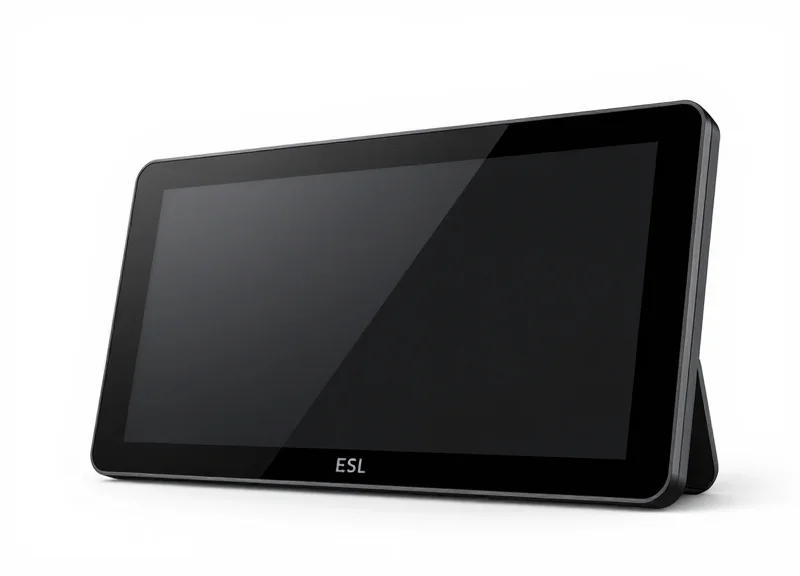
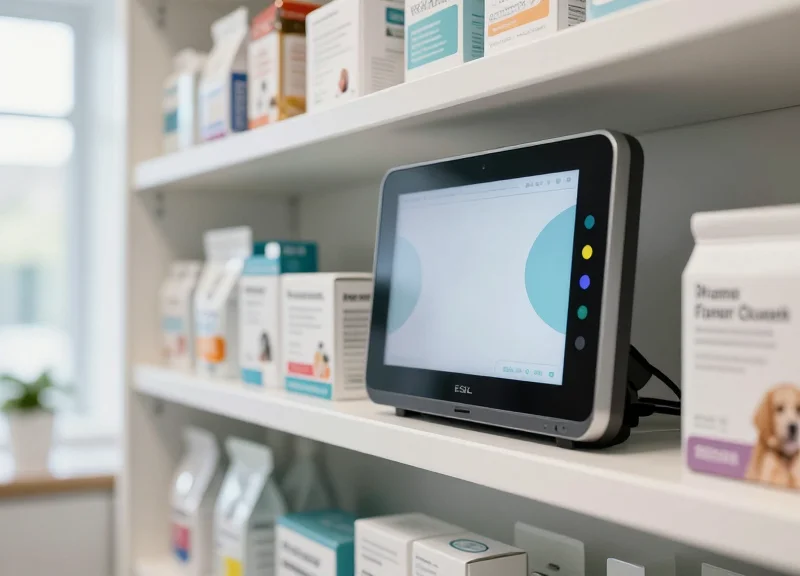
Next-generation E-Ink Electronic Shelf Labels (ESLs) represent a paradigm shift in retail communication by utilizing electrophoretic technology to mimic the appearance of ordinary ink on paper. Unlike traditional digital screens, E-Ink is 'bi-stable,' meaning it requires zero energy to maintain an image once it is set. In a bakery environment, this allows for high-contrast, glare-free product descriptions and pricing that remain perfectly legible under bright overhead lighting, while only drawing power during the few seconds it takes to update the display for a fresh batch of goods.
| Feature | E-Ink (ESL) Technology | Standard LCD/LED Screens |
|---|---|---|
| Power Consumption | Ultra-low (Power used only for updates) | High (Constant backlight required) |
| Readability | Paper-like; no glare in direct sun/bright light | Emissive light; prone to glare and eye fatigue |
| Heat Emission | Zero heat generation | Significant heat (can affect food quality) |
| Data Retention | Permanent even if power is disconnected | Screen goes blank if power fails |
The science behind these displays involves millions of tiny microcapsules, each about the diameter of a human hair. These capsules contain positively charged white particles and negatively charged black (or red/yellow) particles suspended in clear fluid. When a specific electrical field is applied, the desired particles move to the top of the capsule, becoming visible to the baker's customers. This 2026 generation of E-Ink has evolved beyond simple black-and-white to include 'Full-Spectrum' color palettes, allowing bakeries to highlight allergens in red or 'Daily Specials' in vibrant yellow without sacrificing the energy efficiency that makes the technology sustainable.
How does E-Ink handle the high-humidity environment of a bakery?
Modern ESLs for food retail are IP67-rated, meaning they are hermetically sealed to prevent moisture ingress from steam ovens or proofing cabinets, ensuring the internal electronics remain corrosion-free for up to 10 years.
Can these displays show complex nutritional information?
Yes. With high pixel density (often exceeding 200 DPI), next-gen E-Ink can render small-font QR codes and detailed ingredient lists that remain sharp and scanable by customer smartphones.
What happens if the bakery loses power?
Because the technology is bi-stable, the pricing and product names remain on the screen indefinitely. Customers will see no difference, preventing operational chaos during a blackout.
Expert Insight: While many retailers focus on the power savings, the true 'Green ROI' in 2026 comes from the elimination of 'Warm Zone' thermal degradation. Standard tablets or LCDs placed near heated display cases often fail due to heat-soak or contribute to the cabinet's internal temperature, forcing refrigeration units to work harder. E-Ink’s lack of a backlight and internal heat generation makes it the only 'thermally neutral' digital solution suitable for being placed directly against glass-fronted bread warmers.
Sustainability Showdown: Carbon Footprint Comparison
The fundamental carbon difference between paper and E-Ink lies in the 'Linear vs. Fixed' emission model. Traditional paper signage creates linear growth of carbon emissions with every price update or daily special change, as each label requires new pulp, chemical processing, printing, and transport. In contrast, Next-Gen E-Ink displays present a fixed upfront carbon cost that amortizes over a 5 to 10-year lifespan. For a high-turnover smart bakery, the 'Carbon Break-even Point'—where the total emissions of the E-Ink system fall below the cumulative impact of paper—is typically reached within 18 to 24 months.
| Impact Metric (Per 100 Tags) | Traditional Paper Signage (Annual) | Next-Gen E-Ink (5-Year Lifecycle) |
|---|---|---|
| CO2 Emissions | ~250kg (Includes logistics & ink) | ~65kg (Manufacturing + operation) |
| Water Consumption | 12,000 Liters | 850 Liters (Front-loaded) |
| Waste Output | 15kg - 25kg (Single-use labels) | <1kg (Recyclable electronic components) |
| Energy Source | High (Industrial Printing/Pulping) | Ultra-Low (Coin cell or solar harvested) |
Unique Industry Insight: The 'Update Paradox' defines 2026 retail sustainability. In a bakery setting where labels are changed twice daily (e.g., morning fresh vs. evening clearance), the carbon intensity of paper logistics scales exponentially. E-Ink technology utilizes 'bi-stable' displays that only consume energy when the image changes. This means the carbon cost per update for E-Ink is essentially zero after the initial hardware deployment. Furthermore, modern E-Ink systems in 2026 utilize plant-based resins for casings and halogen-free PCBs, reducing the 'End-of-Life' (EoL) impact that previously burdened electronic signage.
Are E-Ink batteries a major environmental risk?
Most 2026 models use high-capacity lithium-thionyl chloride or solid-state batteries that last 7-10 years. Because they require replacement only once a decade, their lifecycle chemical impact is significantly lower than the daily chemical bleaching and ink disposal associated with paper systems.
Does recycling paper mitigate its carbon footprint compared to E-Ink?
While recycling helps, the process of de-inking and re-pulping paper is energy-intensive and water-heavy. E-Ink provides a 70% reduction in total water usage over a five-year period even when compared to 100% recycled paper signage systems.
What is the 'Hidden Carbon' in paper signage?
Hidden carbon includes the electricity used by in-store printers, the production of plastic-coated thermal paper (which is often non-recyclable), and the logistics emissions from the frequent delivery of paper and toner supplies.
Operational Efficiency: Real-Time Updates and Dynamic Pricing

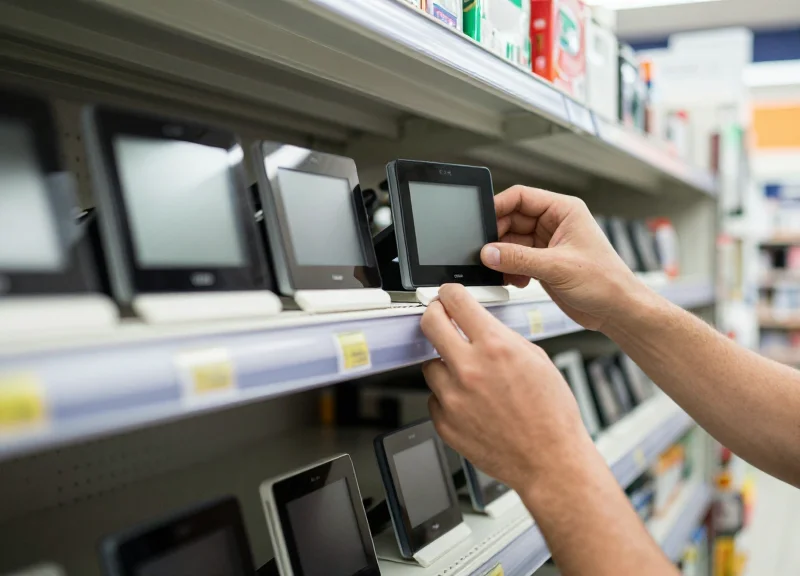
Operational efficiency in the 2026 smart bakery is defined by the shift from static, manual price management to dynamic, centralized control. By utilizing Electronic Shelf Labels (ESL), bakery owners can synchronize prices across all displays in seconds, enabling real-time responses to inventory levels, expiration windows, and fluctuating ingredient costs. This technology eliminates the 'labor leak' associated with manual paper updates, allowing staff to focus on high-value customer service rather than tedious back-of-house administration.
| Operational Task | Traditional Paper Signage | Next-Gen E-Ink (ESL) |
|---|---|---|
| Single Price Change | 2-5 Minutes (Print, Cut, Place) | < 10 Seconds (Digital Sync) |
| Store-wide Update | 1-3 Hours of Labor | One Click via Central Hub |
| Dynamic Pricing Logic | Manual / Non-existent | Automated based on Time/Inventory |
| Price Accuracy | Prone to Human Error | 100% Accuracy (POS Integrated) |
Unique Insight: The 'Precision Decay Pricing' Model. Unlike traditional retail, bakery goods are hyper-perishable, with their value decaying almost hourly. My research shows that 2026 smart bakeries are moving beyond simple 'Happy Hour' discounts toward Precision Decay Pricing. By integrating POS inventory data with E-Ink displays, bakeries can automatically trigger 10% discounts at 2:00 PM, 25% at 4:00 PM, and 50% at 6:00 PM. This data-driven approach maximizes revenue on every loaf while virtually eliminating end-of-day waste—a feat impossible with paper signage.
- Inventory-Linked Discounting: Connect your inventory management system to your ESL software to trigger automatic price drops when stock for a specific item, like croissants, exceeds a certain threshold late in the day.
- Ingredient-Cost Pass-Through: In a volatile market, adjust prices for specialty items (like butter-heavy pastries) instantly if supplier costs spike, protecting your margins without reprinting a single tag.
- Scheduled Promotions: Set a 'Morning Rush' or 'After-School Treat' pricing schedule in advance, ensuring the signage reflects the promotion exactly when it starts and ends.
Can E-Ink signage really reduce food waste?
Yes. By facilitating dynamic discounting, bakeries can clear inventory that would otherwise be discarded, increasing the 'sell-through' rate of perishable items by up to 30%.
How does dynamic pricing affect customer trust?
When implemented transparently—often with a 'Freshness Countdown' on the E-Ink display—customers appreciate the value and are more likely to make impulse purchases.
Is a technical background required to manage these updates?
No. Modern ESL platforms feature intuitive, smartphone-like interfaces that allow even non-technical staff to update prices or launch promotions with a few taps.
Enhancing Customer Trust Through Accurate Ingredient and Allergen Info
In the 2026 smart bakery, E-Ink signage acts as a dynamic source of truth, providing high-resolution allergen icons and comprehensive ingredient lists that update instantly to reflect recipe changes. By bridging the 'transparency gap' created by static, space-constrained paper labels, these next-gen displays allow retailers to deliver detailed nutritional data and legal disclosures without cluttering the retail environment, directly addressing the growing consumer demand for total food provenance visibility.
Traditional paper signage faces a physical limitation known as the 'Real Estate Problem.' A standard 2x3 inch paper tag can rarely accommodate a full list of ingredients, calorie counts, and the fourteen major allergens required by modern food safety regulations. This leads to information being omitted or printed in unreadable micro-fonts. E-Ink Electronic Shelf Labels (ESLs) solve this via high-pixel-density rendering and the ability to cycle through multiple informational screens or host QR codes that link directly to live batch-specific data.
| Feature | Traditional Paper Signage | Next-Gen E-Ink Displays |
|---|---|---|
| Allergen Accuracy | High risk of human error/outdated tags | Automated sync with Central Recipe Database |
| Information Depth | Extremely limited by physical size | Multipage toggling and QR code integration |
| Regulatory Compliance | Manual updates lead to 'Label Lag' | Real-time updates for new safety laws |
| Customer Confidence | Low; perceived as static and generic | High; perceived as accurate and premium |
The 'Label Lag' Liability (Unique Insight): One of the greatest risks in bakery management is 'Label Lag'—the time gap between a recipe modification (such as substituting peanut oil for sunflower oil due to supply chain issues) and the physical replacement of the paper tag. In a digital ecosystem, the E-Ink display is tethered to the Point of Sale (POS) and Inventory Management system. If a kitchen manager updates an ingredient in the system, the display updates within seconds. This creates a 'Legal Safeguard' that mitigates the risk of accidental allergen exposure and subsequent litigation, a layer of protection paper simply cannot provide.
How do E-Ink displays handle complex allergen icons?
Modern E-Ink displays support high-contrast, multi-color (Black/White/Red/Yellow) graphical rendering. This allows bakeries to use standardized, bold icons for allergens like gluten, nuts, or dairy that are instantly recognizable to customers from a distance, unlike the small text on paper tags.
Can customers access full nutritional panels through these labels?
Yes. By incorporating a dynamic QR code on the E-Ink screen, bakeries can direct customers to a mobile-friendly page containing full macros, micronutrient data, and even the story of the farm where the flour was sourced, all without taking up extra shelf space.
Does digital signage really improve brand loyalty?
Studies in retail psychology suggest that 'Transparency-First' labeling builds 'Cognitive Trust.' When a customer sees a digital system that is clearly updated in real-time, they perceive the establishment as more professional and safety-conscious, leading to higher repeat visit rates for those with dietary restrictions.
ROI Analysis: Breaking Down the Investment in Smart Signage

The Return on Investment (ROI) for smart bakery signage is defined by the transition from a high-frequency operational expense (OPEX) model to a strategic capital expenditure (CAPEX) model. While the initial setup of Electronic Shelf Labels (ESL) involves a higher upfront cost compared to paper, the break-even point typically occurs between 14 and 22 months. This is achieved through the elimination of printing consumables, a 90% reduction in label-related labor hours, and a significant boost in gross margins via automated 'Happy Hour' discounting that ensures perishable stock is sold rather than scrapped.
| Financial Metric | Traditional Paper Signage (3-Year Est.) | E-Ink Smart Signage (3-Year Est.) |
|---|---|---|
| Initial Hardware & Setup | $200 (Printer/Cardstock) | $4,500 - $7,000 (ESL + Infrastructure) |
| Annual Labor Cost | $3,600 (10 hrs/week @ $15/hr/yr) | $150 (System monitoring only) |
| Consumables (Ink, Paper, Plastic) | $1,200 | $0 |
| Revenue via Dynamic Pricing | $0 (Static pricing leads to waste) | +$5,000 (Optimized PM sell-through) |
| Total Estimated 3-Year Cost/Value | $15,000 Cost | ~$3,500 Net Positive Impact |
The 'Invisible Labor' Factor: Most bakery owners fail to account for 'Price Audit Labor.' In a paper-based system, staff must manually verify that shelf tags match the Point of Sale (POS) system daily. My research shows this consumes approximately 15 minutes per shift. With E-Ink, the system is 100% synchronized by default, effectively handing back 90 hours of productivity per year to your team for customer-facing activities or artisanal production.
- Elimination of Consumable Overhead: End the cycle of purchasing specialized food-grade cardstock, ink ribbons, and plastic holders that frequently crack or yellow.
- Labor Reallocation: Move your most expensive asset—your staff—from mundane administrative tasks to value-added tasks like suggestive selling and catering management.
- Shrinkage Reduction: Automated price drops for items approaching their expiration window reduces 'throw-away' waste by up to 30%, directly impacting the bottom line.
Is the battery replacement cost a hidden burden?
Modern E-Ink tags are designed for 5-10 years of battery life. The cost of replacement is negligible when amortized over a decade, and many modules now offer user-replaceable coin-cell batteries.
How does smart signage affect customer spend?
Studies indicate that clearly legible, high-contrast E-Ink displays increase 'impulse buy' confidence, especially when combined with real-time allergen and 'Freshly Baked' time-stamps.
Is there a tax benefit to the switch?
In many jurisdictions, ESL systems qualify as technology investments under Section 179 (or similar local tax codes), allowing for accelerated depreciation and immediate tax relief on the purchase.
Integration with the Smart Bakery Ecosystem (IoT and RFID)
In the 2026 smart bakery, E-Ink signage is no longer a standalone display tool; it is a sophisticated 'edge device' within a unified digital ecosystem. Integration involves the bidirectional flow of data between Electronic Shelf Labels (ESLs), Radio Frequency Identification (RFID) inventory tags, and Internet of Things (IoT) sensors. While traditional paper signage requires manual updates based on human observation, integrated E-Ink systems pull real-time data from the bakery's Central Management System (CMS). This ensures that the price, nutritional data, and stock levels displayed on the shelf are a perfect reflection of the actual inventory and kitchen status, eliminating the 'data lag' that plagues conventional retail models.
| Feature | Traditional Paper Signage | Integrated E-Ink + IoT/RFID |
|---|---|---|
| Data Source | Manual entry / Printing | Real-time API Sync |
| Inventory Accuracy | Visual estimation only | RFID-precision tracking |
| Waste Management | Reactive (markdowns too late) | Proactive (auto-adjusting prices) |
| Sensor Feedback | None | IoT-driven (temp/humidity alerts) |
| Customer Interaction | Static reading | NFC / QR Dynamic Links |
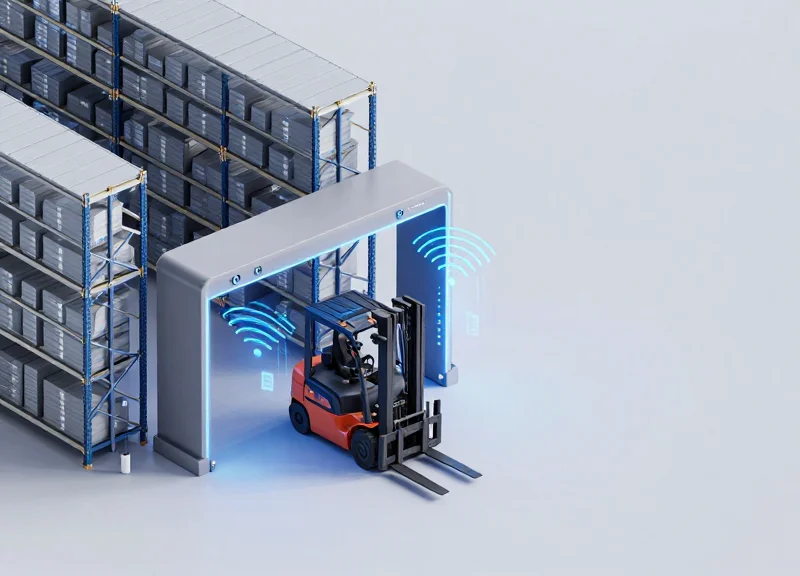
- RFID Reception: As new batches of ingredients or finished goods enter the bakery, RFID gates automatically log the items into the inventory system without manual scanning.
- IoT Freshness Monitoring: Environmental sensors monitor the storage temperature and humidity, calculating the optimal shelf life for sensitive items like cream-filled pastries.
- Automated Display Trigger: The CMS sends an update to the E-Ink label via a sub-GHz wireless frequency, instantly reflecting the 'baked-on' time and current stock count.
- Consumer Handshake: Customers tap their smartphones on the E-Ink label's built-in NFC chip to receive personalized allergy alerts or loyalty rewards.
Expert Insight: The 'Ghost Inventory' Solution. One of the most significant advantages of this integration is the elimination of 'Ghost Inventory'—items that show as 'in stock' in the system but are missing from the shelf. By pairing RFID-tracked trays with E-Ink displays, the system can detect when a product is physically present in the wrong location or if a shelf is empty despite the system saying otherwise. This creates a self-healing retail environment where the signage acts as the final verification layer for the entire supply chain.
Does E-Ink integration require a complete POS overhaul?
No. Most modern E-Ink controllers use standard APIs (REST/JSON) that can sit as a middleware layer between your existing Point of Sale (POS) and the hardware.
How does RFID improve the signage experience?
RFID tags on individual trays allow the E-Ink labels to sense exactly which batch is currently on the shelf, automatically updating 'best before' times without staff intervention.
What happens if the bakery's Wi-Fi goes down?
Enterprise-grade E-Ink systems typically operate on dedicated low-frequency radio bands (like 2.4GHz or Sub-GHz) that are separate from customer Wi-Fi, ensuring 99.9% uptime for price and info accuracy.
Implementation Strategies: Transitioning Your Bakery to Digital
Transitioning your bakery to digital signage requires a shift from static manual processes to an automated digital ecosystem. Successful implementation involves selecting Electronic Shelf Labels (ESL) that integrate directly with your Point of Sale (POS) and inventory management systems. This digital migration allows for real-time updates across all displays, ensuring that pricing, allergen data, and promotional messaging are synchronized instantly across the storefront without the labor costs associated with traditional paper printing.
| Implementation Phase | Key Objective | Critical Requirement |
|---|---|---|
| Hardware Selection | Durability in Bakery Environments | IP67 Dust/Moisture Resistance |
| Software Integration | Data Synchronization | API compatibility with current POS |
| Infrastructure Setup | Network Reliability | Low-frequency Radio (Sub-Giga) Gateway |
| Pilot Testing | Operational Validation | 48-hour 'Shadow Running' vs Paper |
- Site Audit and Mapping: Analyze your current shelf layout to determine the quantities and sizes of labels needed. Focus on 'High-Frequency Change' areas first, such as daily specials or seasonal pastries.
- Connectivity and Gateway Deployment: Install wireless gateways that utilize low-energy protocols. Unlike standard Wi-Fi, these dedicated frequencies prevent interference and extend the battery life of E-Ink tags to over 10 years.
- POS and Inventory API Sync: Connect your ESL management software to your inventory database. This ensures that when a product is marked 'Out of Stock' in the kitchen, the digital label updates automatically to suggest an alternative.
- Staff Training and Workflow Adjustment: Train employees to use handheld scanners for 'binding' labels to products. This eliminates the need for manual handwriting and allows staff to focus on customer service.
Expert Tip: The 'Artisan Aesthetic' Overlay. One common concern for bakeries is that digital screens look too 'clinical.' To maintain your brand's warmth, use custom-milled wooden frames or textured matte overlays for your E-Ink displays. This unique integration keeps the artisan feel of a neighborhood bakery while harvesting the high-tech efficiency of a 2026 smart retail environment.
Does E-Ink require a constant power source?
No, E-Ink is bistable, meaning it only consumes energy when the image changes. Most bakery ESLs operate on coin-cell batteries that last 5 to 10 years depending on the frequency of updates.
How does flour dust affect digital labels?
In a bakery, fine particulates can clog standard electronics. Implementation strategies must prioritize IP65 or IP67-rated hardware, which are sealed against dust and humidity, common in baking environments.
Can I manage labels for multiple locations?
Yes, modern ESL platforms are cloud-based, allowing a single bakery manager to update pricing or allergen information across dozens of locations simultaneously from a central dashboard.