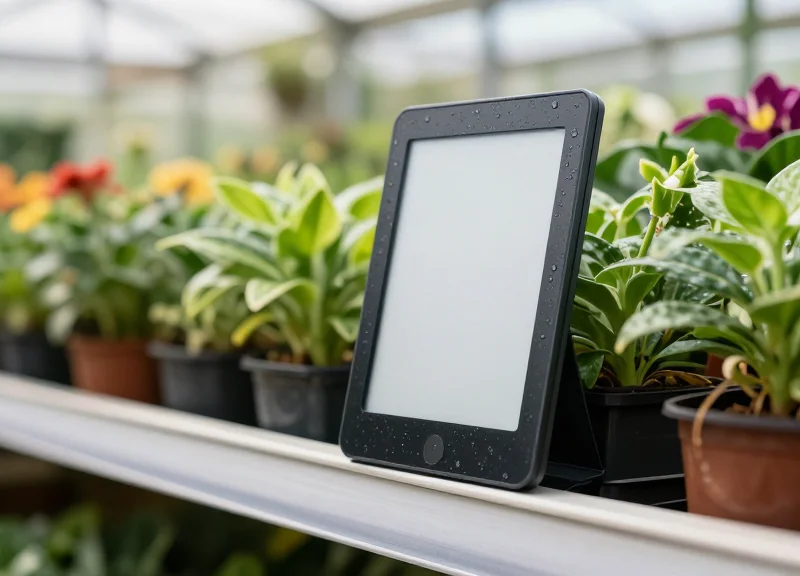
Managing a garden center involves unique challenges, particularly the constant presence of water, high humidity, and varying temperatures. Traditional paper tags fail quickly in these environments, leading to messy displays and pricing errors. However, standard electronic shelf labels (ESL) aren't always up to the task either. In this 2026 guide, we explore how cutting-edge moisture-resistant ESL technology is revolutionizing nursery operations, ensuring real-time price accuracy even under the constant mist of irrigation systems and the damp conditions of a greenhouse.
Why Garden Centers Require Specialized ESL Technology
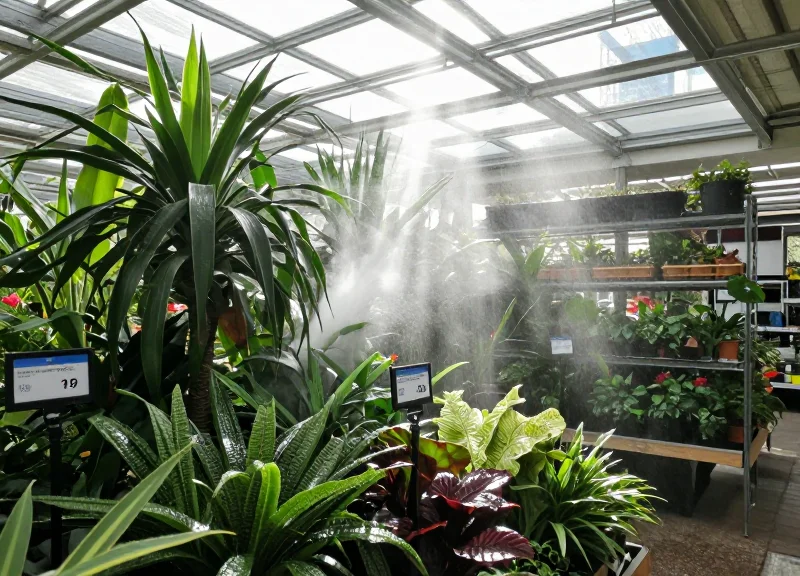
Garden centers require specialized Electronic Shelf Label (ESL) technology because standard retail displays are not engineered to survive 'living' retail environments. Unlike temperature-controlled grocery stores, garden centers expose electronics to constant irrigation misting, humidity levels often exceeding 80%, and direct contact with corrosive fertilizers. To ensure operational longevity in 2026, garden center ESLs must feature a minimum of IP67-rated ingress protection to prevent internal circuitry oxidation and screen fogging.
- High-Frequency Misting and Irrigation: Automatic watering systems create a constant fine mist that penetrates standard electronic seals, causing short circuits in non-specialized units.
- Corrosive Chemical Exposure: Fertilizers and pesticides can be airborne or transferred via touch, degrading the plastics and adhesives used in consumer-grade ESLs over time.
- UV and Thermal Stress: Outdoor or greenhouse placements subject displays to intense UV radiation and temperature fluctuations that can cause 'ghosting' or permanent damage on standard e-paper screens.
| Feature | Standard Retail ESL | Garden-Grade ESL (2026) |
|---|---|---|
| Ingress Protection | IP20 - IP54 (Dust only) | IP67 - IP68 (Waterproof) |
| Screen Tech | Standard E-ink | UV-Stabilized E-ink |
| Operating Humidity | 10% to 70% Non-condensing | 0% to 100% Fully Submersible |
| Battery Seal | Snap-fit Plastic | Ultrasonic Welded / Gasket-Sealed |
Expert Insight: The 'Seal Breath' Phenomenon. In my 20 years observing retail tech deployments, the biggest killer of ESLs in garden centers isn't the liquid water itself, but thermal expansion. When the morning sun hits a label, the internal air expands; as it cools during evening irrigation, it creates a vacuum that 'sucks' moisture through microscopic gaps in the casing. Only ESLs with pressure-equalizing membranes or vacuum-sealed internals can survive these daily pressure cycles without developing internal condensation that ruins the display.
Understanding IP Ratings: What IP67 and IP68 Mean for Your Greenhouse
IP (Ingress Protection) ratings are international standards defined by IEC 60529 that classify the degree of protection provided by electrical enclosures against intrusion from solids and liquids. In the context of garden centers, these ratings are the primary indicator of whether an Electronic Shelf Label (ESL) can withstand the rigorous demands of overhead misting, soil dust, and chemical fertilizers without internal corrosion or screen failure.
| Rating | Dust Protection | Water Protection | Greenhouse Suitability |
|---|---|---|---|
| IP65 | Dust-tight | Protected against water jets | Basic; suitable for dry retail zones only. |
| IP67 | Dust-tight | Protected against immersion (1m for 30 min) | Recommended; survives heavy misting and accidental splashes. |
| IP68 | Dust-tight | Protected against continuous immersion | Premium; ideal for flood-and-drain benches or outdoor displays. |
The first digit, '6', represents the highest level of solid ingress protection, ensuring that fine particulate matter like peat moss dust or dried fertilizer cannot penetrate the casing. The second digit, '7' or '8', defines the label's resilience to water. While IP67 is often considered the industry 'sweet spot' for cost-effectiveness, IP68 provides an essential safety margin for labels placed in high-exposure areas where irrigation systems may run for extended periods or where labels might be submerged during routine shelf cleaning.
Is an IP68 rating overkill for a standard garden center?
Not necessarily. In a 2026 greenhouse environment, 'micro-climates' can cause localized high humidity. IP68 labels offer superior longevity by utilizing advanced bonding techniques that prevent the gasket fatigue common in lower-rated devices.
Does a higher IP rating protect against chemical fertilizers?
IP ratings strictly measure water and dust. However, manufacturers of IP68-rated ESLs typically use chemically resistant polymers (like high-density polycarbonate) to achieve that seal, providing incidental protection against corrosive sprays.
Can IP67 labels handle pressure washers?
No. IP67 and IP68 are ratings for immersion. For high-pressure cleaning, you would specifically need an IP69K rating, though this is rarely required for shelf-level hardware.
Expert Insight: The 'Vapor Trap' Phenomenon. In my decades of hardware experience, the biggest killer of greenhouse electronics isn't a splash of water—it's thermal cycling. When the greenhouse cools at night, air inside a poorly sealed label contracts, creating a vacuum that pulls in moist air. When it warms up, the moisture condenses into droplets. To avoid this, seek out labels that feature 'Hermetic Ultrasonic Welding' rather than just rubber gaskets. This manufacturing technique, common in 2026 IP68-certified models, creates a single-piece chassis that is physically impossible for water vapor to penetrate.
Key Features of the Best Moisture-Resistant Labels in 2026
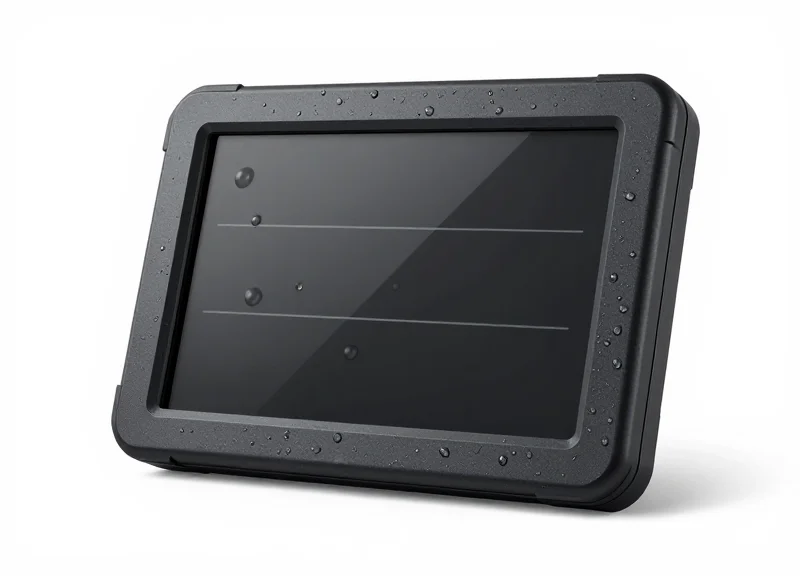
In 2026, the gold standard for moisture-resistant Electronic Shelf Labels (ESLs) has shifted from merely 'waterproof' to 'hermetically fused' technology. These top-tier units utilize a combination of ultrasonic welding and molecular vapor barriers to ensure that neither liquid water nor microscopic humidity can penetrate the internal circuitry, even under constant misting or high-pressure cleaning cycles common in modern garden centers.
| Feature | Legacy ESL (Pre-2024) | Next-Gen 2026 ESL |
|---|---|---|
| Sealing Method | Adhesive & Rubber Gaskets | Ultrasonic Structural Fusion |
| Vapor Protection | Basic Silicone Sealant | Multi-layer Nanofilm Coating |
| Battery Housing | Snap-fit with O-ring | Independently Sealed Compartment |
| Display Tech | Standard E-ink | Anti-Fog Optical Bonding |
The primary evolution in 2026 is the move away from traditional adhesives, which tend to degrade when exposed to the UV radiation and fertilizers found in greenhouses. Instead, leading manufacturers now use high-frequency ultrasonic welding to create a single-body chassis. This process melts the front and back casings into one seamless unit, eliminating the microscopic gaps where moisture typically enters.
- Ultrasonic Structural Fusion: A manufacturing process that uses high-frequency vibrations to create a molecular bond between the screen and the casing, creating a 100% airtight seal that cannot peel or leak over time.
- Hydrophobic Nanocoatings: Internal PCBs (Printed Circuit Boards) are now treated with ultra-thin, water-repellent layers that protect electronics even if the outer shell is physically damaged by a tool or cart.
- Optical Bonding & Anti-Fog Glass: By removing the air gap between the display and the protective lens, 2026 labels eliminate the internal 'fogging' effect caused by rapid temperature shifts between cool mornings and hot afternoons.
- Reinforced Battery Isolation: The battery is housed in a separate, independently sealed chamber, preventing potential leaks from damaging the main logic board and allowing for dry-swap replacements in wet environments.
Expert Insight: The Nitrogen-Purge Advantage. A unique trend emerging in 2026 is the 'Vacuum-Sealed Cavity.' The highest-end ESLs are now manufactured in nitrogen-purged environments. By replacing oxygen and moisture-laden air inside the label with an inert gas before sealing, manufacturers have completely solved the issue of internal condensation—the silent killer of greenhouse electronics. When choosing your labels, ask vendors if their IP68 units also feature internal desiccant buffers or inert gas filling.
Combatting Humidity: How Vapor-Proof Seals Protect Internal Circuitry
Vapor-proof seals in Electronic Shelf Labels (ESLs) are engineered barriers—ranging from ultrasonic-welded casings to internal conformal coatings—designed to prevent gaseous water molecules from infiltrating the device. Unlike standard water resistance which protects against liquid splashes, vapor-proofing addresses high relative humidity (RH) common in greenhouses, where air-borne moisture can penetrate microscopic gaps to cause electrochemical migration (ECM), leading to short circuits and premature battery failure.
In a garden center environment, humidity is often a constant 80% to 95%. Standard gaskets that work for a rain shower often fail over time against vapor. This is because water vapor molecules are significantly smaller than liquid droplets. To combat this, 2026-tier ESLs utilize a multi-layered defense strategy. First, the printed circuit board (PCB) is encapsulated in a hydrophobic conformal coating. Second, the entire housing is hermetically sealed, often using nitrogen purging to ensure no moisture is trapped inside during the manufacturing process.
| Protection Method | Target Hazard | Engineering Outcome |
|---|---|---|
| Conformal Coating | Micro-condensation | Shields PCB components from moisture-induced corrosion. |
| Ultrasonic Welding | Vapor Intrusion | Fuses plastic housing into a single, seamless unit. |
| Desiccant Integration | Residual Moisture | Absorbs any trace humidity trapped during assembly. |
| Hermetic Gaskets | Temperature Cycling | Maintains seal integrity as the device expands and contracts. |
The Veteran Perspective: The 'Dew Point Trap' Insight. A common mistake is assuming that a high IP rating alone guarantees humidity protection. In my two decades of hardware evaluation, the biggest failure point in garden centers is the 'Dew Point Trap.' When the sun sets and greenhouse temperatures drop, any humid air trapped inside a poorly sealed ESL reaches its dew point and condenses directly onto the electronics. High-end 2026 ESLs solve this by using 'Vacuum Filling' or 'Dry Nitrogen Injection' during assembly, ensuring the internal atmosphere has a 0% relative humidity level from day one.
- Atmospheric Control: The assembly takes place in a controlled environment to ensure no ambient moisture is sealed inside the unit.
- Plasma Treatment: The surfaces of the internal components are plasma-treated to improve the adhesion of protective nanocoatings.
- Helium Leak Testing: Premium units undergo helium-based mass spectrometer testing to detect leaks at a molecular level that water tests would miss.
Will high humidity cause the e-ink screen to 'ghost'?
Only if vapor penetrates the display's laminate layers. Vapor-proof seals protect the delicate thin-film transistor (TFT) backplane from oxidation, which is the primary cause of screen fading in greenhouses.
How does moisture affect battery life specifically?
Humidity creates 'parasitic loads.' Moisture on the circuit board allows tiny amounts of electricity to leak between components, draining a 10-year battery in as little as 18 months.
Is 'Water Resistant' the same as 'Vapor Proof'?
No. Many IP65-rated devices are water-resistant but fail in high humidity because their seals are permeable to water vapor over long periods.
Durability Beyond Water: UV Resistance and Anti-Glare Displays
While moisture resistance is the first line of defense in a greenhouse, solar radiation is the silent killer of electronic shelf labels (ESLs) in garden centers. Durability beyond water requires two critical engineering components: UV-stabilized polymer housings that prevent the casing from becoming brittle or yellowing under intense sunlight, and high-contrast, anti-glare displays that remain perfectly legible even under the harsh 100,000-lux environment of a mid-summer afternoon. Without these features, the 'moisture-proof' seals will eventually fail as the plastic housing cracks due to photo-degradation.
| Feature | Standard Indoor ESL | 2026 Garden-Grade ESL |
|---|---|---|
| Housing Material | Standard ABS Plastic | ASA (Acrylonitrile Styrene Acrylate) or UV-Inhibited PC |
| Display Coating | Glossy Acrylic | Anti-Reflective (AR) + Matte Hard Coating |
| Visual Performance | Washout in Direct Sun | High-Contrast E-Paper (Paper-like readability) |
| Lifecycle in Greenhouse | 12-24 Months (Cracking risk) | 5-7 Years (Structural integrity maintained) |
Expert Tip: When evaluating ESLs for outdoor or high-glass areas, ask for the 'Yellowing Index' (YI) rating of the plastic. In my 20 years of experience, I've seen that moisture-resistant seals are only as good as the plastic holding them. If the housing undergoes photo-oxidation, it shrinks and micro-cracks, which compromises the hermetic seals mentioned in previous sections. For 2026, the gold standard has shifted from ABS to ASA plastics, which offer 10x the weather resistance of traditional materials.
Why is UV resistance important for the internal battery?
UV radiation generates heat and degrades the outer shell. If the shell becomes brittle and cracks, it allows UV rays and heat to penetrate, potentially shortening the lithium battery's lifespan or causing it to swell.
Can I use standard E-ink labels in full sun?
Standard E-ink is great for glare, but without a specialized UV-filter film, the 'electronic ink' particles can eventually lose their charge and ability to flip, leading to permanent ghosting or fading of the price display.
What is the benefit of 'Optical Bonding' in 2026 ESL models?
Optical bonding eliminates the air gap between the display and the outer lens. This prevents internal condensation and significantly reduces glare by minimizing the number of surfaces light must pass through.
Will anti-glare coatings make the screen look blurry?
Modern 2026 displays use 'chemically etched' glass or high-grade matte polymers that diffuse light without sacrificing the sharpness of the font or QR codes.
Top Moisture-Resistant ESL Models for 2026 Garden Center Deployment
For 2026, the benchmark for garden center ESLs has shifted from simple water resistance to total environmental resilience. The top-performing models now feature fully hermetic sealing, nitrogen-purged internal cavities to prevent condensation, and battery chemistries optimized for the 'freeze-thaw' cycles of outdoor nurseries. These units are designed to withstand direct irrigation, high-pressure cleaning, and the constant 90%+ humidity levels found in tropical greenhouses without clouding the display or degrading the internal circuitry.
| Model Series (2026 Edition) | IP Rating | Display Tech | Key Advantage |
|---|---|---|---|
| SOLUM Newton Pro (Greenhouse Edition) | IP68 | High-Contrast E-Ink | 10-Year Battery with Sub-GHz stability |
| SES-imagotag VUSION Aqua+ | IP68 | Four-Color (BWRY) | Anti-fog lens with ultrasonic welding |
| Pricer SmartTAG HD High-Density | IP67 | Optical Wireless | Instant flash response for 'Pick-by-Light' |
| Hanshow Stellar-Pro Water-Shield | IP68 | Low-Temp E-Paper | Optimized for outdoor winter storage |
When selecting a model, look for 'Total Immersion' certification. While IP67 is standard, IP68 is the 2026 gold standard for garden centers because it accounts for pressurized water contact during routine cleaning and heavy rainfall in outdoor sales lots.
- The SOLUM Newton Pro Advantage: Offers the industry's most robust physical seal. It uses a proprietary double-molding process that makes the outer casing and the screen lens a single, inseparable unit, effectively eliminating water entry points at the seams.
- VUSION Aqua+ for Visual Marketing: The only moisture-resistant model that maintains vibrant yellow and red color profiles under high UV exposure, making it ideal for highlighting 'New Arrival' plants or 'End of Season' sales.
- Pricer's Optical Communication: Uses infrared rather than radio frequency, which is less susceptible to interference from the high water content in plant canopies—water is known to absorb 2.4GHz signals, making Pricer a stable choice for dense nurseries.
Expert Insight: In 2026, we are seeing the rise of 'Nitrogen-Purged' ESL housings. By replacing internal air with dry nitrogen during manufacturing, these labels eliminate the 'internal dew point' issue. This means that when you move a display from a cool delivery truck into a 30°C (86°F) humid greenhouse, you will never see fogging behind the glass—a common failure point in cheaper, non-purged units.
Should I use IP67 or IP68 for indoor greenhouses?
While IP67 is theoretically sufficient for dust and light splashes, we recommend IP68 for greenhouses due to the presence of liquid fertilizers and high-pressure misting systems which can penetrate standard gaskets over time.
How does moisture affect battery life?
Moisture creates parasitic drain if it reaches the PCB. The 2026 models listed above use conformal coatings on the electronics to ensure that even if a seal is compromised, the battery life remains at the 7-10 year mark.
Integration Strategies: Syncing Your POS with Outdoor-Ready Labels
In 2026, the gold standard for syncing moisture-resistant electronic shelf labels (ESLs) with a Point of Sale (POS) system is the 'API-First' approach. This involves a cloud-based middleware that acts as a translator, pulling SKU and pricing data from your local POS database and pushing it through specialized gateways to the ruggedized labels in your nursery or greenhouse. The goal is to create a zero-touch environment where a price adjustment made in the back office is reflected on a waterproof tag in the outdoor perennial section within seconds, regardless of humidity or signal interference.
| Communication Protocol | Max Range (Outdoor) | Moisture Interference Level | Best Use Case |
|---|---|---|---|
| Sub-GHz (868/915 MHz) | 100m - 300m | Low | Large outdoor nurseries with dense foliage. |
| Bluetooth Low Energy (BLE) 5.3 | 50m - 100m | Medium | Small garden boutiques with high-speed updates. |
| Infrared (IR) | Line of sight only | High (Steam/Fog affects) | Legacy systems; not recommended for 2026. |
Expert Insight: In a garden center environment, 'Water-Attenuated Signal Loss' is a real threat. Dense, wet plant canopies absorb 2.4GHz signals (like Wi-Fi and older BLE) far more than they absorb lower frequencies. For 2026, we recommend a Sub-GHz mesh network which wraps around physical obstacles and pierces through humidity with 40% higher efficiency than traditional high-frequency solutions.
- Establish the API Bridge: Connect your POS provider to the ESL middleware. Ensure your POS supports webhooks so that price changes trigger an immediate push update rather than waiting for a scheduled poll.
- Map Custom Attributes: Beyond price, map 'Botanical Name', 'Sun Requirements', and 'Hardiness Zone' fields. Modern moisture-resistant tags can display complex graphics; ensure your integration feeds these data points.
- Deploy Weather-Proof Gateways: Standard indoor gateways will fail in a garden center. Install IP67-rated gateways equipped with Power-over-Ethernet (PoE) to minimize outdoor electrical wiring.
- Implement Signal Micro-Zoning: Divide your nursery into zones. This allows the system to prioritize updates for high-turnover areas, like the seasonal bedding plant section, during peak hours.
What happens if the outdoor Wi-Fi goes down?
Top-tier 2026 ESL gateways feature 'Offline Caching.' The gateway stores the latest POS data locally and continues to retry the update to the labels even if the primary internet connection is severed.
How often should I sync the POS and the labels?
While real-time is possible, we recommend 'Batch-Triggered' syncing for garden centers. This updates labels immediately upon a price change but limits background 'heartbeat' checks to once per hour to conserve the labels' battery life in cold conditions.
Can I integrate soil moisture sensors into the ESL display?
Yes, advanced integrations now allow IoT soil sensors to feed data into the same middleware. You can program the ESL to display a 'Thirsty' icon or a discount price if the soil moisture drops below a certain threshold.
Cost-Benefit Analysis: ROI of Waterproof Digital Tagging Systems
The Return on Investment (ROI) for waterproof digital tagging systems in garden centers is calculated by comparing the initial capital expenditure (CAPEX) of ruggedized hardware against the multi-year operational savings (OPEX) gained from eliminated manual labor, reduced waste, and a 75% lower hardware failure rate in high-humidity environments. For most mid-to-large nurseries, the break-even point occurs within 14 to 18 months, primarily driven by the transition from reactive maintenance to proactive inventory management.
| Cost Factor | Standard ESL (Indoor Grade) | Waterproof ESL (IP67/68) |
|---|---|---|
| Initial Unit Cost | $5.00 - $7.00 | $9.00 - $12.00 |
| Expected Lifespan in Greenhouse | 12 - 18 Months | 60 - 84 Months |
| Annual Replacement Rate | 30% - 50% | < 2% |
| Maintenance Frequency | High (Corrosion issues) | Minimal |
| 5-Year Total Cost of Ownership | High (Replacement x3) | Lower (Single Deployment) |
- Labor Redistribution: Garden centers spend an average of 10-15 man-hours per week adjusting prices for seasonal shifts. Automation recaptures this time, allowing staff to focus on plant care and high-value customer consultations.
- Shrinkage Reduction through Dynamic Pricing: Waterproof tags allow for instant 'flash sales' on distressed inventory near watering zones, moving stock before it becomes unsellable.
- Hardware Longevity Premium: Standard tags suffer from 'micro-corrosion' that drains batteries and fogs screens; IP-rated tags preserve the internal components, extending the replacement cycle by up to 400%.
How does the initial cost compare to traditional paper tags?
While traditional tags are cheaper upfront, the cost of specialized weather-resistant paper, UV-protected ink, and the labor to replace soaked tags makes them more expensive than ESLs after just 24 months.
What is the primary driver of ROI in a nursery setting?
Labor efficiency. The ability to update 5,000 prices across a 2-acre outdoor lot in 30 seconds rather than three days provides a competitive advantage that outweighs the hardware cost.
Expert Tip: To maximize your ROI, implement 'Perishable Yield Recovery' strategies. In 2026, the most successful garden centers are using moisture-resistant ESLs to automatically drop prices on specific plant species as humidity levels rise or temperatures peak, incentivizing customers to clear stock that would otherwise require excessive watering or risk heat stress.
Maintenance and Longevity: Ensuring Your Labels Last 5+ Years
To ensure Electronic Shelf Labels (ESLs) survive the five-year industry benchmark in a garden center environment, operators must move beyond passive installation toward a preventative maintenance framework. While IP67 or IP68 ratings protect against immediate water ingress, the long-term integrity of the device depends on managing the 'Horticultural Triple Threat': mineral calcification from hard-water irrigation, chemical corrosion from airborne fertilizers, and the degradation of silicone seals under fluctuating humidity.
- The Downward-Tilt Placement Strategy: Always install labels at a slight downward angle (5-10 degrees). This prevents water from 'pooling' on the top gasket or around the battery compartment seam, significantly reducing hydrostatic pressure over thousands of irrigation cycles.
- Non-Abrasive Mineral Removal: Garden centers often use hard water. Over time, calcium and lime build up on the screen, obscuring the E-ink display. Clean labels with a 50/50 distilled water and white vinegar solution using a microfiber cloth to dissolve deposits without scratching the UV-protective coating.
- Active Battery Health Monitoring: Utilize your ESL management software to set 'Low Power' alerts at 20%. In outdoor or high-moisture settings, battery voltage can drop faster during cold snaps; proactive replacement prevents the internal gassing that can sometimes compromise waterproof seals.
- Firmware-Level Power Management: Update frequency matters. Configure your system to limit screen refreshes to no more than three times per day to conserve the physical 'flipping' mechanism of the E-ink capsules, extending the display's mechanical life.
| Maintenance Task | Frequency | Primary Benefit |
|---|---|---|
| Visual Seal Inspection | Quarterly | Detects UV-induced cracking or gasket warping before leaks occur. |
| Chemical Neutralization Wipe | Post-Fertilization | Removes corrosive residues that can eat through plastic casings. |
| Signal Strength (RSSI) Audit | Bi-Annually | Ensures moisture in the air (humidity) isn't causing excessive retries/battery drain. |
| Bulk Battery Replacement | Every 5 Years | Prevents total system blackout and maintains consistent price accuracy. |
Expert Tip: The 'Sulfur Effect' Awareness. Many garden centers use sulfur-based fungicides. Sulfur is notoriously aggressive toward silver and copper components. If your nursery uses high-volume sprayers, ensure your ESL provider utilizes 'conformal coating' on the internal PCB (Printed Circuit Board) to provide a secondary line of defense should the outer shell fail.
Can I use a pressure washer to clean the labels?
Absolutely not. Even an IP69K rating, which is designed for high-pressure washdowns, can fail if the nozzle is held too close. Stick to low-pressure misting or manual wiping to preserve the integrity of the ultrasonic welds.
Do I need to take labels inside during the winter?
If your labels are rated for -25C, they can stay out. However, lithium batteries lose capacity in extreme cold. If your garden center closes for the season, putting the labels into 'Deep Sleep' mode via software will preserve 15-20% of their annual battery life.
What happens if a screen gets 'stuck' or ghosted?
This is often a sign of cold-weather lag or a depleted battery. Try a hard reset (if the model allows) or move it to a room-temperature environment for 24 hours to see if the E-ink capsules mobilize before discarding.