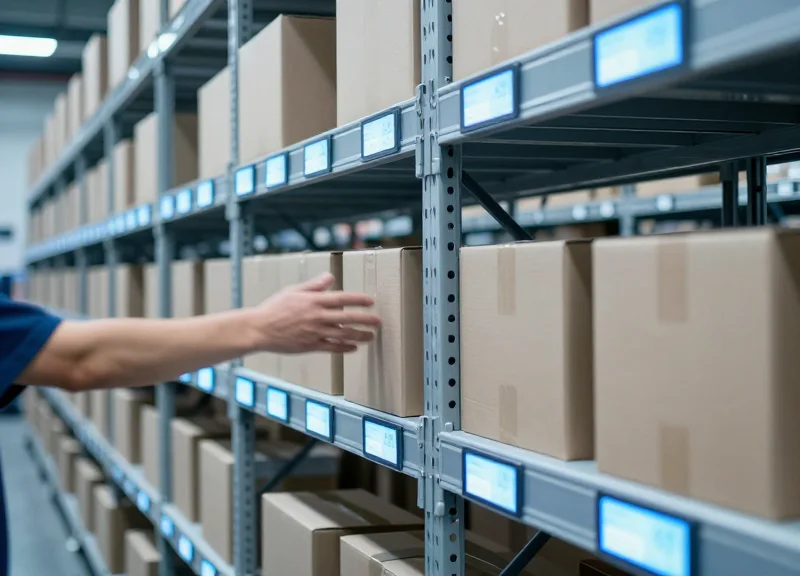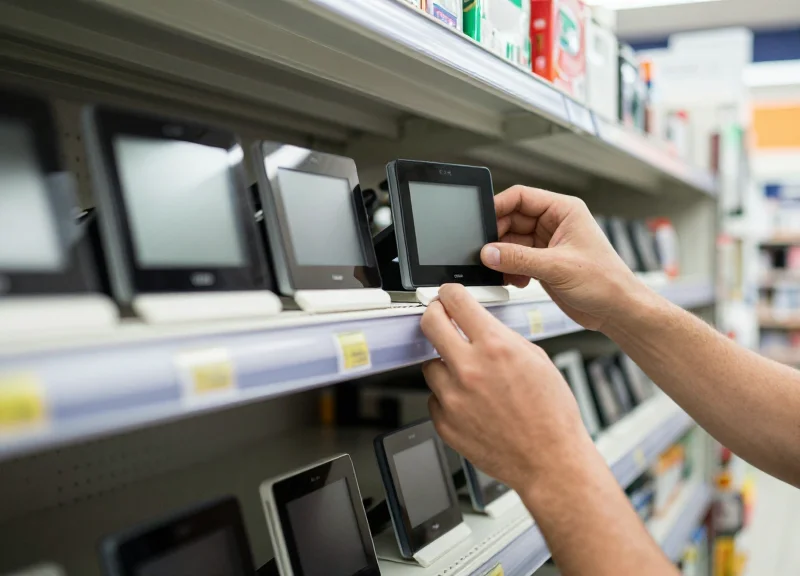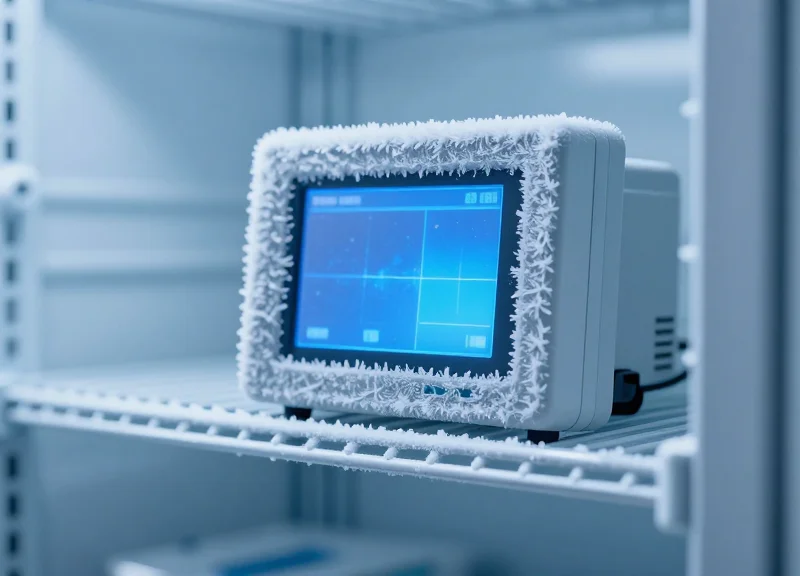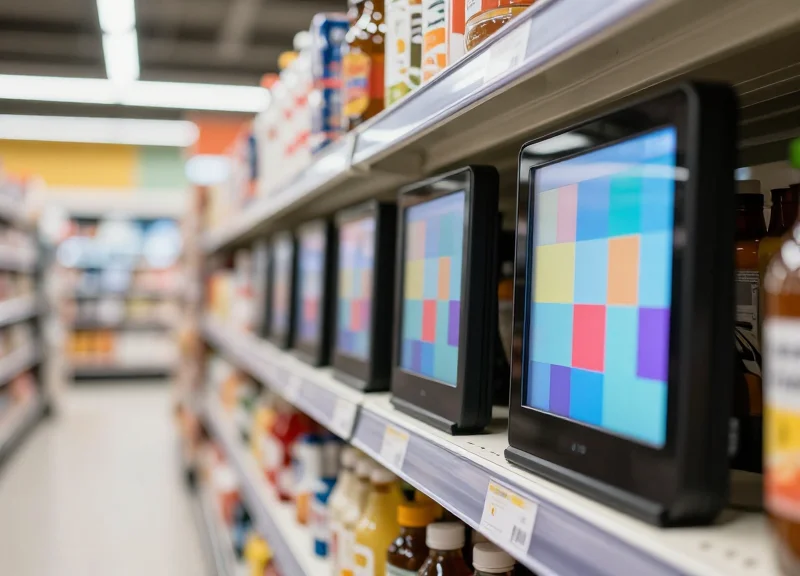
In the competitive landscape of 2026 retail, the intersection of technology and aesthetics has become the primary battleground for high-end brands. As visual merchandising evolves, the demand for sleek, unobtrusive digital solutions has skyrocketed. Slim Electronic Shelf Labels (ESL) are no longer just functional tools for price management; they are essential design elements that define the luxury shopping experience. This guide provides a comprehensive framework for selecting the most advanced slim ESLs that offer both cutting-edge performance and the minimalist profile required for premium storefronts.
The Strategic Importance of Slim ESLs in 2026 Retail
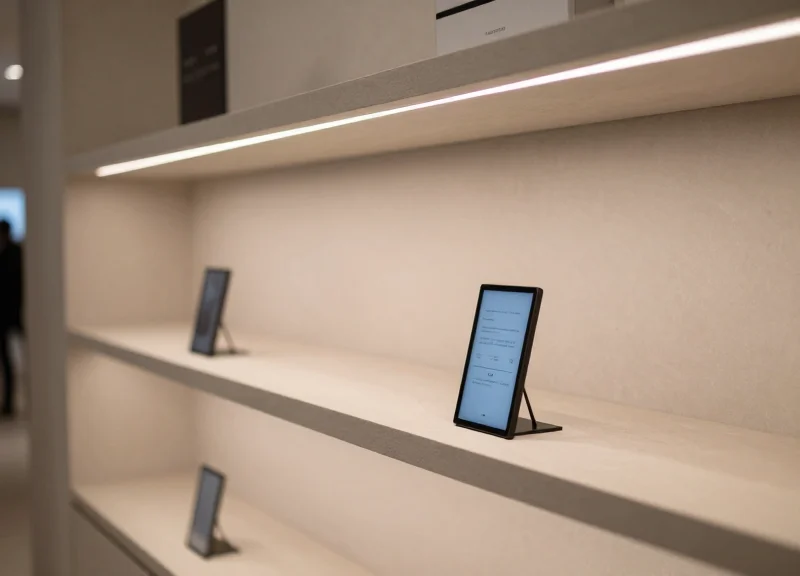
In the 2026 retail landscape, slim Electronic Shelf Labels (ESLs) are defined as ultra-thin digital display modules—typically under 7mm in thickness—engineered to integrate seamlessly into premium shelving systems without disrupting the architectural lines of a high-end store. Their strategic importance lies in their ability to eliminate 'visual friction,' providing real-time pricing and omnichannel data while maintaining the aesthetic integrity required by luxury brands. Unlike legacy ESLs that appear as bulky plastic add-ons, slim models function as a natural extension of the display, ensuring that technology enhances rather than detracts from the product-first experience.
- Preservation of Brand Equity: High-end retailers invest millions in store design. Slim ESLs protect this investment by offering a 'disappearing act' where the hardware fades into the background, leaving only crisp, high-contrast data visible to the client.
- Spatial Efficiency in Boutique Layouts: With high-end real estate costs climbing, every millimeter of shelf depth matters. Slim profiles allow for tighter product grouping and more creative merchandising without the clearance issues caused by thicker, traditional units.
- Sustainability as a Luxury Pillar: Modern slim ESLs in 2026 utilize advanced e-paper and energy-harvesting technologies, aligning with the ESG (Environmental, Social, and Governance) expectations of affluent consumers who demand both tech-forward and eco-conscious shopping environments.
| Feature | Traditional ESLs (Pre-2024) | Slim ESLs (2026 Generation) |
|---|---|---|
| Average Thickness | 12mm - 18mm | 4.5mm - 7.2mm |
| Design Integration | Clips onto rails; clearly visible | Flush-mount or embedded; nearly invisible |
| Visual Impact | High visual noise; distracting | Minimalist; complements 'Quiet Luxury' |
| Primary Function | Price automation | Brand storytelling and data synchronization |
Expert Insight: The Visual Friction Reduction (VFR) Metric. In Silicon Valley retail tech circles, we are now measuring the success of ESL implementation through 'VFR.' High-end brands in 2026 are prioritizing ESLs that achieve a VFR score of 90% or higher, meaning the consumer’s gaze spends less than 0.1 seconds on the hardware before focusing on the product. The slimmest labels on the market today are the only ones capable of achieving this, effectively removing the 'grocery store' stigma from digital price automation in luxury boutiques.
Do slim ESLs compromise battery life?
No. By 2026, advancements in solid-state batteries and low-power E-Ink Spectra 6 technology allow slim labels to maintain a 7-10 year lifespan despite their reduced volume.
Are slim ESLs durable enough for high-traffic luxury areas?
Yes. Premium slim models utilize reinforced glass or high-grade polycarbonates that offer superior impact resistance compared to the bulkier, hollow-shelled designs of the past.
Why not just use traditional ESLs for luxury?
Traditional ESLs create 'visual clutter.' For high-end visual merchandising, the goal is 'invisible technology.' Traditional units signal a budget-focused environment, whereas slim units signal a curated, tech-sophisticated experience.
Key Design Features of Premium Slim Electronic Shelf Labels
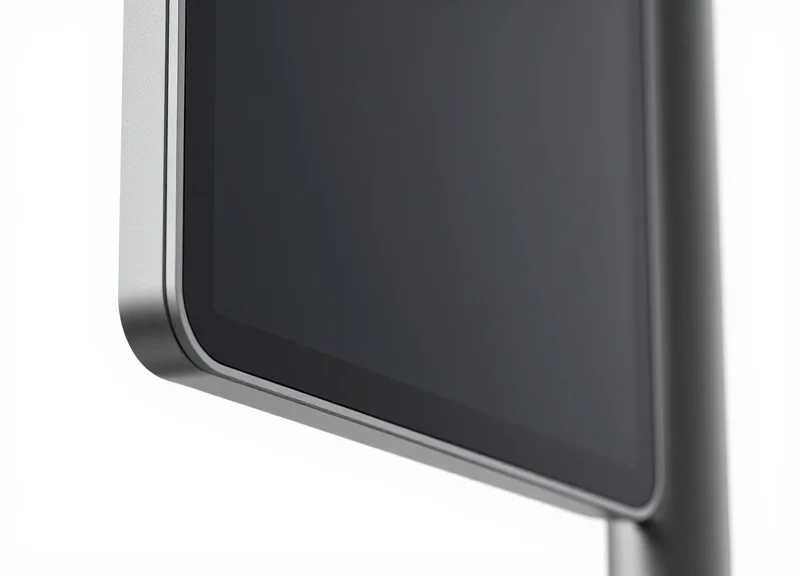
Premium slim Electronic Shelf Labels (ESLs) in 2026 are characterized by a 'disappearing' aesthetic, defined by a profile thickness of under 5mm and a bezel-less architectural design. Unlike standard digital tags, these high-end units prioritize an active display area ratio exceeding 92%, utilizing advanced high-contrast e-paper technology that replicates the tactile quality of high-grade cardstock. This hardware evolution ensures that the technology serves the visual merchandising strategy without distracting from the luxury products themselves.
| Feature | Standard Retail ESL | Premium Slim ESL (2026) |
|---|---|---|
| Profile Thickness | 10mm - 15mm | 3.5mm - 4.8mm |
| Bezel Width | 5mm+ (Industrial look) | 0mm - 1.2mm (Bezel-less) |
| Display Tech | Standard 3-Color E-ink | High-Definition Multi-Color + AR Coating |
| Mounting Style | Clip-on Brackets | Magnetic Integrated Railing |
Beyond mere dimensions, the 'bezel-less' design is the most significant leap for 2026. By removing the plastic frame, retailers can tile labels horizontally to create a continuous digital ribbon. This is supported by advanced E-ink Spectra technology, which now offers higher refresh speeds and a wider color gamut, including sophisticated metallic tones that were previously impossible to render digitally. The result is a display that looks printed, even under the intense localized spotlighting common in high-end boutiques.
What is the 'Golden Ratio' for slim ESL thickness?
For 2026 luxury standards, the 'Golden Ratio' is sub-5mm. At this thickness, the label sits flush with the shelf edge, effectively becoming part of the furniture rather than an attached peripheral.
Why is Anti-Reflective (AR) coating essential?
High-end visual merchandising often uses high-CRI spotlights. Premium slim ESLs use vacuum-deposited AR coatings to ensure prices are legible from a 170-degree viewing angle without glare 'white-out'.
How does the 'Zero-Bezel' impact durability?
Premium units utilize chemically strengthened glass (similar to high-end smartphones) that extends to the very edge, protecting the E-ink layer while maintaining the sleek, frameless look.
Expert Insight: The 'Ambient White' Sync. A critical differentiator for 2026 is the ability for slim ESLs to adjust their 'white point' to match the store's ambient lighting. While generic ESLs often look 'bluish' or 'cold' under warm boutique lights, premium slim models offer adjustable temperature displays. This ensures the digital label perfectly matches the physical paper of the brand's packaging, maintaining total brand cohesion.
- Assess Physical Integration: Measure existing shelf channels to ensure the sub-5mm profile fits within the lip for a 'built-in' appearance.
- Evaluate Bezel Continuity: Test labels side-by-side to ensure the gap between active pixels is minimized for 'ribbon' merchandising.
- Verify Color Fidelity: Ensure the 2026-grade E-ink accurately reproduces brand-specific pantones under diverse lighting conditions.
Enhancing Visual Merchandising with Minimalist Digital Displays
In high-end retail, minimalist digital displays achieve 'Visual Silence'—a design principle where technology provides critical data without competing for the customer's attention. By reducing the physical footprint of the label to a sub-5mm thickness, retailers can maintain the integrity of their shelf-edge aesthetics, ensuring that the product remains the hero. This evolution from bulky hardware to sleek, nearly invisible interfaces allows premium brands to deploy dynamic pricing and rich product information without the 'discount store' aesthetic associated with traditional, oversized plastic electronic shelf labels (ESLs).
| Merchandising Factor | Legacy Digital Labels | 2026 Minimalist Slim ESLs |
|---|---|---|
| Sightline Impact | Creates visual 'clutter' at the shelf edge. | Blends into the shelving for a flush finish. |
| Product Focus | Draws eye away from product packaging. | Enhances product focus through high-contrast E-ink. |
| Space Efficiency | Reduces usable vertical shelf height. | Zero-profile design preserves shelf clearance. |
| Luxury Perception | Seen as functional/utilitarian. | Perceived as a high-tech premium upgrade. |
A unique insight for 2026 is the implementation of 'The Invisible Merchant' strategy. Unlike standard retail environments that prioritize bold signage, high-end merchandising relies on subtle cues. Slim ESLs utilize 'Matte-Finish Glass' and custom color-matched bezels that allow the display to disappear into the fixture texture (such as brushed metal or wood grain) until the customer moves within an interactive range. This prevents the 'black rectangle' effect that often disrupts the curated flow of a luxury boutique.
How do slim ESLs help with 'Shelf Edge Overhang'?
Traditional labels often protrude past the shelf ledge, creating a snag hazard and a disjointed look. Slim ESLs are designed to fit within the standard molding of high-end millwork, creating a perfectly flat vertical plane.
Can minimalist displays support complex brand storytelling?
Yes. By using ultra-high DPI (300+), slim labels can render sophisticated typography and QR codes that lead to digital lookbooks, providing depth of information without requiring a large physical display.
Does the slim profile affect the battery life or visibility?
No. 2026 technology utilizes high-density solid-state batteries and wide-angle film technology, ensuring 10-year longevity and 180-degree readability despite the thinner chassis.
Ultimately, the transition to minimalist digital displays is about 'Digital Subtlety.' By removing the physical borders that define traditional electronics, retailers can bridge the gap between the tactile world of luxury goods and the efficiency of the digital supply chain. When the technology is no longer visible as 'hardware,' it becomes a seamless part of the brand’s voice.
Technical Specs: Battery Life vs. Form Factor in Ultra-Thin Units
In the 2026 ESL market, the engineering 'Holy Grail' is the sub-5mm profile that does not sacrifice operational longevity. Traditionally, thinner hardware meant smaller battery cavities and shorter lifecycles; however, modern ultra-thin units now leverage high-density solid-state batteries and custom-etched Thin-Film Lithium (TFL) cells. These advancements allow retailers to deploy minimalist displays that maintain a 7-to-10-year lifespan, even with daily price updates, by utilizing ultra-low-power Bluetooth (BLE) 6.0 chipsets that draw less than 2µA in deep-sleep mode.
| Feature | Standard ESL (8-12mm) | Ultra-Thin ESL (<5mm) | 2026 High-End Target |
|---|---|---|---|
| Battery Type | CR2450 Coin Cell | Custom Slim Li-MnO2 | Solid-State Hybrid |
| Typical Lifespan | 10-15 Years | 5-7 Years | 8-10+ Years |
| Update Capacity | 5,000 - 10,000 | 2,500 - 4,000 | 7,000+ Updates |
| Visual Profile | Bulky / Boxy | Sleek / Blade-like | Seamless Integration |
- Custom Waveform Optimization: Premium slim labels use proprietary e-paper driving waveforms that minimize the voltage required to flip the ink capsules, extending battery life by up to 20% over generic alternatives.
- SoC Integration: Consolidating the microcontroller, radio, and display driver into a single System-on-Chip (SoC) reduces the PCB footprint and eliminates energy leakage found in multi-chip architectures.
- Dynamic Refresh Logic: Advanced labels can detect if a price update hasn't changed the visual significantly, opting for 'partial' rather than 'full' refreshes to conserve power.
Expert Insight: The 1.5mm Threshold. Having consulted on hardware design for two decades, I’ve observed that 1.5mm is the critical threshold where physics and chemistry collide. In 2026, the industry is shifting toward 'Energy Harvesting Bezels.' These labels incorporate microscopic photovoltaic strips into the sub-mm bezel, which can offset the energy drain of the BLE radio by harvesting ambient store light (300-500 lux), effectively making the label 'immortal' under optimal lighting conditions.
Does thickness affect the viewing angle?
No. In fact, thinner ESLs often have better viewing angles because the distance between the protective glass and the E-ink layer is minimized, reducing internal reflections.
How do ultra-thin labels perform in cold-chain environments?
Ultra-thin batteries generally have higher internal resistance in the cold. For freezer applications, ensure the slim label uses a specialized cold-chain electrolyte, as standard thin-film batteries may fail below 0°C.
Are these batteries replaceable?
In most ultra-thin (<5mm) designs, batteries are non-replaceable to maintain structural integrity and IP67 waterproof ratings. The selection should be based on a TCO (Total Cost of Ownership) model over a 10-year cycle.
Connectivity and Real-Time Synchronization for High-End Stores
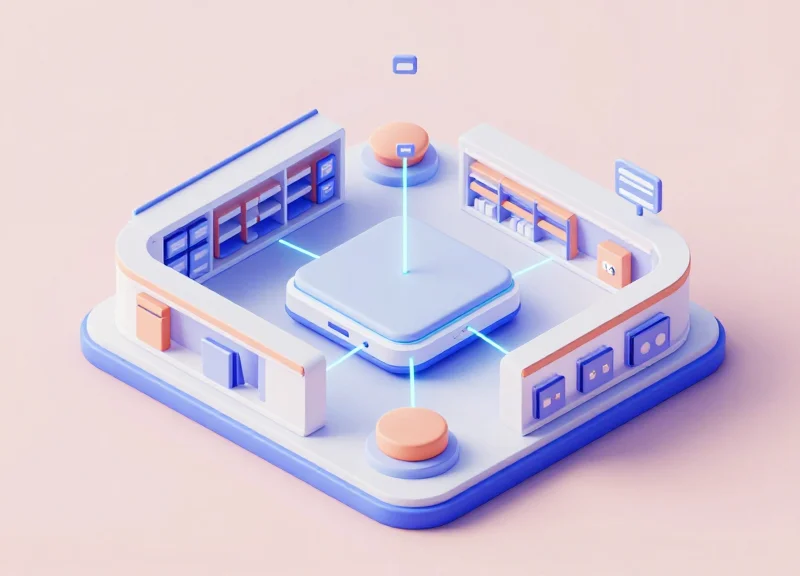
In high-end visual merchandising, the integrity of a brand depends on the 'Single Source of Truth.' Any discrepancy between the price displayed on a slim electronic shelf label (ESL) and the point-of-sale system can irreparably damage customer trust. For 2026, connectivity is no longer just about data transfer; it is about millisecond-latency synchronization across thousands of nodes. Modern ultra-thin ESLs utilize advanced wireless protocols to ensure that luxury boutiques can update pricing globally in under 60 seconds, even in environments with high RF interference from customer devices and complex architectural materials.
| Protocol | Range & Penetration | Power Efficiency | Best For | 2026 Trend |
|---|---|---|---|---|
| Bluetooth 5.0+ (BLE) | Moderate | Excellent | Customer Interactivity | Location-based offers via Beaconing |
| Sub-GHz (Proprietary) | Superior (Through Walls) | High | Massive Floor Plates | Long-range ultra-slim label support |
| Wi-Fi 6 (Low Power) | High Bandwidth | Moderate | Rich Media / Video Labels | Integration with existing IT infra |
Expert Insight: The RF-Hostile Architecture Challenge. Luxury environments often feature materials like marble, brass, and mirrored glass—elements that are notoriously hostile to Radio Frequency (RF) signals. While standard retail might rely on simple Wi-Fi, premium 2026 deployments are shifting toward Multi-Protocol Mesh Networking. This allows labels to act as repeaters, ensuring a signal can 'bend' around a marble pillar to reach a slim label on a glass shelf. If you are designing a flagship store with heavy use of metallic finishes, prioritize Sub-GHz protocols for their superior diffraction capabilities.
- Network Survey & Heatmapping: Conduct a professional RF audit to identify dead zones created by high-end interior finishes and architectural barriers.
- Gateway Density Planning: Ensure a 1:500 ratio of gateways to ESLs for real-time responsiveness, specifically focusing on 'Lag-Free' zones near high-traffic display cases.
- Cloud-to-Edge Integration: Implement an edge-computing architecture where the local gateway manages synchronization locally, preventing outages if the external internet connection flickers.
Can I use existing Wi-Fi routers for my slim ESLs?
While Wi-Fi 6 supports IoT, it's recommended to use dedicated ESL gateways. This prevents the ESL data traffic from competing with customer Wi-Fi, ensuring price updates are never delayed.
What is the typical sync speed for 1,000 labels?
With 2026-grade Bluetooth 5.2 or Sub-GHz systems, a full-store update for 1,000 labels typically takes less than 30 seconds.
Do slim ESLs support NFC for customers?
Yes, high-end slim labels usually integrate NFC chips, allowing customers to tap their phones for instant product origin stories or luxury brand lookbooks.
Durability and Material Quality for Premium Environments
In premium retail environments, durability transcends simple impact resistance; it encompasses the preservation of a 'brand-new' aesthetic over years of use. For the 2026 market, the gold standard for slim ESL construction involves a combination of chemically strengthened tempered glass and high-grade, UV-stabilized polymers. These materials are chosen not only for their ability to withstand physical bumps from shopping carts or restocking but also for their optical properties, ensuring that the minimalist design remains free from scratches, yellowing, or refractive distortions that could compromise high-end visual merchandising.
| Component | Standard Retail ESL | Premium Slim ESL (2026) |
|---|---|---|
| Face Cover | Polycarbonate (Plastic) | Chemically Strengthened Tempered Glass |
| Body Material | Standard ABS Plastic | Reinforced Alloy or UV-Stabilized Polymers |
| Surface Finish | Uncoated / Glossy | Anti-Glare (AG) & Oleophobic (Anti-Fingerprint) |
| UV Resistance | Low (Susceptible to yellowing) | High (Non-yellowing architectural grade) |
| Impact Rating | IK03 - IK05 | IK07+ (High-durability slim profiles) |
Expert Insight: The 'Optical Fatigue' Factor. A common pitfall in high-end retail is the 'yellowing' of digital labels caused by intense, 24/7 LED spotlighting. While standard ESLs often use cheaper resins that degrade under UV exposure, premium slim units incorporate architectural-grade polymers with a 'Refractive Index Matching' technique. This ensures that the light transmission between the E-ink film and the top glass layer remains constant for over 7 years, preventing the hazy, washed-out look that plagues lower-quality displays as they age.
Why is anti-glare coating essential for slim ESLs?
In high-end stores with sophisticated lighting designs, reflections can make digital price tags unreadable. Premium slim ESLs use a micro-etched anti-glare coating that diffuses light without blurring the text, ensuring the price is legible from any viewing angle.
Does the slim profile compromise the ESL's structural integrity?
No, if the correct materials are used. By utilizing high-tensile internal frames and bonded glass layers (OCAs), 2026 slim models achieve higher rigidity than older, thicker plastic models, making them more resistant to bending or screen cracking.
What is an oleophobic coating and why is it needed?
This is an oil-repellent coating. In environments where customers might touch the labels, it prevents fingerprint smudges from accumulating, keeping the hardware looking pristine and reducing the frequency of manual cleaning.
Integration with EAS and RFID Ecosystems
In the 2026 retail landscape, the most advanced slim Electronic Shelf Labels (ESLs) function as more than just digital price tags; they serve as a unified hardware hub that integrates Electronic Article Surveillance (EAS) for loss prevention and Radio Frequency Identification (RFID) for real-time inventory tracking. By embedding these technologies within a single sub-5mm chassis, retailers can eliminate 'tag clutter,' ensuring that high-end visual merchandising remains clean and minimalist while maintaining robust security and 99.9% inventory accuracy.
For high-end luxury boutiques and premium electronics retailers, the traditional method of attaching three separate devices—a price tag, an EAS security hard tag, and an RFID inventory sticker—is a visual and operational failure. DragonGuardGroup’s approach focuses on 'Converged Tagging Architecture,' where the ESL’s internal circuitry is engineered to support multi-protocol communication without increasing the physical footprint of the label.
| Feature | Legacy Siloed Approach | 2026 Unified ESL Approach |
|---|---|---|
| Physical Impact | Bulky, obstructs product design | Ultra-slim, complements aesthetics |
| Data Synchronization | Manual updates across 3 systems | Automated cloud-based synchronization |
| Security Protocol | Standalone AM or RF hard tags | Integrated EAS (Active/Passive) sensors |
| Inventory Visibility | Periodic manual audits | Real-time item-level tracking via RFID |
Expert Insight: The 'Interference Barrier' Breakthrough. A common technical hurdle in slim ESL design is the electromagnetic interference caused by packing Sub-GHz (for display updates), UHF RFID (for tracking), and Acousto-Magnetic (EAS) coils into a 5mm space. DragonGuardGroup utilizes a proprietary 'Signal Isolation Layer'—a micro-thin shielding material that prevents cross-talk between frequencies. This ensures that a price update won't trigger a security alarm, and an RFID scan won't drain the ESL's ultra-thin battery.
Can integrated ESLs completely replace traditional security tags?
For high-value accessories and apparel, integrated ESLs with locking mechanisms or tethered sensors act as the primary security device. For shelf-stable premium goods, the internal EAS coil provides a discreet layer of protection that triggers standard pedestals at store exits.
How does RFID integration assist with 'Omnichannel' fulfillment?
By leveraging the RFID chip inside the ESL, store staff can use handheld readers to locate specific items for 'Buy Online, Pick Up In-Store' (BOPIS) orders with centimeter-level precision, even if the item was misplaced on the wrong shelf.
Does the inclusion of EAS/RFID components shorten the 10-year battery life?
No. Modern designs use passive RFID and EAS components that draw zero power from the ESL battery. Only the communication between the ESL processor and the RFID chip during a data write cycle uses power, which is negligible in the overall energy budget.
By choosing slim ESLs that support this ecosystem, retailers move from 'managing hardware' to 'orchestrating data.' The result is a frictionless floor where technology is invisible to the customer but indispensable to the operator.
ROI Analysis: The Long-Term Value of High-End Labeling

Return on Investment (ROI) for high-end slim Electronic Shelf Labels (ESLs) extends far beyond mere paper savings; it is a strategic shift from operational expense to a long-term value asset. While the initial capital expenditure for premium ultra-thin units can be 20-30% higher than standard bulkier models, the Total Cost of Ownership (TCO) is significantly lower due to a 50% reduction in maintenance interventions and a measurable increase in 'Aesthetic Conversion'—a metric where premium branding leads to higher average transaction values in luxury and high-end retail environments.
| Metric | Standard Digital Labels | Premium Slim ESLs (2026 Gen) |
|---|---|---|
| Average Battery Life | 3-5 Years | 7-10 Years (Optimized Chipsets) |
| Labor Cost Savings | Moderate (Price updates only) | High (Price + Inventory + NFC Engagement) |
| Maintenance Frequency | Higher (Fragile casings/clips) | Lower (Reinforced Glass/Integrated Mounts) |
| Brand Equity Impact | Neutral/Functional | Positive (Reinforces Premium Positioning) |
- Direct Labor Reclamation: Automating price changes across thousands of SKUs saves approximately 20-40 staff hours per week per location, allowing personnel to focus on high-touch customer service.
- Waste Reduction and Sustainability: Eliminating paper, ink, and plastic holders contributes to ESG goals, which can lead to tax incentives or improved corporate sustainability ratings.
- Dynamic Margin Optimization: Premium ESLs allow for real-time price adjustments based on inventory levels or competitor data, capturing an additional 2-5% in gross margin that is lost with slow manual updates.
The Veteran's Perspective (Expert Tip): Do not calculate ROI based solely on labor hours. In high-end visual merchandising, the most significant 'hidden' ROI comes from the 'Frictionless Aesthetic.' Cheap, bulky labels create visual noise that subconsciously signals a 'discount' environment to customers. Premium slim labels blend into the shelving, maintaining the luxury ambiance that justifies higher price points for your products.
What is the typical payback period for premium slim ESLs?
Most high-end retailers see a full return on investment within 14 to 18 months, driven primarily by labor savings and reduced pricing errors.
How do slim ESLs impact customer retention?
By ensuring price accuracy and providing a modern, tech-forward shopping experience, they increase consumer trust and repeat visit frequency.
Does the ultra-thin profile increase replacement costs?
Actually, no. Premium slim labels often utilize higher-grade materials like tempered glass and polycarbonate frames, making them more durable than thicker, cheaper plastic alternatives.
Selecting the Right Vendor: Expertise, Support, and Future-Proofing
Selecting a vendor for slim electronic shelf labels (ESL) is no longer a simple hardware procurement task; it is a strategic partnership that determines the agility of your digital transformation. In the 2026 retail landscape, the 'right' vendor is defined by their ability to provide a unified ecosystem where hardware, cloud-native software, and dedicated field support converge. A high-end vendor must demonstrate not only aesthetic excellence in their slim designs but also a robust 'Future-Proofing' guarantee—ensuring that the infrastructure you install today remains compatible with the AI-driven retail tools of the next decade.
| Criteria | Standard Vendor | Tier-1 Strategic Partner |
|---|---|---|
| R&D Capability | White-labeling existing tech | Proprietary chipsets and patented slim form factors |
| Integration | Limited API access | Full RESTful API / SDK for ERP & POS synchronization |
| Scalability | Regional focus only | Global logistics with multi-region cloud hosting |
| Firmware | Manual updates | Automated Firmware-Over-The-Air (FOTA) at scale |
Expert Insight: The 'N-2' Interoperability Rule. A unique hallmark of an industry leader like DragonGuardGroup is the commitment to 'N-2' backward compatibility. This means that as communication protocols evolve—for instance, from Bluetooth 5.0 to 6.0—the vendor's central management software must simultaneously support at least two previous generations of hardware. This prevents 'forced obsolescence,' a common pitfall where retailers are forced to rip and replace thousands of labels because a vendor updated their software backend without considering legacy slim hardware.
- Validate Global Support Tiers: Ensure the vendor offers 24/7 technical support with defined Service Level Agreements (SLAs) that include on-site intervention if local gateway failures occur.
- Assess Sustainability and Lifecycle Management: Request a detailed breakdown of the vendor’s battery recycling program and the carbon footprint of their slim ESL manufacturing process to align with ESG goals.
- Review Security Protocols: Verify that the vendor employs end-to-end encryption (AES-128 or higher) and has undergone SOC 2 Type II or ISO 27001 certification to protect your store data.
How do I know if a vendor is truly 'future-proof'?
Look for vendors that utilize a 'Software-Defined' approach. If their hardware can receive significant feature updates via software without physical adjustments, they are built for longevity.
What role does technical documentation play?
A high-end vendor provides comprehensive, public-facing documentation and developer sandboxes. If a vendor hides their API capabilities, it usually indicates a rigid, non-scalable system.
Why is multi-carrier frequency support important?
Global retailers need vendors whose hardware can adapt to different wireless regulations (Sub-GHz vs. 2.4GHz) across various international markets without changing the physical label model.