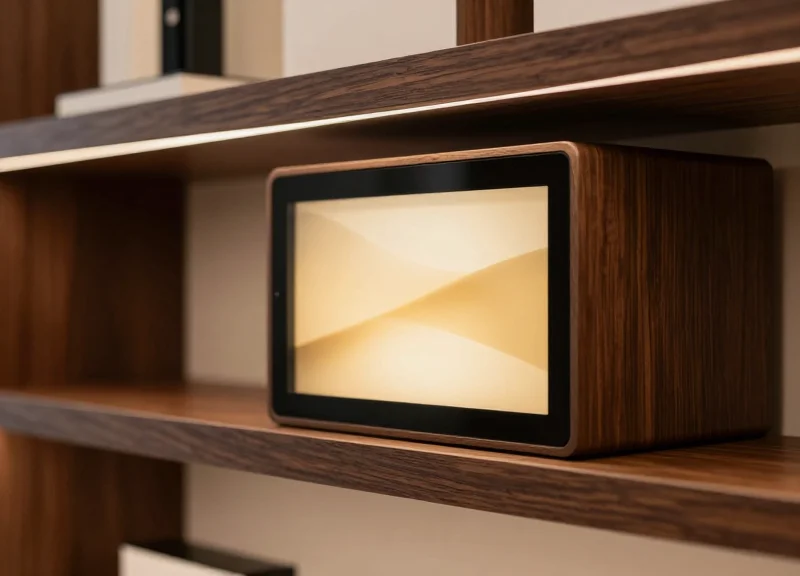
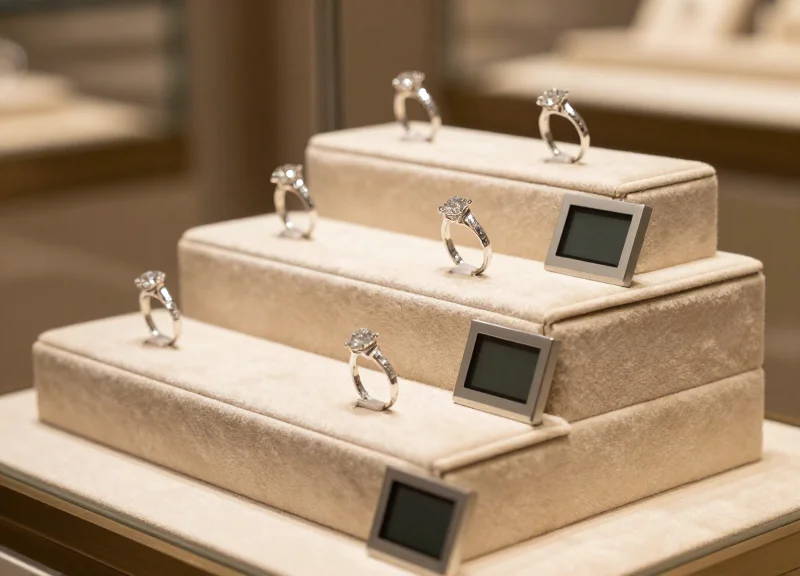
In the high-stakes world of luxury retail, aesthetics are everything. Jewelry counters present a unique challenge: providing clear, real-time pricing via Electronic Shelf Labels (ESL) without cluttering the display or distracting from the brilliance of the gems. This guide explores the precision installation of 2.13-inch ESLs—the gold standard for jewelry displays—specifically designed for complex multi-tiered layouts. We will bridge the gap between digital efficiency and high-end visual merchandising to ensure your store stays modern and elegant.
Why 2.13-inch ESLs are the Industry Standard for Jewelry
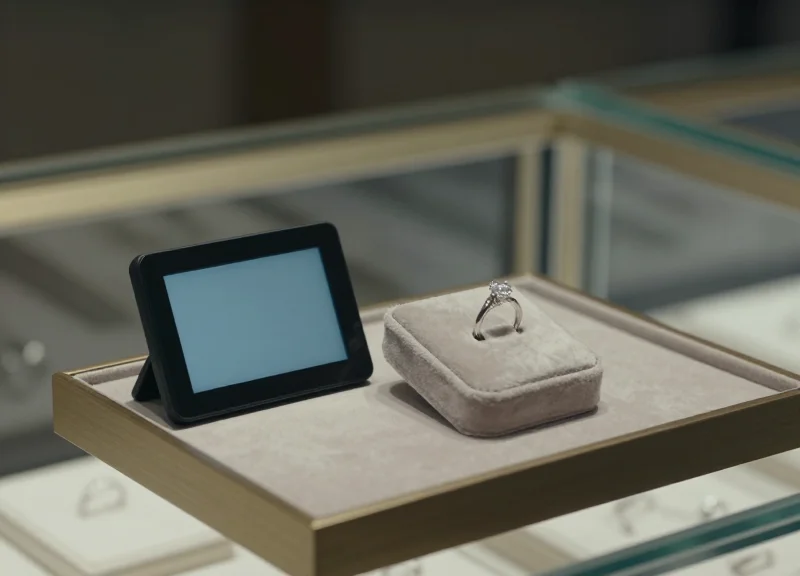
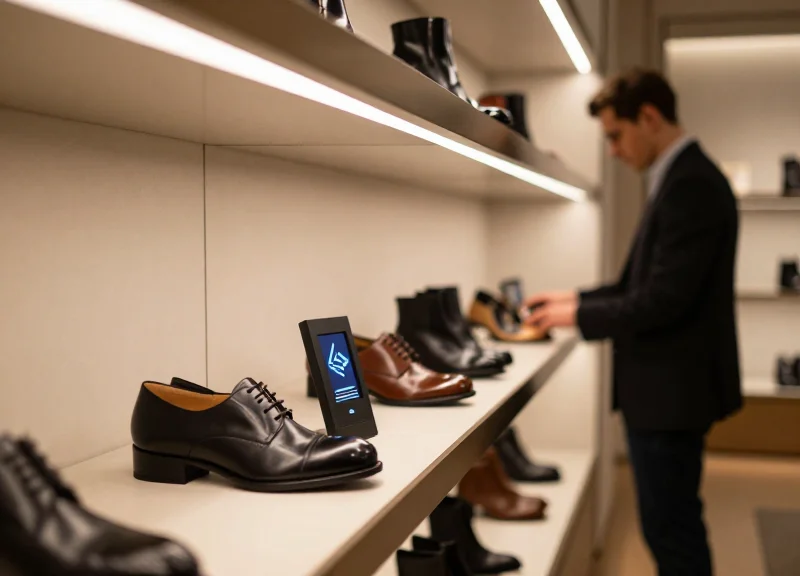
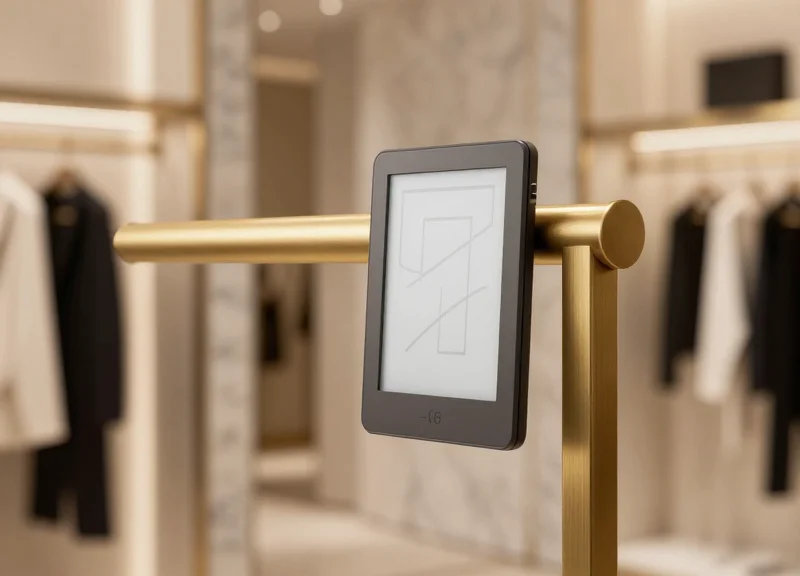
The 2.13-inch Electronic Shelf Label (ESL) has emerged as the industry standard for jewelry retailers because it provides the ideal balance between high-density data visualization and a non-intrusive physical footprint. Measuring approximately 48mm by 23mm, this specific form factor allows for the display of complex item specifications—such as carat weight, clarity, and dynamic QR codes—while remaining small enough to be tucked discreetly into velvet watch rolls or ring slots without obstructing the view of the merchandise.
| Feature | 2.13-inch ESL | Smaller (1.54-inch) | Larger (2.9-inch) |
|---|---|---|---|
| Visual Impact | Balanced/Professional | Too small for complex text | Visually overwhelming |
| Typical Resolution | 250 x 122 pixels | 152 x 152 pixels | 296 x 128 pixels |
| Case Compatibility | High (Multi-tier friendly) | High (But limited data) | Low (Bulky for jewelry) |
| Readability | Excellent for 6pt fonts | Poor for micro-text | Excellent (But uses too much space) |
Expert Insight: The 'Invisible Tech' Principle. In luxury retail, technology should be felt, not seen. My experience with high-end boutiques shows that the 2.13-inch model is the only size that achieves 'Visual Density Equilibrium.' This means it has enough pixel density to render the serif fonts used by luxury brands perfectly, whereas smaller screens often force a move to lower-quality sans-serif fonts that can cheapen the brand perception.
- Aspect Ratio Symmetry: The elongated 2:1 ratio of the 2.13-inch screen mimics the shape of traditional premium price tags, making the digital transition feel natural to legacy customers.
- Multi-Tier Optimization: Its low profile allows it to be mounted on the front edge of multi-tiered steps without blocking the light or the view of items on the level below.
- Energy Efficiency: Despite the higher resolution, these modules are optimized for 5-10 year battery lives, crucial for displays that are rarely opened to minimize security risks.
Can the 2.13-inch ESL display gold prices in real-time?
Yes, when integrated with an ERP or API feeding live market data, the ESL can update prices across an entire store in seconds to reflect market fluctuations.
Is the screen bright enough for high-glare jewelry cabinets?
ESLs use E-Ink technology, which is reflective rather than emissive. This means the brighter the cabinet lights, the clearer and sharper the display appears, eliminating the glare issues common with LCD screens.
Does the 2.13-inch size support QR codes?
Absolutely. It has sufficient resolution to display high-density QR codes that customers can scan to view certification details, styling videos, or insurance options.
Analyzing the Multi-Tiered Counter Challenge
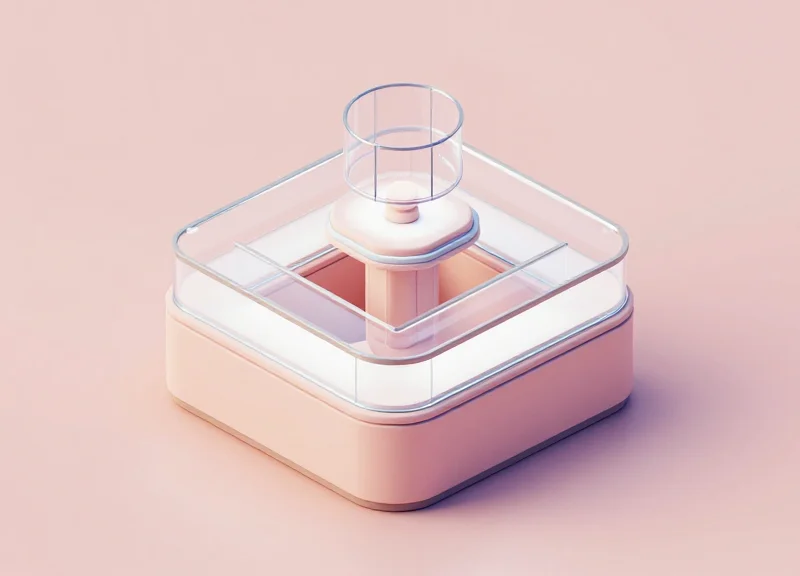
In luxury jewelry retail, the multi-tiered counter is a strategic architectural choice designed to maximize product visibility and create a sense of 'depth' within a limited footprint. However, integrating 2.13-inch Electronic Shelf Labels (ESLs) into these layered environments introduces a complex spatial puzzle. The primary challenge lies in the 'Visual Collision'—where the digital hardware intended to modernize the store inadvertently blocks the customer’s view of the jewelry behind it or creates a cluttered 'staircase' effect that detracts from the brand's premium identity. Successful integration requires balancing the technological footprint with the invisible sightlines essential for high-end merchandising.
| Challenge Factor | Common Pitfall | The Luxury Standard |
|---|---|---|
| Vertical Sightlines | Labels on lower tiers obscure the view of items on the upper tiers. | Low-profile mounting with negative tilt angles to preserve product focus. |
| Light Obstruction | ESL hardware casts shadows on jewelry when placed too close to LED strips. | Offset positioning that leverages existing showcase lighting without interference. |
| Hardware Bulk | Generic plastic clips make the counter look industrial and cheap. | Custom-milled, ultra-thin brackets finished in matte or metallic tones. |
| Information Density | Screen clutter caused by poorly formatted data on the 2.13-inch display. | Minimalist UI design focusing on the price and a single QR code for details. |
Expert Insight: The 15-Degree Rule. My experience in Silicon Valley retail tech deployments has shown that the most common mistake is a 'flat' installation. On multi-tiered displays, the human eye approaches each level at a different angle. For the top tier, a 15-degree upward tilt is often required to avoid ceiling light glare, while the bottom tier requires a 30-degree tilt to remain readable from a standing position. Without considering these 'Gaze Angles,' even the most advanced 2.13-inch ESL will fail to deliver a premium experience.
How do I prevent ESLs from making the display look cluttered?
The key is 'Visual Recess.' Instead of placing labels in front of the jewelry, integrate them into the tier riser or use transparent acrylic stands that disappear under showcase lighting.
Will the 2.13-inch size block my smallest jewelry items?
While 2.13 inches is the industry standard for readability, positioning is critical. On tiered displays, labels should be offset to the left or right of the central focal point to allow the product's silhouette to remain unobstructed.
How do I handle the 'shadowing' effect from the tiers above?
Shadowing occurs when the ESL is tucked too far under the overhang of the next tier. Ensure a minimum 2-inch clearance from the tier above or utilize side-lighting to neutralize hardware-cast shadows.
Pre-Installation Planning: Measuring Angles and Lighting
Pre-installation planning for 2.13-inch Electronic Shelf Labels (ESLs) in jewelry counters centers on the 'Sightline-Lighting Intersection.' This is the geometric sweet spot where the digital display remains perfectly legible to a standing customer (typically viewed from a height of 150cm to 170cm) while the screen surface is angled specifically to deflect high-intensity overhead spotlights. Failure to map these variables results in 'digital washouts'—where the E-ink display becomes unreadable due to specular reflection from the jewelry case's glass or the ESL's own protective lens.
| Display Tier | Typical Height from Floor | Recommended ESL Tilt Angle | Primary Sightline Focus |
|---|---|---|---|
| Top Tier (Eye Level) | 110cm - 125cm | 5° - 10° Forward | Macro-viewing (Rings, Earrings) |
| Middle Tier (Chest Level) | 90cm - 105cm | 15° - 25° Backward | Standard Interaction (Necklaces) |
| Base Tier (Counter Level) | 75cm - 85cm | 35° - 45° Backward | Deep Discovery (Watches, Sets) |
When dealing with multi-tiered counters, the 'occlusion factor' is your primary enemy. You must ensure that the ESL on a higher tier does not cast a shadow over the jewelry on the tier below. This requires a staggered placement strategy where the ESLs are offset laterally from the main jewelry pieces, rather than placed directly in front of them.
- Identify Light Source Vectors: Use a digital inclinometer to measure the angle of your ceiling spotlights. To avoid glare, the ESL screen angle must never be perpendicular to the light's incident ray.
- Determine the 'Golden Viewing Arc': Mark the floor 30cm back from the display glass. This represents the average customer standing position. Measure the line of sight from this point to each tier to calculate the optimal screen pitch.
- Conduct a Lux Gradient Test: Measure the brightness on the shelf surface. E-ink displays perform best at 300-500 lux; if your jewelry spots are hitting 1000+ lux, you must use matte-finish ESL overlays to maintain legibility.
- Simulate the Shadow Map: Place a physical 2.13-inch mockup in the case to ensure the height of the ESL unit (approx 35mm) doesn't obstruct the lower-tier viewing angles for shorter customers.
Expert Insight: The 30-Degree Incident Rule. In twenty years of tech-retail integration, I have found that tilting the ESL exactly 30 degrees away from the primary light vector—not the viewer—is the secret to 'disappearing' the hardware. By controlling the reflection of the glass substrate rather than just the E-ink layer, the tag feels like a physical part of the velvet or silk display rather than a piece of plastic technology.
Can I use the same angle for all tiers?
No. Using a uniform angle across multiple tiers leads to neck fatigue for customers and increases the likelihood of overhead light glare on at least one level.
How do I handle internal case LEDs?
Internal strip lighting is often more problematic than ceiling spots. Position ESLs at least 5cm away from internal LED strips to prevent 'light bleeding' across the E-ink margin.
Does the jewelry color affect ESL placement?
Yes. Darker setups (black velvet) emphasize screen glare more than light setups (white/cream). Use more aggressive tilt angles on dark backgrounds.
Selecting the Right Mounting Hardware and Brackets
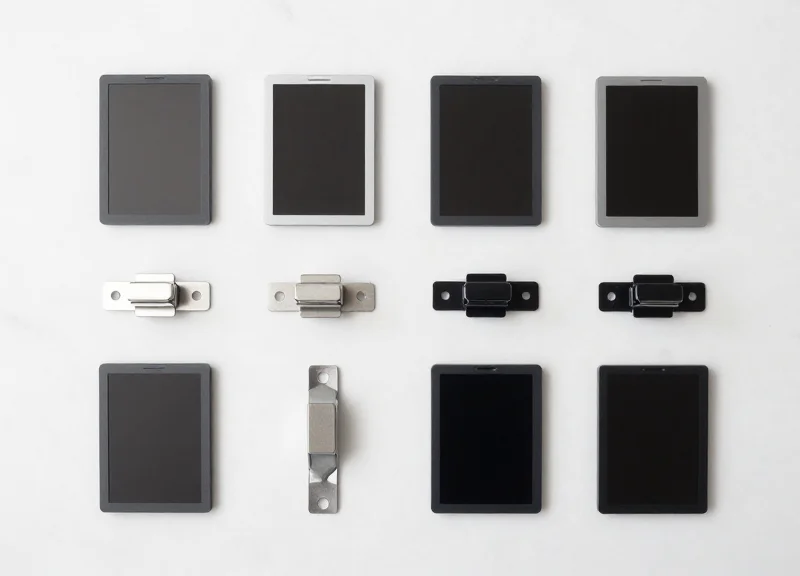
Selecting the right mounting hardware for 2.13-inch Electronic Shelf Labels (ESLs) in a jewelry setting requires a 'jewelry-first' mindset, where the bracket serves as a hidden foundation rather than a visible fixture. The goal is to achieve maximum stability across multi-tiered counters while maintaining a zero-footprint aesthetic that mimics the high-end feel of traditional price cards. For luxury retailers, this means prioritizing ultra-slim profiles, high-transparency materials, and non-invasive attachment methods that protect expensive display cabinetry.
| Hardware Type | Best Use Case | Aesthetic Impact | Stability Level |
|---|---|---|---|
| Clear Acrylic T-Stands | Top-tier flat surfaces | Near-invisible; allows light pass-through | Moderate (Freestanding) |
| Spring-Loaded Edge Clips | Glass shelving or tray borders | Minimalist; clips onto 5-10mm glass | High (Fixed) |
| Nano-Suction Pads | Glossy or glass tiered risers | Zero-residue; extremely low profile | High (Vibration resistant) |
| Weighted Base Angled Brackets | Velvet or fabric-lined tiers | Premium metal finishes (Gold/Silver) | Excellent (Static placement) |
Expert Insight: The 'Micro-Pivot' Advantage. In a multi-tiered environment, fixed-angle brackets often fail because the customer's eye level changes between the top and bottom tiers. I recommend sourcing hardware with a 15-degree micro-pivot capability. This allows you to tilt the ESL slightly upward for lower tiers and downward for eye-level tiers, eliminating the 'dead-zone' reflections caused by overhead jewelry spotlights without needing to move the entire display unit.
- Material Compatibility Check: Ensure the bracket material matches your display. For wood-based counters, avoid aggressive adhesives; use weighted bases or soft-grip clips to prevent scarring the finish.
- Stability vs. Agility: Determine if the ESL needs to be fixed or mobile. For high-turnover items like rings, use magnetic mounts that allow the tag to be moved alongside the piece during customer viewing.
- Cable Management Pathing: Even though ESLs are battery-powered, the bracket design should allow for clean lines. Avoid bulky back-plates that create shadows on the jewelry below.
Will these brackets damage my custom velvet liners?
No, if you select 'Pin-Style' or 'Weighted Base' mounts specifically designed for textiles. Avoid adhesives on velvet, as they will crush the pile and leave permanent marks.
Can I reuse the mounting hardware if I change my layout?
Yes. By opting for mechanical clips or Nano-suction bases instead of permanent VHB tapes, you can reconfigure your tiers seasonally without purchasing new hardware.
Do metal brackets interfere with the ESL signal?
While 2.13-inch ESLs use low-frequency radio or infrared, we recommend high-grade polycarbonate or brushed aluminum mounts with open-back designs to ensure 100% signal reliability.
Step-by-Step Installation Guide for Tiered Layouts
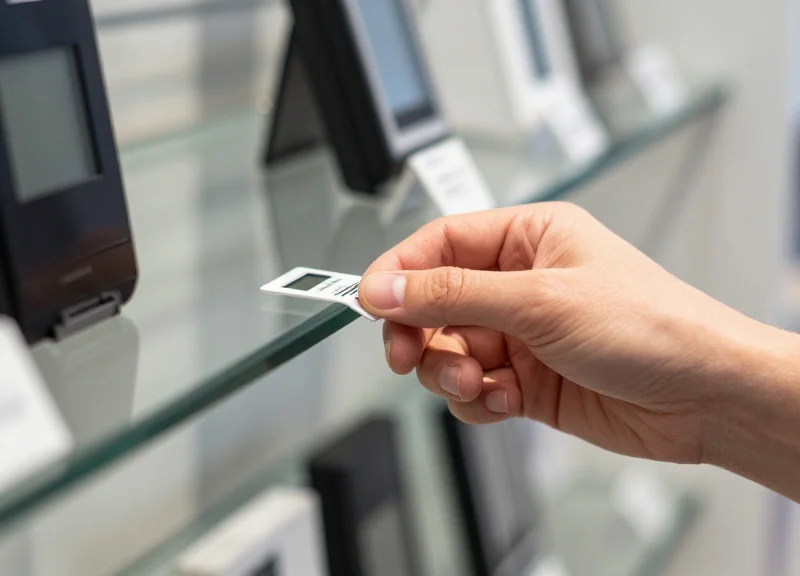
To install 2.13-inch Electronic Shelf Labels (ESLs) on multi-tiered jewelry counters, one must employ a 'Top-Down, Center-Out' methodology. This technical approach ensures that the digital units align perfectly with the spatial hierarchy of the jewelry pieces, maintaining a cohesive luxury aesthetic while ensuring that every price point is visible from a standard standing eye level (approximately 150-160cm from the floor).
- Surface Decontamination: Clean each tier thoroughly with a 70% isopropyl alcohol solution. Residual oils from fingerprints or jewelry cleaners can compromise the bond of high-end adhesive mounts or cause non-slip pads to slide over time.
- Establish the Vertical Focal Axis: Identify the center point of the display case. Use a laser level or a temporary chalk line to mark a vertical axis. For tiered displays, symmetry is only achieved if the ESLs on different levels are aligned to a central or rhythmic grid.
- Execute the Top-Tier Anchor: Always install the ESLs on the highest tier first. These units are closest to the customer's eye and set the visual 'baseline.' Secure the bracket so the screen is tilted at a 15-20 degree angle toward the glass.
- Tier-Specific Graduation: Work your way down. As you move to lower tiers, increase the tilt angle of the ESL bracket. This ensures that the screen remains perpendicular to the customer's line of sight, preventing the 'washed out' look common in lower-tier displays.
- Digital Pairing and Validation: Once physically secured, use your handheld PDA or gateway software to ping each unit. Verify that the product SKU displayed on the 2.13-inch screen matches the physical item on that specific tier before moving to the next section.
Expert Insight: The 15-Degree Parallax Rule. In my two decades of retail tech integration, I've found that the biggest mistake is using the same mounting angle for every tier. To achieve a 'floating' effect where the tech disappears, you must increase the ESL tilt by approximately 7 to 10 degrees for every 10cm drop in tier height. This compensates for the parallax error and ensures the e-ink display maintains maximum contrast for the shopper.
| Tier Level | Target Angle | Mounting Style | Visual Priority |
|---|---|---|---|
| Top Tier (Eye Level) | 15° - 20° | Low-profile clip | High (Flagship items) |
| Middle Tier | 25° - 35° | Angled wedge | Medium (Core collection) |
| Bottom Tier (Base) | 45° - 60° | Extended tilted stand | Inventory Depth |
What if the 2.13-inch ESL blocks the view of the jewelry on the tier below?
Utilize 'offset mounting.' Position the ESL slightly to the left or right of the jewelry piece rather than directly in front of it, and use a staggered layout across tiers to maintain clear sightlines.
How do I manage signal interference in metal-heavy tiered cases?
Ensure the ESL gateway is mounted above the counter level. For heavy steel or lead-glass displays, use a 2.4GHz ESL variant with sub-G frequency hopping to penetrate the tiers effectively.
Can I use magnetic mounts on tiered velvet trays?
Magnetic mounts are only recommended if there is a steel plate beneath the velvet. For standard trays, a micro-suction tape or a weighted 'weighted-toe' bracket is preferred for stability without damaging the fabric.
Cable Management and Wireless Optimization
Effective cable management and wireless optimization for jewelry ESLs involve hiding all power and data lines for base stations within the 'dead zones' of a display—such as the underside of tiers or behind velvet backing—while positioning Access Points (APs) to bypass the Faraday cage effect created by metal casings and thick tempered glass. To ensure 100% update reliability, the signal must be mapped to avoid 'shadow zones' where metal structural supports might block the Sub-GHz or 2.4GHz frequencies used by the 2.13-inch electronic shelf labels.
| Material Type | Signal Interference Level | Impact on 2.13-inch ESL Performance | Mitigation Strategy |
|---|---|---|---|
| Starphire / Low-Iron Glass | Low | Minimal delay; clear line of sight. | Standard AP placement. |
| Mirrored Acrylic/Glass | Medium | Signal bounce can cause packet loss. | Increase AP density or use angled antennas. |
| Stainless Steel / Brass Frames | High | Creates 'shadows' behind the metal bars. | Offset mounting; place APs directly above the glass. |
| Lead-Based Crystal Displays | Extreme | Significant signal attenuation. | Use Sub-GHz ESLs for better penetration. |
- Ghost Routing for Base Stations: Utilize existing lighting tracks to run power to your ESL base stations. By tapping into the 12V/24V DC lines used for LED display lighting, you eliminate the need for new unsightly conduits.
- Signal Path Mapping: Identify the 'Primary View Angle' of the customer. Ensure the wireless Access Point is located behind or above the customer’s head to prevent the human body from becoming a signal attenuator during peak shopping hours.
- The 15-Degree Offset Rule: Avoid placing APs perfectly parallel to metal tiers. A 15-degree offset allows the signal to 'diffract' around metal edges, reaching ESLs tucked into deep corners or lower tiers.
Expert Insight: The 'Reflective Foil' Hack. In multi-tiered displays with heavy metal shelving, the lowest tier often suffers from poor connectivity. An original technique used by high-end installers involves placing a small strip of signal-reflective material (like industrial-grade aluminum tape) inside the back corner of the wooden cabinetry. This acts as a passive reflector, bouncing the signal into the 'blind spot' under the upper tiers without requiring additional hardware.
Will bulletproof glass block the ESL signal?
Yes, high-security glass often contains polycarbonate layers or metallic films that attenuate signals. In these cases, installing a micro-base station inside the display case itself is mandatory.
How do I hide the base station in a minimalist boutique?
Modern ESL base stations are PoE (Power over Ethernet). We recommend mounting them inside the ceiling plenum directly above the display or custom-painting the housing to match the boutique's RAL color code.
Does the jewelry itself interfere with the wireless sync?
Individual pieces like rings or necklaces have negligible impact. However, large quantities of silver or gold trays can create localized interference; always perform a signal 'ping test' with a full inventory layout.
Designing ESL Templates for Luxury Branding
Luxury branding on 2.13-inch ESLs is defined by 'Visual Silence'—the philosophy of minimizing digital noise to ensure the technology serves as a backdrop to the jewelry's brilliance. Unlike retail environments where boldness drives sales, luxury jewelry templates must utilize the 250x122 pixel canvas of a 2.13-inch E-ink display to prioritize legibility through sophisticated serif typography and generous negative space. By treating the electronic display as a miniature piece of high-end stationery rather than a digital screen, brands can maintain a high-fashion aesthetic while automating price and inventory updates across multi-tiered counters.
| Design Element | Supermarket ESL (Typical) | Luxury Jewelry ESL (Optimized) |
|---|---|---|
| Typography | Bold Sans-Serif (Impactful) | Classic Serif or Light Weight Sans (Elegant) |
| Layout | Crowded with icons/promos | Minimalist with 30-40% whitespace |
| Color Usage | Heavy use of Red for discounts | Selective Red/Yellow for 'Limited Edition' or Metal Type |
| QR Codes | Large, center-aligned | Small, bottom-corner aligned (Discreet) |
| Information Hierarchy | Price first, then Product | Brand/Collection name first, then Price |
To achieve a premium look, one must account for the specific rendering capabilities of E-ink. Avoid fine-line gradients or complex shadows, as these can appear muddy on 3-color or 4-color displays. Instead, focus on clean vector-based logos and 'Optical Sizing'—adjusting the kerning (space between letters) to ensure that even at a distance, the text remains crisp under the focused halogen or LED lighting common in tiered jewelry displays.
- Establish a Grid System: Divide the 250x122 pixel area into a 3x3 grid. Place the brand name in the top third and the price in the bottom right, allowing the center to remain relatively clear for a premium feel.
- Select 'DPI-Aware' Fonts: Use fonts with high X-heights. For luxury, fonts like Playfair Display or Montserrat (Light) work exceptionally well at small point sizes without losing their stroke integrity.
- Optimize Vector Assets: Convert all brand logos into high-contrast monochrome bitmaps. Since E-ink doesn't support transparency, ensure your logo is perfectly aliased against the white or black background to prevent 'halo' effects.
- Implement Dynamic Data Fields: Map your CMS fields (e.g., 'Carat', 'Clarity', 'Metal') to specific coordinates. Ensure the template can handle varying character counts without breaking the alignment of the 'Visual Silence' design.
Expert Tip: The 'Inversion' Technique. For ultra-high-end 'Signature' collections, use a black background with white text. This creates a striking 'velvet-box' effect that mimics the traditional jewelry display pads. In a multi-tiered setup, using inverted (white-on-black) ESLs for the top-tier 'Hero' pieces and standard (black-on-white) for the lower tiers creates a natural visual hierarchy that guides the customer's eye toward the most valuable items.
What is the minimum font size for 2.13-inch ESLs in jewelry displays?
While the hardware can render 6pt fonts, for luxury legibility, we recommend a minimum of 8pt for technical details and 12pt-14pt for pricing to ensure customers don't have to lean in too close to the glass.
Can I use my brand's specific hex colors?
Most ESLs are limited to Black, White, Red, and sometimes Yellow. To maintain brand consistency, use these colors functionally—for example, use Red specifically for 'Certified Natural' or 'Ethically Sourced' markers rather than for price discounts.
How do I handle long product names like '18k Rose Gold Diamond Halo Engagement Ring'?
Use 'Smart Truncation' or abbreviations in the template design. For luxury, it is better to have 'Diamond Halo Ring - 18k' in a clean font than to squeeze the full name into a tiny, unreadable size.
Troubleshooting Common Installation Hurdles
Troubleshooting 2.13-inch ESL installations in high-end jewelry environments requires a dual focus on optical alignment and environmental engineering. The most prevalent issues—parallax distortion across tiered levels and premature battery depletion due to thermal stress from display lighting—can be mitigated by adjusting the physical placement angles and utilizing RF-transparent materials. Success lies in ensuring that the digital price tag remains as legible and elegant as the jewelry it accompanies, regardless of the consumer's viewing height or the store's lighting intensity.
| Issue | Probable Cause | Expert Resolution |
|---|---|---|
| Parallax Error | Misalignment between top and bottom tier viewing angles. | Implement a 'Staggered Tilt' (15 degrees for bottom, 5 degrees for top). |
| Ghosting / Fading | High-intensity LED spotlights causing thermal E-ink drift. | Reposition lights or add a UV-filtering acrylic shield over the ESL. |
| Signal Dropouts | Heavy metal frames or high-lead glass blocking RF signals. | Use external antenna extenders or move APs to a ceiling-mount position. |
| Sync Lag | Congested 2.4GHz frequency from guest Wi-Fi. | Shift ESL gateway to a dedicated sub-GHz channel or clean 2.4GHz band. |
How do I fix visual 'washout' from overhead jewelry spotlights?
E-ink displays are reflective, but high-intensity spots can create a 'hot spot' that obscures text. Use an anti-glare matte finish overlay on the ESL lens or adjust the spotlight to an 85-degree angle rather than direct vertical orientation.
Why is the battery life shorter on my bottom-tier displays?
Bottom tiers often experience lower signal strength (RSSI), causing the ESL to increase its transmit power to communicate. Ensure the access point has a clear line of sight to the lower display levels to normalize power consumption.
Can the 2.13-inch ESL handle the heat inside a closed glass case?
Standard ESLs operate up to 40°C (104°F). If your halogens are pushing the case temperature higher, the battery chemistry will degrade. Switch to LED lighting or implement a 2mm 'Air Gap' between the ESL and the back panel for passive cooling.
Expert Marketing Insight: The 'Gold-Standard' 10-cm Rule. To prevent signal attenuation in multi-tiered metal displays, always maintain a minimum of 10 cm between the ESL and any large solid gold or silver surfaces. Precious metals are highly conductive and can act as unintentional Faraday cages; providing this small buffer zone ensures 99.9% update reliability without sacrificing the density of your display layout.
Future-Proofing Your Digital Display System
To future-proof a 2.13-inch Electronic Shelf Label (ESL) system for jewelry, retailers must adopt a 'decoupled' installation strategy where the digital infrastructure remains independent of the physical jewelry layout. This ensures that as seasonal collections rotate or pricing fluctuates, the system can scale through software updates and modular hardware adjustments rather than requiring a complete aesthetic overhaul. A truly future-proofed system prioritizes Sub-GHz wireless stability, API-first software integration, and non-destructive mounting techniques that allow for immediate reconfiguration as luxury trends evolve.
- Adopt Modular Rail Systems: Instead of fixed adhesives, use ultra-slim, magnetic or clip-on rail systems. These allow the 2.13-inch units to slide horizontally across tiered displays, accommodating different jewelry box sizes without the need for new mounting hardware.
- Prioritize Cloud-Native Management: Ensure your ESL backend is cloud-based. This allows for 'Bulk Seasonal Overlays,' where you can push a unified design language (e.g., a 'Lunar New Year' or 'Valentine's Day' theme) to every tag in the store with a single click.
- Battery Longevity and OTA Updates: Select ESLs that support Over-the-Air (OTA) firmware updates. This ensures that as display protocols improve or security patches are released, your physical tags don't become obsolete.
| Scenario | Traditional Fixed Labeling | Future-Proofed ESL System |
|---|---|---|
| New Collection Launch | 4-8 hours of manual printing and re-sticking. | Instant update via POS integration. |
| Holiday Sale Branding | Requires physical decorative overlays. | Digital template update with festive borders. |
| Inventory Re-tiering | Visible residue or damage to counter tiers. | Modular rails allow seamless sliding/re-spacing. |
Expert Insight: The 'Aesthetic Buffer' Strategy. A common mistake in jewelry ESL deployment is matching the number of tags exactly to the current SKU count. For true future-proofing, I recommend a 15% 'buffer' deployment. By keeping 15% of your tags in a 'Sleep/Branding Mode' (displaying only a minimalist brand logo or a subtle pattern), you can instantly activate them for high-inventory periods without the friction of a new hardware installation. This maintains the visual 'fullness' of a display while providing instant scalability for new arrivals.
How long will a 2.13-inch ESL system typically last before needing a hardware refresh?
High-quality E-ink ESLs typically have a battery life of 5 to 10 years, depending on update frequency. Future-proofing is less about battery life and more about ensuring the communication protocol (like BLE or Zigbee) remains compatible with your store's evolving Wi-Fi and IoT infrastructure.
Can I integrate these displays with my existing POS system?
Yes, look for ESL providers offering RESTful APIs or pre-built connectors for Shopify, Lightspeed, or Oracle NetSuite. This allows the ESL to automatically reflect price changes made in your inventory management software.
What happens if I change my counter materials from glass to metal?
Metal can interfere with RF signals. A future-proofed installation uses external access points (gateways) positioned strategically to ensure a clear line of sight, avoiding the need to move the tags if the furniture changes.